


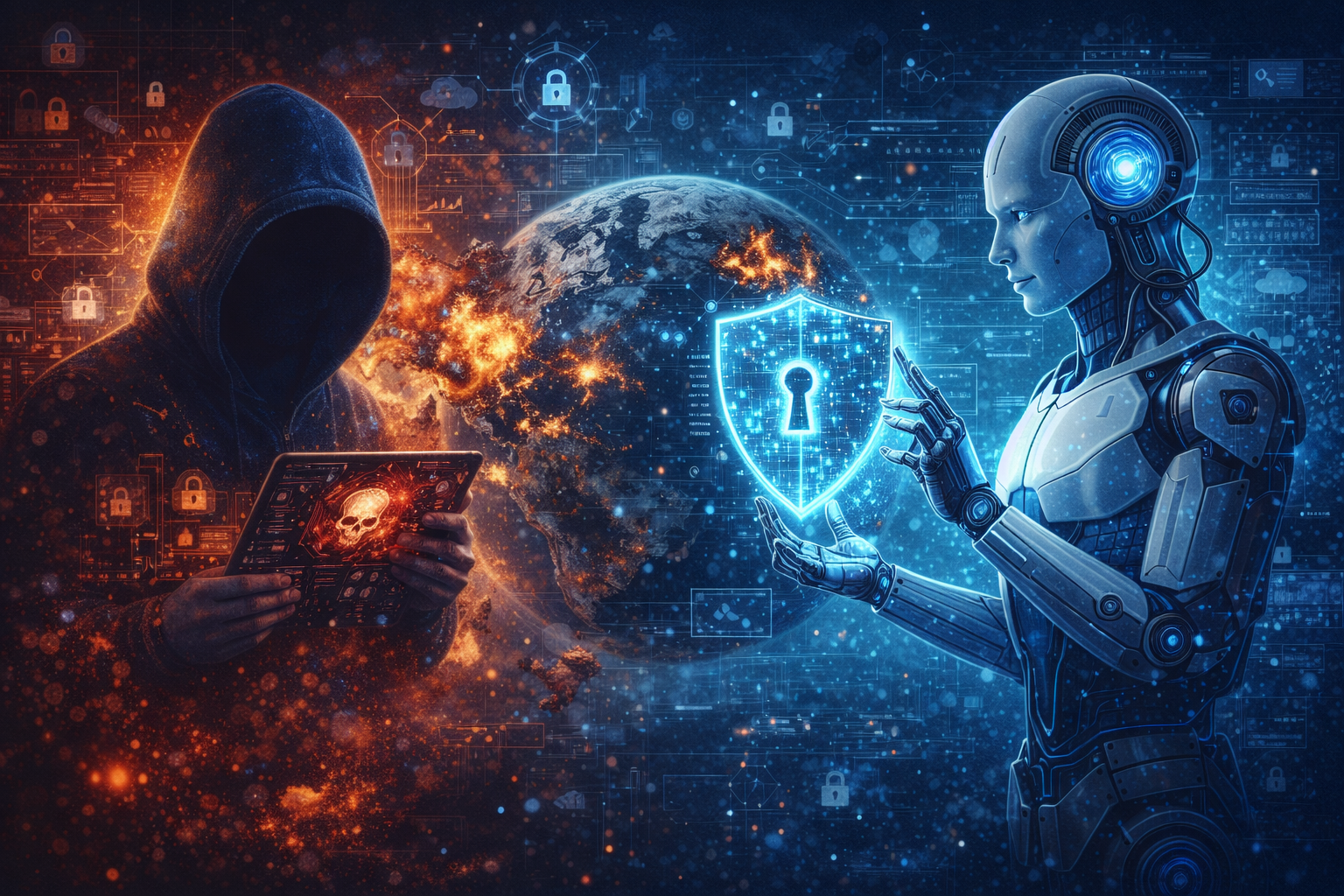
Cyber warfare is no longer a future threat — it is a permanent feature of modern geopolitics. It targets power grids, banks, defense systems, airports, telecom networks, hospitals, media outlets, and government infrastructure. It doesn’t always explode in public, but it bleeds nations silently: through disruption, data theft, manipulation, and erosion of trust.
And now, artificial intelligence is about to escalate this battlefield.
AI will not simply make cyberattacks faster. It will make them smarter, scalable, automated, and constant. In the AI era, cyber warfare will shift from isolated operations by skilled hackers into persistent machine-driven conflict — where algorithms attack, defend, learn, and adapt with minimal human involvement.
The world is entering an era in which wars can be initiated without boots on the ground. Economies can be harmed without missiles. Political chaos can be engineered without soldiers.
In the AI age, cyber warfare becomes the most powerful weapon because it is invisible, deniable, and unstoppable.
The key question is no longer whether cyber warfare will grow.
The key question is: Will AI become a weapon of domination or a shield of resilience?
Cyber Warfare Before AI: Dangerous, But Still Human-Limited
Traditional cyber attacks, even at advanced levels, had limits:
- they required human expertise
- they required time to plan and execute
- they required careful reconnaissance
- they required manual adaptation
- they were costly to scale
Nation-state cyber operations were powerful, but they were also slow, selective, and resource intensive. Criminal cyber gangs could cause damage, but they still required the same fundamentals: talent, time, and trial-and-error.
AI changes that.
AI shifts cyber operations from human skill to machine scale.
How AI Changes Cyber Warfare: The Big Shift
AI transforms cyber warfare in four major ways:
1) Speed: Attacks happen at machine velocity
AI reduces the time between discovery and exploitation.
A vulnerability found today could be exploited across thousands of systems within hours — automatically.
2) Scale: Attacks become mass-produced
Instead of attacking one target at a time, AI enables attacks on multiple sectors simultaneously:
- banking
- logistics
- health
- telecom
- defense contractors
- government agencies
Cyber warfare becomes industrial.
3) Adaptation: Attacks become flexible
AI systems can adjust behaviour based on the environment.
Instead of static malware, attackers can create malware that:
- observes defenses
- changes patterns
- hides intelligently
- chooses the most vulnerable path
4) Deception: AI makes lies believable
Cyber warfare is no longer only about hacking machines.
It becomes about hacking human perception.
Deepfakes, synthetic media, AI-generated news narratives — these become strategic weapons.
The future war is not only about disrupting systems, but about destroying trust.
Part 1: How AI Can Be Misused in Cyber Warfare (The Offensive Revolution)
AI will empower attackers — criminal groups, hostile states, and extremist networks. The cost of cybercrime will drop, and the sophistication will rise.
1) AI-Generated Phishing and Social Engineering
Phishing has always been the most common entry point because humans are the weakest link.
AI makes phishing far more deadly because it can:
- write flawless emails in any language
- mimic corporate tone (CEO voice, HR voice, client voice)
- personalise messages using public data
- scale persuasion across thousands of targets
Older phishing attacks were easy to detect: broken English, suspicious wording.
AI phishing is different.
It sounds professional. It sounds familiar.
It can be customised:
- “Hello Danish, I reviewed your notes from yesterday’s meeting…”
- “Please approve this invoice urgently…”
- “Here is the updated contract, kindly review…”
This kind of AI-powered social engineering will become routine.
2) Deepfake Audio: The New “CEO Fraud”
The world has already seen financial scams based on fake calls.
AI will intensify this by enabling:
- voice cloning of CEOs
- deepfake video of executives
- fake Zoom calls
- synthetic instructions during emergencies
Imagine this scenario:
A CFO receives a call from a CEO’s voice demanding an urgent transfer. The voice sounds real. The tone feels correct. The urgency is believable.
The CFO acts.
Millions disappear in minutes.
In cyber warfare, this is even more dangerous because it can target governments and military chains of command.
3) Automated Vulnerability Discovery
Traditionally, discovering vulnerabilities required time and skill.
AI can accelerate this by scanning:
- code repositories
- network architectures
- exposed systems
- leaked credential dumps
AI can identify patterns humans might miss — and it can do it continuously.
This allows attackers to exploit weaknesses faster than security teams can patch them.
4) AI-Enhanced Malware That Learns
Future malware will not behave like traditional malware.
It will behave like intelligent organisms.
AI-based malware could:
- watch user behaviour
- imitate normal activity
- choose timing strategically
- change file signatures automatically
- disable security systems quietly
- avoid detection by adapting continuously
This creates a terrifying reality:
Malware becomes less like a weapon and more like a living spy.
5) Targeted Attacks Against Critical Infrastructure
AI-driven cyber warfare will increasingly target national infrastructure:
- water supply systems
- power grids
- railway and airline systems
- emergency services networks
- hospitals and medical equipment
- ports and shipping
These attacks don’t need to kill directly. They can break society psychologically.
When electricity shuts down, hospitals fail. When supply chains collapse, fear rises.
AI gives attackers the ability to strike precisely — and repeatedly.
6) AI Weaponises Data Theft
Cyber warfare is not always about disruption. It is often about intelligence.
AI makes stolen data far more useful.
When attackers steal millions of files, AI can:
- classify it
- search it
- identify high-value information
- extract patterns
- build profile databases
The impact is massive:
- espionage becomes efficient
- blackmail becomes scalable
- manipulation becomes precise
Part 2: The Deepfake Battlefield — Cyber Warfare Becomes Information Warfare
AI expands cyber warfare into something darker: reality manipulation.
Because war is no longer just about territory. It is about narratives.
AI enables:
- fake speeches by leaders
- fake “breaking news” during crises
- fake military announcements
- fake casualty videos
- fake evidence of atrocities
In a conflict environment, deepfake narratives can:
- trigger riots
- collapse market confidence
- destabilise governments
- inflame ethnic violence
- provoke escalation
In many cases, the goal is not to convince everyone — only to confuse enough people.
The modern weapon is not always the bomb. Sometimes it is doubt.
Part 3: AI as Defense — How It Can Protect Nations and Corporations
AI is not only a threat.
It is also the strongest defense humanity has ever built — if used correctly.
Cyber defense is difficult because humans cannot monitor modern systems manually. Networks generate millions of signals per hour.
AI gives defenders something essential:
speed and pattern recognition.
1) Real-Time Threat Detection
AI systems can detect anomalies such as:
- unusual login locations
- abnormal file access
- suspicious downloads
- strange network traffic patterns
- unusual employee behaviour on systems
AI doesn’t get tired, doesn’t lose attention, and doesn’t miss patterns across large data.
2) Predictive Security: Stopping Attacks Before They Happen
AI can identify early warning signals:
- probing activity
- small repeated login attempts
- unusual scanning behaviour
- suspicious system communications
This allows organizations to act before full-scale damage occurs.
3) Automated Response (Machine-Speed Defense)
One of the most important future developments is AI-based response.
AI can automatically:
- lock compromised accounts
- isolate infected machines
- shut down vulnerable systems
- block dangerous IPs
- trigger emergency protocols
In cyber warfare, speed is survival.
In the AI era, defense must operate at machine speed — or it loses.
4) AI-Powered Threat Intelligence
AI can help security teams by:
- summarising threat reports
- tracking global malware families
- identifying new patterns
- updating defenses continuously
This reduces response time and improves readiness.
The Race Problem: Attackers Get AI Too
The biggest strategic issue is this:
AI strengthens both attackers and defenders.
But cyber warfare has always favoured attackers because:
- attackers need to find only one weakness
- defenders must protect everything
AI increases that imbalance by lowering the cost of attack.
Smaller groups — even individuals — may gain the power once reserved for state-level actors.
This will lead to:
- a rise in cyber terrorism
- increased attacks on infrastructure
- continuous disruption campaigns
- more “grey zone” warfare (below military threshold)
What Governments Must Do: Cyber Defense Becomes National Security
In the AI era, cyber defense becomes as important as military defense.
Governments must treat cyber as:
- a national battlefield
- a permanent war zone
- a strategic deterrence domain
Key actions include:
1) Protect critical infrastructure aggressively
Electricity, water, transport, telecom must have:
- hardened security systems
- redundancy plans
- crisis simulations
- independent emergency networks
2) Cyber drills like military drills
Nations need rehearsals for:
- coordinated cyber blackouts
- banking disruption
- misinformation attacks
- election interference
3) AI governance and security regulation
Without regulation:
- unsafe AI tools will leak data
- private sector vulnerability becomes national vulnerability
4) Talent development
Countries must build cyber and AI expertise — not import it fully.
Because in cyber warfare:
dependence is weakness.
What Companies Must Do: Cybersecurity Becomes Survival Strategy
Companies must stop treating cybersecurity as an IT issue.
Cybersecurity is leadership strategy.
Executives should:
- invest in AI security systems
- train employees against AI phishing/deepfake threats
- build incident response plans
- audit AI tools for leakage and compliance
- enforce strict access controls
And most importantly:
Assume breach. Plan resilience.
Potential Outcomes: The Future of Cyber Warfare
Scenario 1: Permanent Low-Level Cyber War
Constant attacks become routine. Nations adapt. Cyber conflict becomes background noise.
Scenario 2: Major AI-Cyber Shock Event
A single AI-driven attack shuts down a major city, banking system, or national infrastructure — causing economic panic.
Scenario 3: AI vs AI Warfare
Attack and defense systems fight automatically, reducing human involvement. This is fast, invisible war.
Scenario 4: Cyber Arms Race
Countries compete for AI superiority. Cyber becomes like nuclear competition: deterrence through capability.
Conclusion: AI Will Not End Cyber Warfare — It Will Normalise It
Cyber warfare used to be a specialized war.
AI will make it industrial.
It will become:
- constant
- automated
- scalable
- harder to attribute
- driven by machines
- mixed with propaganda and deepfakes
And therefore it will become one of the most powerful instruments of geopolitical conflict.
The next major wars may not start with tanks.
They may start with:
- a blackout
- a hacked airport
- an empty ATM
- a deepfake order
- a collapsed telecom network
AI will not just change cyber warfare.
It will redefine warfare itself.
January 2026: A Month in Review — Crises, Confrontation, and a World Reordering
- El Niño 2026: The Climate Phenomenon Reshaping Weather, Food Security and the Global Economy
- Rahul Gandhi’s Political Evolution: From Reluctant Heir to a More Assertive Challenger to the BJP
- India’s Middle East Strategy Explained: Energy, Alliances and the Battle for Strategic Autonomy
- The Rise of Private Military Technology Companies: Who Is Building the Future of Warfare?
- Riyadh Under Attack: Why Saudi Security Matters to the Entire World


