


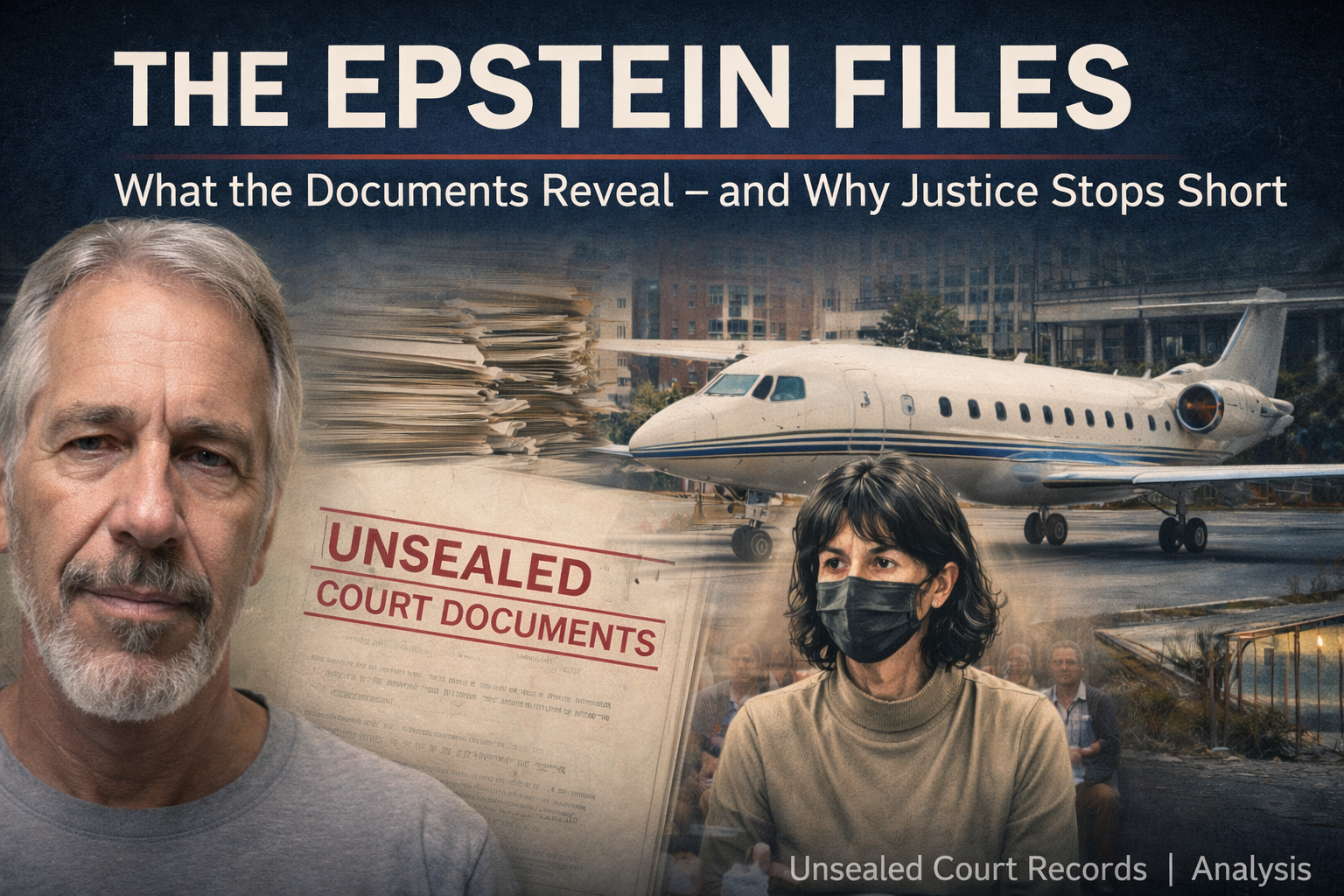
Few modern criminal cases have generated as much sustained public suspicion as that of Jeffrey Epstein. Years after his death in federal custody, the steady release of documents loosely grouped under the label “the Epstein files” continues to fuel expectations of definitive exposure—of hidden networks, sealed names, and delayed justice.
What these files actually offer is something more limited, and arguably more unsettling: a fragmented record of institutional failure, legal constraint, and the structural difficulty of holding powerful actors to account once criminal processes collapse.
Background: What the “Epstein Files” Really Are
The Epstein files are not a single cache of classified material or an official government disclosure. Rather, they comprise court records unsealed over time, primarily from civil litigation brought by Epstein’s victims, alongside investigative journalism, flight logs, depositions, and correspondence entered into evidence.
They gained renewed prominence after Epstein’s death in 2019, which abruptly ended the prospect of a criminal trial that might have compelled sworn testimony and cross-examination of associates.
What followed instead was disclosure by degrees—legally cautious, procedurally slow, and often misinterpreted in the public arena.
Timeline: Key Releases and Turning Points
2005–2008
- Local investigations in Florida culminate in a controversial non-prosecution agreement, shielding Epstein from federal charges and limiting exposure of potential accomplices.
2015–2018
- Civil suits filed by survivors reopen the case in public consciousness. Previously sealed depositions begin to attract judicial scrutiny.
July 2019
- Epstein is arrested on federal sex-trafficking charges in New York.
August 2019
- Epstein dies in custody. Criminal proceedings end without trial.
2020–2022
- Court orders lead to incremental unsealing of documents tied to civil litigation.
- Ghislaine Maxwell is convicted for her role in recruiting and abusing minors.
2023–2024
- Additional names and testimonies are unsealed, reigniting public debate—often without new allegations or charges accompanying them.
Myth vs. Fact: Separating Disclosure From Speculation
Myth: The Epstein files contain a secret “client list.”
Fact: No verified, court-certified list of clients exists. Documents include names mentioned in testimony, correspondence, or social contexts—not findings of guilt.
Myth: Every name in the files represents a perpetrator.
Fact: Many individuals appear as witnesses, accusers, staff, or peripheral contacts. Legal implication requires evidence and due process.
Myth: The files were hidden to protect elites.
Fact: Most documents were sealed under standard civil-procedure rules and later unsealed through court orders—not whistleblowing.
Myth: Further releases will trigger mass prosecutions.
Fact: Without corroboration or criminal jurisdiction, document releases alone rarely meet prosecutorial thresholds.
Analysis: What the Files Tell Us About Power
The enduring significance of the Epstein files lies not in the promise of dramatic revelation, but in what they reveal about how power operates when criminal accountability fails.
First, they expose the fragility of justice systems when cases hinge on a single defendant. Epstein’s death foreclosed compulsory testimony, plea leverage, and evidentiary discovery that might have clarified responsibility beyond doubt.
Second, they highlight the asymmetry between public expectation and legal reality. Transparency, while necessary, does not substitute for admissible evidence or viable defendants.
Finally, the files show how elite proximity—social, financial, institutional—can blur lines of responsibility without necessarily crossing into prosecutable conduct, leaving moral outrage without legal resolution.
This gap is not accidental; it is structural.
Is It Important?
Yes—but for reasons that are often misunderstood.
The Epstein files matter because they demonstrate:
- how civil litigation becomes a fallback mechanism when criminal justice collapses
- why document disclosure does not equal accountability
- how public trust erodes when outcomes feel procedurally correct but morally incomplete
They are less a roadmap to hidden villains than a mirror held up to institutional limits.
The Current Situation
At present:
- Most relevant documents have been unsealed.
- No new criminal cases against third parties have emerged directly from the disclosures.
- Public interest spikes with each release, though substantive legal consequences remain unchanged.
The Epstein files are now better understood as a closed evidentiary universe, revisited rather than expanded.
What Legal Experts Say
Legal scholars caution that public expectations often exceed what court records can deliver.
“Unsealing documents satisfies transparency interests, not prosecutorial ones,” says Alan Dershowitz, who has written extensively on civil procedure and due process. “A name in a filing is not a finding of fact.”
Similarly, Preet Bharara, a former federal prosecutor, has noted in commentary that criminal cases depend on admissible evidence, living defendants, and jurisdiction—all of which were compromised once Epstein died.
According to American Civil Liberties Union legal analyses, unsealed records are often “raw materials” of litigation: allegations, testimony, and correspondence that have not been tested in open court.
Analysis: Disclosure Without Closure
From a global perspective, the Epstein case illustrates a broader problem familiar to many legal systems: what happens when elite wrongdoing is alleged, but procedural windows close before accountability is established.
In common-law systems like that of the United States, civil litigation becomes a substitute forum when criminal justice fails. But civil courts are not designed to assign guilt in the public sense—only liability.
The Epstein files therefore represent maximum transparency with minimum resolution. They expose patterns of access and influence without crossing the evidentiary threshold required for criminal sanction.
- El Niño 2026: The Climate Phenomenon Reshaping Weather, Food Security and the Global Economy
- Rahul Gandhi’s Political Evolution: From Reluctant Heir to a More Assertive Challenger to the BJP
- India’s Middle East Strategy Explained: Energy, Alliances and the Battle for Strategic Autonomy
- The Rise of Private Military Technology Companies: Who Is Building the Future of Warfare?
- Riyadh Under Attack: Why Saudi Security Matters to the Entire World


