


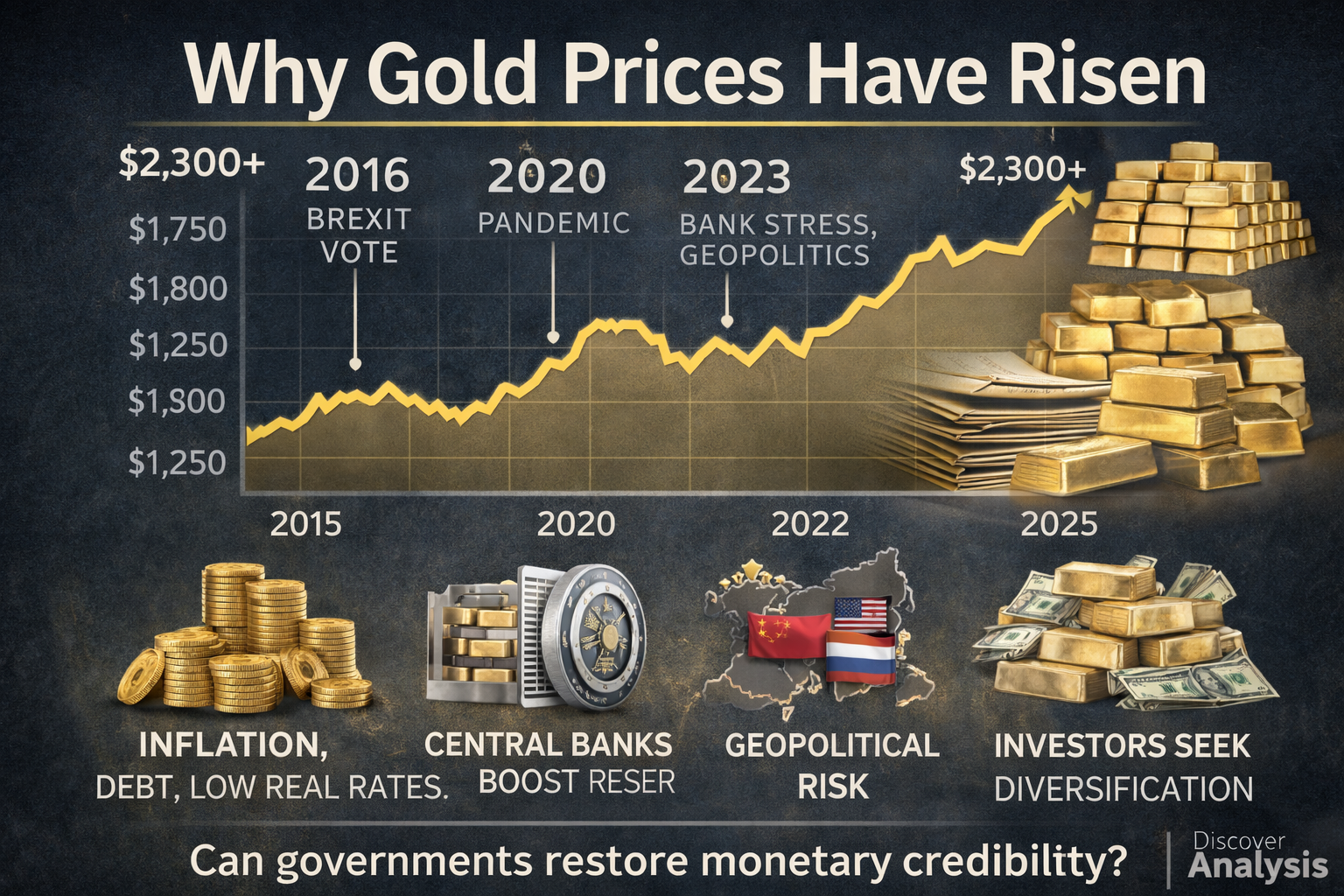
Over the past ten years, gold has staged a sustained and at times dramatic rise, outperforming many traditional assets and repeatedly testing record highs. While short-term price movements often attract attention, the deeper story is structural: gold’s ascent reflects a decade defined by monetary experimentation, geopolitical instability, and a quiet reordering of the global financial system.
This is not a rally driven by a single shock, but the cumulative outcome of multiple forces acting in parallel.
The Long Decade: From Crisis Insurance to Strategic Asset
In the mid-2010s, gold was widely seen as a defensive hedge—insurance against tail risks rather than a core portfolio asset. Since then, its role has expanded.
The period since 2014 has included:
- prolonged ultra-low interest rates,
- repeated financial shocks,
- rising sovereign debt,
- geopolitical fragmentation,
- and growing distrust in fiat currencies.
Gold has absorbed each of these pressures, gradually shifting from a fear trade to a strategic reserve asset.
Key Annotations
- 2016: Brexit vote reinforces gold’s role as political-risk hedge
- 2020: COVID-era monetary expansion drives first sustained break above $2,000
- 2022: Aggressive tightening by the Federal Reserve temporarily suppresses prices
- 2023–24: Banking stress, war, and record central bank purchases underpin renewed rally
Editorial note: Gold’s long-term trend is upward, but not linear. Each correction reflects tighter monetary conditions rather than a collapse in underlying demand.
What Drives Gold Prices Higher?
1. Monetary Policy and Real Interest Rates
Gold does not yield interest. Its attractiveness therefore rises when real interest rates—nominal rates minus inflation—are low or negative.
Following the global financial crisis and again after the pandemic, central banks led by the Federal Reserve kept rates suppressed while expanding balance sheets. Even when rates later rose, inflation often outpaced them, preserving gold’s appeal.
In simple terms: when holding cash guarantees a loss of purchasing power, gold becomes competitive.
2. Currency Debasement and Debt Expansion
Public debt levels across advanced economies have expanded sharply over the past decade. The perception—fair or not—that governments may ultimately rely on inflation to manage debt has strengthened gold’s role as a store of value.
Unlike currencies, gold cannot be printed, frozen, or digitally altered. That scarcity remains central to its appeal.
3. Central Bank Buying
One of the most underreported drivers of gold’s rise has been central bank demand.
Countries including China, Russia, and several emerging economies have steadily increased gold reserves—often at the expense of U.S. dollar assets.
This trend reflects:
- diversification away from dollar dependence,
- concerns about sanctions risk,
- and a desire for politically neutral reserves.
Central banks are now net buyers of gold at levels not seen in decades.
4. Geopolitics and Systemic Risk
The past ten years have brought:
- war in Europe,
- escalating U.S.–China rivalry,
- Middle East instability,
- supply-chain weaponisation,
- and sanctions as a financial tool.
Each episode reinforces gold’s function as a non-sovereign asset—valuable precisely because it sits outside the financial system.
Gold prices tend to rise not only during crises, but when uncertainty becomes persistent.
5. Investment Flows and Portfolio Rebalancing
Institutional investors have gradually increased gold allocations, particularly through ETFs and sovereign wealth vehicles. While speculative flows can amplify short-term moves, the broader trend reflects strategic diversification, not panic buying.
Gold has benefited from its low correlation with equities and bonds—especially during periods when both fall together.
What Makes the Gold Rate Move Day to Day?
While long-term trends are structural, short-term price movements are driven by:
- changes in interest-rate expectations,
- currency fluctuations (especially the U.S. dollar),
- inflation data surprises,
- geopolitical headlines,
- and ETF inflows or outflows.
These forces create volatility, but they do not fully explain the decade-long upward trajectory.
What This Means for Investors
Gold Has Shifted From Tactical Hedge to Strategic Allocation
For portfolio managers, gold’s relevance has changed in three important ways:
- Correlation Shift
Gold has shown resilience during periods when both equities and bonds decline—challenging traditional 60/40 assumptions. - Monetary Credibility Hedge
Persistent fiscal deficits and rising debt loads have made gold a hedge against policy error, not just inflation. - Reserve Asset Repricing
Central bank demand—particularly from China and non-aligned economies—has reduced gold’s sensitivity to Western interest-rate cycles.
For long-term investors, gold increasingly functions as insurance against regime change, not quarterly volatility.
Policy Perspective: What Rising Gold Prices Signal to Governments
From a policy standpoint, gold’s ascent is less about the metal and more about confidence.
Persistent strength in gold suggests:
- scepticism about long-term fiscal sustainability,
- concern over financial sanctions as a policy tool,
- fragmentation of the global monetary order.
For reserve managers, gold is attractive precisely because it carries no counterparty risk—a growing concern in a geopolitically divided world.
This trend complicates efforts to maintain dollar-centric financial stability, even as alternatives remain fragmented.
Future Outlook
Short Term (1–2 years)
- Sensitive to rate cuts, inflation surprises, and geopolitical shocks
- Volatility likely, but downside cushioned by central bank demand
Medium Term (3–5 years)
- Structural support from reserve diversification
- Prices increasingly detached from Western investor flows
Long Term (5–10 years)
- Gold evolves into a monetary anchor asset rather than a crisis hedge
- Returns moderate, but strategic relevance persists
Bottom Line
Gold’s rise over the past decade is not a speculative anomaly. It reflects a world of:
- higher debt,
- persistent geopolitical risk,
- and declining confidence in policy permanence.
Yet gold is not invincible. Its future depends less on fear than on whether governments can restore credible, stable monetary and fiscal frameworks.
If they do, gold’s ascent slows.
If they do not, gold remains a quiet vote of no confidence.
Editorial Takeaway
Gold’s rise over the past decade is not a mystery, nor a speculative anomaly. It is the cumulative outcome of policy choices, geopolitical shifts, and institutional uncertainty.
Whether prices continue to climb is less important than what their rise already tells us: gold is thriving in a world where confidence is fragile and permanence is prized.
India–EU Trade Deal: Why It Matters Now for India, Europe & the World
- El Niño 2026: The Climate Phenomenon Reshaping Weather, Food Security and the Global Economy
- Rahul Gandhi’s Political Evolution: From Reluctant Heir to a More Assertive Challenger to the BJP
- India’s Middle East Strategy Explained: Energy, Alliances and the Battle for Strategic Autonomy
- The Rise of Private Military Technology Companies: Who Is Building the Future of Warfare?
- Riyadh Under Attack: Why Saudi Security Matters to the Entire World


