


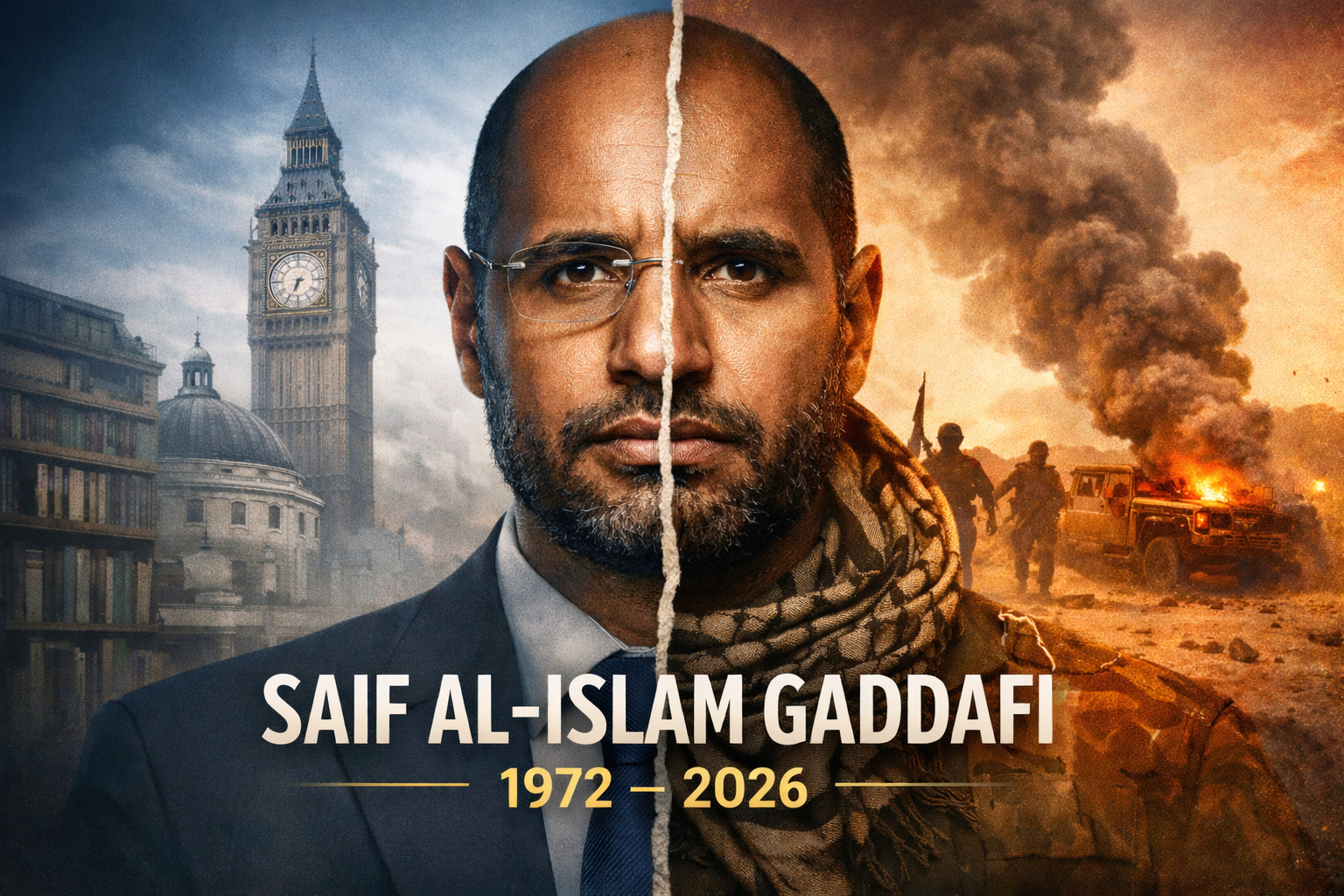
The reported killing of Saif al-Islam Gaddafi, son of former Libyan leader Muammar Gaddafi, has revived global attention on one of the most enigmatic figures of the post-Arab Spring era. Educated in the West yet forged inside an authoritarian system, Saif al-Islam’s life straddled reformist promise, civil war, imprisonment, and unresolved legal battles.
This article offers a neutral, non-political examination of his life, separating myth from fact — and exploring what his death means for Libya, the Arab world, and international justice.
“Saif al-Islam Gaddafi embodied both Libya’s promise of reform and the weight of its authoritarian past.”
Childhood and Family Life
Raised in privilege yet isolation, Saif grew up inside a security-heavy environment shaped by his father’s revolutionary ideology. Unlike many siblings, he was groomed intellectually rather than militarily.
Education and Worldview
His doctorate from the London School of Economics focused on civil society and governance — fueling a reputation as a reform-minded insider, particularly among European policymakers.
Political Role and Heir Apparent Status
Though never officially appointed, Saif functioned as a de-facto successor, managing sensitive negotiations and projecting a softer Libyan image abroad.
Civil Uprising and Fall
During the 2011 uprising, Saif chose loyalty over reform, delivering speeches that framed the revolt as existential chaos — a turning point that permanently altered his image.
Arrest, Detention, and Legal Limbo
Captured by Zintan militias, he spent years outside central state control. The International Criminal Court maintained charges against him even after his local release.
Return Attempt and Isolation
His 2021 election bid exposed Libya’s unresolved past — neither fully rejecting nor embracing figures from the former regime.
Quotes That Shaped Perceptions
- On Libya’s future (2011): “We fight here in Libya, we die here in Libya.” — statement during the uprising that underscored his loyalty to the regime.
- On his political strategy (2021): In later interviews, he suggested Libya’s leaders were “afraid of … elections,”reflecting frustration with the stalled political process.
These contrasting moments encapsulate the duality of his image: at once a cultured reformer and a hard-line loyalist.
Myths vs Facts
Myth: He was a democratic reformer.
Fact: He advocated limited reform but defended violent repression in 2011.
Myth: He was Libya’s official crown prince.
Fact: Libya had no formal succession system.
Myth: His release cleared him legally.
Fact: ICC charges were never withdrawn.
Gaddafi Family: Who Is Dead, Who Is Alive, Where They Are
Confirmed Deceased
- Muammar Gaddafi – Killed in Sirte (2011)
- Mutassim Gaddafi – Killed during 2011 conflict
- Khamis Gaddafi – Killed in NATO-era fighting
- Saif al-Arab Gaddafi – Killed in NATO airstrike (2011)
- Saif al-Islam Gaddafi – Killed in Zintan (2026)
Alive (As of 2026)
- Aisha Gaddafi – Living in exile (widely reported in Algeria / Oman)
- Hannibal Gaddafi – Detained in Lebanon (related to Musa al-Sadr case)
- Mohammed Gaddafi – Low public profile, believed in Libya
- Safia Farkash (widow) – Living outside Libya, minimal public presence
Note: Locations are based on public reporting; exact movements remain opaque.
What His Death Means
For Libya
Symbolically, this closes the most visible chapter of the Gaddafi legacy. Practically, Libya’s political fragmentation remains unchanged.
For the Arab World
His life mirrors a broader regional struggle: how societies deal with fallen regimes without clear reconciliation or justice mechanisms.
For International Politics
His death removes the possibility of ICC prosecution, reinforcing critiques that international justice often depends on political stability that never arrives.
North Korea and the Kim Dynasty: The Dictator’s Paradox Explained
- El Niño 2026: The Climate Phenomenon Reshaping Weather, Food Security and the Global Economy
- Rahul Gandhi’s Political Evolution: From Reluctant Heir to a More Assertive Challenger to the BJP
- India’s Middle East Strategy Explained: Energy, Alliances and the Battle for Strategic Autonomy
- The Rise of Private Military Technology Companies: Who Is Building the Future of Warfare?
- Riyadh Under Attack: Why Saudi Security Matters to the Entire World


