


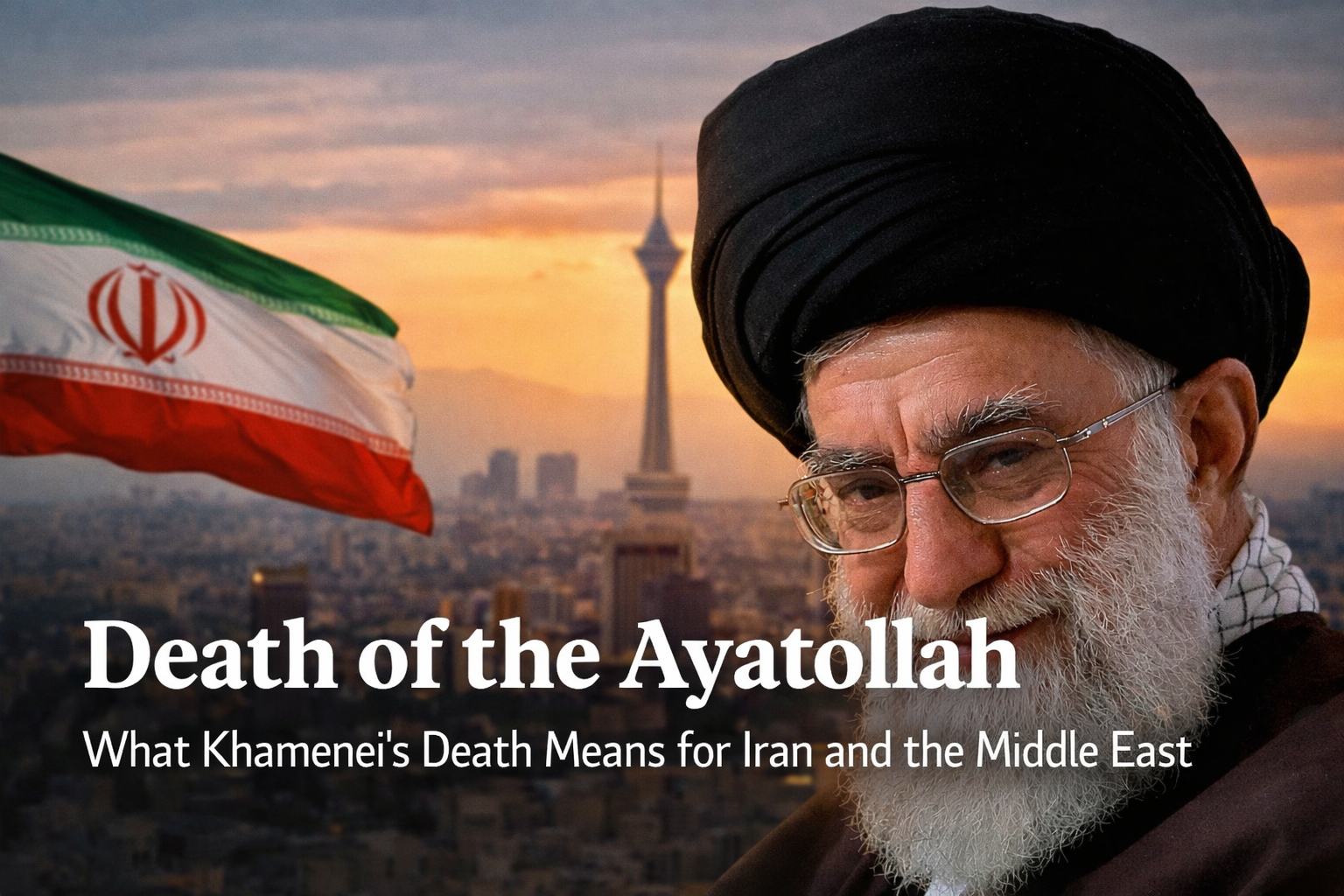
Iran’s Most Powerful Man Is Gone — Now What?
The death of Ayatollah Ali Khamenei has triggered a wave of reactions that stretch from Tehran’s mosques to Washington’s policy circles, from Beirut’s southern suburbs to Iranian diaspora communities in Europe and North America.
For nearly four decades, Khamenei stood at the apex of the Islamic Republic’s political and religious structure. His authority was constitutional, theological, and strategic. His death — sudden and violent — is not merely a leadership change. It is a rupture in the architecture of power that defined Iran since 1989.
But history is not shaped by death alone. It is shaped by reaction.
Who He Was: From Revolutionary to Supreme Leader
Born in 1939 in Mashhad, Khamenei emerged from modest clerical roots to become one of the central figures of the 1979 Islamic Revolution led by Ruhollah Khomeini.
Arrested multiple times under the rule of Mohammad Reza Pahlavi, he gained credibility among revolutionaries for his endurance and ideological clarity.
When Saddam Hussein invaded Iran in 1980, launching the Iran–Iraq War, Khamenei was thrust into senior leadership roles. The eight-year conflict — marked by missile strikes on cities, trench warfare, and chemical weapons — shaped his worldview permanently.
He believed Iran survived because it refused to bend.
When Khomeini died in 1989, Iran’s Assembly of Experts selected Khamenei as Supreme Leader. Many at the time questioned whether he possessed the religious stature for the role. Over time, he consolidated authority through strategic alliances with the Revolutionary Guard and state institutions.
By the 2000s, he was the uncontested center of Iran’s political gravity.
The First Reaction: Official Mourning
Within hours of confirmation, Iranian state television broadcast Quranic recitations and declared national mourning.
An official statement from Tehran read:
“The Leader of the Islamic Revolution has joined the martyrs of this nation. His life was devoted to defending Islam, independence, and the dignity of oppressed Muslims.”
The statement framed his death as martyrdom — a powerful concept in Shia theology, especially in a political system rooted in the symbolism of sacrifice.
Senior commanders from the Islamic Revolutionary Guard Corps issued a joint declaration:
“This crime will not weaken the Islamic Republic. It will strengthen our resolve.”
The message was clear: continuity over collapse.
Regional Reactions
Across the Middle East, reactions were polarized.
In Lebanon, a spokesperson aligned with Hezbollah described Khamenei as:
“A guardian of resistance and a voice for the oppressed.”
In Iraq, responses were more nuanced. While some Shia political factions mourned him as a defender of Shia empowerment, clerical circles in Najaf emphasized stability. A senior Iraqi cleric reportedly stated:
“Leadership passes, faith remains. The unity of Muslims must be preserved.”
The message reflected a longstanding theological distinction between Iran’s model of clerical rule and Iraq’s more quietist religious tradition.
In the Gulf states, official statements were restrained. One senior Gulf diplomat, speaking anonymously, described the moment as:
“A period of high volatility. Stability in Iran is in everyone’s interest.”
Western Governments: Strategic Framing
In Washington, officials described the event in strategic, not theological, terms.
A senior U.S. official stated:
“This marks the end of an era in Iranian leadership. Our focus remains regional stability and the protection of American interests.”
European leaders urged de-escalation. One EU foreign policy representative said:
“The region cannot afford further escalation. A peaceful transition is essential.”
Meanwhile, Moscow and Beijing condemned the killing sharply. A Russian Foreign Ministry spokesperson called it:
“A destabilizing act that risks igniting broader conflict.”
China’s statement focused on sovereignty and warned against “external interference in regional affairs.”
Reactions Inside Iran: Divided Sentiment
Public reaction within Iran is complex.
State-organized mourning ceremonies filled major squares. Black flags were raised. Religious chants echoed through Tehran.
Yet social media — where accessible — reflected division.
Some posts praised him as steadfast:
“He stood when others would have fled.”
Others were bluntly critical:
“He ruled too long. Iran deserves a different future.”
Iran has experienced deep generational divides in recent years, particularly following protests in 2009, 2019, and 2022–23. His death does not erase those tensions.
It amplifies them.
The Diaspora: Grief, Relief, Uncertainty
Among Iranians abroad, reactions mirror the fractures inside the country.
In Los Angeles, home to one of the largest Iranian communities outside Iran, community leaders reported emotional and polarized gatherings.
One Iranian-American business owner said:
“For my parents, this is the loss of a revolutionary figure. For my children, it’s something else entirely.”
In London, an activist who has long criticized the Islamic Republic remarked:
“His death does not automatically mean freedom. Systems outlive individuals.”
Students in Europe expressed anxiety about family safety and possible instability.
The diaspora’s reaction underscores a central truth: Iran’s identity extends far beyond its borders, and its politics are deeply personal for millions worldwide.
Standing for Muslims — The Global Narrative
Khamenei consistently positioned himself as a defender of Muslims facing injustice, particularly in Palestine and Lebanon.
In one of his final major speeches, he declared:
“Resistance is not a choice. It is a duty when dignity is threatened.”
Supporters interpret this as principled defiance. Critics argue it entrenched conflict and diverted resources from domestic reform.
Either way, the narrative of resistance became inseparable from his identity.
The Strategic Unknown
The immediate question is succession.
Iran’s Assembly of Experts is constitutionally responsible for appointing a new Supreme Leader. Behind closed doors, factions will debate continuity versus recalibration.
A former Iranian diplomat, speaking anonymously, summarized the stakes:
“The system was designed to survive individuals. The test is whether it can survive this individual.”
The Revolutionary Guard’s posture will be crucial. So will economic stability. So will public patience.
The Historical Balance
Ali Khamenei leaves behind a country stronger militarily than it was in 1989, but economically strained and socially divided.
He survived:
- The Iran–Iraq War aftermath.
- International sanctions.
- Covert attacks.
- Waves of protest.
He did not seek exile. He did not retreat from ideological confrontation. He governed through endurance.
To his followers, that endurance was faith in action.
To his critics, it was rigidity that limited Iran’s evolution.
What His Death Ultimately Means
This is not just the killing of a national leader.
It is:
- A spiritual shock for some Shia communities.
- A strategic recalculation point for the Middle East.
- A moment of uncertainty for Iranians abroad.
- A test of institutional resilience inside Iran.
Leadership can be removed in a moment.
Legacy cannot.
As Iran enters its first post-Khamenei chapter, the question is no longer who he was.
It is whether the system he built adapts — or doubles down.
The world is watching Tehran.
And history is already writing its next page.


