


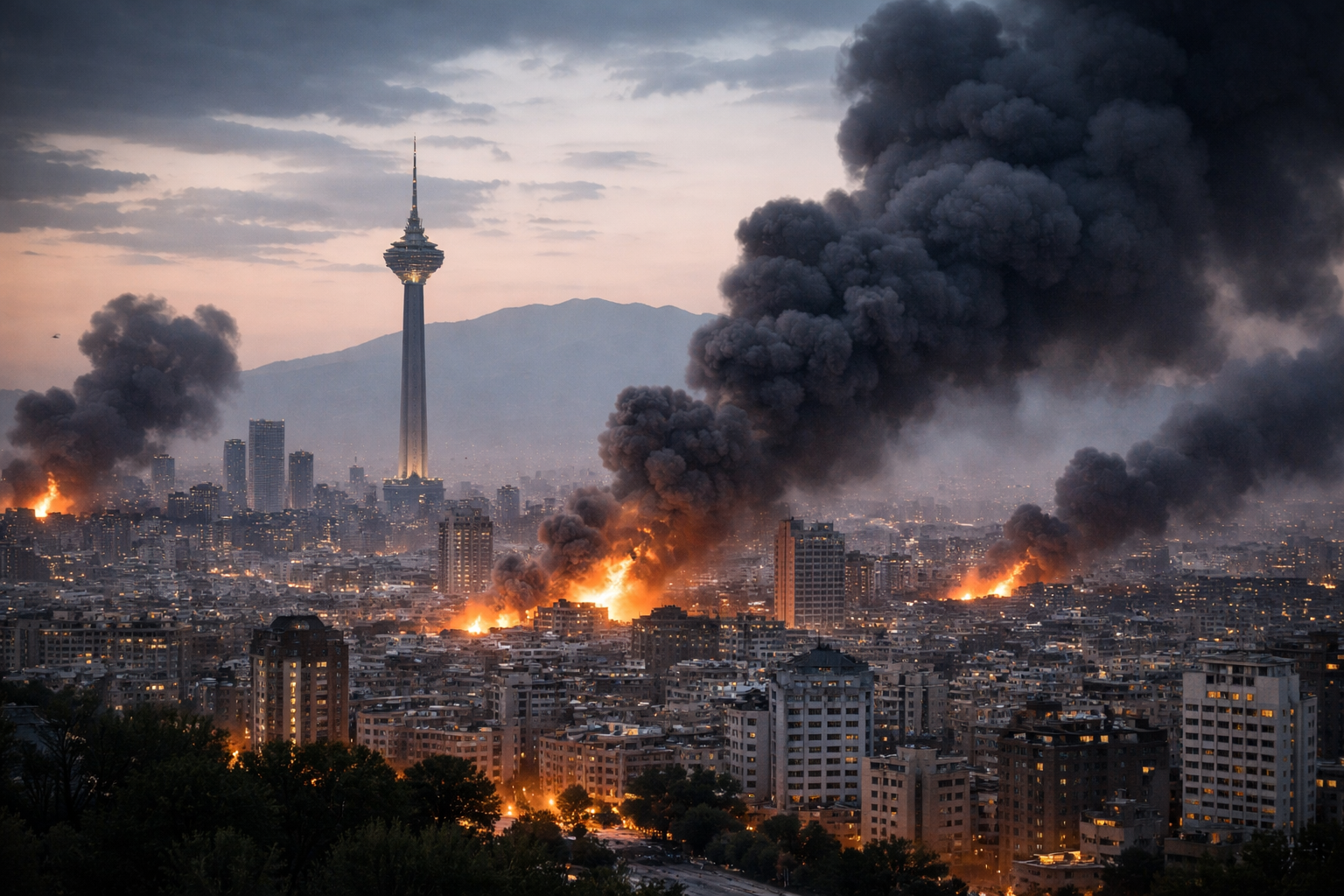
When coordinated strikes hit strategic sites inside Iran, the immediate impact was regional: explosions, retaliatory missiles, emergency mobilizations.
The deeper shockwaves were global.
Within hours, oil prices surged. Gold climbed. Airlines rerouted. Insurance markets repriced risk. Intelligence agencies across Europe and North America elevated alert levels. Proxy groups signaled escalation.
What is unfolding is not simply another Middle Eastern flare-up. It is a systemic geopolitical event — one that could reorder deterrence doctrine, reshape alliance structures, and embed long-term risk premiums into the global economy.
As one Gulf-based energy strategist put it:
“When Iran moves, the oil market moves. When oil moves, the global economy feels it.”
This conflict is not only about territory or retaliation. It is about infrastructure — the infrastructure of global energy, finance, aviation, and security.
And it intersects with leadership legacies shaped by figures such as Khomenie, Kamenie, Trump, and Netanyahu — individuals whose strategic calculations continue to influence escalation dynamics.
I. Energy: The Strait That Holds the World
At the center of the crisis lies a narrow maritime artery: the Strait of Hormuz.
Nearly one-fifth of globally traded oil passes through this corridor. Liquefied natural gas shipments from Qatar — critical to Europe and Asia — transit the same waters.
Even the threat of disruption is enough to move markets.
Following direct exchanges involving Israel and the United States, Brent crude rose sharply as traders priced in supply risk. Futures contracts spiked not because exports had fully halted — but because uncertainty carries a premium.
If exports were to drop significantly:
- Oil could break well above $100 per barrel.
- Global inflation would reaccelerate.
- Central banks would face renewed tightening pressure.
- Emerging markets would absorb currency shocks.
Energy is not simply a commodity. It is the bloodstream of global GDP.
Gas markets are particularly vulnerable. Europe, still sensitive to supply volatility after previous disruptions, relies heavily on Gulf-linked LNG flows. A prolonged interruption could increase electricity prices, raise industrial costs, and strain fragile economies.
A European commodities analyst summarized the vulnerability succinctly:
“The Strait of Hormuz is not a regional chokepoint. It is a global economic switch.”
II. The Nuclear Shadow
No analysis of Iran’s war posture can ignore the nuclear dimension.
Since the collapse of the JCPOA during the Trump administration, tensions over enrichment have remained central to strategic calculations. Iran insists its nuclear program is civilian. Israel, under leaders including Netanyahu, has repeatedly framed a nuclear-capable Iran as an existential threat.
Kamenie’s doctrine emphasizes deterrence through resilience and asymmetry. Netanyahu’s security doctrine prioritizes pre-emption.
The result is a persistent nuclear shadow over any conventional confrontation.
A senior regional diplomat noted privately:
“The danger is not what is happening today. It is what might happen if deterrence fails tomorrow.”
Escalation involving nuclear facilities — even short of weaponization — would dramatically alter global risk perception.
III. Gold, Markets and the Return of Strategic Risk
Whenever instability rises in the Middle East, gold typically responds.
Safe-haven flows strengthen the U.S. dollar. Equity markets wobble. Volatility indices climb.
But this episode carries layered risk:
- Direct state-to-state confrontation.
- Proxy network activation.
- Energy supply vulnerability.
- Nuclear uncertainty.
Commodity markets are pricing not just conflict — but escalation probability.
A sustained oil spike would feed directly into transport costs, fertilizer pricing, agricultural output, and consumer inflation. Emerging markets dependent on imports would feel disproportionate strain.
The macroeconomic consequences could include:
- Slower global growth.
- Monetary policy tightening under inflation pressure.
- Currency instability in energy-importing states.
- Higher sovereign borrowing costs.
As one London-based macro strategist observed:
“War in Iran is not a headline risk. It is a macroeconomic event.”
IV. Aviation: Airspace as Strategic Terrain
Modern warfare extends beyond land and sea. Air corridors are economic arteries.
Commercial airlines have diverted routes over Iran, Iraq, Syria and parts of the Gulf. Each reroute increases fuel consumption and operational costs. Insurance premiums climb when missile exchanges intensify.
The consequences include:
- Longer flight times.
- Elevated ticket prices.
- Reduced cargo capacity.
- Delayed global supply chains.
High-value goods — pharmaceuticals, electronics, perishable commodities — depend on reliable air logistics. Disruption compounds inflationary pressure already building from energy markets.
Aviation risk analysts warn that prolonged instability could hardwire higher insurance premiums into global transport costs.
V. Proxies and Asymmetric Escalation
Iran’s strategy has long relied on asymmetric depth.
Groups such as Hezbollah, Hamas and the Houthi movement expand Tehran’s strategic reach without requiring conventional force deployment.
If escalation widens, additional fronts could open:
- Northern Israeli territory via Lebanon.
- Red Sea shipping routes.
- Gulf energy infrastructure.
- Maritime chokepoints beyond Hormuz.
Proxies strike not only military assets — but commerce.
As one regional security expert explained:
“Missiles target bases. Proxies target economies.”
This multiplication of uncertainty complicates deterrence calculations for the United States and Israel alike.
VI. Terrorism and Lone-Actor Risk
Beyond structured proxy networks lies a more diffuse threat: individual radicalization.
Periods of geopolitical escalation historically correlate with:
- Lone-actor attacks.
- Ideologically motivated retaliation.
- Targeting of symbolic civilian sites.
Security services across Europe and North America monitor Iranian-linked networks as well as the potential for self-radicalized actors responding to wartime narratives.
The risk does not guarantee incidents. But elevated alert levels alter domestic security postures — expanding surveillance, increasing police visibility, and reinforcing counterterrorism frameworks.
History shows that conflict narratives can travel far beyond battlefields.
VII. Crime, Inflation and Domestic Strain
Energy-driven inflation produces domestic consequences.
Higher fuel costs raise food prices, transport expenses and household energy bills. In fragile economies, this can spark protests or social unrest.
Economic stress correlates with:
- Expansion of organized crime networks.
- Black-market fuel distribution.
- Cross-border smuggling operations.
The connection between geopolitical conflict and domestic instability is indirect but real. Sustained inflation erodes social cohesion.
One policy researcher cautioned:
“Wars abroad can destabilize politics at home through the quiet channel of prices.”
VIII. Alliances Under Pressure
The conflict is reshaping alliance calculations.
The United States–Israel alignment has hardened. Military coordination and intelligence sharing have intensified. Netanyahu has emphasized Israel’s right to self-defense in increasingly assertive terms.
At the same time, Gulf states must balance carefully:
- Avoiding direct confrontation.
- Maintaining U.S. security guarantees.
- Protecting energy exports.
- Managing relations with Iran.
China calls for de-escalation while safeguarding energy flows. Russia observes for leverage opportunities.
If escalation deepens, potential outcomes include:
- Expanded missile defense integration.
- Accelerated arms procurement.
- Defense pact recalibration.
- Nuclear hedging by regional actors.
Strategic doctrine shifts in wartime.
IX. Could This Become a Systemic Reset?
Comparisons to the post-September 11 transformation are increasingly discussed in policy circles.
After 9/11:
- Security budgets surged.
- Global surveillance architecture expanded.
- Military doctrine evolved.
- Counterterrorism alliances solidified.
The current conflict carries similar reset potential.
If Hormuz closes.
If proxy warfare spreads.
If a mass-casualty retaliation occurs.
If nuclear facilities are targeted.
Then structural transformation could follow:
- Accelerated energy independence policies.
- Permanent geopolitical risk premiums in commodities.
- Expanded missile defense architecture.
- Hardened security blocs.
- Reduced tolerance for ambiguity in alliance commitments.
Wars sometimes redraw borders. Occasionally, they redraw systems.
X. Leadership, Doctrine and Historical Memory
Understanding this conflict requires acknowledging leadership narratives.
Khomenie’s revolution institutionalized ideological resistance to Western dominance. Kamenie’s stewardship has prioritized regime survival and strategic deterrence.
Trump’s withdrawal from the nuclear deal reshaped diplomatic channels and recalibrated sanctions pressure. Netanyahu has consistently framed Iran as the central security threat facing Israel.
These leadership decisions did not create hostility — but they shaped its trajectory.
As one historian of the region noted:
“Strategy is rarely spontaneous. It is layered over decades of grievance, doctrine and identity.”
The legacy of revolution, sanctions, proxy warfare and nuclear ambiguity converges in the present moment.
XI. The Reset Scenario
If escalation intensifies, several structural shifts are plausible:
1. Energy Realignment
Acceleration of renewable energy investment, nuclear expansion and supply diversification.
2. Financial Repricing
Long-term geopolitical risk premiums embedded into oil, shipping insurance and aviation costs.
3. Military Integration
Closer missile defense coordination among the United States, Israel and Gulf partners.
4. Strategic Polarization
Clearer division between Western-aligned blocs and Iran-linked networks, with emerging powers navigating neutrality.
Each scenario carries implications far beyond the region.
XII. The Crossroads
The war in Iran is not merely a regional crisis. It is a convergence point of:
- Energy security.
- Financial stability.
- Terrorism risk.
- Alliance architecture.
- Great-power competition.
If contained, it becomes another episode in a long Middle Eastern rivalry.
If escalated, it becomes a structural inflection point.
Oil markets are reacting. Gold is rising. Airspace is tightening. Alliances are hardening.
History rarely announces turning points in advance. But when energy prices surge, maritime corridors strain, and nuclear rhetoric intensifies, signals accumulate.
One veteran diplomat summarized the stakes:
“The danger is not just escalation. The danger is normalization — when markets, militaries and alliances permanently adjust to a more volatile baseline.”
The conflict’s trajectory remains uncertain.
But one conclusion is increasingly clear:
This war is not only about Iran.
It is about how the global system absorbs — or fails to absorb — concentrated geopolitical shock.
And in that sense, its consequences may define the strategic landscape of the next decade.


