


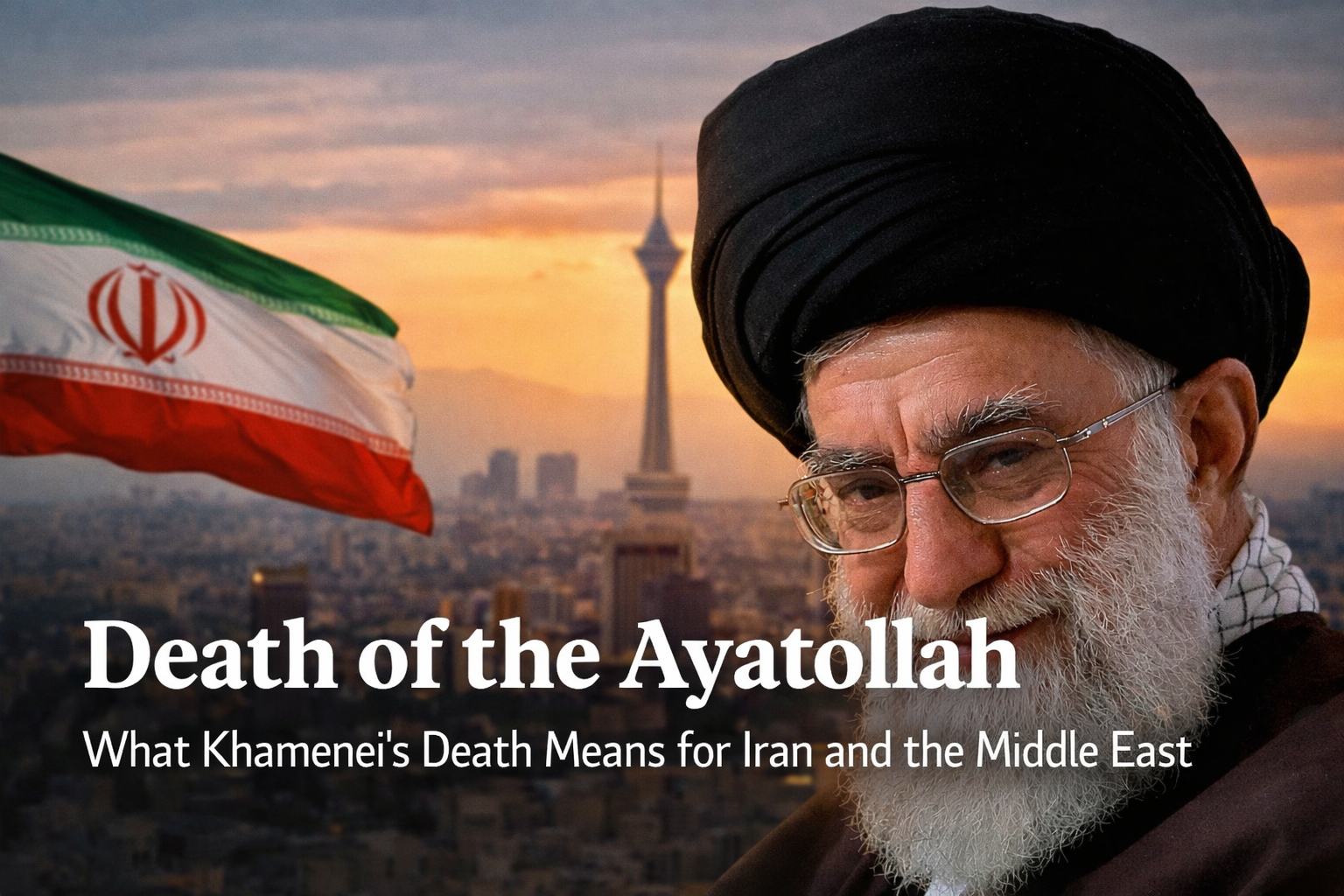
Power, Selection, Authority and Global Impact in the Islamic Republic
The Supreme Leader of Iran is the most powerful political figure in the Islamic Republic — more powerful than the president, parliament (Majlis), judiciary, or military commanders. To understand Iranian politics, foreign policy, nuclear negotiations, the Islamic Revolutionary Guard Corps (IRGC), and even domestic protest movements, one must first understand this office.
The role is not ceremonial. It is constitutional, ideological and structural. It fuses religious authority with ultimate state power under the doctrine of velayat-e faqih — the “Guardianship of the Islamic Jurist.”
Since the 1979 Islamic Revolution, Iran has had only two Supreme Leaders: Ruhollah Khomeini and Ali Khamenei. Across nearly five decades, the office has shaped Iran’s domestic governance, regional strategy, nuclear policy and relations with the United States, Israel, and Europe.
This explainer examines the origins, constitutional basis, powers, selection process, political significance and global implications of the Supreme Leader of Iran — and why the position remains central to understanding Middle East geopolitics.
What Is the Supreme Leader of Iran?
The Supreme Leader (in Persian, Rahbar) is the highest authority in the Islamic Republic of Iran. The position was created under Iran’s 1979 constitution following the overthrow of the Shah.
Unlike the President of Iran — who is elected by popular vote — the Supreme Leader is chosen by a clerical body known as the Assembly of Experts. Once selected, the Leader serves indefinitely unless removed.
Under the constitution, the Supreme Leader stands above:
- The executive branch (President and cabinet)
- The legislative branch (Majlis)
- The judiciary
- The armed forces
- The Islamic Revolutionary Guard Corps (IRGC)
- State broadcasting networks
- The Guardian Council
In effect, the Supreme Leader is Iran’s ultimate decision-maker in political, military, religious and strategic matters.
Origins: The Vision of the 1979 Islamic Revolution
The position emerged from the ideology of Ruhollah Khomeini, who led the 1979 Islamic Revolution that overthrew Mohammad Reza Pahlavi.
Khomeini argued that Islamic governance required supervision by a senior Shiite jurist to ensure that laws aligned with Islamic principles (sharia). This doctrine — velayat-e faqih — became the ideological cornerstone of the Islamic Republic.
Under this framework:
- Sovereignty belongs ultimately to God.
- The Islamic jurist interprets divine law.
- Political institutions must operate under religious supervision.
This structure differs sharply from secular democracies, where political authority is separate from religious doctrine.
As Khomeini declared in 1979: “The guardianship of the jurist is a divine authority.”
How Is the Supreme Leader Chosen?
The Supreme Leader is selected by the Assembly of Experts, an 88-member clerical body elected by popular vote.
Assembly of Experts
However, the process is tightly structured:
- Candidates for the Assembly are vetted by the Guardian Council.
- The Guardian Council itself includes members appointed directly or indirectly by the Supreme Leader.
- The Assembly meets in closed sessions.
In theory, the Assembly can dismiss the Supreme Leader if he is deemed incapable of fulfilling his duties. In practice, it has never publicly challenged the office in a decisive way.
This layered vetting system ensures ideological continuity.
Constitutional Powers of the Supreme Leader
The Supreme Leader’s authority spans military, political, judicial and religious domains.
Military and Security Authority
Islamic Revolutionary Guard Corps
The Leader is:
- Commander-in-chief of all armed forces.
- Direct authority over the IRGC and its elite Quds Force.
- Responsible for declaring war or peace.
- Empowered to appoint top military commanders.
Given the IRGC’s influence across Iran’s economy, intelligence networks and regional operations, this power is decisive.
Political and Government Authority
Guardian Council
The Supreme Leader:
- Appoints the head of the judiciary.
- Appoints six members of the Guardian Council.
- Influences candidate eligibility in presidential and parliamentary elections.
- Can dismiss the president.
- Sets overarching domestic and foreign policy direction.
While the President of Iran manages day-to-day governance, the Supreme Leader defines the strategic boundaries.
Judicial and Media Authority
The Leader appoints:
- The judiciary chief.
- Heads of state media networks.
- Senior clerical and cultural officials.
These appointments shape media narratives, legal outcomes and ideological messaging.
Religious Authority
As a senior Shiite cleric, the Supreme Leader may issue religious decrees (fatwas) that can carry political consequences. In a system where religion and state are intertwined, religious authority reinforces political legitimacy.
The Two Supreme Leaders in Iran’s History
1. Ruhollah Khomeini (1979–1989)
Ruhollah Khomeini
Founder of the Islamic Republic, Khomeini established the power and scope of the office. His leadership shaped:
- The Iran–Iraq War (1980–1988)
- The consolidation of clerical rule
- The institutionalization of the IRGC
Khomeini’s tenure cemented the doctrine of velayat-e faqih as central to governance.
2. Ali Khamenei (1989–2026)
Ali Khamenei
After Khomeini’s death in 1989, constitutional amendments allowed Khamenei — not then the most senior cleric — to assume the role.
Over nearly four decades, he:
- Expanded the IRGC’s influence.
- Consolidated oversight of elections.
- Managed nuclear negotiations and sanctions crises.
- Directed Iran’s regional posture in Syria, Lebanon and Iraq.
Under Khamenei, the Supreme Leader’s institutional power deepened significantly.
Why the Supreme Leader’s Role Is So Powerful
Iran’s political system blends republican and theocratic elements. Elections occur — but within boundaries defined by clerical oversight.
The Supreme Leader’s authority ensures:
- Ideological continuity.
- Strategic control over the military.
- Religious legitimacy in policymaking.
Unlike constitutional monarchies or parliamentary democracies, Iran’s system places religious authority above elected institutions.
This structural hierarchy explains why reformist presidents often find their agendas constrained.
Domestic Impact: Governance and Dissent
The Supreme Leader influences:
- Media freedom
- Judicial rulings
- Protest responses
- Cultural regulation
Youth-led protest movements in recent years have tested the boundaries of this authority. Calls for reform frequently challenge not only policy but the concentration of power itself.
Yet the system is designed to maintain ideological coherence over pluralistic competition.
Foreign Policy and Global Geopolitics
Iran’s nuclear program, regional alliances and military strategy ultimately fall under the Supreme Leader’s oversight.
Key implications:
- Nuclear negotiations hinge on the Leader’s approval.
- Relations with the United States reflect ideological positioning.
- Support for regional actors aligns with strategic doctrine.
Because foreign policy authority is centralized, external powers negotiating with Iran must consider the Supreme Leader’s worldview above that of elected officials.
Succession and Stability
The question of succession periodically draws global attention.
If a Supreme Leader dies or becomes incapacitated:
- A temporary leadership arrangement is formed.
- The Assembly of Experts selects a successor.
Succession represents a critical inflection point for Iran’s domestic and foreign policy trajectory.
Criticism and Support
Supporters argue:
- The system ensures ideological stability.
- It protects Iran from external political interference.
- It preserves Islamic governance principles.
Critics contend:
- Concentrated authority limits democratic accountability.
- Election vetting restricts political diversity.
- Institutional oversight is weakened by hierarchy.
These debates define Iran’s internal political discourse.
Key SEO Concepts Explained
For readers researching Iran Supreme Leader powers, Iran political system explained, velayat-e faqih meaning, or who controls Iran’s military, the answer consistently points back to this office.
The Supreme Leader is:
- Iran’s highest political authority
- Commander-in-chief of the armed forces
- Ultimate authority on nuclear policy
- Head of ideological oversight
- Appointer of judiciary and Guardian Council
Understanding this structure is essential to analyzing Middle East geopolitics, Iran nuclear negotiations, IRGC power, and regional conflict dynamics.
In Summary: Why the Supreme Leader Matters
The Supreme Leader of Iran is:
- The ultimate religious and political authority.
- A position created after the 1979 Islamic Revolution.
- More powerful than the president or parliament.
- Responsible for the military, judiciary, foreign policy and election oversight.
- Selected by a clerical body but shaped by controlled political processes.
For policymakers, analysts and observers, the office explains why Iranian governance functions differently from Western democracies — and why strategic decisions often reflect ideological continuity rather than electoral change.
To understand Iran’s domestic politics, nuclear strategy, relations with the United States and Israel, and regional security posture, one must begin — and often end — with the Supreme Leader.


