


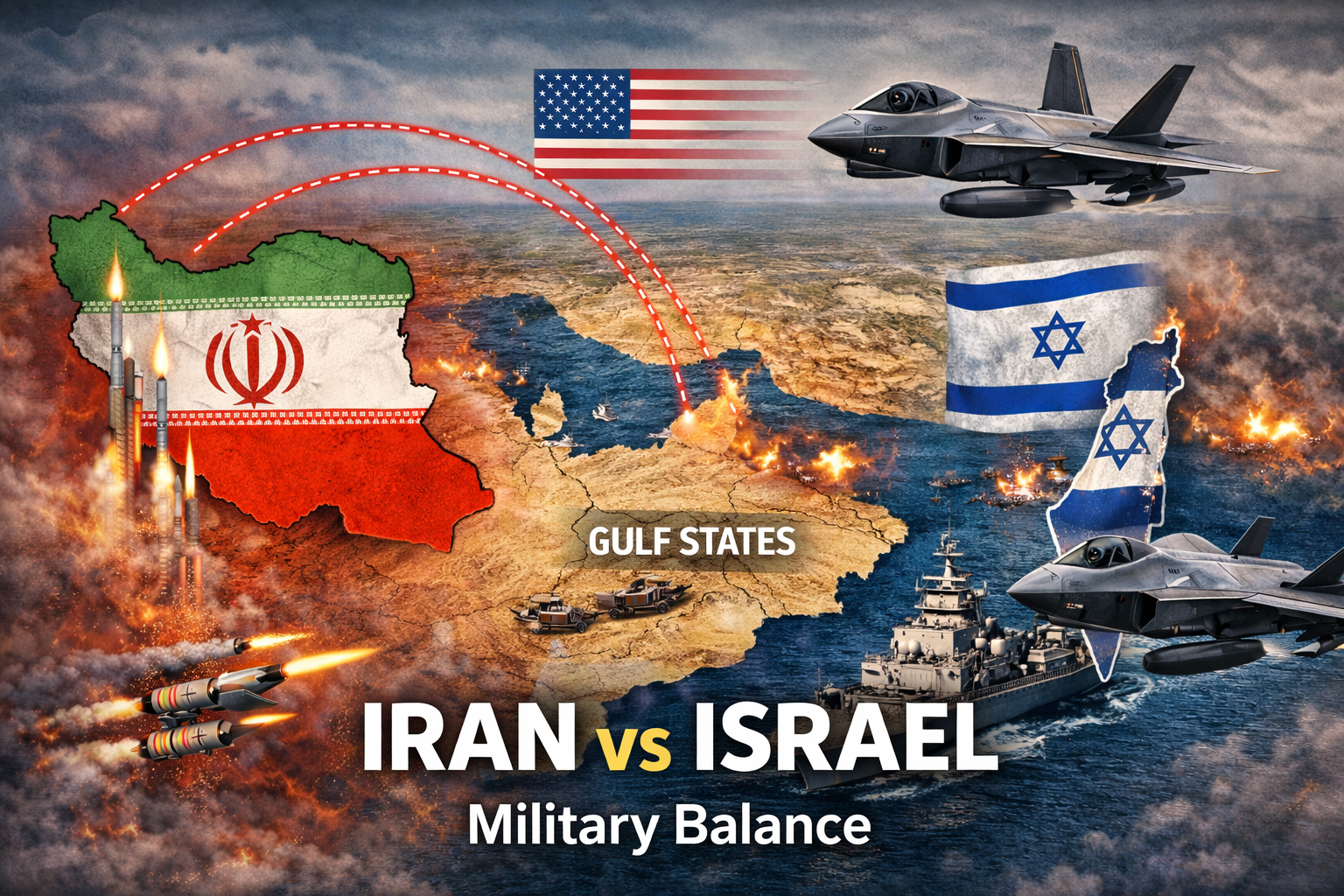
Strategic Balance in the Middle East
A Strategic Explainer on the Middle East’s Emerging Military Balance
The Middle East is once again entering a period of profound strategic uncertainty. Escalating tensions between Iran and Israel, the expanding role of the United States, and the vulnerability of Gulf states have revived concerns about a potential regional war that could reshape the global security landscape.
Over the past decade, a shadow conflict between Israel and Iran — involving cyber operations, covert strikes, sabotage, and proxy warfare — has steadily intensified. Today, the confrontation increasingly features direct missile exchanges, long-range precision strikes, and the mobilization of military assets across the region. The United States has reinforced its military presence in the Middle East, while Gulf states are strengthening air defenses in response to expanding missile and drone threats.
At the center of the strategic equation lies a fundamental question: how do the war capabilities of Iran, Israel, the United States, and the Gulf Cooperation Council (GCC) states compare?
Each actor approaches conflict through a distinct military doctrine shaped by geography, technology, alliances, and political constraints. The United States commands unparalleled global power projection. Israel fields one of the most technologically advanced militaries in the world relative to its size. Iran relies heavily on missiles, drones, and proxy forces to offset conventional weaknesses. Meanwhile, Gulf states act as both strategic hosts for Western forces and increasingly capable defenders of critical infrastructure.
Understanding the interplay between these military capabilities is essential for evaluating the risks of escalation and the balance of power in a region that sits at the crossroads of global energy supply, international trade routes, and great-power competition.
This strategic explainer examines the strengths, weaknesses, and operational doctrines of the major actors shaping the evolving Middle Eastern conflict environment.
1. United States: Global Military Dominance and Strategic Reach
The United States remains the most powerful military actor involved in the Middle East. Its ability to project force across continents, deploy advanced aircraft and naval systems, and sustain long-term operations gives Washington capabilities unmatched by any regional state.
The U.S. military’s presence in the Middle East is anchored by a network of bases, naval deployments, and air assets stretching from the eastern Mediterranean to the Persian Gulf.
Air Superiority and Advanced Aircraft
A central pillar of American military dominance is its control of the air domain.
Fifth-generation stealth aircraft such as the F-22 Raptor and F-35 Lightning II represent the most advanced fighter platforms currently deployed. These aircraft combine stealth technology, electronic warfare capabilities, and precision strike systems that allow them to penetrate heavily defended airspace.
In a conflict involving Iran or regional proxies, these aircraft would play a decisive role in suppressing air defenses, conducting reconnaissance, and striking high-value targets such as missile launch facilities or command centers.
The United States also maintains large fleets of strategic bombers capable of delivering long-range precision weapons. Aircraft such as the B-52 and B-1 can launch stand-off missiles from outside hostile air defense zones, extending the reach of American strike capabilities.
Naval Power in the Persian Gulf
American naval power provides another crucial advantage.
The U.S. Navy regularly deploys aircraft carrier strike groups and guided-missile destroyers in waters surrounding the Middle East, particularly the Persian Gulf and Arabian Sea. These ships are equipped with Tomahawk cruise missiles, capable of striking targets more than 1,000 kilometers away with high precision.
Submarines also play a significant role in deterrence and strike capability. Nuclear-powered submarines can operate undetected for extended periods, providing both surveillance and the capacity to launch cruise missiles against land targets.
The U.S. Fifth Fleet, headquartered in Bahrain, oversees naval operations in the region and is responsible for safeguarding key maritime chokepoints such as the Strait of Hormuz — a vital artery through which roughly one-fifth of global oil shipments pass.
Logistics and Global Military Infrastructure
One of the defining advantages of the U.S. military is its logistics network.
American forces operate from numerous bases across the Middle East, including facilities in Qatar, Bahrain, Kuwait, and the United Arab Emirates. These installations provide staging grounds for aircraft, intelligence operations, and rapid deployment forces.
Estimates suggest that between 30,000 and 40,000 American troops are stationed across the region at any given time. This forward presence allows Washington to respond quickly to crises while reinforcing regional deterrence.
Nuclear Deterrence
Although nuclear weapons are unlikely to be used in a regional conflict, the United States maintains a large strategic arsenal that reinforces deterrence against existential threats.
The American nuclear triad — consisting of intercontinental ballistic missiles, submarine-launched ballistic missiles, and strategic bombers — ensures that any nuclear escalation would carry catastrophic consequences.
Limitations and Strategic Risks
Despite overwhelming military power, the United States faces operational constraints.
Strikes deep inside Iranian territory would require careful coordination, intelligence preparation, and political risk assessment. Iran’s large geography, extensive missile arsenal, and potential for retaliation against U.S. bases complicate the prospect of sustained military campaigns.
In short, while the United States possesses unmatched military capabilities, the political and strategic costs of a large-scale war with Iran remain significant.
2. Israel: Technological Superiority and Precision Warfare
Israel’s military is comparatively small in manpower but extraordinarily sophisticated in technology, intelligence, and operational experience.
The Israel Defense Forces (IDF) are built around rapid mobilization, advanced surveillance systems, and precision strike capabilities designed to neutralize threats before they escalate.
The Israeli Air Force
The Israeli Air Force is widely regarded as one of the most capable in the world.
Equipped with advanced fighter aircraft such as the F-35I Adir, Israel can conduct long-range strikes across the Middle East. These aircraft allow Israel to target missile bases, weapons depots, and military infrastructure with remarkable precision.
Israel has demonstrated its capacity to conduct complex operations far from its borders. Past missions targeting nuclear facilities and military infrastructure have required intricate planning, aerial refueling, and electronic warfare capabilities.
In a confrontation with Iran, Israel’s air force would likely prioritize degrading missile launch sites, destroying drone production facilities, and disrupting command networks.
Layered Missile Defense Systems
One of Israel’s most distinctive military strengths lies in its multi-layered missile defense network.
Three major systems form the backbone of this defensive shield:
Iron Dome intercepts short-range rockets and artillery shells, protecting populated areas from attacks launched by militant groups.
David’s Sling is designed to counter medium-range missiles and large rockets.
Arrow systems target long-range ballistic missiles, including those potentially launched from Iran.
These systems are integrated into a broader early-warning network that allows Israel to intercept incoming threats before they reach major cities or strategic infrastructure.
Intelligence and Cyber Operations
Israel’s intelligence community plays a central role in national security.
Signals intelligence, cyber operations, and human intelligence networks provide the country with a detailed understanding of regional military developments.
Cyber capabilities in particular have become a key tool in Israel’s strategy against Iran. Disrupting missile programs, sabotaging infrastructure, and gathering digital intelligence allow Israel to counter threats without direct military confrontation.
Strategic Partnership with the United States
Israel’s alliance with Washington amplifies its capabilities.
American intelligence sharing, military aid, and joint training exercises strengthen Israel’s technological edge. The presence of U.S. assets in the region also acts as a powerful deterrent against large-scale attacks.
Limitations
Despite its advanced technology, Israel faces strategic challenges.
The country’s small geographic size makes it vulnerable to sustained missile barrages. Large-scale attacks could strain even the most advanced missile defense systems if they occur simultaneously from multiple fronts.
This vulnerability partly explains Israel’s emphasis on pre-emptive strikes and rapid retaliation.
3. Iran: Missiles, Drones, and Asymmetric Warfare
Iran approaches warfare through a fundamentally different strategic doctrine.
Decades of sanctions and military isolation have limited Tehran’s ability to develop a modern conventional air force. Instead, Iran has invested heavily in missiles, drones, naval disruption tactics, and proxy forces.
This strategy allows Iran to challenge more technologically advanced adversaries without directly confronting them in traditional battlefield engagements.
Ballistic Missile Arsenal
Iran possesses one of the largest missile arsenals in the Middle East.
These missiles range from short-range tactical systems to medium-range ballistic missiles capable of reaching targets up to 2,000 kilometers away. This range allows Iran to strike Israel, U.S. bases in the Gulf, and major cities across the region.
Missiles such as the Shahab and Sejjil families form the backbone of Iran’s strategic deterrent.
These weapons are deployed across numerous launch sites, including underground facilities designed to protect them from pre-emptive strikes.
Drone Warfare
Iran has also become a significant producer of military drones.
Unmanned aerial systems such as the Shahed-136 have gained international attention for their use in conflicts across the Middle East and beyond.
These drones are relatively inexpensive compared with conventional missiles, allowing Iran to deploy them in large numbers. By launching swarms of drones simultaneously, Iran can attempt to overwhelm air defense systems.
Proxy Networks and Regional Influence
Iran’s military reach extends beyond its borders through allied militias and political movements often described as the “Axis of Resistance.”
These groups include organizations in Lebanon, Iraq, Syria, and Yemen that possess large rocket and missile arsenals.
In a regional conflict, these forces could open additional fronts against Israel or target U.S. bases across the Middle East, complicating the strategic environment.
Geographic Advantages
Iran’s geography provides natural strategic depth.
The country’s vast territory and mountainous terrain make it difficult for adversaries to conduct large-scale ground operations. Missile launch sites dispersed across remote areas further complicate efforts to eliminate Iran’s strike capabilities.
Limitations
Iran’s conventional military weaknesses remain significant.
Its air force relies heavily on older aircraft dating back decades, and sanctions have constrained its ability to acquire advanced technology.
As a result, Iran’s military doctrine emphasizes asymmetric warfare rather than conventional dominance.
4. Gulf States: Defensive Systems and Strategic Partnerships
The Gulf Cooperation Council — consisting of Saudi Arabia, the United Arab Emirates, Bahrain, Kuwait, Qatar, and Oman — occupies a unique position in the regional security architecture.
While these states possess modern military equipment, their strategic strength lies primarily in defensive systems and alliances with Western powers.
Air Defense Infrastructure
Gulf countries have invested heavily in missile defense systems designed to protect energy infrastructure and urban centers.
Systems such as Patriot interceptors and other radar-guided defenses form the backbone of this shield.
However, recent drone and missile attacks have exposed vulnerabilities in these defenses, particularly when faced with large numbers of simultaneous threats.
U.S. Military Presence
Perhaps the most significant security guarantee for Gulf states is the presence of American forces.
U.S. naval bases, airfields, and logistics centers across the region serve as deterrents against large-scale attacks.
This arrangement allows Gulf states to rely on American power projection while gradually expanding their own capabilities.
Military Modernization
Several Gulf countries are investing heavily in advanced aircraft, missile defenses, and surveillance systems.
Saudi Arabia and the United Arab Emirates in particular have sought to develop more independent military capabilities.
Despite these investments, Gulf states remain heavily dependent on external security partnerships.
5. How These Military Capabilities Interact
The current strategic environment in the Middle East is defined by an interplay between precision warfare and asymmetric tactics.
Iran’s missile and drone capabilities aim to saturate and overwhelm defenses. Israel and the United States rely on advanced aircraft and precision weapons to eliminate launch sites and disrupt command structures.
Meanwhile, Gulf states act as strategic hosts and defensive partners within the broader Western security framework.
Missile and Drone Exchanges
Large-scale missile and drone barrages represent one of the most likely forms of escalation.
These attacks could target military bases, energy infrastructure, and major cities across the region.
Defensive systems may intercept many incoming threats, but the sheer number of missiles and drones could still inflict damage.
Precision Strike Campaigns
In response, Israel and the United States would likely conduct precision strikes against missile facilities, drone factories, and military command centers.
Such operations could involve aircraft, cruise missiles, and cyber attacks designed to disrupt Iran’s military networks.
Risks of Regional Escalation
The greatest strategic danger lies in the possibility of a multi-front conflict involving Iran, Israel, Gulf states, and various proxy forces.
Such a scenario could disrupt global energy markets, threaten maritime trade routes, and draw in major international powers.
Conclusion: A Fragile Balance of Power
The Middle East’s military balance is defined not by a single dominant regional power but by a complex interplay of capabilities.
The United States provides unmatched global military reach and advanced strike capabilities. Israel combines technological sophistication with highly effective defensive systems. Iran relies on missiles, drones, and proxy forces to compensate for conventional limitations. Gulf states serve as both strategic hosts and defensive partners within a broader Western security architecture.
This balance creates both deterrence and instability.
Advanced missile defenses reduce the effectiveness of large-scale attacks, yet the proliferation of drones and precision weapons continues to challenge traditional security frameworks.
As tensions between Iran, Israel, and the United States continue to evolve, the region’s strategic landscape will remain one of the most volatile in global geopolitics.
Understanding the military capabilities of these actors is therefore essential not only for assessing the risks of war but also for evaluating the future of security in the Middle East.


