


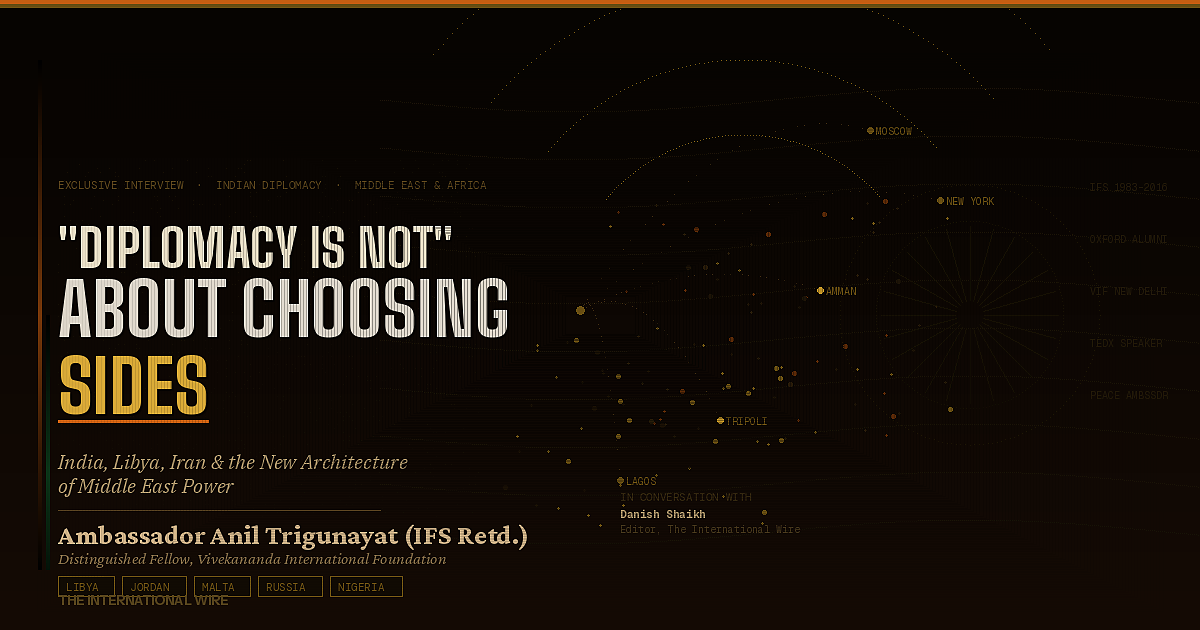
India, Libya, Iran & the New Architecture of Middle East Power: A Conversation with Ambassador Anil Trigunayat
In conversation with Ambassador Rtn. Anil Trigunayat (IFS Retd.)
Distinguished Fellow & Head, West Asia Experts Group | Vivekananda International Foundation
Former Ambassador of India to Libya, Jordan & Malta
Interviewed by Danish Shaikh, Editor, The International Wire
There are few individuals alive today who have seen the Middle East — in all its complexity, contradiction, and consequence — from the inside of a diplomatic mission during its most violent convulsions.
Ambassador Anil Trigunayat is one of them.
A career diplomat of over three decades with the Indian Foreign Service, Ambassador Trigunayat served India across some of the world’s most strategically sensitive postings — New York, Moscow, Stockholm, Lagos, Dhaka, and Ulaanbaatar — before taking on his most consequential role: India’s Ambassador to Libya and Malta from 2012 to 2014, arriving in Tripoli in the immediate, chaotic aftermath of the fall and killing of Muammar Gaddafi. He subsequently served as India’s Ambassador to Jordan from 2014 to 2016, stationed in Amman at the precise moment the Syrian civil war, the rise of ISIS, and the Palestinian crisis were redrawing the region’s map in real time.
During his tenure in Libya, he was personally engaged in conflict management and in organising assistance for scores of stranded Indian nationals — men and women caught in a country disintegrating around them. It is the kind of diplomacy that does not appear in textbooks: improvised, high-stakes, and deeply human.
Since retiring from active service, Ambassador Trigunayat has become one of India’s most authoritative and prolific voices on West Asia and African affairs. He is Distinguished Fellow and Head of the West Asia Experts Group at the Vivekananda International Foundation — India’s leading strategic think tank — and sits on the boards of multiple institutions spanning trade, education, energy, and international governance. He was recently appointed an Independent Director on the board of NTPC Limited, India’s largest power generation company. He is an Oxford alumnus, a TEDx speaker, and a Peace Ambassador at Unity Earth.
He brings to this conversation something rare in the current cacophony of geopolitical commentary: the lived experience of having represented a great democracy inside a failing state, and the analytical discipline of having spent the years since making sense of what it all means.
Now, as the Middle East faces its most dramatic rupture in four decades — with the Iran crisis reshaping the entire regional order — we speak with Ambassador Trigunayat about Libya then, Iran now, India’s extraordinary diplomatic position, and what comes next for a world in the middle of being rewritten.
What follows is a wide-ranging, candid, and deeply informed conversation — from the rubble of post-Gaddafi Tripoli to the corridors of South Block in New Delhi — about the craft of diplomacy, the weight of national interest, and the choices a rising India must now make.
THREE DECADES OF DIPLOMACY — A PERSONAL REFLECTION
Ambassador, you served India as a diplomat for over three decades — across the United States, Russia, Nigeria, Sweden, Bangladesh, and the Middle East. Looking back, which posting shaped your understanding of diplomacy the most, and why?
Thank you . Even though it may sound a bit of a cliché , I must admit that I have been very fortunate to be in a country when I was able to contribute to serving our national interests to the extent possible in each of my assignment from the Cushiest like New York, USA to difficult times in Ulaanbaatar, Mongolia and conflict zones of Libya. In fact in my very first posting I became the Cda with in a few months of my arrival in Abidjan , Cote d’Ivoire in West Africa and had to learn the intricate dimensions of diplomacy across the whole functional spectrum.
India’s diplomatic posture has evolved considerably since the early 1980s when you joined the Indian Foreign Service. How has the philosophy of Indian diplomacy changed over your career — and is today’s India more or less effective on the world stage than the India you first represented?
Indeed India has evolved and has begun to assert on the global stage as it wishes to become a rule maker than a rule taker. One of the most critical time for the Indian diplomacy was immediately after the economic reforms of the 1990s when I was Trade commissioner in New York . Economic Diplomacy became a key focus for attracting FDI, FII and quest for appropriate technologies .In old days Western diplomats were the flavour but now Indians are sought out . Under PM Narendra Modi while the essence of foreign policy may not have radically changed but it has surely been marked by 3 Rs: Robust, Resilient and Result oriented.
You are an Oxford alumnus and a TEDx speaker — how important is intellectual rigour and communication in the craft of diplomacy? Is the modern diplomat sufficiently equipped for a world of information overload and strategic disinformation?
A diplomat has to be a good listen keeping his eyes and ears open at all times . Cogent and effective Communication is an art that needs to be assiduously developed. Each word you convey to your interlocutors will be analysed and interpreted by the other side ,hence it is important to precise unless one intends to leave it in the grey zone . Modern diplomats are well versed with the latest communication medium and tools and are trained in dealing with all situations including Grey Zone warfare more effectively . However , as a country I feel we have to develop a robust and strategic communication strategy to counter the disinformation especially through traditional and social media .
INDIA’S AMBASSADOR TO LIBYA (2012–2014): THE POSTING THAT DEFINED A CAREER
You served as India’s Ambassador to Libya from 2012 to 2014 — one of the most turbulent periods in the country’s modern history, coming immediately after the fall and killing of Muammar Gaddafi in 2011. What was the ground reality when you arrived? What did post-Gaddafi Libya actually look like from inside the Embassy?
In fact since we had closed the Embassy in Tripoli during the revolution we did not have the ground level information . I was posted as Deputy Ambassador in Moscow and was in touch with the Russian envoys who were visiting Libya frequently and was keeping abreast with developments there which were quite disconcerting . These were not India centric . So when I was asked by the then PM Late Dr Manmohan Singh, whom I knew since my New York days, to take over the responsibility to retrieve the situation and secure our economic interests I thought of this as a real good challenge . But when I arrived I was shocked to see the negative sentiment against India at the grass roots level , let alone among the leadership and political classes because we had opposed military intervention and subsequently abstained on the UNSC vote . Western powers maligned India as being supportive to the Gaddafi regime which was figment of their imagination and caused a major irritant for us. So my job became how to bring that utter negativity to the level of zero or neutral from where the positive trends could ensue. There was no law and order with scores of armed militias and powerful gangs straddling across the country . I believed that you cannot die twice and hence went about doing my job without fear and made scores of Libyan friends and eventually was able to discharge my duty as best as I could in the new two and half years .
You were actively engaged in conflict management and in providing assistance to scores of stranded Indians during that trying time. Can you walk us through what that operation involved — the scale, the risks, and the decisions you had to make under pressure?
Although large number of Indians working in Libya were evacuated but thousands stayed back and refused to leave due to monetary reasons . But several Indian doctors refused to leave as they felt it was their duty to serve the Libyans in their difficult times . Evacuating Indians and other nationalities from the pitched battles was a difficult exercise since there was no effective police or military and systems to help us much,. Hence , I reached out to several militia group leaders and was able to persuade them to even stop firing for few hours so sthat we could bring out our people .
India has a long tradition of strategic autonomy and non-interference. How do you balance that doctrine with the practical reality of protecting Indian nationals and interests inside a country in the middle of a civil war?
Precisely because of our policy of strategic autonomy and Vasudhaiv Kutumbakam and having become the first responder it becomes easier for us to approach the concerned countries and groups to let the Indians leave unharmed as they are there to help build their countries or communities . India is seen as a benign and friendly country by most .
INDIA’S AMBASSADOR TO JORDAN (2014–2016): THE EYE OF THE MIDDLE EAST STORM
Your posting to Jordan immediately followed Libya — moving from a failed state to one of the most diplomatically sensitive and strategically vital countries in the region. Jordan hosts millions of Palestinian and Syrian refugees and shares borders with Israel, Syria, Iraq, and Saudi Arabia. How does Jordan maintain its extraordinary balancing act?
Jordan is a moderate and highly strategic country with an excellent and forward looking leadership . they do have many challenges became of the regional hotspots and humanitarian stress caused due to refugees and immigrants . Arab hospitality is on full display there with regard to looking after the refugees from Syria , Libya and elsewhere,
THE IRAN WAR: AN INDIAN DIPLOMATIC PERSPECTIVE
Ambassador, India occupies a unique position in the current Iran crisis — it has historically warm relations with Tehran, deep ties with Israel, and is America’s strategic partner. How is New Delhi navigating this extraordinary diplomatic tightrope?
India has adopted a policy of de-hyphenation which means our relationship with a country is not predicated on our relationship with any other country in the region or outside, We have special strategic partnership with Israel but Iran and Saudi Arabia are also our historic and strategic partners. It is difficult but doable since the regional countries understand India ‘s non-prescriptive approach which is driven by dialogue , diplomacy and peace.
CLOSING: DIPLOMACY, WISDOM & THE ROAD AHEAD
You have described public diplomacy and the promotion of India’s interests as your passion for over three decades. In an era of social media, digital warfare, and algorithmic narratives — what does effective public diplomacy look like today, and is India doing it well?
In this information age the role of Public diplomacy becomes even more important as our adversaries will continue to target us through disinformation campaigns and can have first liar advantage as happened during Op-Sindoor. Hence we need to harness modern day communication tools and develop a 24×7 proactive and robust communication strategy .

Amb. Anil Trigunayat is a member of the Indian Foreign Service. He has served in the Indian Missions in Cote d’Ivoire, Bangladesh, Mongolia, USA, Russia, Sweden and Nigeria, Libya and Jordan. In the Ministry of External Affairs he has worked in the Economic, West Asia and North Africa and Consular Divisions. He also served as Director General/Joint Secretary for the Gulf & Haj Divisions in the Ministry of External Affairs, New Delhi. Thereafter, Mr. Trigunayat worked as Deputy Chief of Mission in the rank of Ambassador in the Embassy of India, Moscow Prior to his superannuation in May 2016, he served as Ambassador of India to Jordan and Libya and High Commissioner to Malta (June 2012 – May 2016). He is a post Graduate in Physics from the Agra/Kumaon University and also studied Russian History, Culture and Language at the Jawaharlal Nehru University, New Delhi. As a visiting fellow he also conducted research work on “WTO and Regional Trading Blocs” at the Oxford University. He is a member of the All India Management Association/Delhi Management Association as well as that of Oxford and Cambridge Society of India and the Association of Indian Diplomats (former Ambassadors). He is also the Honorary Member of the International Trade Council, Brussels.


