


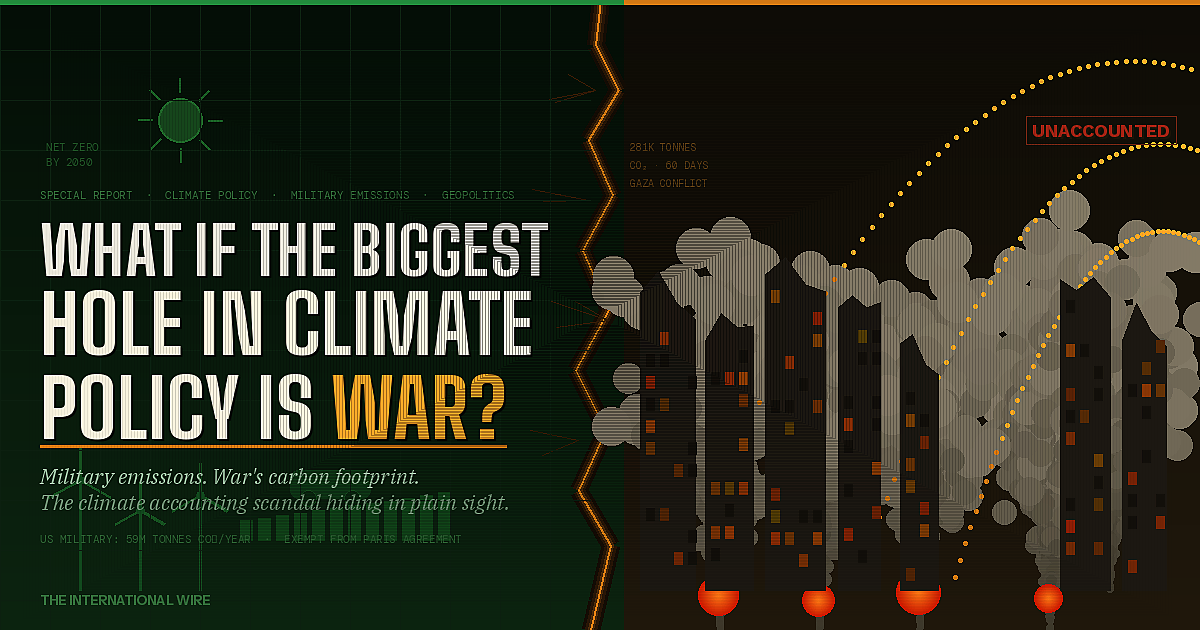
The massive, unaccounted carbon cost of modern warfare — and the climate accounting scandal hiding in plain sight
Somewhere in the world this week, a government minister stood at a podium and announced a new target — net zero by 2050, or electric vehicle mandates, or a carbon tax designed to change the behaviour of millions of ordinary citizens. Citizens who will be asked to pay more for fuel, drive different cars, insulate their homes, and reconsider every purchasing decision in the name of a planet under stress.
Somewhere else this week, a fighter jet burned through 6,000 litres of fuel in a single hour. A cruise missile completed a manufacturing chain that consumed more energy than a family home uses in a decade. A fuel depot exploded, releasing in minutes the pollution equivalent of tens of thousands of cars. A city block collapsed into concrete dust, heavy metals, and toxic debris that will contaminate the surrounding soil for a generation.
Neither event appeared in the same policy document. Neither was counted in the same set of national emissions statistics. And therein lies one of the most consequential — and most carefully avoided — contradictions in contemporary climate politics.
The world is attempting to decarbonise its economies while simultaneously conducting wars that generate massive, unaccounted environmental destruction. No one in either conversation wants to acknowledge the other.
The climate debate has, for decades, focused with remarkable consistency on the same categories of human activity: fossil fuel combustion, heavy industry, transportation, agriculture, and land use. These are the sectors that feature in national pledges, international agreements, and the annual reports of the Intergovernmental Panel on Climate Change. They are the sectors that generate carbon taxes, regulate emissions, and attract the billions in green investment that have become one of the defining economic stories of the early twenty-first century.
War is not on that list. Military emissions — from the fuel burned by fighter jets, warships, and armoured vehicles, to the carbon cost of manufacturing the weapons systems they deploy, to the environmental destruction caused when those weapons are used — occupy a zone of extraordinary privilege in the global accounting of planetary damage. They are systematically underreported, frequently excluded from international climate frameworks, and almost never discussed in the same breath as the emissions targets that governments trumpet at international summits.
This article examines that contradiction — and argues that it represents not merely an accounting anomaly, but a fundamental failure of moral and political seriousness in the global response to climate change.
The Numbers That Don’t Appear in the Climate Reports
To understand the scale of what is being omitted from global climate accounting, it is necessary to begin with the data — data that exists, that has been documented by researchers and advocacy organisations, and that nonetheless remains largely absent from mainstream climate policy discussions.
| 5.5%Share of global greenhouse gas emissions attributable to the world’s militariesConflict and Environment Observatory, 2022 | 140M+Tonnes of CO₂-equivalent emitted annually by global military operationsScientists for Global Responsibility estimate |
| 1stRanking of the US military as the world’s single largest institutional consumer of fossil fuelsBrown University Costs of War Project | 59MMetric tonnes of CO₂ emitted by the US military in 2017 alone — more than many mid-sized nationsNeta Crawford, Boston University |
| ~100Countries whose entire national CO₂ output is lower than the US military’s annual emissionsComparative national data, World Bank / BU | ZEROMilitary emissions excluded from Kyoto Protocol national reporting requirements (1997–2012)UNFCCC historical framework records |
These figures represent a conservative estimate. They capture only the direct operational emissions — the fuel burned in vehicles, aircraft, and vessels during active operations. They do not include the emissions embedded in the manufacturing of weapons systems, the construction and operation of military bases, the energy consumed by defence supply chains, or — critically — the environmental destruction caused when military hardware is used in conflict.
The Brown University Costs of War Project, which has produced some of the most rigorous independent accounting of US military emissions, estimated that between 2001 and 2017 alone — covering the post-September 11 wars in Afghanistan, Iraq, Syria, and beyond — the US Department of Defense emitted approximately 1.2 billion metric tonnes of greenhouse gases. That figure, which represents only one military in one sixteen-year period, is comparable to the total annual emissions of entire industrialised nations.
Between 2001 and 2017, the US military alone emitted an estimated 1.2 billion metric tonnes of greenhouse gases. That is one military, one sixteen-year period — and it still does not appear in the standard climate ledger.
The United Kingdom’s Ministry of Defence emitted approximately 2.8 million tonnes of CO₂-equivalent in 2021, a figure that represents only direct operational emissions and excludes the full supply chain. France’s military emissions were estimated at over 3 million tonnes in the same period. For Russia and China — which maintain two of the world’s largest military establishments — comprehensive independent data is unavailable, but extrapolations from force size, operational tempo, and known equipment characteristics suggest emissions that dwarf those of most Western militaries.
The global picture, when all of this is assembled, is of a sector producing somewhere between 140 and 180 million tonnes of CO₂-equivalent per year in direct operational emissions — before a single bomb is dropped or a single city block is reduced to rubble.
The Green Paradox: Net Zero in the Boardroom, Napalm in the Field
The juxtaposition would be darkly comic if the stakes were not so serious.
In 2021, world leaders gathered at COP26 in Glasgow and made sweeping commitments to the most ambitious climate agenda in history. Net zero targets were announced. Fossil fuel phase-out timelines were pledged. Hundreds of billions in climate finance were promised. The language was urgent, the photography was aspirational, and the communiqués were dense with the technical vocabulary of decarbonisation.
In the same year, global military spending reached approximately 2.1 trillion US dollars — its highest level since the Cold War. NATO members were under pressure to increase defence budgets to two percent of GDP. The world’s major powers were accelerating the development and procurement of next-generation fighter aircraft, hypersonic missiles, nuclear-powered submarines, and autonomous weapons systems — all of which carry enormous embedded carbon costs and operational emission footprints.
The cognitive dissonance required to hold both of these realities simultaneously — the green summit and the arms race — without acknowledging any tension between them is remarkable. And it has been sustained, with considerable political effort, for decades.
| 2.1 TRILLION USDGlobal military spending in 2021 — the highest since the Cold WarSIPRI Military Expenditure Database, 2022. The year governments simultaneously pledged their most ambitious climate commitments. |
The Kyoto Protocol, negotiated in 1997 and regarded as the first serious international climate treaty, contained an explicit exclusion for military emissions at the insistence of the United States. Military operations were carved out of national reporting requirements, meaning that the emissions generated by armed forces — in peacetime and in conflict — were simply not counted in the national totals that countries submitted as their contribution to global climate accounting.
The Paris Agreement of 2015 took a different approach: it did not explicitly exclude military emissions, but it also did not require their reporting. Countries are free to include or exclude military emissions from their Nationally Determined Contributions — the national climate pledges that form the operational core of the Paris framework. The result, in practice, is that most major military powers do not include their military emissions in their national climate submissions, or include only a partial and often understated figure.
The European Union has moved furthest toward transparency, requiring member states to report military emissions as part of their national inventories. But even within the EU, the methodology is inconsistent, the figures are disputed, and the emissions generated by EU militaries in operations outside EU territory remain inadequately captured.
The Paris Agreement does not require countries to report military emissions. Most major military powers do not. The result is that one of the world’s largest emission sectors exists, in the global climate ledger, as effectively invisible.
The Carbon Cost of Modern Weaponry: What a Single Strike Actually Emits
The environmental cost of modern warfare does not begin when a weapon is fired. It begins in the manufacturing facility — and the figures, when examined closely, are staggering.
| ~25 tonnesCO₂ emitted in manufacturing a single Tomahawk cruise missileEstimated from materials, propellant and manufacturing energy analysis | 4,900 L/hrAverage fuel consumption of an F-35 fighter jet at full powerUS DoD operational specifications |
| ~14 kg CO₂Emitted per litre of jet fuel burned (kerosene, including contrail forcing)IPCC aviation emissions factors | 350+ tonnesCO₂-equivalent emitted by a single F-35 sortie (8hr combat mission)Calculated from fuel consumption and IPCC factors |
| $2.5MCost per Tomahawk cruise missile — each representing a significant embedded carbon budgetUS Navy procurement records | 600+Tomahawk-class missiles fired by US forces in the opening days of the 2003 Iraq War aloneCongressional Research Service |
A single strike package — a coordinated attack involving multiple aircraft, cruise missiles, and supporting logistics — can emit more greenhouse gases in a matter of hours than a mid-sized European city produces in a week. And that accounts only for direct combustion. It does not include the emissions generated when targets are destroyed.
When a fuel depot is struck, the resulting fire can burn for days, releasing not only the stored fuel but the combustion products of the facility’s structural materials — steel, concrete, plastics, insulation, industrial chemicals. The Buncefield oil storage depot fire in the United Kingdom in 2005 — not a military strike, but a comparable event — released an estimated 100,000 tonnes of CO₂ in a single incident. Military strikes on fuel infrastructure in active conflict zones routinely produce events of comparable or greater magnitude.
When a power station is targeted, the environmental consequences extend beyond the immediate emission event. The loss of grid capacity forces the use of backup diesel generators, which produce dramatically higher per-unit emissions than grid electricity. The disruption to water treatment and industrial processes creates secondary pollution events. The reconstruction, when it eventually occurs, produces its own substantial carbon footprint.
When Wars Become Environmental Disasters: The Historical Record
The environmental consequences of armed conflict are not hypothetical — they are documented across decades of military history, in case studies that have been studied by environmental scientists, public health researchers, and conflict analysts. What is remarkable is how rarely this documented history enters mainstream climate discourse.
| 600+ OIL WELLS. 9 MONTHS. ONE WAR.The Gulf War Oil Fires of 1991 — the defining environmental catastrophe of the twentieth century’s final decade When retreating Iraqi forces ignited over 600 Kuwaiti oil wells in 1991, the resulting fires burned from January to November, releasing an estimated 2.1 billion cubic metres of gas and 1 million barrels of oil per day at peak. The fires produced a plume of black smoke visible from space, deposited oil-contaminated rainfall across regions thousands of miles away, and released an estimated 2 million tonnes of sulphur dioxide — comparable to half of Europe’s total annual industrial SO₂ output at the time. |
The Gulf War oil fires remain the most dramatic single instance of war-generated environmental catastrophe in the modern era. But they represent only the most visible point on a long continuum of conflict-related environmental damage.
The Vietnam War involved the aerial spraying of approximately 77 million litres of herbicides — including the notorious Agent Orange — across an estimated 6 million acres of Vietnamese territory. The long-term ecological consequences included the destruction of approximately one-fifth of South Vietnam’s forests, severe disruption of river ecosystems, and soil contamination that persists in parts of the country to this day, more than fifty years later. The human health consequences — including elevated cancer rates, birth defects, and neurological conditions — continue to affect Vietnamese communities and the children of US veterans.
The 2003 invasion of Iraq triggered fires across numerous oil infrastructure sites, releasing carbon and toxic emissions that blanketed parts of the country for months. Studies published in environmental science journals documented elevated levels of heavy metals, polycyclic aromatic hydrocarbons, and volatile organic compounds in soil and water samples taken from areas surrounding strike zones.
In Syria, the decade-long civil war caused extensive damage to oil infrastructure, industrial facilities, and agricultural land. A 2019 study estimated that the conflict had released approximately 68 million tonnes of CO₂-equivalent through direct military operations and infrastructure destruction — roughly equivalent to Belgium’s total annual emissions.
The Syrian civil war released an estimated 68 million tonnes of CO₂-equivalent through direct military operations and infrastructure destruction. That is approximately equal to Belgium’s entire annual national emissions — and it appears in no climate accounting framework.
The Middle East Conflicts of 2023–2026: An Unaccounted Environmental Emergency
The conflicts currently unfolding across the Middle East — in Gaza, Lebanon, and now Iran — represent, by any reasonable environmental assessment, a significant and ongoing emission event. Yet they feature in climate discussions, if at all, only as background context rather than as a direct and quantifiable contribution to the planetary carbon budget.
The assault on Gaza that began in October 2023 and continued through 2024 was, by the assessment of a November 2023 study published by researchers at Queen Mary University of London and published in the journal Conflict and Environment, among the most environmentally destructive military campaigns in recent decades. The study estimated that in the first sixty days of the conflict, the campaign generated approximately 281,000 tonnes of CO₂-equivalent emissions from military activity alone — excluding the ongoing environmental impact of destroyed infrastructure, burning fuel depots, and contaminated soil.
| 281,000 TONNES CO₂-eqEstimated emissions from the first 60 days of the Gaza conflict (military activity alone)Preliminary estimate, Queen Mary University of London / Conflict and Environment Observatory, November 2023. This figure excludes infrastructure destruction, fuel depot fires, and long-term soil and water contamination. |
The escalation of the conflict to include Lebanon, and then the unprecedented strikes on Iranian territory, has dramatically extended the environmental footprint of the regional crisis. Each missile strike on Iranian infrastructure — oil facilities, power generation assets, military installations — releases a combination of direct combustion emissions and the secondary pollution of destroyed industrial materials. Iran’s oil and gas sector, parts of which have been targeted in the current conflict, represents one of the region’s largest concentrations of carbon-intensive infrastructure.
Fuel depot strikes in the region are of particular environmental concern. When a large petroleum storage facility burns, it can release thousands of tonnes of CO₂, black carbon, and toxic combustion by-products within hours. Black carbon — or soot — is of particular significance in climate terms: it is a potent short-lived climate forcer with a warming effect per unit mass approximately 3,200 times greater than CO₂ over a twenty-year period, according to the IPCC. Black carbon from burning oil infrastructure also deposits on Arctic ice, accelerating melt.
The reconstruction that will eventually follow these conflicts will itself generate a further wave of emissions. The rebuilding of Gaza alone — a territory in which an estimated 60 to 70 percent of structures have been damaged or destroyed — will require the production of millions of tonnes of cement and steel, the operation of heavy construction machinery, and the restoration of energy infrastructure, all of which carry substantial carbon costs. One preliminary estimate by the UN Environment Programme suggests that the reconstruction of Gaza could generate between 15 and 30 million tonnes of additional CO₂-equivalent emissions.
The Climate Accounting Scandal: How Military Emissions Disappeared From the Ledger
The exclusion of military emissions from global climate frameworks was not an accident or an oversight. It was a deliberate political decision, driven by the strategic interests of the world’s major military powers — and it has been sustained, through successive rounds of international climate negotiation, with remarkable tenacity.
At Kyoto in 1997, the United States made the exclusion of military emissions from national reporting requirements a condition of its participation in the treaty. The argument advanced — that military operations serve collective security purposes that transcend national interests — was accepted by the negotiating parties, establishing a precedent that has shaped every subsequent climate framework. The United States subsequently declined to ratify the Kyoto Protocol regardless, rendering the concession it had extracted politically redundant while leaving the exclusion in place as a structural feature of international climate law.
The Paris Agreement’s voluntary pledge architecture created a different kind of exclusion — not explicit, but equally effective in practice. Because national climate pledges are self-determined and self-reported, and because the Agreement does not specify that military emissions must be included, major military powers have continued to report partial or excluded military figures without consequence. The Agreement’s transparency mechanisms, while theoretically robust, have not in practice been used to challenge the military emissions reporting of major powers.
There is a deeper structural problem. The IPCC’s assessment framework, which provides the scientific foundation for climate policy, addresses military emissions only in passing and does not include a dedicated methodology for their measurement, reporting, and verification. Without a standard methodology, the data that does exist is inconsistent, incomplete, and not directly comparable across countries. This is not primarily a technical failure — the methodological challenges of measuring military emissions are not fundamentally different from those of measuring other mobile combustion sources. It is a political failure, reflecting the sustained unwillingness of powerful states to subject their military operations to the same scrutiny they apply to their civilian economies.
The exclusion of military emissions from global climate frameworks was not an oversight. It was a deliberate political decision made by the world’s largest military power — and it has been maintained, with great care, through every subsequent round of international climate negotiation.
The Moral Argument: Who Pays the Carbon Price of War?
The politics of climate change are, at their core, a politics of burden-sharing. Who bears the cost of the transition to a low-carbon economy? How are emissions targets distributed between rich and poor countries, between present and future generations, between those who have historically contributed most to atmospheric carbon concentration and those who have contributed least but are most exposed to the consequences?
These questions — fiercely contested, imperfectly resolved in every international framework — become even more complex when the military dimension is introduced.
The countries most exposed to climate change — small island states, low-lying coastal nations in South and Southeast Asia, the Sahel region of Africa — are among the world’s smallest military emitters. Their cumulative contribution to the atmospheric burden of military emissions is negligible. Yet they bear the full consequences of a warming atmosphere to which military operations have contributed and continue to contribute without accountability.
The countries whose militaries produce the largest emissions — the United States, Russia, China, and to a lesser extent the United Kingdom and France — are also the countries whose climate pledges carry the most weight and whose cooperation is most essential to any serious global climate effort. The political economy of climate diplomacy makes it extraordinarily difficult to challenge these countries on military emissions without risking the collapse of broader climate cooperation.
This creates a structural moral hazard: the more powerful a country’s military, the more insulated it is from accountability for the environmental consequences of its use. A government can simultaneously demand that its citizens reduce their personal carbon footprints, impose taxes on the carbon content of consumer goods, and operate a military establishment that emits more greenhouse gases in a single conflict than some nations produce in a year — without any of this being regarded as contradictory in the climate policy framework.
The citizens who are asked to change their behaviour — to drive electric vehicles, to pay more for energy, to alter their diets and their travel habits in the name of a shared planetary future — are largely not the citizens who decide when wars are fought, where they are fought, or with what intensity. The distributional injustice of the current framework is not incidental. It is its defining feature.
What Would a Serious Response Look Like?
The argument here is not that climate policy is pointless because wars produce emissions that offset individual behavioural change. That would be a counsel of despair, and it would be analytically mistaken. The decarbonisation of the civilian economy is necessary and urgent, regardless of what happens in the military sphere.
The argument is that a climate policy framework that systematically excludes one of the world’s largest and most rapidly growing emission sectors is not merely incomplete — it is dishonest. And a framework that is dishonest about the scale of the problem it purports to address will, over time, lose the political legitimacy it needs to demand the sacrifices it requires.
A serious response would involve several elements that are currently absent from the international climate architecture.
— Mandatory military emissions reporting as a condition of participation in international climate frameworks, using a standardised IPCC methodology developed specifically for military operations.
— The inclusion of conflict-related environmental destruction — fuel depot fires, industrial facility strikes, infrastructure collapse — in national emissions inventories, reported alongside operational military emissions.
— A dedicated multilateral mechanism for addressing the environmental consequences of armed conflict, with funding drawn from the defence budgets of the states responsible.
— The development of a ‘war emissions’ accounting standard that captures the full lifecycle carbon cost of weapons systems, from manufacturing through operational use to environmental impact at point of use.
— Climate impact assessments as a formal requirement in the legal and diplomatic frameworks governing the conduct of armed conflict, building on the existing body of international humanitarian law.
None of this will happen quickly. The political obstacles are formidable — they involve the core strategic interests of the most powerful states in the international system, and the institutional architecture of both the climate and security multilateral systems would need to be significantly reformed to accommodate them.
But the conversation needs to begin. And it needs to begin with an honest acknowledgement that the current framework — which asks ordinary citizens to bear the costs of decarbonisation while exempting the most powerful and emission-intensive actors from accountability — is not, in any meaningful sense, fit for purpose.
Conclusion: You Cannot Decarbonise a Planet You Are Still Bombing
The transition to a low-carbon economy is one of the most ambitious collective undertakings in human history. It requires the coordinated transformation of energy systems, industrial processes, transportation networks, and consumption patterns across every nation on earth. It demands sacrifice from individuals, investment from governments, and a degree of international cooperation that strains the limits of what the current international order can deliver.
All of that is hard enough. It is made immeasurably harder by the refusal to acknowledge that the world is attempting to conduct this transformation while simultaneously operating military establishments that produce emissions on the scale of major industrialised nations — and while fighting wars that generate sudden, massive, and entirely unaccounted environmental destruction.
The Gulf War oil fires. The contaminated soil of Vietnam. The burning fuel depots of Iraq and Syria. The 281,000 tonnes of CO₂ produced in the first sixty days of the Gaza conflict. The Iranian oil infrastructure burning as this article is written. None of it appears in the climate ledger. None of it informs the targets, the timelines, or the policy frameworks that governments present to their citizens as the path to a sustainable future.
That is not a gap. It is a choice. And it is a choice that, as the frequency and intensity of armed conflict shows no sign of diminishing, becomes harder to defend with every year that passes and every city that burns.
Humanity may electrify its cars, decarbonise its industries, and build enough solar panels to power entire continents. But as long as wars continue to burn cities, fuel depots, and oil infrastructure — and as long as the international climate framework continues to look away — the environmental cost of conflict will remain one of the most significant, and most deliberately ignored, threats to the planet we claim to be protecting.


