


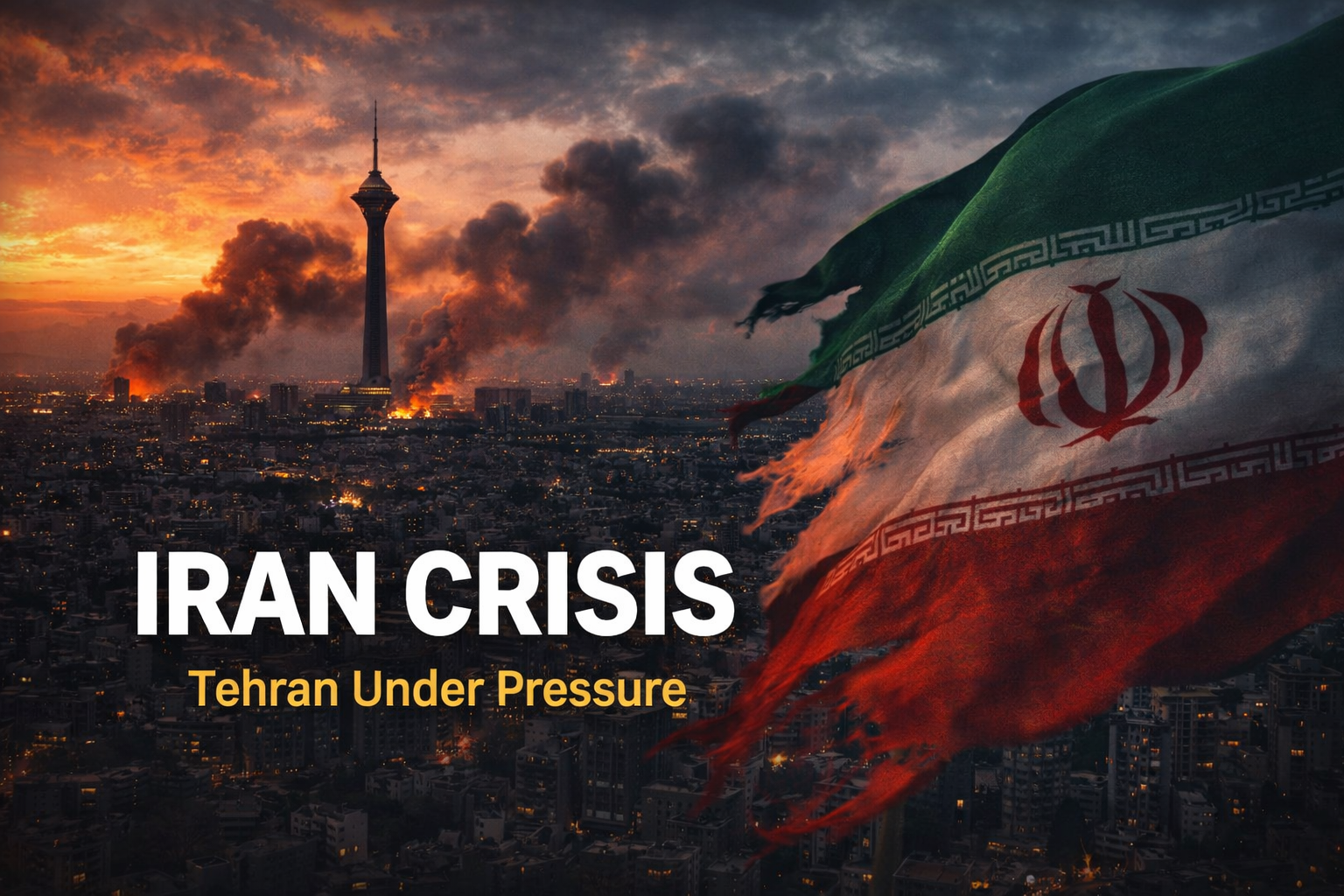
History offers warnings. Iraq, Libya, and Syria show what happens when states fracture and why Iran would be different in ways that should terrify the world
The Question the World Is Afraid to Ask
For decades, the dominant question in Western foreign policy regarding Iran was how to change the behaviour of the Islamic Republic — through sanctions, diplomacy, covert action, and the threat of military force. The question assumed that the Islamic Republic would endure: that the task was management of a hostile but stable state, not preparation for what would follow its potential collapse.
That assumption is now under active revision. The assassination of Supreme Leader Ali Khamenei — whether by Israeli intelligence, American action, or internal actors — and the resulting power vacuum at the apex of the Iranian state has forced a question that governments, intelligence agencies, and strategic analysts have been reluctant to ask seriously: what actually happens if the Islamic Republic collapses?
The reluctance was understandable. Asking the question implies preparing for an answer, and the answer — based on the accumulated evidence of every comparable state collapse in the modern Middle East — is extraordinarily alarming. The fall of the Islamic Republic would not be a transition to democracy, a liberation of the Iranian people from theocratic rule, or a strategic windfall for the United States and Israel. It would be, if the historical pattern holds, the beginning of something worse.
The most dangerous moment in the life of an authoritarian state is not its period of maximum repression. It is the moment when the repressive apparatus begins to lose coherence — when the question of who controls the guns becomes genuinely uncertain.
This analysis does not predict the collapse of the Islamic Republic. Iran is a state of 90 million people, with deep institutional roots, a sophisticated military and security apparatus, and a political class that has demonstrated — through the 2009 Green Movement, the 2019 fuel protests, the 2022 Mahsa Amini uprising, and multiple other challenges — a formidable capacity for survival. What it does is examine, with rigorous reference to the most relevant historical comparisons, what the collapse of comparable states has produced — and what makes Iran structurally different in ways that could make its collapse either more contained or more catastrophic than anything the region has yet witnessed.
Section I: Why Regime Collapse Often Triggers State Collapse
The distinction between regime collapse and state collapse is one of the most important in modern political science, and one of the most consistently misunderstood by the political leaders who make decisions about intervention, sanctions, and the promotion of political change.
A regime is the specific governing arrangement — the ruling party, the leader, the constitutional framework, the ideological identity — that controls state power at a given moment. A state is the broader institutional infrastructure — the civil service, the military, the judiciary, the tax collection apparatus, the public utilities, the institutions of education and public health — that makes organised social life possible. In mature democracies, regime change is routine: governments fall, parties lose elections, constitutions are amended, and the state apparatus continues to function. The state outlasts any particular regime.
In authoritarian states — particularly those that have used the state apparatus as an instrument of regime survival — this distinction breaks down. The Baath Party in Iraq had spent decades embedding party loyalists throughout the Iraqi state. The Gaddafi regime in Libya had deliberately hollowed out state institutions to prevent any power centre from emerging that might challenge the Leader’s personal authority. The Assad regime in Syria fused the security apparatus so completely with the structures of state governance that it became impossible to separate regime from state without destroying both.
The Patrimonialisation Problem
Political scientists call this process patrimonialisation — the transformation of public institutions into instruments of personal or factional rule. Patrimonialised states are extraordinarily resilient as long as the ruler maintains the loyalty of the key institutional actors, because the entire institutional apparatus is oriented toward regime survival rather than public service. But they are uniquely fragile at the moment of transition, because the institutions that should manage succession and political change have been deliberately designed not to function independently of the ruler.
When a patrimonialised regime collapses, what collapses with it is not just the government but the entire institutional infrastructure that has been reorganised around regime service. The army fragments into factional militias. The civil service disintegrates as its members flee or realign with competing successor factions. The judiciary loses its authority. The police dissolve into local power structures. And the resulting vacuum attracts external actors — regional powers, terrorist organisations, criminal networks — who fill the governance void with their own purposes.
This is the pattern that Iraq, Libya, and Syria all exemplify, in different ways and with different specific causes, but with a consistency that amounts to a structural warning: regime collapse in the modern Middle East does not produce democratic transitions. It produces state fragmentation, militia proliferation, sectarian and ethnic conflict, humanitarian catastrophe, and regional destabilisation that takes years or decades to resolve — if it resolves at all.
Section II: Iraq — The Catastrophe of Deliberate Dismantlement
The Decision That Changed Everything
The United States invaded Iraq in March 2003 with three claims: that Iraq possessed weapons of mass destruction, that there were links between Saddam Hussein’s regime and al-Qaeda, and that the removal of Saddam would produce a democratic Iraq that would transform the Middle East. None of these claims was accurate. But even if they had been, the strategic failure that followed was not primarily caused by the falsity of the casus belli. It was caused by two administrative decisions made in the weeks after Baghdad fell that destroyed the institutional infrastructure of the Iraqi state almost as thoroughly as the invasion itself had destroyed its military.
L. Paul Bremer, the head of the Coalition Provisional Authority, issued two orders in May 2003 that are now recognised as among the most consequential policy mistakes in modern American history. CPA Order Number 1 — de-Baathification — removed from their positions all members of the top four tiers of Baath Party membership throughout the Iraqi government. CPA Order Number 2 dissolved the Iraqi army, the Ministry of Defence, the Ministry of Interior, and all other security services, immediately and without transition arrangements.
What De-Baathification Destroyed
The logic of both orders was superficially coherent: the Baath Party was Saddam’s instrument of control, and the security services were the mechanisms of his repression. Removing them would clear the way for a clean democratic transition. What this logic missed was that the Baath Party had been the administrative backbone of the Iraqi state for thirty-five years. Teachers, engineers, doctors, civil servants, and administrators throughout the country had joined the party as a career requirement, not a political commitment. De-Baathification did not purge Saddam loyalists from the state. It purged the state of its administrative competence.
The dissolution of the Iraqi army was even more consequential. At a stroke, approximately 400,000 trained, armed, male soldiers were stripped of their employment, their status, their pensions, and their institutional identity. Many were Sunni Arabs from the western provinces that had been the military’s traditional recruitment base. They were not disarmed — they retained their personal weapons and access to a country saturated with military hardware. They were simply told they no longer had jobs.
Within eighteen months of the invasion, the armed insurgency that would eventually become the Islamic State was drawing its military leadership almost entirely from the officer corps of the dissolved Iraqi army. The United States had, with administrative efficiency, manufactured its own most dangerous adversary.
The Sectarian Inheritance
The political vacuum left by de-Baathification was filled by sectarian and ethnic political parties — Shia Islamist parties closely aligned with Iran, Kurdish nationalist parties with their own security forces (the peshmerga) and territorial ambitions, and a Sunni Arab political class that had been effectively excluded from the new political order. The 2005 constitution entrenched this sectarian arithmetic in the state’s institutional architecture — a confessional allocation of top positions that ensured the perpetuation of sectarian competition rather than its management.
The consequences unfolded with terrible logic: the 2006-2007 sectarian civil war, which brought Baghdad to the brink of full partition; the emergence of al-Qaeda in Iraq and its metamorphosis into the Islamic State; the capture of Mosul in June 2014 by an ISIS force that routed two entire Iraqi army divisions whose soldiers simply fled rather than fight for an institution they had no loyalty to; and the retaking of Mosul in 2016-17 in the most destructive urban warfare since the Second World War.
Twenty years after the invasion, Iraq functions as a state — it holds elections, manages oil revenues, and maintains a government — but it does so in permanent tension between Iranian influence through Shia political parties and militias, Kurdish semi-independence in the north, and a Sunni population that remains politically marginalised and economically underdeveloped. It is a cautionary tale about what happens when the institutional infrastructure of a state is deliberately dismantled faster than anything can be built to replace it.
Section III: Libya — Fragmentation Without a Centre
Gaddafi’s Deliberately Hollowed State
If Iraq’s collapse was a catastrophe of deliberate dismantlement from outside, Libya’s is a catastrophe of deliberate hollowing from inside. Muammar Gaddafi ruled Libya for 42 years by a strategy of systematic institutional destruction: he dissolved every independent power centre, abolished political parties, emasculated the military, and replaced all formal institutions with a labyrinthine system of revolutionary committees, tribal patronage networks, and oil-revenue distribution that concentrated all real authority in his personal control.
His explicit political theory — the Third Universal Theory articulated in the Green Book — rejected both capitalism and communism in favour of a ‘Jamahiriya’: a state of the masses governed through direct democracy. In practice, it was a state of one man, governed through the deliberate prevention of any institution from developing the capacity to function independently of him. When Gaddafi fell, there was nothing left to fall back on.
What NATO’s Intervention Left Behind
The NATO air campaign of 2011 — authorised by UN Security Council Resolution 1973 to protect civilians from Gaddafi’s forces during the Arab Spring uprising — achieved its immediate humanitarian objective: it prevented the assault on Benghazi that Gaddafi had publicly promised would leave no mercy for its inhabitants. But the campaign went beyond its UN mandate to become a regime-change operation, and when Gaddafi was captured and killed in October 2011, no plan existed for what would follow.
What followed was the rapid fragmentation of Libya into a patchwork of competing armed groups: the remnants of Gaddafi’s tribal militias, the revolutionary brigades that had fought to overthrow him, Islamist militias with various degrees of affiliation to al-Qaeda and ISIS, and the military forces of two rival governments — one based in Tripoli in the west, one in Tobruk in the east — each claiming to be the legitimate successor to the Libyan state.
The weapons from Gaddafi’s enormous arsenal — stockpiled over decades of oil wealth-funded arms purchases — flooded across North Africa and the Sahel, fuelling conflicts in Mali, Niger, Chad, and beyond. The migration routes through Libya became the primary pathway for millions of migrants and refugees attempting to reach Europe, generating a humanitarian crisis on the Mediterranean that has directly shaped European politics for the past decade. ISIS established a Libyan franchise in the coastal city of Sirte that required a US-supported military campaign to dislodge in 2016.
The Frozen Conflict
Libya in 2026 remains a frozen conflict — not resolved, not escalating, but not stabilised. The Government of National Unity in Tripoli controls the west; the Libyan National Army under Khalifa Haftar controls the east. Turkey backs the Tripoli government with military forces; Russia’s Wagner Group (now operating under different branding post-Wagner mutiny) backs Haftar. The oil facilities that are Libya’s primary economic asset are periodically seized by one faction or another as leverage in political negotiations. The Libyan state, in any meaningful sense, does not exist.
The Libya case offers a specific warning for Iran: what happens when regime collapse occurs in a country where the regime has, by design, prevented the development of any institutional alternative. Libya had no army, no civil service, no functioning judiciary, and no civil society capable of managing a transition. It had only militias, oil money, and the memory of a regime that had told its people for forty years that institutions were the enemy of authentic governance.
Section IV: Syria — Regime Survival Through Catastrophe
The Road Not Taken
Syria offers the third historical template, and in some respects the most relevant one for Iran: not collapse but survival through catastrophe. The Assad regime faced the same Arab Spring uprisings that toppled Ben Ali in Tunisia, Mubarak in Egypt, and Gaddafi in Libya. It survived — at a cost that is almost beyond comprehension.
The Syrian civil war, which began in 2011 and has not formally ended, has produced the largest humanitarian catastrophe of the twenty-first century: approximately 600,000 deaths, the displacement of more than 13 million people (over half the pre-war population), the destruction of major cities, the reduction of the Syrian economy to approximately one-fifth of its pre-war size, and the creation of a power vacuum that attracted every major regional and global actor — Iran, Russia, Turkey, the United States, Saudi Arabia, Qatar, Israel, and al-Qaeda and ISIS — into a proxy conflict of extraordinary complexity and destructiveness.
How Assad Survived
The Assad regime survived where Gaddafi did not for a specific reason: it had, unlike Libya, maintained functional state institutions. The Syrian Arab Army — though weakened, desertions-ridden, and dependent on Iranian and Russian support — remained a coherent enough force to hold the state’s key population centres. The civil service continued to function in regime-controlled areas. The security apparatus, though brutal beyond any international legal standard, retained its institutional coherence.
This institutional resilience allowed Assad to pursue a strategy of siege, starvation, and aerial bombardment of opposition-held areas that gradually, at enormous human cost, retook the territory lost in the early years of the uprising. Russian air power from 2015 and Iranian ground forces and proxy militias were the decisive external factors that enabled regime survival — but they could only be effective because there was a functioning, if battered, state structure for them to support.
The lesson of Syria is not that regime survival is preferable to regime collapse. It is that the choice is often between catastrophic collapse and catastrophic survival — and that the populations of the country in question bear the entire cost of both outcomes.
The Fragmented Outcome
The Syria that emerged from a decade of civil war is not the Syria that entered it. Assad controls approximately 70% of the country’s territory, but large areas of the north and northeast remain outside Damascus’s authority — Turkish-backed Syrian opposition forces in the northwest, Kurdish-led Syrian Democratic Forces (backed by the United States) in the northeast, and the former HTS-controlled Idlib province, which has now evolved into a new transitional government following the HTS offensive that toppled Assad in late 2024. The country remains de facto partitioned, economically destroyed, and dependent on Iranian and Russian patronage for the Assad government’s continued existence — or the new transitional administration’s efforts to build from the rubble.
Section V: Why Iran Is Structurally Different — And Why That Makes It More Dangerous
The Institutional Depth of the Islamic Republic
Iran is not Iraq, Libya, or Syria. Understanding why is the most important analytical task in assessing what follows the current crisis, and the most important corrective to the optimism that sometimes characterises Western commentary on Iranian political change.
The Islamic Republic of Iran has, over 47 years of existence, built one of the most institutionally sophisticated authoritarian systems in the world. Unlike Gaddafi’s Libya, which deliberately prevented any institution from developing independent capacity, the Islamic Republic has created a dense ecosystem of parallel institutions — the Revolutionary Guards alongside the regular military, the Basij alongside the police, the bonyads (revolutionary foundations) alongside the formal economy, the velayat-e faqih (guardianship of the jurist) alongside the formal constitutional order — each reinforcing the others and each oriented around a specific constituency within the Islamic Republic’s political base.
The Islamic Revolutionary Guard Corps alone is not merely a military force. It is a political actor, an economic empire (controlling an estimated 20-40% of the Iranian economy through affiliated companies and foundations), an intelligence apparatus, a foreign policy instrument (through the Quds Force and its network of regional proxies), and the most potent armed force in the country. It has its own air force, navy, missile force, and ground forces — parallel to and in practice more powerful than the regular military.
The Nuclear Dimension
Iran also possesses something that Iraq, Libya, and Syria did not: an advanced nuclear programme. At the time of the current crisis, Iran’s uranium enrichment programme has reached levels of purity — approximately 60%, with the technical capacity to move quickly to weapons-grade 90% — that put it within weeks of a breakout capability if a political decision were made to proceed. The fate of Iran’s nuclear material, expertise, and infrastructure in a scenario of state collapse is one of the most alarming questions in contemporary non-proliferation policy.
A fragmenting Iran, with competing factions each seeking to control or weaponise nuclear assets, represents a proliferation scenario without precedent. The IRGC’s missile forces — which control the delivery systems for any future nuclear weapon — could become an independent actor in a collapse scenario, operating without civilian governmental oversight and potentially offering their capabilities to the highest bidder or the most committed ideological successor movement. The parallel with the dissolution of the Soviet Union’s nuclear arsenal — which required extraordinary diplomatic and financial effort by the United States to manage — does not adequately capture the danger, because unlike the Soviet successor states, Iran has no institutional framework for nuclear responsibility and no Western power with the leverage to enforce it.
The Proxy Network Problem
Iran’s network of regional proxies — Hezbollah in Lebanon (severely degraded but not destroyed), the Houthi movement in Yemen, various Iraqi Shia militia groups, Palestinian Islamic Jihad, and smaller affiliates across Syria, Bahrain, and elsewhere — represents a second structural difference from the Iraq, Libya, and Syria cases. These groups have their own organisational coherence, their own sources of funding (including significant criminal enterprises in drug trafficking, money laundering, and weapons dealing), and their own ideological commitments that do not depend entirely on direction from Tehran.
In a scenario of Iranian state collapse or severe fragmentation, these groups would not simply dissolve. They would become autonomous actors in their own right, pursuing their own agendas with the weapons, training, and organisational capacity that Iranian support has given them — but without the constraints that Iranian state-level calculations have sometimes imposed. Hezbollah’s residual capacity, Houthi control of significant Yemeni territory, and the PMF militias’ deep integration into Iraqi political and security structures would all persist and potentially intensify in a power vacuum.
The Strait of Hormuz
Perhaps the most globally consequential structural difference between Iran and its historical comparators is geographic and economic: the Strait of Hormuz. Approximately 20% of the world’s oil supply, 30% of global LNG trade, and a significant proportion of global petrochemical exports transit the Strait, which at its narrowest point is 33 kilometres wide and bordered on its northern shore by Iranian territory. Iran has long maintained the capability and the stated willingness to close the Strait in the event of military conflict — through mine-laying, anti-ship missile deployments, and the use of IRGC fast-boat swarms.
In a scenario of internal conflict or state fragmentation, the question of who controls the Iranian shoreline of the Strait of Hormuz and what they choose to do with that control becomes one of the most urgent strategic questions in the global economy. Even a temporary closure or credible threat of closure would send oil prices to levels that would trigger global recession. The deliberate or accidental interdiction of tanker traffic by non-state actors operating from Iranian territory without governmental authority or constraint would represent a new category of economic warfare for which the international community has no established response doctrine.
Section VI: Four Possible Futures for Iran
With those structural factors as the analytical foundation, four distinct scenarios can be identified for Iran’s political trajectory following the current crisis. These are not predictions — the Iranian political system is opaque, the relevant actors are numerous and their calculations are hidden, and the range of possible outcomes is genuinely wide. They are frameworks for thinking about what different outcomes would mean for the region and the world.
| SCENARIO 1 · PROBABILITY: MODERATE MANAGED SUCCESSION — THE SYSTEM HOLDS The Islamic Republic’s succession mechanisms — the Assembly of Experts, the Guardian Council, the IRGC’s institutional weight — produce a new Supreme Leader who commands sufficient legitimacy within the system to maintain institutional coherence. The transition is contested but ultimately managed within the existing constitutional framework. Iran emerges weakened, more pragmatic on the nuclear question due to the devastation of its external infrastructure, but as a functioning state. Key risks: → The IRGC’s factional interests may not align with a constitutionally legitimate succession — the institution may prefer a weak successor it can dominate to a strong one it cannot control. → Popular pressure for political reform may make the system’s traditional mechanisms inadequate — a successor who satisfies the establishment may not satisfy the streets. → Economic devastation from sanctions, war damage, and capital flight may make governing even a politically stable Iran extremely difficult. → External actors — Israel, Saudi Arabia, the United States — may prefer continued pressure to consolidation, preventing the stabilisation this scenario requires. |
| SCENARIO 2 · PROBABILITY: MODERATE TO HIGH IRGC TAKEOVER — PRAETORIAN STATE The IRGC, the most institutionally coherent and economically powerful actor in the Iranian state, effectively takes control of the transition — installing a Supreme Leader it controls or governing through a collective body in which IRGC commanders hold decisive power. The Islamic Republic continues in formal structure but becomes essentially a military state with theocratic branding. Key risks: → An IRGC-dominated state would face immediate questions about nuclear weapons development — the military logic of acquisition is strong, and civilian moderating voices would be absent. → IRGC control of Iran would foreclose diplomatic engagement with the West, making sanctions permanent and the economic situation catastrophic. → The IRGC’s factional divisions — between pragmatists and ideological hardliners, between those with economic interests to protect and those with ideological commitments to pursue — could produce internal conflict rather than cohesive governance. → An overt military takeover would likely trigger further military action by Israel and the United States, potentially preventing this scenario from stabilising. |
| SCENARIO 3 · PROBABILITY: MODERATE FRAGMENTATION — THE LIBYAN TEMPLATE The Islamic Republic fractures along regional, ethnic, and factional lines — with Kurdish groups in the northwest, Arab populations in Khuzestan, Baluch groups in the southeast, and IRGC factional militias all asserting territorial control. No single successor emerges with authority over the whole. Iran becomes, like Libya, a fragmented state with competing power centres, no central government with genuine authority, and an ongoing low-intensity civil conflict. Key risks: → This scenario poses the most acute nuclear proliferation risk — multiple competing factions, each potentially with access to components of the nuclear programme, none with the institutional accountability that formal state structures provide. → The Strait of Hormuz in this scenario could become ungovernable — with competing armed factions controlling different sections of the Iranian coastline. → Iran’s proxy network would fragment into autonomous actors, each pursuing their own agendas without the constraints of Iranian state-level calculations. → A fragmented Iran would become the largest and most consequential failed state in modern history — dwarfing Libya in population, strategic importance, and potential for regional contagion. |
| SCENARIO 4 · PROBABILITY: LOW TO MODERATE REVOLUTIONARY TRANSITION — THE OPTIMISTIC SCENARIO A broad-based popular movement — drawing on the accumulated grievances of the 2009, 2019, and 2022 uprisings, and empowered by the crisis of regime legitimacy following the Supreme Leader’s death — produces a genuine political transition toward a more representative government. A coalition of reformists, technocrats, diaspora Iranians, and pragmatic members of the existing establishment manages a negotiated transition that preserves institutional continuity while fundamentally changing the political system. Key risks: → Iran has no history of managed democratic transition. Every previous political rupture has been followed by the consolidation of a new authoritarian system — the 1979 revolution replaced the Shah’s authoritarianism with the Islamic Republic’s, which proved more durable. → The IRGC’s economic and political interests are incompatible with genuine democratic governance — a transition government would face immediate pressure from the military to limit the scope of reform. → The speed and severity of the current crisis may not allow the gradual coalition-building that a managed transition requires. → This scenario is the one that Western governments would most prefer — which means it is the one most likely to be undermined by the contradictions between Western rhetorical support for Iranian democracy and the strategic interests of actors who prefer a weak Iran to a stable one. |
The Comparison: Iran Against the Historical Template
The table below compares Iran’s structural characteristics against the three historical cases examined in this analysis — across the dimensions that most reliably predict the character and severity of post-regime instability.
| IRAQ 2003 | LIBYA 2011 | SYRIA 2011 | IRAN (POTENTIAL) | |
| Collapse trigger | External military invasion | NATO air campaign + rebel uprising | Internal uprising, external proxy war | Elite fracture / external strikes / internal uprising |
| State institutions pre-collapse | Intact but Baath-dependent | Weak, heavily personalised | Relatively strong, regime-loyal | Strong, deep, ideologically embedded |
| Armed non-state actors | Created by de-Baathification | Multiple, regionally fragmented | Multiple, externally supported | Pre-existing; IRGC, Basij, proxies |
| Nuclear dimension | None (WMD claims were false) | None | None | Advanced enrichment; possible weapons capability |
| Regional spillover | Catastrophic; ISIS, sectarian war | Severe; weapons proliferation, migration | Massive; regional proxy war | Potentially existential; Strait of Hormuz, proxy network fragmentation |
| Current status | Ongoing instability; ISIS residual threat | Failed state; two rival governments | Partial regime survival; fragmented | Unknown — crisis ongoing |
Conclusion: History’s Warning and the World’s Unpreparedness
The history of state collapse in the modern Middle East offers a consistent warning: the fall of an authoritarian regime does not produce political liberation. It produces a power vacuum into which flow the most capable and most ruthless actors — militias, external powers, terrorist organisations, criminal networks — who fill the governance void with their own interests rather than those of the population.
Iraq produced ISIS, the empowerment of Iranian regional influence, and twenty years of sectarian conflict that has not yet resolved. Libya produced a failed state, a humanitarian catastrophe, and a weapons flood that destabilised North Africa and the Sahel. Syria produced the worst humanitarian crisis of the twenty-first century, the most complex proxy war in modern history, and a regional population displacement that has shaped European politics for a decade.
Iran would be different from all three — larger, more institutionally sophisticated, more geopolitically significant, more economically important to the global energy system, and — most alarmingly — nuclear. The scenarios for what follows Iranian regime collapse range from managed succession (the best case, and probably the least likely) to fragmentation (the worst case, and potentially the most likely if the current crisis continues without a clear resolution of the succession question).
What is most alarming about the current moment is not the specific scenario that seems most probable. It is the evidence of how little preparation has been done, by any actor, for any of these scenarios. The United States, whose Iraq experience should have generated the most rigorous post-collapse planning doctrine ever developed, appears no better prepared for the consequences of Iranian state fragmentation than it was for the consequences of de-Baathification in 2003. Israel, which has done more than any other state to create the current crisis through its elimination of Iranian leadership, has no publicly stated plan for what it wants to follow the Islamic Republic. The regional powers — Saudi Arabia, Turkey, the UAE — each have interests in Iranian fragmentation that conflict with each other and with any plausible path to stability.
History does not repeat. But it does, with sufficient consistency, warn. The warning from Iraq, Libya, and Syria is that the day after a regime falls is more dangerous than any day during its tenure — and that the international community has, repeatedly, been comprehensively unprepared for it. Iran is a larger, more complex, and more consequential state than any of its predecessors in the collapse canon. The preparation required is proportionally greater. The evidence that it is happening is, so far, absent.


