


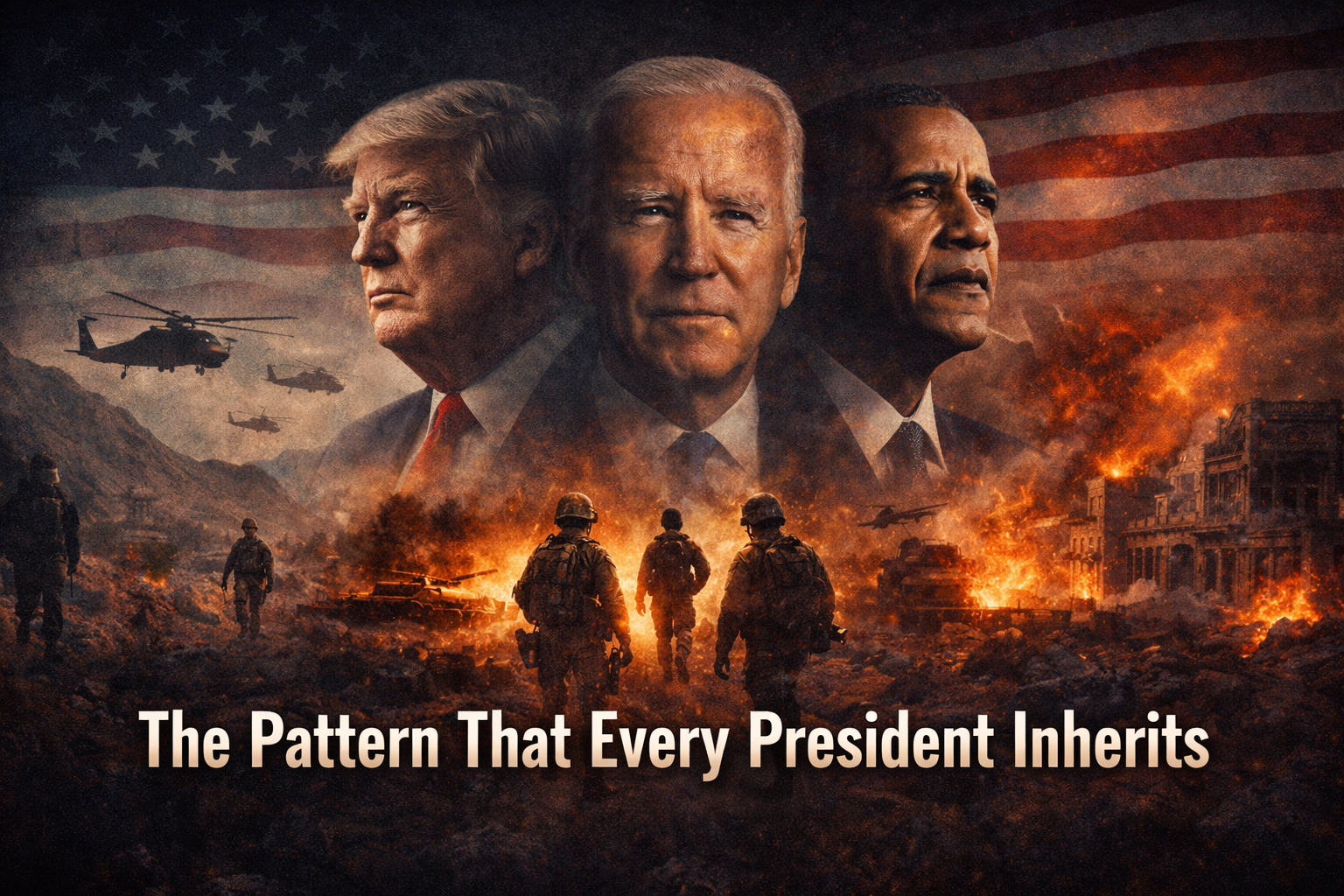
Eight decades of American military intervention, the logic that drives it, the human cost it extracts, and the question no president has answered
The Pattern That Every President Inherits
On 20 January 2017, Donald Trump stood on the steps of the Capitol and delivered an inaugural address that promised, in blunt terms, to end what he called ‘American carnage’ at home and to stop fighting other people’s wars abroad. It was a promise that resonated with tens of millions of Americans who had watched their country spend twenty years and trillions of dollars on wars in Afghanistan and Iraq that had not produced the outcomes promised at the outset.
On 20 January 2021, Joe Biden stood in the same spot and promised a return to American global leadership — to alliances, multilateralism, and the international order that Trump had questioned. He then proceeded, in August of that year, to complete the withdrawal from Afghanistan that Trump had begun, producing scenes of chaos at Kabul airport that became one of the defining images of American foreign policy in the twenty-first century.
The pattern is instructive. Different presidents, different parties, different ideologies, different rhetorical frameworks — yet the same fundamental questions recur: why does the United States fight so many wars? Why do the results so rarely match the objectives? And why, despite the accumulated evidence of the past eighty years, does each generation of American political leadership arrive at the same destination?
Since the end of World War II in 1945, the United States has been involved in major military conflict in Korea, Vietnam, the Gulf, Iraq, Afghanistan, Libya, and dozens of smaller operations across four continents. No other country in the modern era comes close to that record of sustained military engagement.
This is not a polemic against American military power, which has undeniably served important purposes at important moments in the post-war world. It is an attempt to understand, with historical seriousness and analytical rigour, why the United States has fought so often, what those wars have cost, what they have achieved, and what the pattern tells us about the relationship between military power and political outcomes in the modern world.
Section I: The Architecture of American Military Power
How the United States Became the World’s Policeman
The United States did not emerge from the Second World War intending to become the permanent security guarantor of the international system. It emerged from that war as the world’s dominant economic and military power — the only major combatant whose industrial base had not been destroyed, the possessor of the world’s only nuclear arsenal, and the architect of the post-war international institutional order, from the United Nations to the Bretton Woods financial system.
But the logic of that position created commitments that proved extraordinarily difficult to contain. The Truman Doctrine of 1947, which pledged American support to free peoples resisting subjugation by outside pressures, was conceived as a response to the specific circumstances of Greece and Turkey. It became, within a decade, the intellectual foundation for American military engagement across four continents. The containment strategy articulated by diplomat George Kennan — originally conceived as a political and economic strategy for frustrating Soviet expansion — was militarised almost immediately into a commitment to resist communist advances wherever they occurred.
The physical infrastructure of that commitment is staggering in its scale. The United States currently maintains approximately 750 military bases in more than 80 countries — a global military footprint that dwarfs that of any other power in history. It operates eleven carrier strike groups capable of projecting lethal force to any point on the globe within days. It maintains alliance commitments, through NATO and bilateral treaties, that obligate it to the defence of over 50 countries. No other nation has ever built or sustained a military establishment of this global reach.
| 750+ US military bases in more than 80 countries worldwide No other nation in history has maintained a comparable global military footprint. The United States spends more on defence than the next ten countries combined. |
This infrastructure did not create American interventionism by itself. But it created the capability and the institutional habit of intervention — a military establishment, an intelligence apparatus, and a diplomatic system all oriented toward global engagement, all generating their own institutional momentum toward the use of the tools they had been built to employ.
Section II: The Cold War Interventions — Korea and Vietnam
Korea: The War That Defined the Template
The Korean War, which began in June 1950 when North Korean forces crossed the 38th Parallel in a Soviet-backed invasion of South Korea, established the template for American military interventionism that would define the next seven decades. It was the first test of the containment doctrine in military form, the first time American forces fought under a multilateral framework (the UN Command), and the first time the United States fought a war to a draw rather than a victory.
The military intervention was rapid and initially successful — General Douglas MacArthur’s Inchon landing in September 1950 reversed the North Korean advance and drove UN forces to the Yalu River. Then China intervened, driving UN forces back south in what became the longest retreat in American military history. The war stabilised roughly where it had started, and an armistice was signed in July 1953 — not a peace treaty, as the peninsula technically remains at war today.
| COLD WAR · 1950–1953 Korean War HUMAN COST ~5 million total (military and civilian, all sides) FINANCIAL COST ~$400 billion (2021 dollars) VERDICT STRATEGIC DRAW |
Korea’s enduring strategic significance is more often noted than understood. South Korea is today one of the world’s most prosperous democracies, with a GDP exceeding $1.7 trillion and a per capita income comparable to many European nations. The contrast with North Korea — one of the world’s most repressive and economically devastated states — is a striking argument for the value of the intervention. But the Korean War also established patterns that would prove costly in later conflicts: the assumption that American military power could reshape the politics of Asian states, the difficulty of defining victory against an adversary willing to absorb enormous casualties, and the willingness of great powers to intervene on behalf of local clients in ways that transformed local conflicts into superpower confrontations.
Vietnam: Where the Template Broke
Vietnam was Korea’s nightmare iteration — the same containment logic, the same commitment to preventing communist takeover of a divided nation, applied to a conflict whose political, cultural, and strategic dynamics were fundamentally different, and prosecuted with a combination of hubris, institutional self-deception, and civilian-military dysfunction that produced one of the most consequential strategic failures in American history.
The United States’ involvement in Vietnam deepened gradually across four presidencies — Eisenhower’s advisory mission, Kennedy’s expansion of that mission, Johnson’s escalation to full-scale conventional warfare, and Nixon’s long, bloody withdrawal strategy. At its peak in 1969, the United States had approximately 543,000 troops in Vietnam. It dropped more bombs on Vietnam, Laos, and Cambodia than were dropped by all sides in the entire Second World War. It spent an estimated $840 billion in 2021 dollars on the conflict.
| COLD WAR · 1955–1975 Vietnam War HUMAN COST ~3.5 million total deaths, including approximately 58,000 American military fatalities and up to 2 million Vietnamese civilians FINANCIAL COST ~$840 billion (2021 dollars) VERDICT STRATEGIC DEFEAT |
It lost. Saigon fell on 30 April 1975. The reunification of Vietnam under communist rule was completed by July 1976. The strategic objective for which 58,000 Americans and approximately three million Vietnamese had died was not achieved.
What Vietnam demonstrated — conclusively, at enormous cost — was the limit of military power as an instrument of political transformation. The United States possessed overwhelming firepower, air supremacy, logistical capacity, and economic resources. Its adversary possessed none of these things in comparable measure. Yet the political will, popular legitimacy, and ideological coherence of the North Vietnamese and Viet Cong forces, combined with the fundamental illegitimacy of the South Vietnamese government it was fighting to preserve, negated every material advantage.
Vietnam was not a military failure. American forces won virtually every major engagement. It was a political failure — the recognition, too late and at too great a cost, that military victory and political success are not the same thing.
Section III: The Post-Cold War Era — Gulf, Iraq, Afghanistan, Libya
The Gulf War: The Model That Could Not Be Repeated
The Gulf War of 1990–91 appeared, at first, to vindicate the utility of American military power as a tool of international order. Iraq’s invasion of Kuwait in August 1990 was a clear violation of international law, condemned by the UN Security Council. The US-led coalition assembled to reverse it was genuinely multilateral, including Arab states alongside Western powers. The military operation was swift, devastating, and precisely bounded — coalition forces liberated Kuwait in approximately 100 hours of ground combat and then stopped, as the UN mandate required, at the Iraqi border.
| POST-COLD WAR · 1990–1991 Gulf War (Operation Desert Storm) HUMAN COST ~25,000–35,000 Iraqi military dead; 147 American fatalities FINANCIAL COST ~$61 billion (1991), largely reimbursed by Gulf state partners VERDICT LIMITED OBJECTIVE ACHIEVED |
The decision not to advance to Baghdad — controversial at the time, condemned loudly by some after the fact — was, by the standards of the subsequent decade, one of the most strategically sound decisions in American post-war history. President George H.W. Bush and his National Security Advisor Brent Scowcroft both later wrote that they had deliberately not pursued the overthrow of Saddam Hussein because they could not see a stable political outcome on the other side. That restraint was vindicated comprehensively by what happened when their successors made the opposite choice.
Iraq: The War That Changed Everything
The 2003 invasion of Iraq was predicated on three claims: that Iraq possessed weapons of mass destruction, that there were links between Saddam Hussein’s regime and al-Qaeda, and that the removal of Saddam would produce a democratic Iraq that would transform the broader Middle East. None of these claims was accurate. The WMD did not exist. The al-Qaeda connection was fabricated or grossly exaggerated. And the aftermath of the invasion produced not a democratic transformation but a catastrophic sectarian civil war, the emergence of the Islamic State, and a regional power vacuum that Iran was the principal beneficiary of.
| POST-COLD WAR · 2003–2011 (US combat operations); ongoing instability Iraq War (Operation Iraqi Freedom) HUMAN COST Estimates range from 151,000 to over 600,000 Iraqi civilian deaths (Iraq Body Count to Lancet study); 4,431 American military fatalities FINANCIAL COST ~$2.4 trillion (Brown University Costs of War Project, including long-term veteran care) VERDICT STRATEGIC CATASTROPHE |
The Iraq War’s consequences continue to reshape the Middle East nearly two decades later. The de-Baathification policy — the dissolution of the Iraqi army and the exclusion of Baath Party members from the new state — created hundreds of thousands of trained, armed, unemployed, and politically marginalised Sunni men who became the recruitment base for the Islamic State. The empowerment of Iraq’s Shia majority created a Baghdad government closely aligned with Tehran, dramatically expanding Iranian influence in the Arab world. The demonstration that the United States would remove governments it disliked, combined with the evidence that possession of WMD might have deterred the invasion, created a powerful incentive for states like North Korea and Iran to accelerate their nuclear programmes.
Afghanistan: The Longest War
The invasion of Afghanistan in October 2001 — in direct response to the September 11 attacks — had a clearer casus belli and broader international legitimacy than almost any American military action since Korea. The Taliban government had provided sanctuary to al-Qaeda, refused to surrender Osama bin Laden after the attacks, and was removed from power within weeks by a combination of American airpower, special forces, and Northern Alliance ground forces.
What followed was twenty years of nation-building, counter-insurgency, and gradually escalating military commitment, ending with the chaotic withdrawal of August 2021 and the Taliban’s return to power within days of the last American aircraft departing Kabul. The longest war in American history — longer than World War I, World War II, and Korea combined — ended precisely where it had begun: with the Taliban controlling Afghanistan.
| POST-9/11 · 2001–2021 War in Afghanistan HUMAN COST Over 176,000 deaths including 47,245 Afghan civilians, 2,448 US military, and 66,000+ Afghan national security forces (Brown University) FINANCIAL COST ~$2.3 trillion direct costs; $2.6 trillion including veteran care and interest (Brown University Costs of War) VERDICT TOTAL STRATEGIC FAILURE |
The Afghanistan failure was not primarily military. American and NATO forces were consistently superior in every engagement. It was a failure of political imagination — the inability to build a political settlement that could survive the withdrawal of external force, to create Afghan state institutions with genuine legitimacy and capacity, and to understand that the Taliban’s capacity for resilience was ultimately a function of its rootedness in Afghan society in ways that the Kabul government never was.
Libya: The Intervention That Created a Failed State
The 2011 intervention in Libya — authorised by UN Security Council Resolution 1973 to protect civilians from Muammar Gaddafi’s forces during the Arab Spring uprising — began as a humanitarian operation and became a regime change mission that its legal mandate did not authorise. Gaddafi was removed and killed. No plan for what followed was developed or implemented. Libya became a failed state, divided between competing governments and militias, and a major transit route for migrants and weapons that destabilised the broader region.
| POST-COLD WAR · 2011 (NATO air campaign); ongoing civil war Libya Intervention (Operation Unified Protector) HUMAN COST Estimated 10,000–25,000 deaths during the civil war; continued casualties in subsequent conflict FINANCIAL COST ~$1.1 billion (US share of NATO operation) VERDICT CREATED FAILED STATE |
Section IV: The True Cost — Human and Financial
The Brown University Watson Institute’s Costs of War Project has produced the most comprehensive independent accounting of the human and financial costs of America’s post-9/11 wars. Its findings are, even for those familiar with the general contours of the debate, staggering.
| $8 TRILLION+ Total estimated cost of US post-9/11 wars (Afghanistan, Iraq, Pakistan, Syria and related operations) Brown University Costs of War Project, 2021. This figure includes direct military costs, State Department and USAID spending, Homeland Security costs, veteran care through 2050, and interest on war debt. It does not include the economic costs to affected countries or the global macroeconomic impacts. |
| 900,000+ Direct deaths in post-9/11 war zones, including military, police, contractors, journalists, and aid workers Brown University Costs of War Project. This figure is a conservative direct count. Indirect deaths from conflict-related causes — disease, displacement, destroyed infrastructure — are estimated at three to four times this number. |
| 38 MILLION People displaced from their homes by post-9/11 US wars in Afghanistan, Pakistan, Iraq, Libya, Syria, and related conflicts Brown University Costs of War Project. The displacement figure includes both internal displacement and refugees — one of the largest forced displacement events since World War II. |
These figures represent only the direct costs of the post-9/11 wars. They do not include the costs of the Korean War, the Vietnam War, or the dozens of smaller interventions — Panama, Grenada, Haiti, the Balkans — that punctuate the post-war record. The full accounting of American military intervention since 1945, measured in lives and dollars, is of an order of magnitude that the American public has rarely been asked to confront in its totality.
Section V: Why the System Keeps Producing War
The Institutional Logic of Intervention
One of the most important and least discussed facts about American foreign policy is how little it changes between administrations. Presidents campaign on strategic transformation — Trump on ending ‘stupid wars’, Obama on withdrawing from Iraq, Bush on a ‘humble foreign policy’ without nation-building — and govern in far greater continuity with their predecessors than their rhetoric suggests. This is not hypocrisy or weakness. It reflects the structural reality that American foreign policy is made not primarily by presidents but by the permanent national security establishment: the State Department, the Pentagon, the intelligence community, the network of think tanks and academic institutions that populate those bureaucracies.
This establishment — sometimes called the ‘Blob’ by its critics, including officials within the Obama administration — has its own institutional culture, its own career incentives, its own theory of American interests and America’s role in the world. It is generally bipartisan in its commitment to American global leadership, to forward military deployments, and to the view that American security requires active management of the global environment rather than retreat from it. Presidents can override this establishment on specific decisions, but they rarely restructure its fundamental assumptions.
The Military-Industrial Complex: Still Relevant
President Eisenhower’s 1961 warning about the military-industrial complex — the self-reinforcing relationship between the defence industry, the military, and the political system — has become so frequently cited as to risk losing its analytical force. But the underlying dynamic he identified remains structurally significant. The United States defence industry employs approximately 2.5 million people directly and supports millions more in indirect employment. Defence contracts are geographically distributed across congressional districts with mathematical precision. Weapons systems, once funded and contracted, develop their own political constituencies that make them extraordinarily difficult to cancel even when their strategic rationale has evaporated.
The Credibility Trap
Perhaps the most insidious driver of American military intervention is the logic of credibility — the proposition that failure to respond militarily to challenges, provocations, or the collapse of client states will be interpreted by adversaries and allies alike as a signal of weakness that will invite further challenges. This logic drove the escalation in Vietnam beyond any rational connection to American strategic interests — the concern was not Vietnam itself but what withdrawal would signal to Soviet and Chinese clients around the world. It drove the Iraq surge of 2007, the persistence in Afghanistan long after any reasonable assessment of achievable objectives had been abandoned, and the repeated reluctance of administrations to execute withdrawals that their own analysis told them were strategically necessary.
The credibility trap is the most dangerous driver of American military intervention: the belief that withdrawal signals weakness, that weakness invites further challenges, and that therefore every commitment, however ill-conceived, must be sustained — regardless of its costs and regardless of whether it is working.
Section VI: The Verdict — What Did These Wars Actually Achieve?
Assessing the outcomes of American military interventions requires separating the different dimensions of success and failure: immediate military objectives, medium-term political outcomes, long-term strategic results, and unintended consequences. The record, examined on these dimensions, is mixed in ways that resist simple characterisation.
Clear Strategic Successes
The defeat of Imperial Japan and Nazi Germany in World War II stands as the clearest success of American military power — an existential conflict in which the stakes were unambiguous and the outcome decisive. The post-war order that American power helped construct and sustain — NATO, the international financial institutions, the UN framework, the alliance system in the Indo-Pacific — has provided a framework for the longest period of relative great-power peace in modern history. South Korea’s emergence as a prosperous democracy, sustained by American security guarantees since 1953, represents a genuine strategic achievement.
Costly Inconclusive Outcomes
The Gulf War achieved its limited objective — the liberation of Kuwait — at relatively modest cost and with genuinely broad international legitimacy. The 2001 Afghanistan intervention achieved its immediate objective of removing the Taliban from power and degrading al-Qaeda’s organisational capacity, though the failure to capture bin Laden at Tora Bora in December 2001 and the subsequent mission creep into nation-building set the stage for the twenty-year failure that followed.
Strategic Failures with Lasting Consequences
Vietnam, Iraq, and Afghanistan each represent strategic failures whose consequences continue to shape the international environment. Vietnam’s immediate political outcome — communist reunification — was the outcome the intervention was designed to prevent. Its long-term consequence was a reconfiguration of Southeast Asian geopolitics that, paradoxically, left Vietnam as a more significant partner for the United States in its contemporary competition with China than the South Vietnamese client state could ever have been. Iraq created the conditions for the Islamic State and expanded Iranian regional influence in ways that directly threatened American interests. Afghanistan ended with the Taliban in power and with the United States’ regional counter-terrorism infrastructure significantly degraded.
Section VII: What the World Has Learned — and What America Has Not
The historical record of American military intervention generates several conclusions that are, at this point, supported by substantial evidence and that represent the accumulated strategic learning of the post-war era. What is remarkable is how imperfectly this learning has been absorbed into the actual practice of American foreign policy.
— Military power can destroy regimes and defeat conventional armies. It cannot, by itself, build stable political systems, create legitimate governance, or resolve the social and political contradictions that generate insurgency and civil conflict.
— Nation-building — the transformation of post-conflict societies into functioning liberal democracies — requires time measured in generations, not years or presidential terms. American domestic politics, with its four-year electoral cycle and short attention span for foreign commitments, is structurally ill-suited to sustaining the patient, long-term engagement that nation-building requires.
— The definition of achievable objectives before military action begins is not a procedural nicety. It is the most important strategic decision in any military operation, because it determines what success looks like, what resources are required to achieve it, and when the operation can end. Every major American strategic failure in the post-war era has involved the expansion of objectives beyond what military force could realistically achieve.
— Military intervention creates its own logic of escalation that is extraordinarily difficult to reverse once engaged. The credibility trap — the belief that withdrawal signals weakness — has persistently driven the continuation of failed strategies long past the point at which rational reassessment would have produced different decisions.
— The human and financial costs of military intervention fall disproportionately on populations that had no voice in the decision to intervene and no mechanism to hold decision-makers accountable. The asymmetry between the costs borne by the intervened-upon and the costs borne by the intervening state is one of the most significant moral failures of the post-war interventionist record.
Conclusion: Can Military Power Reshape Societies?
The question with which this analysis began — why does the United States fight so many wars, and why do the results rarely last — has an answer that the historical record makes clear, even if American strategic culture continues to resist it.
Military power is extraordinarily good at certain things: destroying enemy forces, seizing territory, deterring adversaries, protecting allies, and demonstrating resolve in ways that shape others’ calculations. It is the most powerful coercive instrument ever developed by human civilisation, and in the hands of the United States it has been deployed with technical sophistication and, at its best, with a degree of restraint that distinguishes it from the military behaviour of most historical great powers.
But military power cannot manufacture political legitimacy, social cohesion, or economic development. It cannot resolve the contradictions within divided societies that make them susceptible to insurgency. It cannot substitute for the political settlements that are the only durable foundation of stable states. And it cannot, in the modern era, deliver the rapid decisive victories that might once have made it a reliable instrument of political transformation — because modern insurgencies, unlike conventional armies, are not defeated by losing battles but only by losing the political conditions that sustain them.
The United States will face choices, in the years ahead, about whether to intervene militarily in crises from the Taiwan Strait to the Middle East to Eastern Europe. Those choices will be made against the backdrop of an $8 trillion bill from the wars of the past twenty-five years, a military that has been shaped by two decades of counter-insurgency into a force whose readiness for great-power conventional conflict is a matter of ongoing concern, and a domestic political environment that is deeply sceptical of further foreign adventures. Whether the lessons of Korea, Vietnam, Iraq, and Afghanistan have been genuinely absorbed — or merely temporarily internalised, to be forgotten when the next crisis demands a military response — is perhaps the most important open question in contemporary American strategy.
Allies or Opportunists? How Global Power Politics Is Reshaping Diplomacy


