


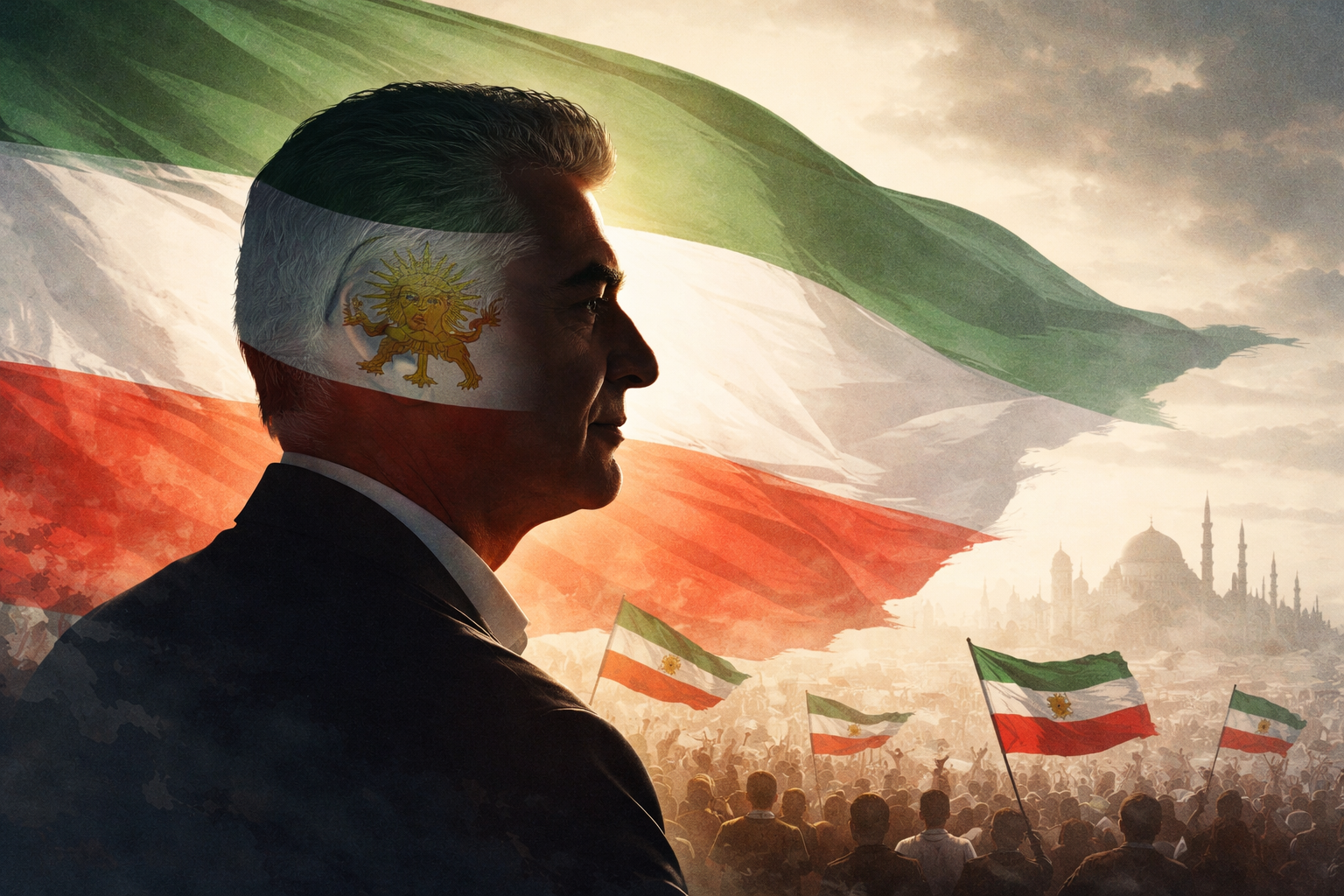
Forty-seven years after the Islamic Revolution, the son of Iran’s last Shah remains one of the most visible and most debated faces of Iranian opposition
“Iran’s political future will not be decided by a single exile figure, but by the complex forces operating inside the country.”
The Weight of a Name
In the decades since the 1979 Islamic Revolution forced the Pahlavi dynasty into exile, Iran’s opposition movement has been characterised by extraordinary diversity, persistent fragmentation, and the recurring difficulty of translating international visibility into political influence inside the country. Within that complex landscape, one figure has consistently attracted attention, admiration, and controversy in roughly equal measure: Reza Pahlavi, born 31 October 1960, the eldest son of Mohammed Reza Shah Pahlavi, Iran’s last monarch.
Reza Pahlavi was eighteen years old when the revolution ended his father’s 37-year reign and sent the royal family into permanent exile. He has spent the intervening decades primarily in the United States — in Bethesda, Maryland — building what he describes as a democratic opposition movement while carefully positioning himself not as a monarchist pretender but as a symbol of secular, democratic, post-Islamic-Republic Iran. He does not claim a throne. He claims, instead, a constituency: the millions of Iranians, inside the country and in the diaspora, who oppose the Islamic Republic and are searching for a viable political alternative.
In the current crisis — following the death of Supreme Leader Ali Khamenei and the acute uncertainty about the Islamic Republic’s political future — his name has again become prominent in international discussions about what might follow. This analysis examines who Reza Pahlavi is, what he represents, where his support lies, what the credible criticisms of his political project are, and what the historical evidence suggests about the realistic prospects of exiled opposition figures exercising political authority when authoritarian regimes fall.
The Fall of the Monarchy: A History That Shapes Everything
The Pahlavi Dynasty and Its Contradictions
To understand Reza Pahlavi’s political position, it is necessary to understand both the achievements and the failures of the dynasty he represents. Mohammed Reza Shah came to power in 1941, initially under British and Soviet pressure following the forced abdication of his father Reza Shah. His reign was characterised by dramatic modernisation — the White Revolution of the 1960s brought land reform, women’s suffrage, literacy campaigns, and rapid industrialisation — and by authoritarian repression through SAVAK, the feared secret police, which systematically suppressed political opposition.
By the late 1970s, the Shah’s Iran was one of the wealthiest and most rapidly modernising countries in the developing world, with a per capita income that had grown dramatically on the back of oil revenues. It was also a country in which political freedoms were severely restricted, in which the gap between a rapidly urbanising middle class and the rural poor had widened dramatically, and in which the Shah’s increasing dependence on American support had generated resentment that cut across ideological lines — from secular nationalists to Marxists to Islamists.
The 1979 revolution that overthrew him was not primarily or initially an Islamist revolution. It was a broad coalition of Iranians — students, intellectuals, merchants, women’s activists, leftists, and religious conservatives — united by opposition to the Shah’s regime. The Islamists under Ayatollah Khomeini were the best organised faction within that coalition, and after the Shah’s fall they moved with decisive speed to consolidate control, marginalising and then eliminating their secular and leftist allies in the revolution.
The Exile
The royal family left Iran in January 1979, initially to Egypt and then to a series of countries as the Shah sought treatment for the lymphoma that would kill him in July 1980. Reza Pahlavi, who had been training as a military pilot in the United States and was completing his education at Williams College in Massachusetts when the revolution occurred, did not return to Iran. He has not returned since.
In October 1980, on his twentieth birthday, following a tradition of the Pahlavi dynasty, he declared himself Reza Shah II in a ceremony attended by Iranian monarchists. But he has subsequently moved away from explicit monarchist positioning, stating that the question of whether Iran should be a monarchy or a republic is one for the Iranian people to decide through a free referendum after the fall of the Islamic Republic. This repositioning has been politically significant: it has allowed him to address a broader opposition constituency while maintaining the symbolic weight of the Pahlavi name.
Life in Exile: Building an Opposition Platform
The Early Decades
For much of the 1980s and 1990s, Reza Pahlavi’s political activity was conducted primarily through the Iranian diaspora — through interviews with Iranian-language media, speeches to Iranian-American community organisations, and the cultivation of relationships with American political figures who shared an interest in Iran policy. He was a consistent, if often marginalised, voice calling for international pressure on the Islamic Republic and for support for democratic opposition within Iran.
The media landscape available to the Iranian diaspora was transformed in the 1990s and 2000s by satellite television — particularly the Persian-language satellite channels broadcasting into Iran from Los Angeles (colloquially known as ‘Tehrangeles’) — and then by social media in the 2010s. These platforms gave Pahlavi a direct channel to audiences inside Iran that had not previously existed, and his following inside the country has grown significantly as successive protest movements — 2009, 2019, 2022 — demonstrated the depth of popular dissatisfaction with the Islamic Republic.
The Solidarity Initiatives
In recent years, Pahlavi has invested significant political capital in building formal solidarity frameworks with other opposition figures. In January 2023, he signed the ‘Charter of Mahsa’ with several other prominent Iranian opposition figures — including Hamed Esmaeilion, a representative of the families of victims of Iran’s 2020 downing of Ukraine International Airlines Flight PS752, and Masih Alinejad, an activist and journalist known for her women’s rights campaigning. The charter was an attempt to present a united opposition front with shared democratic principles.
The solidarity initiative attracted both enthusiasm and criticism. Supporters saw it as an important step toward the political unity that the Iranian opposition has historically lacked. Critics — including many within the opposition — questioned whether the signatories represented genuinely diverse constituencies or were primarily a collection of diaspora figures with limited organic connection to political movements inside Iran.
Support Among the Diaspora
A Transnational Constituency
The Iranian diaspora is one of the largest and most professionally accomplished in the world. Estimates of the total Iranian diaspora population range from four to eight million people, with the largest communities in the United States (approximately one million, concentrated in Southern California and the greater Washington area), Germany, Canada, the United Kingdom, Sweden, France, and the UAE. This diaspora includes a disproportionate share of Iran’s pre-revolutionary educated and professional class — engineers, doctors, academics, entrepreneurs, and artists who left in the years after 1979 or in subsequent waves of emigration.
Within this diaspora, support for Reza Pahlavi is significant but not uniform. He commands genuine popularity among Iranians who came of age under or remember the Pahlavi era, who associate his family’s rule with a period of modernisation, secularism, and relative prosperity, and who believe that the symbolism of the Pahlavi name could serve as a rallying point for opposition. He is the most recognisable Iranian opposition figure internationally, and his fluency in English and his media presence make him an effective communicator to Western audiences.
The Generational Dimension
His relationship with younger generations of the diaspora and with Iranians inside Iran is more complex. The generation that drove the 2022 Mahsa Amini uprising — the ‘Woman, Life, Freedom’ movement — was born after the revolution. For them, the Pahlavi era is not a lived memory but a historical narrative, one that includes both the modernisation achievements and the SAVAK repression. Many young Iranians express support for Pahlavi’s democratic rhetoric while being ambivalent about monarchism as a political system, and some are actively hostile to any suggestion of a return to dynastic rule.
This generational complexity is reflected in the polling and social media data available. Reza Pahlavi consistently ranks among the most-followed Iranian political figures on social media platforms accessible in Iran (often through VPNs), suggesting genuine popular interest. But social media following does not translate directly into political support, and the conditions for testing actual political preference inside Iran — free elections, free political organisation — do not currently exist.
Criticism From Iranian Opposition Groups
The Democratic Legitimacy Question
The most serious and sustained criticism of Reza Pahlavi comes not from defenders of the Islamic Republic but from within the Iranian opposition itself. The core of this criticism is about democratic legitimacy: the argument that leadership of a democratic opposition movement cannot be inherited, that the prominence accorded to Pahlavi is a function of birth rather than demonstrated political capacity, and that his elevation crowds out opposition figures with deeper organisational roots inside Iran.
This criticism has been made by Iranian republicans, Kurdish political organisations, leftist groups, and some feminist activists who argue that the women’s rights movement that powered the 2022 uprising should not be subordinated to a leadership framework shaped by diaspora dynamics and Western media preferences. The argument is not that Pahlavi is personally undemocratic — his stated commitment to democracy, free elections, and secular governance is consistent — but that the structural dynamics of his prominence replicate the hierarchical, personality-centred politics that the opposition claims to be opposing.
The SAVAK Legacy
A second dimension of criticism concerns the Pahlavi dynasty’s historical record. While Reza Pahlavi personally was a child during most of his father’s reign and bears no personal responsibility for SAVAK’s activities, the political project of invoking the Pahlavi name necessarily invokes that record. Critics argue that a genuinely forward-looking democratic opposition should not be anchored to a dynasty associated with political repression, however modernising its economic record may have been. Proponents of Pahlavi’s approach respond that he has acknowledged his father’s failures and that the question of the monarchy’s future is one for the Iranian people to decide, not one he is pre-emptively answering.
The Inside-Outside Divide
Perhaps the most fundamental criticism is structural: the gap between diaspora-based opposition and whatever political forces exist inside Iran. The Islamic Republic has, over 47 years, systematically destroyed the organised political opposition inside the country — through execution, imprisonment, forced exile, and the gradual erosion of any space for independent political organisation. The opposition figures who are most visible internationally — Pahlavi, Alinejad, Esmaeilion and others — are, almost by definition, those who are outside Iran and therefore safe to be visible. The political forces that might actually shape Iran’s future — including whatever networks exist within the reform movement, the labour movement, the women’s movement, and the moderate clergy — are largely invisible from outside and have had almost no opportunity to coordinate with diaspora opposition.
The Historical Evidence: Can Exiled Opposition Leaders Govern?
The historical record of exiled opposition figures exercising political authority when authoritarian regimes fall is mixed, and the lessons it offers for Iran are both encouraging and sobering.
The Successful Cases
The most often cited successful case is Charles de Gaulle, whose Free French movement operated from London during the Nazi occupation and whose personal authority was sufficient to claim leadership of liberated France in 1944. But de Gaulle’s case is exceptional: he had been a senior French military figure before the occupation, his exile was a matter of months not decades, and France had extensive institutional infrastructure that survived the occupation and could immediately support a legitimate successor government.
The post-communist transitions of Eastern Europe in 1989-1991 produced several cases of exiled or imprisoned opposition figures assuming leadership: Václav Havel in Czechoslovakia, Lech Wałęsa in Poland. But these transitions occurred in the context of relatively rapid negotiations between regimes that had lost confidence in their own legitimacy and opposition movements with organised mass support. The Iranian case resembles neither de Gaulle’s France nor Eastern Europe’s negotiated transitions.
The Cautionary Cases
The more relevant historical parallel may be the Iraqi National Congress — the Ahmed Chalabi-led exile organisation that enjoyed significant American support in the lead-up to the 2003 Iraq invasion and whose members expected to assume leadership of post-Saddam Iraq. The INC’s diaspora figures proved almost entirely unable to translate their international profile into domestic political authority inside Iraq, where they were widely perceived as American clients with no organic connection to Iraqi society. The lesson is that political authority inside a post-authoritarian state is built through domestic struggle and sacrifice, not international visibility.
The history of exile politics suggests a consistent pattern: the most visible opposition figures internationally are rarely the ones who exercise authority domestically, because visibility abroad and credibility at home are built through different processes and require different kinds of capital.
Realistic Assessment: What Role Could Reza Pahlavi Play?
A realistic assessment of Reza Pahlavi’s political prospects requires distinguishing between several different questions: his symbolic importance, his organisational capacity, his democratic credentials, and his realistic path to governing authority.
On the symbolic dimension, his importance to a significant section of the Iranian diaspora and to a meaningful number of Iranians inside Iran is real. The Pahlavi name carries weight for Iranians who associate it with a pre-revolutionary national identity, and in a crisis moment — when the Islamic Republic’s legitimacy is in acute question — symbolic figures can play important roles in crystallising political sentiment.
On the organisational dimension, however, the Iranian opposition’s persistent fragmentation — of which the tensions around Reza Pahlavi are partly a symptom — represents a serious obstacle. A successful political transition in Iran would require not a single charismatic leader but a coalition of diverse political forces capable of managing a complex transition, maintaining security, preserving state institutions, and delivering the democratic elections that could produce legitimate authority. No exiled opposition figure currently commands that kind of coalition.
On the democratic credentials dimension, Pahlavi’s stated commitment to democracy, free elections, and secular governance is genuine and consistent. There is no credible evidence that he harbours authoritarian ambitions, and his explicit positioning — as a citizen advocate rather than a pre-determined leader — is more democratic in its form than the claims made by some other opposition figures.
Conclusion: Iran’s Future Is Not One Person’s Story
Iran’s political future, if it changes, will be shaped not by any single individual but by the complex interaction of forces inside the country — the IRGC’s institutional interests, the reform movement’s residual capacity, the economic pressures on ordinary Iranians, the geopolitical calculations of regional and global powers, and the accumulated political consciousness of a population that has been engaged in one form or another of resistance to the Islamic Republic for decades.
Reza Pahlavi is a significant figure in the Iranian opposition landscape — visible, articulate, symbolically potent for a substantial constituency, and genuinely committed to a democratic alternative. He is not, and realistically cannot be, the answer to the question of what comes after the Islamic Republic. That answer, if it comes, will come from inside Iran — from forces that have been built in conditions of repression and danger that no diaspora figure has faced — and it will reflect the political priorities of Iranians rather than the preferences of the international community or the Iranian-American community.
The most honest assessment of Reza Pahlavi’s role is this: he may be a useful symbol in a transition, a credible voice for democratic principles in international forums, and a bridge between the diaspora and certain audiences inside Iran. He is unlikely to be a governing authority in a post-Islamic-Republic Iran. And the insistence that he should be — from some quarters of the diaspora — risks displacing attention from the harder, less visible work of building the political coalitions and institutional capacity that a genuine democratic transition would actually require.
Why Every American President Ends Up Fighting the Same Wars


