


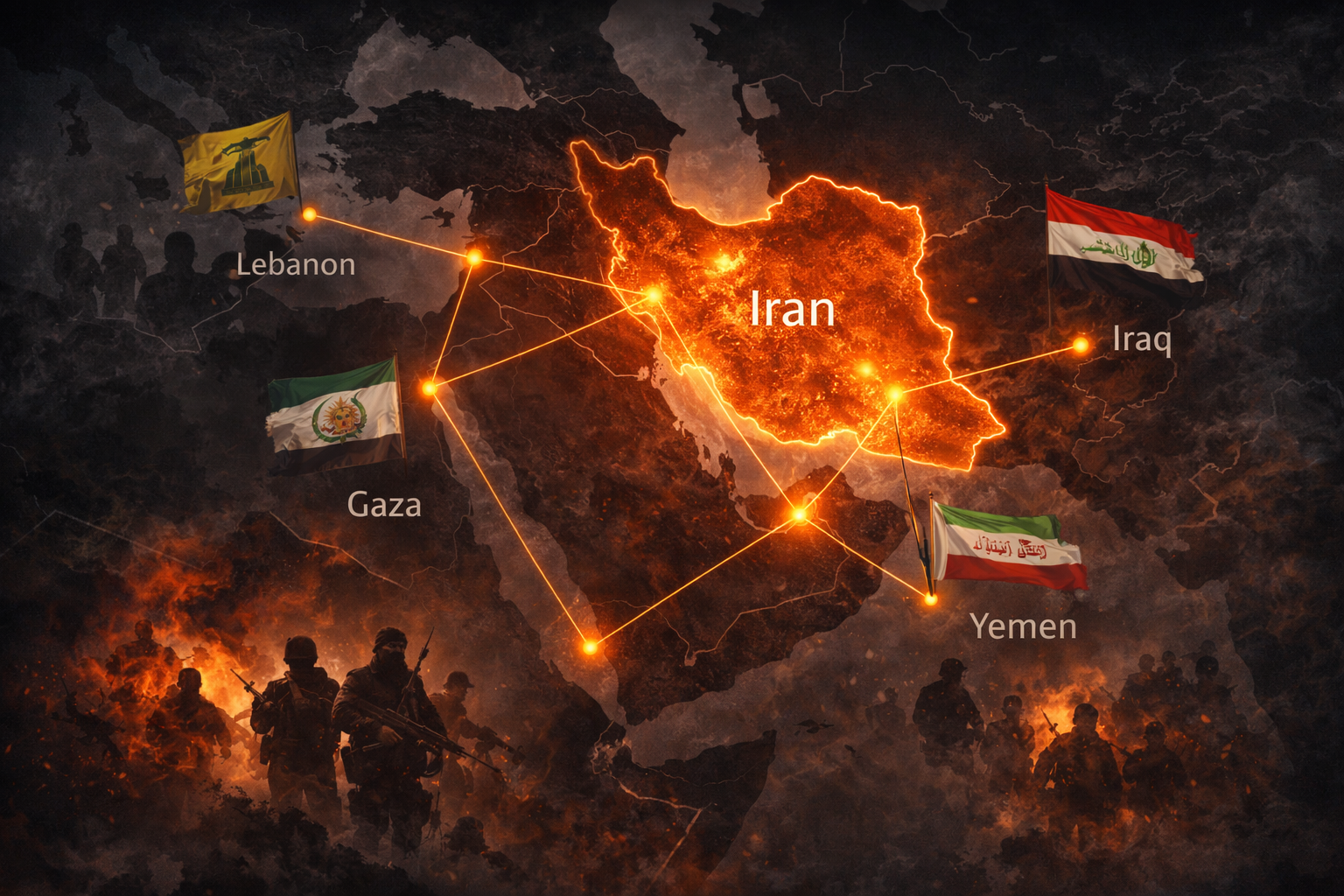
Iran’s regional network of allied armed groups was built over four decades to project power without direct confrontation but the current crisis is testing that architecture in ways its architects may not have anticipated
“Iran’s proxy network was designed to raise the cost of confrontation without triggering full-scale war — and in the current crisis it appears to be performing exactly that function.”
The Architecture of Indirect Power
One of the defining strategic innovations of the Islamic Republic of Iran has been the development, over four decades, of a network of allied non-state armed groups across the Middle East — groups that expand Iranian influence, deter adversaries, and project power well beyond Iran’s borders without requiring Iran to commit its own conventional military forces to direct conflict. This network — known in Iranian strategic discourse as the ‘Axis of Resistance’ — has been the primary instrument of Iranian regional strategy since the 1980s, when the Quds Force of the IRGC began its systematic investment in armed groups in Lebanon, Palestine, Iraq, Yemen, and Syria.
The architecture of this network has several consistent features. Iran provides funding, weapons, training, intelligence, and doctrinal guidance to its affiliated groups while maintaining a degree of strategic ambiguity about the precise nature of those relationships. The groups maintain their own leadership, their own political identities, their own domestic constituencies, and — critically — their own decision-making autonomy on tactical matters, which allows Iran to benefit from their actions while maintaining plausible deniability about direct direction.
The current crisis — following the elimination of Quds Force commanders and the systematic degradation of Iran’s proxy coordination infrastructure — has raised fundamental questions about how these groups are behaving: are they escalating in solidarity with Iran, are they holding back to preserve their own capacity, or are they behaving as genuinely autonomous actors whose choices Iran can no longer reliably predict or direct?
Hezbollah: The Flagship Proxy
Built Over Four Decades
Hezbollah, the Shia political and armed movement in Lebanon, is the jewel of Iran’s proxy network — the group that has received the most sustained investment, achieved the greatest military capability, and most fully realised the Iranian model of a non-state actor with the military capacity of a state. Founded in 1982 with direct Iranian support following Israel’s invasion of Lebanon, Hezbollah developed over four decades into an organisation with a political wing (holding seats in the Lebanese parliament and government), a social service infrastructure (schools, hospitals, financial institutions), and a military wing with an estimated arsenal of 130,000-150,000 rockets and missiles, making it more heavily armed than most state militaries in the region.
The relationship between Hezbollah and Iran has been characterised by genuine ideological alignment — Hezbollah’s founding ideology is explicitly based on the concept of velayat-e faqih, the political theory of the Islamic Republic — alongside the operational dependency created by Iranian funding and weapons supply. Hezbollah’s leadership has maintained a degree of autonomy in tactical decisions, but strategic decisions — particularly decisions about major military escalation — have historically been made in close coordination with Tehran.
After the 2024 War
The 2024 Israeli military campaign against Hezbollah severely degraded the organisation’s military capacity. The systematic assassination of much of its senior leadership — including Secretary-General Hassan Nasrallah — the destruction of significant portions of its missile infrastructure, and the ground campaign in southern Lebanon imposed losses that will take years to repair. Hezbollah remains an organisation with significant political presence in Lebanon and residual military capacity, but it is a diminished version of the force that existed before 2024.
In the current crisis, Hezbollah’s posture has been one of strategic restraint. The organisation has engaged in rhetorical solidarity with Iran and has maintained a forward military posture in southern Lebanon, but has stopped short of the large-scale missile campaign that its pre-2024 arsenal would have made possible. This restraint reflects a rational calculation: launching a major escalation against Israel before the organisation has rebuilt its military capacity would risk a second Israeli campaign that could be existentially damaging. Hezbollah’s long-term interests — political power in Lebanon, the preservation of its military capacity — are better served by survival than by solidarity.
Hamas: The Gaza Dimension
A Different Kind of Relationship
Iran’s relationship with Hamas is more complex and more contingent than its relationship with Hezbollah. Hamas is a Sunni Islamist organisation with roots in the Muslim Brotherhood tradition, not in the Shia Islamist framework that animates Hezbollah and the Quds Force’s other principal allies. The relationship between Iran and Hamas has been ideologically pragmatic rather than organically aligned — built on the common interest of confronting Israel rather than on shared political theology.
That relationship has also been more variable. Iran and Hamas had a significant rupture in the early 2010s over the Syrian civil war — Hamas refused to support Assad’s suppression of a largely Sunni uprising, creating a break with Iran that lasted several years. The relationship was repaired through the late 2010s, with Iran restoring financial support and weapons supply that had been suspended during the rupture.
After October 2023
The Hamas attack of October 2023 and the subsequent Israeli military campaign in Gaza transformed Hamas’s capacity but not its political survival. The military wing — the Izz ad-Din al-Qassam Brigades — suffered very significant losses in the Gaza campaign. Hamas’s senior political leadership has been systematically targeted, including the assassination of Yahya Sinwar in October 2024. The organisation’s control of Gaza has been destroyed.
What remains is a political organisation without a geographic base, a military wing rebuilding in difficult conditions, and a political identity that has gained significant symbolic weight among Palestinian and broader Arab and Muslim populations as a result of the 2023-2024 Gaza war. Iran’s ability to direct Hamas’s actions in the current crisis is limited — the organisation is in survival mode, its leadership is dispersed, and its immediate priorities are organisational reconstitution rather than regional escalation.
The Houthis: The Unexpected Strategic Asset
A Late Addition to the Network
The Houthi movement — Ansar Allah — in Yemen was not originally a core element of Iran’s proxy network. The Houthis are a Zaydi Shia movement (a distinct branch of Shia Islam from the Twelver Shia tradition dominant in Iran) with roots in northern Yemen’s Saada province. Iran’s investment in the Houthis deepened gradually through the 2010s, particularly after the Saudi-led military intervention in Yemen’s civil war beginning in 2015 created both the strategic opportunity and the Iranian incentive to develop a Yemeni proxy capable of threatening Saudi Arabia.
The Houthis have proved to be Iran’s most strategically significant proxy in the current crisis. Their campaign of drone and ballistic missile strikes on Red Sea shipping — begun in November 2023 in response to the Gaza war — has demonstrated a capability to disrupt one of the world’s most important maritime trade routes that Iran could not have achieved through any other means. The disruption of Red Sea shipping has had measurable global economic consequences and has imposed significant operational costs on the US Navy and partner forces attempting to defend commercial shipping.
Strategic Autonomy in Practice
The Houthi campaign also illustrates the degree to which Iran’s proxies can act with genuine strategic autonomy in ways that serve Iranian interests without requiring Iranian direction of specific operations. Whether the Houthi Red Sea campaign reflects close Iranian operational coordination or primarily Houthi initiative is a matter of analytical debate — the evidence suggests elements of both. What is clear is that the campaign has achieved significant effects for the Iranian strategic position while Iran has maintained deniability about direct involvement.
In the current crisis, the Houthis have maintained their confrontational posture — continuing to demonstrate missile capabilities, maintaining control of significant Yemeni territory including the capital Sanaa, and projecting an image of defiance that serves the ‘Axis of Resistance’ narrative regardless of its operational military significance.
Iraqi Militias: The Most Direct Threat to US Forces
The Popular Mobilisation Forces
The Popular Mobilisation Forces (PMF, or Hashd al-Shaabi) in Iraq represent the most complex element of Iran’s proxy architecture. Originally mobilised in 2014 in response to the Islamic State’s capture of Mosul and Ayatollah Sistani’s fatwa calling on Iraqis to defend their country, the PMF is officially part of the Iraqi state security apparatus — legally incorporated into the Iraqi military structure and paid by the Iraqi government. Yet its most powerful factions — including Kata’ib Hezbollah, Asaib Ahl al-Haq, and the Badr Organisation — are closely aligned with Iran, receive direct Iranian funding and support, and have demonstrated willingness to act against Iraqi government preferences when Iranian interests demand it.
The PMF’s most significant role in the current crisis context has been the campaign of drone and rocket attacks on US military facilities in Iraq and Syria — attacks that have escalated and de-escalated in response to Iranian strategic calculations, demonstrating both the directability of these groups and the operational risk they create of American-Iranian escalation through proxy action.
The Iraq Sovereignty Dilemma
The PMF’s deep integration into the Iraqi state creates a strategic dilemma for both Iraq and the United States. For Iraq, the PMF represents both a necessary element of the country’s security architecture (it was essential in defeating ISIS) and a source of Iranian influence that undermines Iraqi sovereignty and complicates Iraq’s relationships with its Gulf Arab neighbours and with the United States. For the United States, targeting PMF groups risks drawing Iraq more firmly into Iran’s orbit and potentially triggering a political crisis that would force American forces out of the country entirely.
The Central Question: Escalating or Holding Back?
The pattern that emerges from examining each of Iran’s proxy groups in the current crisis is one of calibrated restraint rather than maximum escalation. Each group is facing the rational calculation that maximum escalation risks destruction of the capacity they have spent years building, while calibrated pressure maintains the credibility of the ‘Axis of Resistance’ narrative without triggering the kind of response that would set back their long-term project.
Hezbollah is preserving its rebuilt capacity. Hamas is focused on organisational survival. The Houthis are maintaining a confrontational posture that demonstrates capability without triggering a decisive military response. The Iraqi militias are engaging in episodic harassment of US forces rather than sustained escalation that would invite a comprehensive campaign.
The proxy network is performing its primary strategic function: raising the cost of action against Iran without being so provocative that it invites the kind of comprehensive military response that would destroy the groups themselves. It is strategic coercion by indirection — and in the current environment, it is working.
Conclusion: Strategic Depth and Its Limits
Iran’s proxy network has provided the Islamic Republic with strategic depth that no other regional power possesses — the ability to project influence, deter adversaries, and impose costs without direct military engagement across Lebanon, Palestine, Yemen, Iraq, and Syria simultaneously. It remains a significant strategic asset even in its degraded post-2024 state.
But the proxy network also carries fundamental risks that the current crisis is exposing. Groups with genuine organisational autonomy can make decisions that serve their own interests rather than Iran’s — as Hezbollah’s decision to enter the 2024 war demonstrated. Groups that operate beyond Iranian territory are vulnerable to military campaigns that Iran’s conventional deterrent cannot protect them from. And a proxy network that is seen to be holding back in the face of direct attacks on Iran risks losing the credibility on which its deterrent value depends.
The deeper question that the current crisis raises about Iran’s proxy strategy is whether it can survive the loss of the centralised Quds Force coordination that has been its operational backbone. The groups that make up the ‘Axis of Resistance’ were built as instruments of a coherent Iranian strategic vision. Whether they can remain strategically coherent instruments without the central direction that Iran is currently unable to provide is one of the most consequential open questions in the region’s political future.
Why Every American President Ends Up Fighting the Same Wars


