


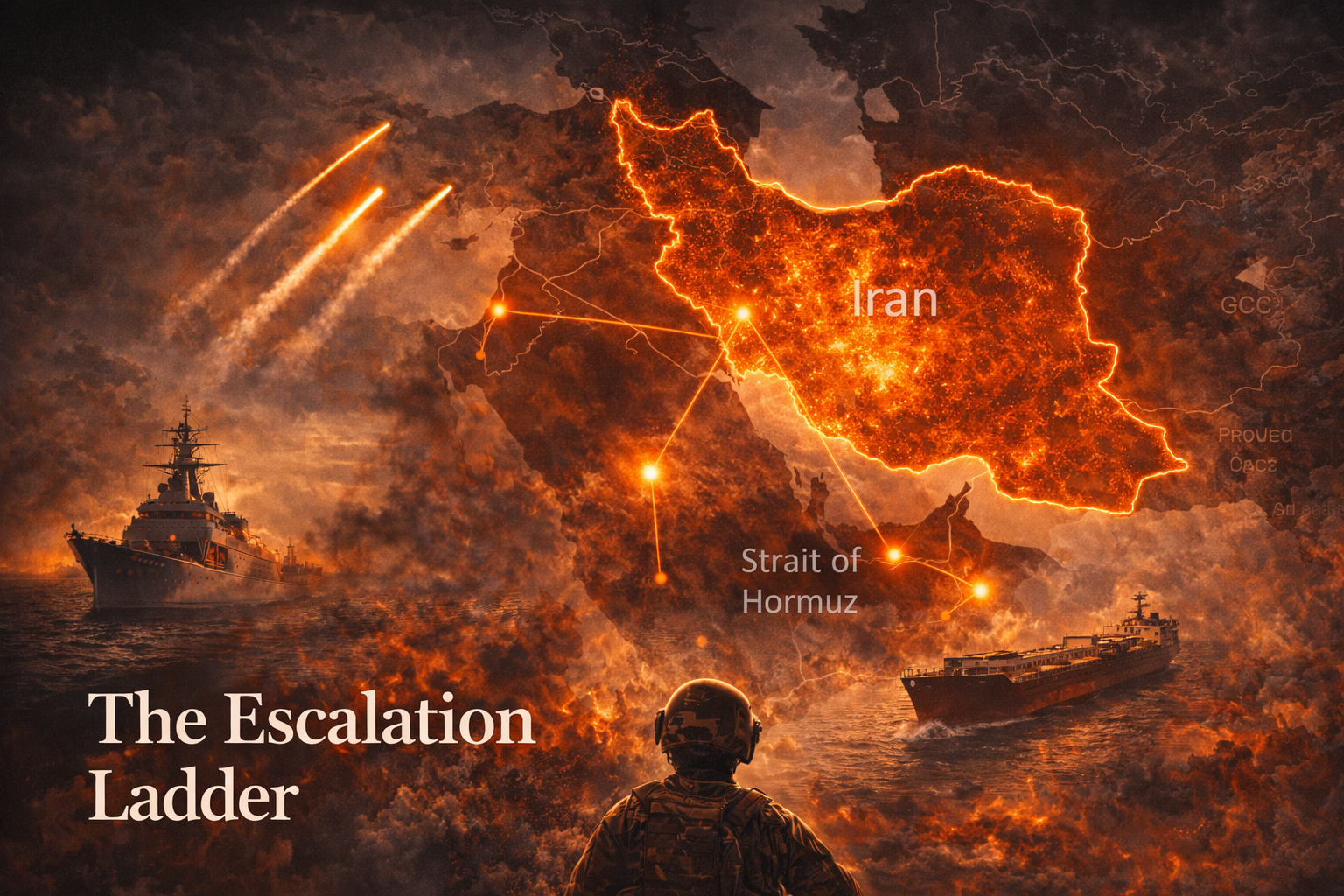
Air strikes can be calibrated and controlled — ground and naval combat carry escalation dynamics that are far harder to manage and far more consequential for the global economy
The Escalation Ladder
Every military conflict begins with some theory of controlled escalation — the belief, held by at least one party, that military action can be calibrated to achieve specific objectives while remaining below thresholds that would trigger responses that the initiating party cannot manage. Air campaigns are the preferred instrument of this theory: they are relatively precise, they can be started and stopped, they minimise the physical occupation of adversary territory, and they do not create the personal, unit-level, and tactical dynamics that ground combat generates and that are extraordinarily difficult to control once begun.
The current conflict involving Iran has, so far, been characterised primarily as an air and missile exchange. Israel has conducted air strikes on Iranian military and nuclear infrastructure. Iran has responded with ballistic missile and drone attacks. The exchange has been severe — in terms of the scale of the strikes and the strategic significance of the targets — but it has retained the character of an air campaign, with each side making calculated decisions about how far to escalate and where to hold back.
The question of whether this exchange could expand into ground or naval combat is not a question about military capability — the forces and equipment exist on multiple sides to conduct ground and naval operations of significant scale. It is a question about political calculations, accidental escalation dynamics, and the specific tripwires that could convert a managed air exchange into something qualitatively different and far harder to control.
Section I: The Strategic Importance of the Strait of Hormuz
No geographic feature is more central to the escalation calculus of the current conflict than the Strait of Hormuz. The Strait — the narrow waterway between the Iranian mainland and the Musandam Peninsula of Oman — is the passage through which approximately 17 million barrels of oil travel daily from the Gulf to the global market. Saudi Arabia, Iraq, the UAE, Kuwait, and Bahrain all depend on the Strait for their oil exports. Iran itself uses the Strait for its own limited oil exports. Japan, South Korea, India, and China import massive proportions of their energy needs through the Strait.
Iran has the physical capacity to threaten the Strait through a combination of mines, anti-ship missiles deployed from its southern coastline, fast attack craft from the IRGC Navy, and submarines capable of operating in the relatively shallow Gulf waters. The threat does not require Iran to physically close the Strait — which would require military action that the US Fifth Fleet and partner forces would respond to comprehensively and swiftly. It requires only the creation of sufficient uncertainty about safety that tanker operators, shipping insurers, and oil companies begin re-routing, delaying, or simply refusing to transit the waterway.
The economic consequences of Strait disruption are calculable and alarming. Oil price projections from major financial institutions for a genuine Strait closure range from $150 to $200 per barrel or higher — from a baseline of approximately $80-90. At those price levels, the global economic impact would be recessionary. Even a partial disruption — say, 50% of normal Strait traffic — would produce oil price increases sufficient to impose significant economic pain on every major importing economy.
Section II: Naval Confrontation Risks
The naval dimension of the Iran conflict is not hypothetical. Incidents involving IRGC fast boats and US and partner naval forces in the Gulf have occurred with regularity since the 1980s, producing the 1987-88 ‘Tanker War’ in which both American and Iranian naval forces were in active combat. In January 2016, the IRGC detained ten American sailors whose patrol boats had entered Iranian territorial waters, releasing them after 16 hours in an incident that highlighted the proximity of American and Iranian forces and the potential for escalation through miscalculation.
In the current crisis environment, the risk of naval escalation comes from several directions. The US Fifth Fleet maintains a significant force in the Gulf, including carrier strike groups when the regional tension warrants it. Iran’s IRGC Navy continues its practice of provocative close encounters with US and partner vessels. Any incident — a collision, a misidentified vessel, a trigger-happy engagement at night in the confined Gulf waters — could trigger a rapid escalation sequence that neither side’s political leadership might be able to control at the speed at which naval incidents develop.
The historical parallel most frequently invoked by military analysts is the 1988 USS Vincennes incident, in which the American cruiser shot down Iran Air Flight 655, killing all 290 people on board, in a misidentification during an active naval engagement in the Gulf. The incident — which deeply shaped Iranian political attitudes toward the United States — illustrates the potential for catastrophic mistakes in a conflict environment where forces are in close proximity, communication is imperfect, and the time available for decision-making is measured in seconds rather than hours.
Section III: Regional Escalation Dynamics
The primary risk of regional escalation beyond the direct Iran-Israel-US triangle comes from the Gulf Arab states — particularly Saudi Arabia and the UAE — whose territory hosts major American military facilities, whose oil infrastructure is vulnerable to Iranian missile and drone attack, and whose governments are making daily calculations about how to manage their own exposure in the current environment.
Saudi Arabia hosts American forces at Prince Sultan Air Base south of Riyadh, and the UAE hosts American forces at Al Dhafra Air Base. Both countries’ oil infrastructure — the Saudi Abqaiq processing facility and the Ras Tanura terminal, through which approximately 7% of global oil supply flows, and the UAE’s ADNOC facilities — are within range of Iranian ballistic missiles and have been struck or threatened in previous escalation cycles. The 2019 Abqaiq-Khurais attack — attributed to Iran and its Yemeni proxies, which temporarily knocked out about 5% of global oil supply — provided a demonstration of vulnerability that Gulf state planners have not forgotten.
Turkey presents a different escalation variable. Turkey is a NATO member but has maintained its own complex and relatively independent relationship with Iran — including significant trade ties and diplomatic channels that are distinct from the US or European approach. Turkish escalation into the conflict is not a primary risk, but Turkish diplomatic positioning could significantly affect the diplomatic environment in which the conflict is managed.
Section IV: Ground War Scenarios
A large-scale ground campaign against Iran by the United States or Israel is among the least likely escalation scenarios, primarily because the military and political logic against it is overwhelming. Iran is geographically large, mountainous, and populated by approximately 90 million people. The US military’s Iraq experience provided a comprehensive demonstration of the costs of occupying a country of one-third Iran’s population with less complex terrain. No responsible American military planner has seriously proposed a ground invasion of Iran as a viable option, and the current political environment — in which American domestic support for foreign military engagement is at a historic low — makes it even less conceivable.
The Israeli ground war scenario is different in character. Israel lacks the force size for a sustained ground campaign in Iran proper, but it has conducted multiple ground operations in Lebanon — most recently in 2024 — as part of its campaign against Hezbollah. A limited Israeli ground incursion into southern Lebanon, should Hezbollah resume large-scale rocket fire, is not implausible. But this would be a replay of the Lebanon dynamic rather than a new theatre, and its escalation implications for the broader Iran conflict would be significant primarily through the Hezbollah-Iran command relationship.
The scenario that military analysts consider more plausible than a ground campaign is a naval and special forces campaign targeted at Iranian offshore oil infrastructure — the platforms and loading terminals in the Gulf that constitute Iran’s primary revenue source. Such a campaign would impose severe economic costs on Iran without requiring ground occupation, but its escalation risks — Iranian responses against Gulf state oil infrastructure, Strait mining, and proxy escalation — are severe enough that it has not been pursued in previous confrontation cycles.
Section V: Global Economic Consequences
The global economic consequences of significant escalation in the Iran conflict — whether through Strait disruption, strikes on Gulf Arab oil infrastructure, or a sustained naval conflict in the Gulf — would be of a severity that distinguishes this conflict from most regional military disputes. The Middle East supplies approximately one-third of the world’s oil, and the Gulf’s production infrastructure is the most concentrated and therefore most vulnerable in the world.
The immediate consequence of significant Gulf oil supply disruption would be a spike in global oil and gas prices that would impose inflationary pressure on every major importing economy. For countries that import most of their energy — Japan, South Korea, India, most of Europe — the impact would be recessionary. For commodity-dependent developing economies already under fiscal stress, the consequences could be acute.
The medium-term consequences would depend on the duration of the disruption, the extent to which strategic petroleum reserves could be deployed, and the speed with which alternative supply routes and producers could compensate. Saudi Arabia — whose interests are seriously threatened by Iranian action against Gulf infrastructure — has significant spare production capacity that could partially offset Iranian disruption, but at production levels that would take months to ramp up rather than days.
Conclusion: The Escalation Management Challenge
The expansion of the current Iran conflict into ground and naval combat is not inevitable — the political logic on multiple sides pushes against it, and the most acute escalation risks can be managed if decision-makers are careful and communication channels are maintained. But ‘can be managed’ is not the same as ‘will be managed’, and the historical record of conflict escalation in the Middle East is not reassuring.
The specific risk that military analysts identify as most acute is not intentional escalation — the deliberate decision by a political leader to widen the conflict — but accidental escalation: the naval incident that is misread as an attack, the strike on a facility that turns out to be more militarily sensitive than the targeting intelligence indicated, the proxy action by a group acting beyond its mandate that triggers a disproportionate response. In a conflict environment with multiple actors, degraded communication channels, and decision-making under pressure, the gap between controlled escalation and uncontrolled escalation can be crossed by accident as easily as by design.
Managing that gap requires the maintenance of de-escalation channels even in the midst of active military conflict — back-channel communications, agreed rules of engagement, crisis hotlines, and the sustained engagement of intermediaries like Oman and Qatar who have historically served as interlocutors between Iran and its adversaries. Whether those channels are currently functioning effectively is one of the most consequential unknown variables in the current situation.
Can Iran Withstand the Air Power of the United States and Israel? A Military Analysis


