


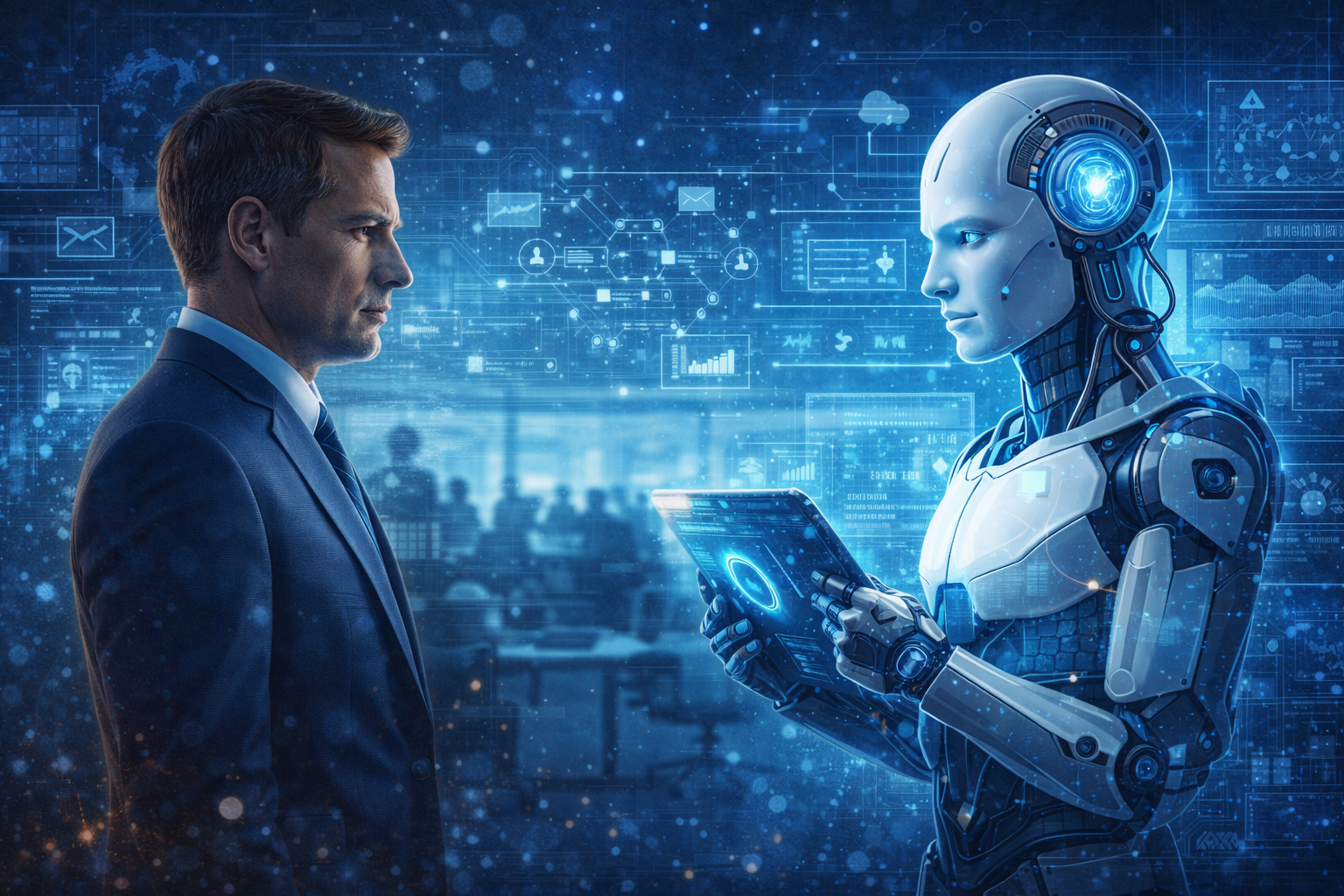
For years, the greatest fear surrounding artificial intelligence has been about jobs. Will AI replace workers? Will it automate tasks? Will millions become redundant?
But this debate misses the deeper truth.
AI is not just a threat to employees at the bottom of the organisational pyramid. In many ways, it is a bigger disruption to leadership at the top — because it challenges the very foundations of executive power.
The C-suite — CEOs, CFOs, COOs, CMOs, CHROs, and CIOs — has traditionally been powerful for three reasons:
- access to information
- the ability to interpret that information
- the authority to turn interpretation into decisions
AI strikes at all three.
It can analyse faster than humans, summarise better than most executives, generate multiple strategic options, test scenarios, predict risks, and produce recommendations at a speed no boardroom can match. It changes how information is produced and who controls it. It reduces the gap between senior leadership and everyone else.
That’s why the real question is not whether AI will change work. It will.
The real question is:
Will AI empower the C-suite — or expose it?
The Old C-Suite Advantage: Information Was Scarce
To understand why AI is so disruptive, we must understand why executives were dominant in the first place.
For most of corporate history, information was scarce and slow:
- sales data arrived after weeks
- performance reports were manually prepared
- operations updates came through layers of managers
- customers’ needs were discovered through long feedback cycles
- market research was expensive and infrequent
In such a world, executives naturally controlled decision-making because they controlled access to the big picture.
Even the best employees often saw only their portion of the business.
In short:
The C-suite was powerful partly because it owned the narrative of reality.
AI Changes the Game: Information Becomes Abundant and Fast
AI flips the equation.
Instead of needing an army of analysts to gather insights, executives can now generate intelligence in minutes.
AI can:
- summarise financial reports instantly
- compare competitors automatically
- analyse customer sentiment across channels
- identify operational bottlenecks
- simulate scenarios
- create decision-ready dashboards
This creates a new corporate reality:
The C-suite is no longer the primary holder of insight
AI becomes the holder of insight.
And anyone with access can use it.
That is the power shift.
AI as a Competitor: Why It Threatens Executive Identity
Executives have traditionally justified their importance through their mental value:
- “I know what is happening.”
- “I understand the market.”
- “I can predict outcomes.”
- “My experience gives me advantage.”
AI now competes with each of these claims.
It does not replace executive accountability, but it does reduce executive mystique.
AI becomes a rival to:
- intuition
- experience-based confidence
- delayed decision cycles
- vague strategic talk
And this creates pressure.
Because when intelligence becomes cheap, the board and investors ask:
Why does this leadership team cost so much?
AI raises the performance expectations of leadership itself.
The New C-Suite Role: From Decision-Maker to Decision Architect
The future executive will not be the person who memorises the most data.
That job will be done by machines.
The future executive will be the person who builds the system that produces good decisions.
This is a crucial shift.
Old leadership skill: having answers
In the traditional model, leaders were expected to have quick answers and confident opinions.
New leadership skill: asking the right questions
In the AI era, executives must master:
- defining the right problem
- asking the right prompts/questions
- validating output
- knowing what AI cannot see
- applying human judgment and ethics
- making trade-offs with accountability
AI gives options — but executives must choose outcomes.
AI produces intelligence. Leaders still own consequences.
How AI Reshapes Each C-Suite Function
AI does not disrupt leadership equally. It disrupts different roles in different ways.
1) CEO: From Vision to System Builder
The CEO’s job shifts from:
- being the main decision-maker
to - being the organisational architect of intelligence
They must:
- drive AI strategy
- integrate AI across functions
- manage disruption and culture
- ensure ethical governance
2) CFO: Finance Becomes Real-Time
CFOs already work with data — AI amplifies their power.
AI can:
- improve forecasting
- automate reporting
- detect fraud and anomalies
- model risk scenarios quickly
But it also increases pressure. Mistakes become visible earlier.
3) COO: Operations Become Predictive
AI transforms operations by enabling:
- predictive maintenance
- automation in logistics
- performance monitoring
- process optimisation at scale
The COO becomes less of a “process controller” and more of a “system optimiser.”
4) CMO: Marketing Becomes Algorithmic
AI will reshape marketing faster than most functions.
It can:
- generate content at scale
- personalise campaigns
- analyse customer behavior deeply
- optimise budgets in real time
This can make large marketing teams redundant — but also makes the CMO’s role more technical and performance-driven.
5) CHRO: Human Capital Faces an AI Shock
CHROs will face the most difficult transformation because AI impacts:
- hiring
- workforce planning
- job redesign
- layoffs and morale
- culture stability
The CHRO becomes central in preventing internal chaos.
6) CIO/CTO: The New Most Powerful Office
AI naturally increases the power of technology leadership.
The CIO/CTO increasingly becomes:
- the gatekeeper of AI tools
- the protector of data
- the architect of automation
- the defender against AI risks
In many organisations, the CIO/CTO becomes the most strategically critical executive.
The Hidden Change: AI Shrinks Middle Management
One of the most disruptive impacts of AI is organisational design.
Many middle layers exist to:
- share information
- coordinate teams
- track tasks
- report performance
- produce summaries
AI can do much of this.
So companies begin to ask:
- Why do we need so many reporting layers?
- Why do approvals take so long?
- Why does information travel slowly?
AI pushes businesses toward:
- flatter structures
- smaller leadership teams
- faster execution chains
- direct decision systems
This impacts the C-suite indirectly because it changes how power flows.
The Biggest Danger: AI Doesn’t Just Empower Leaders — It Can Destroy Them
The biggest threat is not AI itself.
The biggest threat is bad AI leadership.
1) Wrong AI strategy can waste millions
Many companies will rush into AI due to hype.
They will buy tools without:
- clear use cases
- change management
- process redesign
- governance structures
Result: expensive failure.
2) Hallucination risk: confident wrong answers
AI can generate convincing outputs that are incorrect.
If executives treat AI like “truth,” strategy becomes fragile.
3) Compliance and regulatory risk
AI can create legal exposure:
- privacy violations
- discriminatory outcomes
- IP infringement
- transparency failures
4) Data leaks and security threats
Executives who upload sensitive data into uncontrolled AI tools can cause massive damage.
A leader can survive a bad quarter. They may not survive a data scandal.
Can AI Replace the C-Suite?
Short answer: no.
But it will replace weak executives.
AI cannot replace:
- accountability
- crisis leadership
- moral judgment
- trust-building
- political navigation
- stakeholder persuasion
- human courage
In times of crisis, people don’t follow algorithms. They follow leadership.
However, AI will replace executives who:
- don’t understand technology
- rely only on authority
- cannot interpret data
- cannot create strategy
- cannot adapt to modern decision-making
This creates a brutal truth:
AI will not eliminate leadership. It will eliminate leadership without competence.
The Future Company: Smaller C-Suite, Faster Decisions, Higher Standards
AI will reshape corporations into:
- faster execution engines
- more automation-driven structures
- fewer layers
- more data-dependent decisions
- more measurable leadership performance
The C-suite will shrink in some companies because AI reduces the need for:
- large reporting functions
- slow approval chains
- repetitive analysis
Executives will be judged less on speeches and more on outcomes.
How the C-Suite Can Win in the AI Era (Practical Strategy)
To make this article actionable, include a leadership framework:
1) Define 3–5 AI use cases that matter
Examples:
- customer support automation
- forecasting improvement
- internal reporting automation
- fraud detection
- procurement optimisation
2) Build AI governance
- AI ethics rules
- audit trails
- compliance checks
- approval for sensitive use
3) Train leadership teams
Executives must understand:
- AI limitations
- data quality issues
- bias and security risks
- operational integration
4) Preserve human responsibility
AI can advise. Humans must decide.
5) Redesign roles, not just automate tasks
Automation without redesign creates confusion.
Conclusion: AI Is Not a Tool — It Is a New Corporate Power
AI is often described as a productivity tool.
That is a misunderstanding.
AI is a shift in corporate power because it changes:
- who controls insight
- who controls the narrative
- how fast decisions are made
- what skills matter
- what leadership looks like
The C-suite is not being replaced yet.
But it is being challenged.
In the AI era, executives must become:
- systems thinkers
- governance leaders
- ethical decision-makers
- technology-aware strategists
Those who adapt will lead stronger companies than ever.
Those who don’t may remain in the boardroom — but lose relevance inside their own organisation.
Because the new corporate reality is simple:
AI won’t replace the C-suite — but the C-suite that masters AI will replace the one that doesn’t.


