


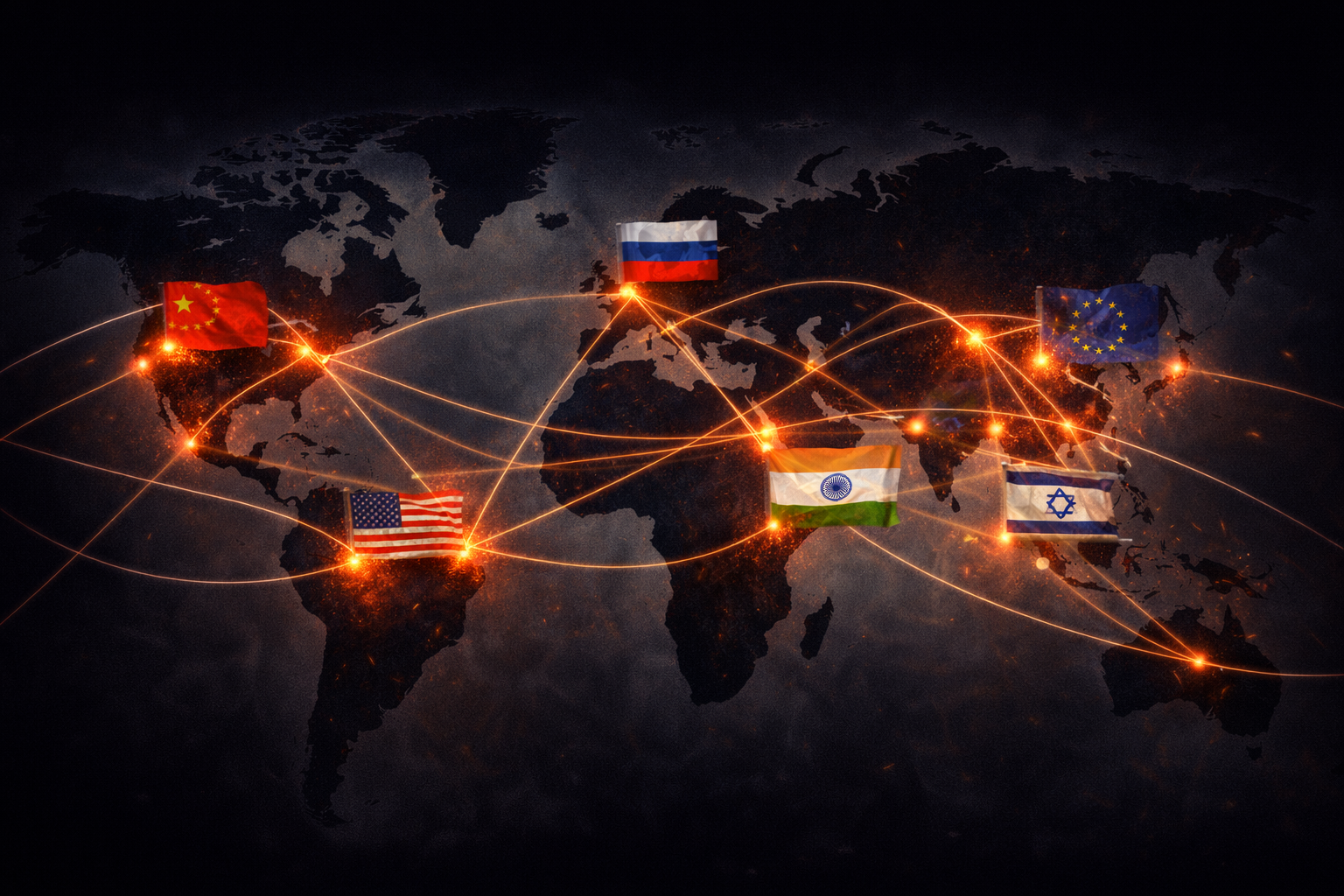
In the new world order, countries publicly declare alliances while privately pursuing competing interests — and the gap between the two has never been wider
The Illusion of Permanent Alliances
In September 2019, approximately 50,000 people filled a stadium in Houston, Texas, to watch two elected leaders embrace on a stage draped with the flags of two nations. ‘Howdy, Modi!’ proclaimed the banner. The American president and the Indian prime minister waved, clasped hands, and delivered speeches celebrating one of the world’s most consequential bilateral relationships. The chemistry was genuine. The warmth was real. The photographs were spectacular.
Three months later, India signed a deal to purchase Russian S-400 air defence systems — a procurement that triggered American sanctions legislation and considerable diplomatic friction. A year after that, India was purchasing Russian oil at discounted prices in volumes that helped sustain the Russian economy after the invasion of Ukraine, despite American pressure to restrict such purchases. And throughout this period, India maintained its traditional position of strategic autonomy, declining to condemn Russia in UN votes while simultaneously deepening its defence cooperation with Washington.
The Houston stadium moment was real. So was the S-400 purchase. So was the oil deal. All of these things can be simultaneously true — and the tension between them is not hypocrisy or inconsistency. It is the operating reality of international diplomacy in the twenty-first century.
In modern geopolitics, there are no permanent allies — only permanent interests. The countries that have understood this most clearly are the ones navigating the current era most successfully. The ones that have not are increasingly confused by a world that refuses to behave as their alliance frameworks predict.
The post-Cold War assumption — that the world was sorting itself into a liberal democratic order bound by shared values, common institutions, and deepening economic interdependence — has not survived contact with the twenty-first century. What has emerged in its place is something more complex, more fluid, and in many ways more honest about the actual foundations of international relations: a world in which countries pursue their interests through multiple, overlapping, and often contradictory relationships simultaneously, maintaining strategic ambiguity as a deliberate policy tool rather than an embarrassing inconsistency.
This analysis examines how global alliances actually work in the current era — the four types of alliance relationships that coexist in the contemporary system, the most significant case studies of public-private diplomatic divergence, and what this architecture means for the question of whether countries can actually trust each other in a world where interests, rather than values, are the primary currency of international relations.
Section I: The Era of Clear Alliances — What We Lost and Why
Understanding why the current diplomatic environment feels so confusing requires understanding what it replaced. The Cold War alliance system — for all its tensions, contradictions, and hypocrisies — had one clarifying feature: the existence of an ideological binary that sorted most of the world into two camps, defined the stakes of most disputes, and provided a framework within which commitments could be tested and reputations established.
NATO was an alliance in the traditional sense — a mutual defence commitment among states that shared not merely interests but a broadly common political identity, with institutional structures, integrated military commands, and a shared threat assessment that had been refined over four decades of Cold War competition. The Warsaw Pact was its mirror image: a Soviet-led alliance of communist states bound by ideology, economic integration, and the presence of Soviet military forces that made the voluntary character of membership somewhat theoretical.
Outside these formal structures, a network of bilateral alliances — the US-Japan Security Treaty, the US-South Korea alliance, the US-Philippines Mutual Defence Treaty, the Soviet alliance with Cuba, China’s relationship with North Korea — extended the bipolar framework across Asia and the developing world. Even the Non-Aligned Movement, which explicitly rejected alignment with either superpower bloc, was in practice a political coalition of states navigating the bipolar system by exploiting the space between the two blocs.
This system was simpler to understand than the current one — but not simpler to manage. The Cuban Missile Crisis of 1962, the Sino-Soviet split of the 1960s, the Nixon opening to China in 1972, the fractures within NATO over the Vietnam War and nuclear weapons deployment — all demonstrated that even in the age of ideological blocs, strategic interests regularly diverged from declared alignments. What the Cold War provided was not genuine ideological unity but a framework of apparent clarity within which the inevitable divergences could be managed without calling the entire architecture into question.
The end of the Cold War removed that framework without replacing it with anything of comparable clarity. The brief unipolar moment of the 1990s — in which American dominance was so overwhelming that the question of alignment seemed almost moot — gave way, within a decade, to a multipolar world in which multiple powers were simultaneously pursuing global influence, regional hegemony, and bilateral relationships that cut across the old bloc boundaries in ways the post-Cold War institutional architecture was not designed to accommodate.
Section II: The Four Types of Alliance in the Modern System
The first analytical step toward understanding how global alliances actually work is to recognise that the word ‘alliance’ covers at least four distinct types of relationship, each with different characteristics, different levels of reliability, and different implications for the behaviour of the parties involved.
| TYPE 1: FORMAL SECURITY ALLIANCES PUBLIC FACE Unconditional mutual defence commitment. An attack on one is an attack on all. Article 5 is sacrosanct. STRATEGIC REALITY Commitment is real but conditional on domestic political support, geographic proximity of the threat, and the credibility of the guarantor’s willingness to honour the commitment under fire. Alliance cohesion is regularly tested and never guaranteed. Current examples: NATO (32 members); US-Japan Security Treaty; US-South Korea Mutual Defence Treaty; ANZUS; AUKUS |
| TYPE 2: STRATEGIC PARTNERSHIPS PUBLIC FACE Deep friendship, shared values, and convergent interests. A ‘comprehensive strategic partnership’ or equivalent diplomatic language. STRATEGIC REALITY A relationship managed for mutual benefit in specific domains while preserving freedom of action in others. Neither party expects unconditional support. Both parties know the limits of the relationship without stating them publicly. Current examples: US-India; China-Russia (‘no limits partnership’); India-Russia (legacy relationship); US-Saudi Arabia; China-Pakistan CPEC; EU-China |
| TYPE 3: TRANSACTIONAL RELATIONSHIPS PUBLIC FACE Bilateral cooperation framed in the language of partnership, shared interests, and mutual benefit. STRATEGIC REALITY An economic or security arrangement with a specific price — arms sales, investment, diplomatic support — that each party evaluates on a cost-benefit basis and adjusts when the calculus changes. No expectation of loyalty beyond the transaction. Current examples: US arms sales to Gulf states; China BRI investment in Africa and South Asia; Russian energy relationships with Europe; IMF conditionality arrangements |
| TYPE 4: ADVERSARIAL CO-DEPENDENCY PUBLIC FACE Public hostility, regular condemnation, and declared strategic competition. STRATEGIC REALITY A relationship in which rivals maintain extensive back-channel communication, economic interaction, and informal rules of engagement that prevent competition from escalating to conflict. The adversaries need each other to define their own identities and interests. Current examples: US-China; US-Russia (pre-2022); India-Pakistan (crisis communication channels); North Korea-US (periodic nuclear diplomacy) |
Section III: Case Studies in Public-Private Diplomatic Divergence
The gap between declared alliance and strategic reality is not a modern phenomenon — it has characterised international relations since the first treaties were signed. What is distinctive about the current era is the scale, the transparency, and the speed at which this gap has become visible. In a world of 24-hour news cycles, social media diplomacy, and real-time satellite intelligence, the divergence between the public face of an alliance and its operational reality is harder to sustain — and the management of that divergence has become a core diplomatic skill.
| CASE STUDY: United States – India: Strategic Partners Who Compete Declared position: The world’s largest democracies, bound by shared values, common concerns about Chinese expansionism, and deepening defence, technology, and intelligence cooperation through the Quad framework, the GSOMIA intelligence-sharing agreement, and bilateral defence deals worth billions of dollars. Strategic reality: A relationship of genuine strategic convergence on China, managed alongside persistent divergences on trade (India runs a significant trade surplus with the US and resists American market-access demands), energy (India continues to purchase Russian oil and Iranian oil when sanctions permit), multipolarity (India explicitly rejects bloc alignment and maintains extensive relationships with Russia and Iran), and digital governance (India’s data localisation requirements conflict with American technology companies’ global operating models). The tension: Both sides understand the relationship accurately — it is a partnership of converging interests on the China question, not a formal alliance. The management challenge is maintaining the convergence on China while avoiding the accumulated friction of the divergences threatening the broader relationship. The US periodically invokes CAATSA sanctions over the S-400 purchase; India periodically references its strategic autonomy tradition. Neither side wants to force a choice the other cannot make. |
| CASE STUDY: United States – Saudi Arabia: The Relationship That Defies Its Own Logic Declared position: A foundational security partnership since the 1945 Quincy Agreement — American security guarantees in exchange for reliable oil supply and Gulf stability. Periodically reaffirmed through major arms deals, military cooperation, and high-level diplomatic engagement. Strategic reality: A relationship under sustained stress from multiple directions simultaneously: American energy self-sufficiency has eroded the oil dependency that made Saudi Arabia indispensable; the Saudi-led OPEC+ production decisions have repeatedly conflicted with American inflation management priorities; Saudi Arabia’s war in Yemen has generated significant Congressional opposition to arms sales; and the Abraham Accords — the Trump-era normalisation framework between Israel and Arab states — has created both new common ground and new complications as the Gaza conflict has tested Saudi domestic politics. The tension: The relationship survives because both sides still need each other — the US for Gulf stability and Israeli security architecture, Saudi Arabia for the American security umbrella against Iran. But it is no longer the uncomplicated partnership of the Cold War era. Riyadh has been diversifying its security relationships, purchasing Chinese weapons, engaging diplomatically with Beijing, and exploring BRICS membership — maintaining strategic ambiguity as a hedge against American unreliability. |
| CASE STUDY: China – Russia: The ‘No Limits’ Partnership and Its Limits Declared position: A comprehensive strategic partnership of coordination declared in February 2022, days before Russia’s invasion of Ukraine — a relationship of ‘no limits’ in Xi Jinping’s formulation, standing against Western hegemony and the liberal international order. Strategic reality: A relationship of tactical convergence and strategic competition between two great powers that share a common interest in challenging American dominance but have different and potentially conflicting visions of the world order that would replace it. China has provided Russia with economic lifelines — trade, technology, diplomatic cover — while stopping short of military assistance that would trigger Western sanctions on Chinese entities. It has not condemned the Ukraine invasion but has also not endorsed it. It is using Russia’s strategic desperation to extract concessions and technology transfers on terms Москва would not accept in better circumstances. The tension: China is the senior partner in this relationship, and both sides know it. Russia needs China far more than China needs Russia. Beijing is extracting value from Moscow’s isolation — cheap energy, diplomatic solidarity, a distraction of American attention toward Europe — while maintaining its own economic relationships with the West and avoiding the secondary sanctions that would result from overt military support. The ‘no limits’ language was always more aspiration than operational commitment. |
| CASE STUDY: European Union – China: Economic Partners, Strategic Rivals Declared position: China is the EU’s largest trading partner for goods. European companies have trillions of euros invested in Chinese manufacturing, market access, and supply chains. The relationship has been managed through decades of economic engagement on the assumption that trade would produce political moderation. Strategic reality: The EU has formally designated China a ‘systemic rival’ since 2019 — a partner, competitor, and rival simultaneously. European companies face asymmetric market access in China, state-sponsored technology theft, and Chinese state investment in critical European infrastructure. The Ukraine war has demonstrated the strategic danger of economic dependency on authoritarian states, generating pressure to ‘de-risk’ European exposure to China. But the economic integration is so deep that genuine decoupling would impose costs most European governments are unwilling to absorb. The tension: Europe cannot afford to confront China in the way that Washington demands, and Washington cannot manage China without European economic coordination. The result is a transatlantic alliance that is broadly aligned on China as a strategic challenge but persistently divided on how aggressively to respond — with Europe seeking managed competition and the US increasingly seeking strategic decoupling. |
Section IV: Why Countries Publicly Cooperate While Privately Competing
The divergence between public alliance declarations and private strategic calculations is not a failure of the international system. It is the international system operating normally — a reflection of the fundamental reality that states are not individuals, that governments change while interests persist, and that the complexity of modern interdependence makes it impossible for most countries to afford the luxury of ideologically pure alignment.
The Domestic Politics of Foreign Policy
Every foreign policy decision is simultaneously a domestic political decision. A government that publicly acknowledges that its valued ally is also its trade rival, its competitor for regional influence, and the source of intelligence threats against its domestic infrastructure is a government making itself politically vulnerable in ways that most democratic leaders prefer to avoid. The gap between public alliance rhetoric and private strategic reality is partly sustained by the demands of domestic political management — the need to maintain the narrative of partnership even when the operational reality is more complicated.
The Insurance Logic of Multi-Alignment
In a world of multiple competing powers, the most strategically rational posture for most medium and smaller states is not exclusive alignment with any single great power but the maintenance of productive relationships with multiple powers simultaneously. India’s multi-alignment is the most sophisticated contemporary example of this logic — maintaining deep ties with the United States, Russia, Iran, the Gulf states, and the EU simultaneously, extracting benefits from each relationship while avoiding the costs that exclusive alignment with any one power would impose. Turkey’s maintenance of NATO membership while purchasing Russian air defence systems and mediating between Russia and Ukraine is another example. The UAE’s simultaneous hosting of American military forces and Chinese technology infrastructure is a third.
Economic Interdependence as a Constraint on Strategic Clarity
The depth of global economic integration means that most countries trade significantly with their strategic rivals. China is simultaneously the United States’ largest trading partner and its most significant strategic competitor. India purchases arms from Russia while deepening military cooperation with the US. European countries import Chinese goods while restricting Chinese investment in critical infrastructure. This economic interdependence creates powerful incentives to maintain at least the appearance of cooperative relationships even when strategic competition is the operational reality — because economic decoupling carries costs that most governments are unwilling to impose on their own populations.
In modern geopolitics, the question is not whether your ally is also your competitor. It almost certainly is. The question is whether you understand clearly which interests you share, which interests diverge, and where the line is — and whether your diplomatic management of the gap between them is sophisticated enough to preserve the relationship’s value while containing its costs.
Section V: The Architecture of Strategic Ambiguity
Strategic ambiguity — the deliberate maintenance of uncertainty about one’s commitments, intentions, or red lines — has become one of the defining features of twenty-first century diplomacy. It is not evasion or confusion. It is a policy tool, deployed with considerable sophistication by the states that have mastered it.
Taiwan and the American Ambiguity Model
The United States’ ‘One China Policy’ — acknowledging the Chinese position that there is one China and Taiwan is part of China, without endorsing it — is the most consequential example of strategic ambiguity in the current international system. The policy simultaneously preserves the possibility of peaceful cross-strait resolution (by not explicitly committing to Taiwan’s independence), deters Chinese military action (by not explicitly ruling out American military intervention), and maintains the economic and diplomatic relationships with both Beijing and Taipei that serve American interests. The cost of this ambiguity is permanent uncertainty — for Taiwan, for China, and for the allies who would need to decide whether to join an American intervention — but that uncertainty is, from Washington’s perspective, a feature rather than a bug.
India’s Ambiguity as Strategic Doctrine
India has elevated strategic ambiguity from a tactic into a doctrine. Non-Alignment in the Cold War, multi-alignment today — the underlying principle is consistent: preserve maximum freedom of action by avoiding binding commitments that constrain India’s choices in unpredictable future circumstances. The doctrine has costs — it limits India’s ability to extract unconditional security guarantees from partners who want exclusive commitment in return — but it has also delivered substantial benefits: the ability to purchase Russian arms while receiving American intelligence, to abstain on UN votes condemning Russian aggression while deepening the Quad partnership, and to maintain the Chabahar Port relationship with Iran while cooperating with Israel on defence technology.
China’s Patient Strategic Patience
China’s diplomatic strategy under Xi Jinping has been characterised by a combination of aggressive tactical assertion — in the South China Sea, along the LAC, in economic coercion of states that challenge Chinese interests — and patient strategic ambiguity about its ultimate intentions. China maintains that it seeks a ‘multipolar world’ and ‘win-win cooperation’ while simultaneously building a military capability oriented toward coercing Taiwan and projecting power across the Indo-Pacific. It declares respect for sovereignty and territorial integrity while occupying features in the South China Sea and pressing territorial claims against India, Japan, Vietnam, and the Philippines. The gap between the rhetoric and the reality is not a diplomatic failure — it is the operational architecture of a great power that has learned from history that strategic intentions are best concealed until the capability to act on them is decisive.
Section VI: Can Countries Really Trust Their Alliances?
The analytical framework developed above produces an uncomfortable answer to the question of whether countries can trust their alliances: it depends entirely on what you mean by trust, and what you are trusting your ally to do.
Formal security alliances, at their best, can be trusted to deliver on their core commitments when those commitments are clearly defined, when the defending state has the capability and the domestic political will to honour them, and when the costs of doing so do not exceed what the alliance is worth to the defending state. NATO has operated on this basis for 75 years, and Article 5 has never been invoked in circumstances that would have required any member state to fight for another — though the Baltic states’ concerns about whether it would be honoured in an Article 5 scenario with Russia are entirely rational.
Strategic partnerships and transactional relationships can be trusted to operate within the terms of the specific interests they serve. The US-India relationship can be trusted to deliver on defence cooperation, intelligence sharing, and coordination on China-related challenges. It cannot be trusted to deliver Indian support for American positions on Russia, or American willingness to accept Indian preferences on trade and technology without friction. Both sides understand this, which is why the relationship has survived repeated divergences without fundamental rupture.
The deeper question is not whether individual alliances are reliable, but whether the current international system — in which most major relationships involve a complex mix of cooperation, competition, and managed divergence — can sustain the collective action required to address the genuinely global challenges of the current era: climate change, pandemic response, nuclear non-proliferation, and the management of the AI revolution in military affairs.
The preliminary evidence is not encouraging. The international response to COVID-19 was characterised by vaccine nationalism and supply chain competition rather than coordinated action. Climate negotiations have produced commitments whose implementation is consistently outpaced by the scale of the challenge. Nuclear non-proliferation has been undermined by North Korea’s successful development of a deliverable arsenal and Iran’s progressive development of enrichment capability. And the AI arms race is proceeding without the arms control frameworks that might manage its most dangerous implications.
The greatest risk in a world of flexible, interest-based alliances is not that countries will betray each other on bilateral matters — their interests are usually well enough understood to make betrayal predictable and therefore manageable. The risk is that no coalition of interests will prove strong enough to address the challenges that require genuine multilateral cooperation, because those challenges threaten everyone in general but constrain the immediate interests of the powerful specifically.
Conclusion: Interests, Not Friendships
Lord Palmerston, the nineteenth-century British Foreign Secretary, is alleged to have said that England has no permanent allies and no permanent enemies — only permanent interests. The formulation is often quoted, but its implications are rarely fully absorbed. It is not a counsel of cynicism. It is a description of how international relations actually work, and a guide to how they should be managed.
The current international system is not more dishonest than previous systems. It is arguably more honest — more transparent about the interest-based foundations of diplomatic relationships, less insistent on the ideological fictions that gave Cold War alliances their apparent clarity. The United States and India are not allies in the NATO sense. They are strategic partners with overlapping interests on China and divergent interests on Russia, trade, and global governance — and both sides are better served by acknowledging that complexity than by pretending it does not exist.
China and Russia are not ideological brothers, whatever their joint statements claim. They are great powers with convergent tactical interests in challenging American dominance and divergent strategic visions of the order that would replace it — and the divergence will become more visible as American power is constrained and the competition between them for influence in Central Asia, in the Arctic, and in the developing world intensifies.
The European Union is not a unified strategic actor, whatever its institutional architecture implies. It is a coalition of states with different historical relationships to Russia, different economic dependencies on China, different threat perceptions on the eastern flank, and different capacities for defence spending — and the management of those differences is the central challenge of European foreign policy.
In the world that is emerging — multipolar, technologically accelerating, and diplomatically fluid — the countries that will navigate most successfully are those that understand their alliances for what they are: not permanent loyalties but evolving arrangements shaped by power, interests, and opportunity. Clarity about which interests are genuinely shared, which are merely parallel, and which are in direct competition is not cynicism. It is the precondition for diplomacy that actually works.
If Iran’s Regime Collapses, What Comes Next?


