


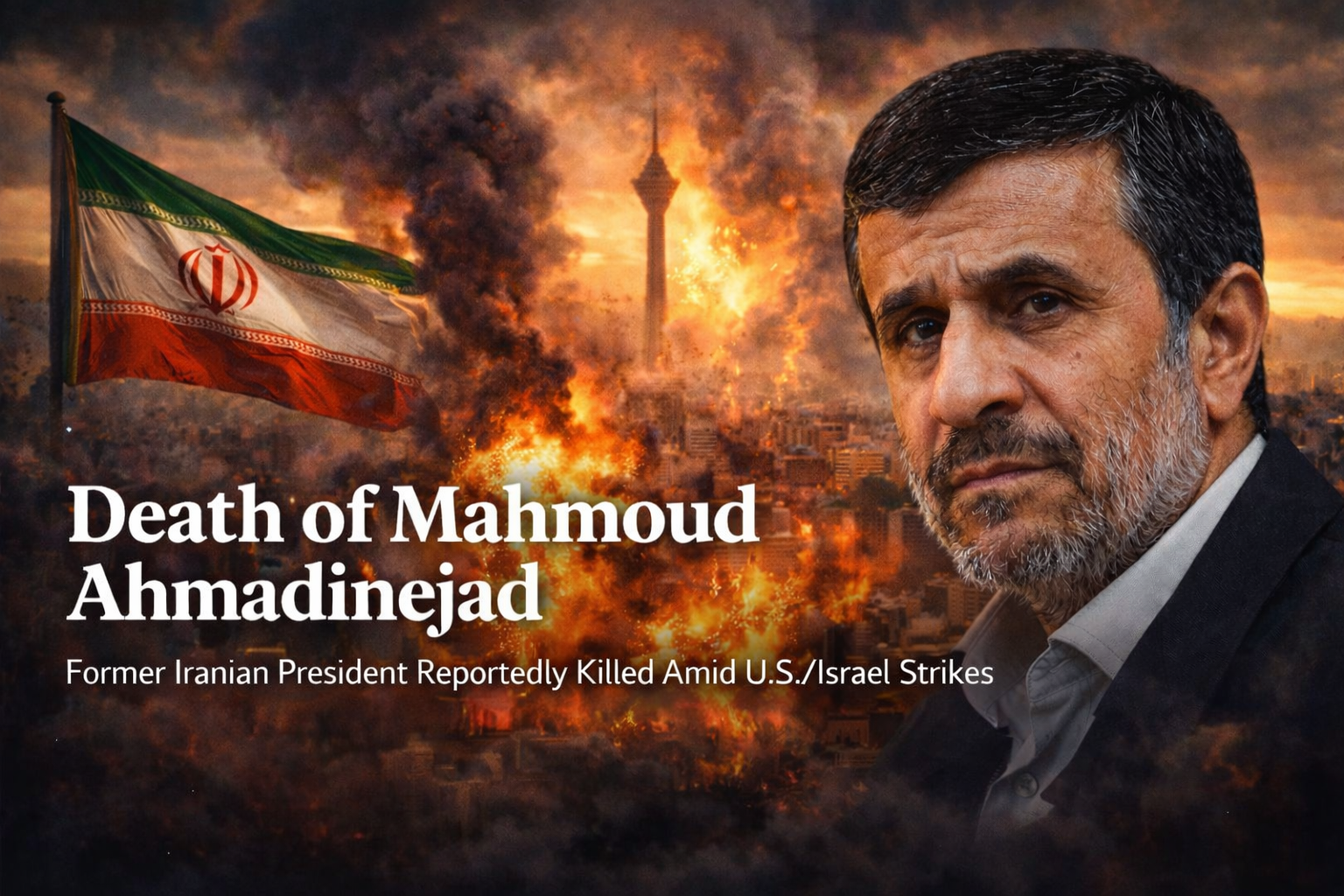
Ahmadinejad Dead? What His Reported Killing Means for Iran
Reports are emerging that Mahmoud Ahmadinejad, the controversial former president of Iran, has been killed in an Israeli–U.S. military strike on Tehran — marking another dramatic escalation in a widening regional conflict.
The claims originate from Iranian state-linked media and Israeli outlets reporting that Ahmadinejad’s residence in the Narmak district of Tehran was struck late on Saturday, February 28, 2026, killing him along with some of his bodyguards.
Officials in Tehran have not yet issued a fully confirmed statement on his death, and some sources suggest his office has challenged reports — underscoring the fog of information in the midst of a broader war.
This development follows the confirmed death of Iran’s Supreme Leader, Ayatollah Ali Khamenei, earlier in the conflict — placing Iran’s political establishment under unprecedented strain.
A Provocative Career
Mahmoud Ahmadinejad was born in 1956 in Aradan, Iran, and rose from a background in engineering and local governance to become one of the Islamic Republic’s most recognized hardline politicians.
After serving as governor of Ardabil Province and then as mayor of Tehran, he shocked the political establishment by winning the 2005 presidential election, subsequently winning a second term in 2009.
His presidency was marked by:
- Confrontational rhetoric toward the West, especially the United States and Israel.
- Acceleration of Iran’s controversial nuclear program, which drew stiff international sanctions.
- A disputed 2009 election that sparked the Green Movement protests, one of the largest popular uprisings in Iran since the revolution.
After leaving office in 2013, he was appointed to the Expediency Discernment Council, a political advisory body in Tehran.
Later in life, Ahmadinejad became increasingly at odds with Iran’s hardline establishment, leading to his political marginalization and the rejection of his presidential nominations in subsequent elections.
What Reports Say About His Death
According to multiple reports:
- The strike that hit Ahmadinejad’s home occurred amid a major Israeli and U.S. assault on Iranian leadership figures in Tehran.
- Several of his bodyguards — reportedly from the Islamic Revolutionary Guard Corps — were also killed, healing ties between Ahmadinejad and the IRGC.
- Videos circulating on social media appear to show widespread damage around the targeted site.
Iranian authorities have not released an official confirmation of his death, and some reports from Ahmadinejad’s office have explicitly denied the claims — though those denials remain unverified and are part of conflicting real-time information.
For now, global media and regional outlets continue to treat the reports as likely but unconfirmed amid the broader war narrative.
Reactions and Regional Shockwaves
Inside Iran
Official state channels in Iran have not yet fully confirmed the news, reflecting the ongoing chaos of Tehran’s military and political response.
But Iranian social media and diaspora communities are reacting with a mix of shock, speculation, grief, and anger. Many recall Ahmadinejad’s tenure as one of deep polarization — both domestically and internationally.
International Response
World leaders have responded cautiously, calling for clarity amid conflicting reports.
- Some governments have stated that if verified, the killing of a former head of state could further destabilize the region.
- Others have emphasized the need for diplomatic de-escalation.
The strikes that allegedly killed Ahmadinejad come on the heels of the broader campaign against Iranian leadership — including the death of Supreme Leader Ali Khamenei — sharply raising tensions across the Middle East.
Legacy of a Polarizing Figure
Ahmadinejad’s time in office was defined by:
- A refusal to temper Iran’s nuclear ambitions in the face of sanctions.
- Clerical support that helped him rise, but later friction with Iran’s establishment.
- Rhetoric that energized hardliners abroad and alarmed Western capitals.
Domestically, his legacy remains complex: credited by supporters for outspoken defiance, and criticized by opponents for economic mismanagement and political repression.
As with many high-profile figures in Iranian politics, his trajectory reflected the deep tensions between revolutionary zeal, political survival, and the pressures of global diplomacy.
Why This Matters
The reported death of Mahmoud Ahmadinejad — if verified — is more than the fall of a former president:
- It symbolizes the depth of the current war between Iran and U.S./Israeli forces.
- It reflects the targeting of not just current commanders but former regime figures.
- It underscores how internal divisions within Iran’s elite may now intersect with regional military conflict.
And it comes at a time when Iranian politics — already destabilized by the loss of its Supreme Leader — is in dramatic flux.
The Bigger Picture
This moment may represent a structural crisis for Iran:
- Leadership vacuums at the highest levels.
- Fractures within the clerical and political elite.
- Public uncertainty and potential unrest.
For analysts and citizens alike, the question now is not just whether Ahmadinejad was killed, but what his death (or continued life) means for the future trajectory of Iran’s political evolution and the ongoing conflict with the United States and Israel.
Also Read: Death of the Ayatollah


