


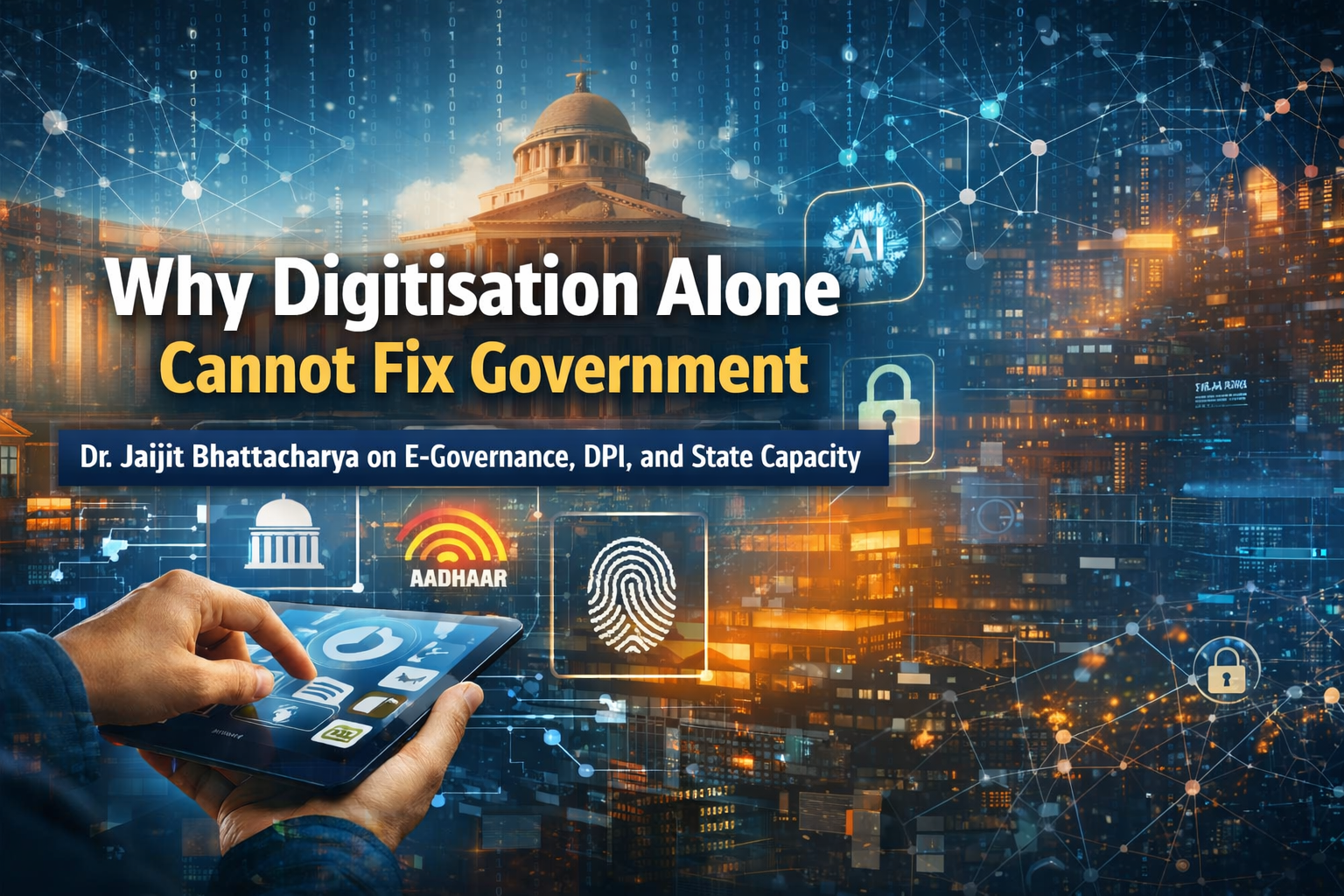
While governments have made tremendous progress in creating portals, platforms, and dashboards to support governance, Dr. Jaijit Bhattacharya lays out the way forward to leverage these tools. As President of the Centre for Digital Economy Policy and one of India’s most influential voices on digital public infrastructure, Bhattacharya argues that the central challenge is no longer technology, but governance itself.
In this wide-ranging conversation with Danish Shaikh, Editor at The International Wire, Bhattacharya traces how the original promise of e-governance to make the state simpler, fairer, and more responsive needs to be doubled down upon with institutional reforms, supported by the digitisation. From Aadhaar and UPI to data protection, AI, and board-level oversight, he returns repeatedly to a core insight: digital transformation is ultimately a state-capacity project, not an IT one. Platforms can scale, but trust, accountability, and grievance redressal determine legitimacy.
Spanning public administration, political economy, enterprise systems, and the future of algorithmic governance, the discussion reads less as a celebration of India’s digital success than as a cautionary guide to its next phase. The question, Bhattacharya suggests, is no longer whether governments can govern at scale—but how to built-in human aspects such as restraint, age-gating and democratisation of access.
Why Digital Government Is Not the Same as Good Governance
How has reality diverged from the original vision?
We assumed digitisation would automatically make government simpler, fairer, and more responsive. In practice, we digitised forms and queues faster than we redesigned rules, workflows, and accountability. The biggest divergence is that technology moved ahead, but governance reform did not move at the same pace.
Too much digitising services, too little transforming governance?
Yes. Many projects treat “online delivery” as the destination. True transformation means re-engineering processes end-to-end—eliminating unnecessary approvals, reducing discretion where it breeds rent-seeking, and making outcomes measurable.
Biggest misconception policymakers still have?
That e-Governance is an IT project. It is a state-capacity project—about institutions, incentives, data quality, and rule design. Software can only amplify what the system already is.
Why do platforms succeed technically but fail socially?
Because social adoption depends on trust, usability, language, inclusion, and grievance redressal—not just uptime. A platform can be “live” yet fail if it increases friction for the weakest user or offers no remedy when things go wrong.
Digitised government vs truly intelligent government?
Digitised government puts existing processes online. Intelligent government uses data and rules to prevent problems, target benefits, detect fraud without harassing honest citizens, and continuously improve. It is proactive, measurable, and accountable—not merely online.
Why Digital Government Is Not the Same as Good Governance
Hidden vulnerabilities of India’s DPI?
Three main ones: (i) concentration risk—few rails becoming single points of failure, (ii) weak grievance redressal and liability clarity when systems fail, and (iii) uneven last-mile capacity—connectivity, devices, and frontline training. A fourth risk is data governance fragmentation across departments.
Can Aadhaar, UPI, DigiLocker become global public goods?
Parts of the architecture and standards can—especially interoperable payments principles and verifiable digital credentials. But identity and foundational registries are deeply sovereign. What can travel globally is the “design pattern,” reference implementations, and governance playbooks—not a copy-paste of India’s specific stack.
Balancing scale with accountability?
Scale must be matched with enforceable accountability: clear service-level obligations, transparent audits, accessible grievance channels, and liability allocation across government and vendors. At population scale, even a small error rate becomes a governance crisis.
DPI strengthened participation or centralised power?
Both. It strengthens participation when it reduces friction and corruption, and increases transparency. It centralises power if the architecture concentrates control without checks—especially if access can be denied without due process. The outcome depends on oversight, decentralised control layers, and remedies.
Lessons for developing nations?
Build for inclusion first, not feature richness. Establish identity/consent/data governance early. Invest in frontline capacity and grievance systems. Keep architectures modular and interoperable. And avoid making any single rail so dominant that failure becomes systemic.
Privacy, Data & Trust
Assessment of today’s data protection frameworks?
We are moving in the right direction, but many frameworks still over-rely on legal compliance and under-invest in engineering controls. The next leap is operational privacy—how consent is managed, how access is logged, how misuse is detected, and how citizens get remedies.
Has regulation kept pace with surveillance capabilities?
Not fully. Surveillance tech evolves faster than legislative cycles. The gap shows up in opaque data sharing, weak oversight of lawful access, and limited transparency on how data is combined across systems.
Can privacy coexist with large-scale digital governance?
Yes, if privacy is treated as an architecture choice, not a checkbox. Data minimisation, purpose limitation, strong access controls, decentralised storage where appropriate, and auditable trails make scale compatible with privacy.
Are citizens sufficiently aware of data use?
Awareness is improving, but most citizens do not have real visibility into secondary use, data sharing chains, or retention. The trust deficit grows when people can’t tell who accessed their data, why, and what to do if harm occurs.
Architectural changes needed for privacy-by-design?
Default minimisation, tokenisation/pseudonymisation, fine-grained consent with revocation, immutable access logs, role-based access with separation of duties, and privacy-preserving verification (prove eligibility without exposing full identity). Crucially: built-in redress and penalties for misuse.
Policy, Regulation & the Digital Economy
Why do digital policies lag?
Because policy is negotiated across stakeholders, and incentives favour short-term deliverables over long-term guardrails. Technology changes weekly; institutions move annually. The solution is adaptive regulation—principles plus iterative rules and strong regulators.
Regulate Big Tech without stifling innovation?
Focus on outcomes and conduct: competition, data portability, interoperability, transparency for high-risk systems, and consumer protection. Don’t regulate features—regulate harms, market power abuse, and opaque decision-making.
Strategic autonomy or regulatory overreach?
India is genuinely pursuing strategic autonomy—rails, standards, domestic capability. The risk of overreach arises when regulation becomes unpredictable or overly prescriptive. Autonomy should mean resilient choices and standards, not permanent friction for innovators.
Role of independent think tanks?
Translate technology into governance language, stress-test policy for second-order impacts, provide evidence, convene stakeholders, and keep policy anchored to constitutional values and economic competitiveness. They should function as a bridge—neither captured by industry nor driven by ideology.
Avoid copying Western models uncritically?
Start from India’s market structure, state capacity, judiciary load, and citizen realities. Borrow principles, not templates. Pilot, measure, and iterate. And ensure enforcement practicality—rules that can’t be enforced only create rent-seeking.
Enterprise Systems, ERP & Public Sector Efficiency
Why do many large projects fail?
Because of unclear outcomes, scope creep, poor data quality, weak change management, and misaligned incentives in procurement. Many failures are governance failures disguised as IT failures.
Improve procurement and vendor management?
Define measurable outcomes, not just deliverables. Use modular contracting, enforce SLAs, insist on interoperability and documentation, and keep ownership of data and architecture. Also: build internal product capability so government is not a passive buyer.
Is tech the main bottleneck—or culture?
Institutional culture is often the bottleneck: incentives, risk aversion, and resistance to standardisation. Technology can accelerate reform, but it cannot substitute for leadership, accountability, and process redesign.
Governance models that support complex infrastructure?
A strong mission-mode unit with product authority, clear roles across ministries, independent security and audit functions, and a federation model for states. Complex systems need one accountable owner, but multiple checks.
Deliver sustained ROI?
Measure ROI as fiscal savings, leak reduction, time saved, grievance resolution quality, and compliance outcomes—not vanity metrics like downloads. ROI sustains when systems are continuously improved and when maintenance budgets and talent are planned from day one.
Leadership, Boards & Technology Oversight
How should boards oversee digital risk?
Treat digital as enterprise risk: cybersecurity, resilience, data governance, vendor concentration, and regulatory exposure. Demand dashboards that track incident readiness, audit findings, and recovery capability—not just “IT updates.”
Are boards prepared for AI, cyber, data governance?
Many are improving, but preparedness is uneven. Boards often understand financial risk better than digital risk. The gap is not intelligence; it’s structured oversight, vocabulary, and time allocation.
Mistakes leaders make adopting emerging tech?
They chase buzzwords, underinvest in data quality, ignore change management, and assume vendors will solve governance problems. They also underestimate operational risk and overestimate short-term ROI.
How should governance evolve for AI enterprises?
Model risk management, auditability, human-in-the-loop for high-stakes decisions, clear accountability for outcomes, and strong data governance. AI governance must be embedded into business processes, not parked in a policy document.
Should digital literacy be mandatory at board level?
Yes—at least foundational literacy. Not everyone must be a technologist, but every board must be able to ask the right questions about risk, resilience, and accountability.
International Advisory Experience
Common governance failures globally?
Over-centralised design without local ownership, weak data governance, procurement that rewards paperwork over outcomes, and neglect of citizen grievance systems. Also: “pilot paralysis”—projects that never scale responsibly.
How do political incentives affect long-term policy?
They favour visible launches over boring maintenance, and quick wins over institutional reform. Digital systems need stable funding, predictable governance, and continuity across political cycles.
What distinguishes successful reforms in Asia?
Execution discipline, mission-mode delivery, clear authority, and willingness to standardise. Many Asian successes also combine strong state capacity with private-sector engineering strength—under a clear public interest framework.
Managing foreign technology dependencies?
Map dependencies like you map national security risks: chips, cloud, telecom, identity components, cybersecurity tooling. Create diversification strategies, national standards, strong procurement clauses, and domestic capability building in critical layers.
Can regional digital cooperation help?
Yes—through mutual recognition of credentials, payment interoperability, cyber incident cooperation, and shared standards. But cooperation must preserve sovereignty and be grounded in trust, verification, and reciprocity.
Future of Governance & Technology
Will AI reshape public administration?
Yes—especially in triage, detection, forecasting, and citizen assistance. But high-stakes decisions must remain accountable. AI will reshape how governments work, not replace the need for judgment and due process.
“Algorithmic governance” in practice?
Rules and models influencing eligibility, prioritisation, risk scoring, and enforcement. The danger is invisible power—when citizens cannot see or challenge why the state acted.
Preparing for autonomous decision systems?
Define what decisions can be automated, require explainability proportional to harm, maintain human review for contested cases, and build audit trails. Also invest in data quality and bias testing.
Risk of technocratic authoritarianism?
Yes, if digital tools enable denial of services, profiling, or surveillance without transparent legal process and oversight. The risk is not technology; it is unchecked power amplified by technology.
Safeguards democracies must build?
Due process by design, independent oversight, transparency on rules and data use, strong grievance mechanisms, periodic audits, and clear liability. Also: decentralised control where appropriate and constitutional alignment.
Strategy, Economics & Systemic Reform
How can digital transformation drive productivity?
By reducing transaction costs: faster compliance, predictable approvals, lower leakage, quicker dispute resolution, and better logistics and payments. The productivity jump comes from redesigning workflows, not merely digitising them.
Why do reforms remain fragmented?
Because ownership is fragmented. Departments optimise local goals rather than system outcomes. Without an enterprise architecture and shared metrics, you get many portals instead of one coherent citizen experience.
Underestimated economic benefits?
Time saved for citizens and businesses, reduced uncertainty, and lower compliance burden. These are not always captured in fiscal numbers but have large productivity effects.
Align digital reforms with industrial strategy?
Use digital systems to reduce cost of compliance, improve logistics and credit access, enable trusted data-sharing for MSMEs, and support export readiness (standards, traceability, documentation). Digital is an industrial enabler when designed around firms’ friction points.
Is India ready for platform-based governance at scale?
India has the rails, but readiness depends on governance maturity: resilience, accountability, state capacity, privacy-by-design, and grievance mechanisms. Scale is not the challenge anymore—trust and stewardship are.
Reflection & Legacy
Which ideas proved most prescient?
That identity, payments, and data exchange would become foundational rails—and that governance and architecture would matter as much as software. Also, that privacy and trust would decide long-term legitimacy.
What still worries you most?
Concentration without accountability—systems becoming indispensable while grievance, oversight, and liability remain weak. If trust breaks, adoption can reverse quickly.
Advice to young policy professionals?
Learn systems thinking, basics of data and cybersecurity, and how institutions behave under incentives. Respect implementation realities. And always design policy with the citizen’s worst day in mind—when the system fails.
Next frontier of research?
Accountable AI in government, privacy-preserving architectures at population scale, digital resilience and continuity planning, and governance models that align centre-state capacity without coercion.
Define “good governance” in the digital age?
Governance that is simple, fair, transparent, and accountable—where technology reduces discretion and friction while strengthening rights, trust, and remedies.
Rapid-Fire
- Paper files or digital dashboards?
Digital dashboards, with auditable trails. - Centralisation or decentralisation?
Federated: common rails, local control. - Regulation or innovation?
Smart regulation that enables innovation. - Privacy or convenience?
Privacy with convenience—design can deliver both. - Open-source or proprietary systems?
Open standards first; mix implementation. - AI advisors or human judgment?
AI advisors, humans accountable. - Global standards or national frameworks?
Global standards, national safeguards. - Speed or accountability?
Accountability—then speed. - Automation or discretion?
Automation for routine; discretion with oversight. - Technology first or people first?
People first—technology follows purpose.

Dr. Jaijit Bhattacharya, President, Centre for Digital Economy Policy, India.
Dr. Jaijit Bhattacharya is a noted expert in technology led Governance and is Founder and President of Centre for Domestic Economy Policy Research, Dr. Bhattacharya has authored numerous books and research papers on technology policy, including the first book on e-governance in this country that was released by the then President, Dr. Abdul Kalam. He has coined the terms Digital Colonization and Technological Sovereignty. He was awarded with the prestigious APJ Abdul Kalam Award for innovation in e-governance.


