


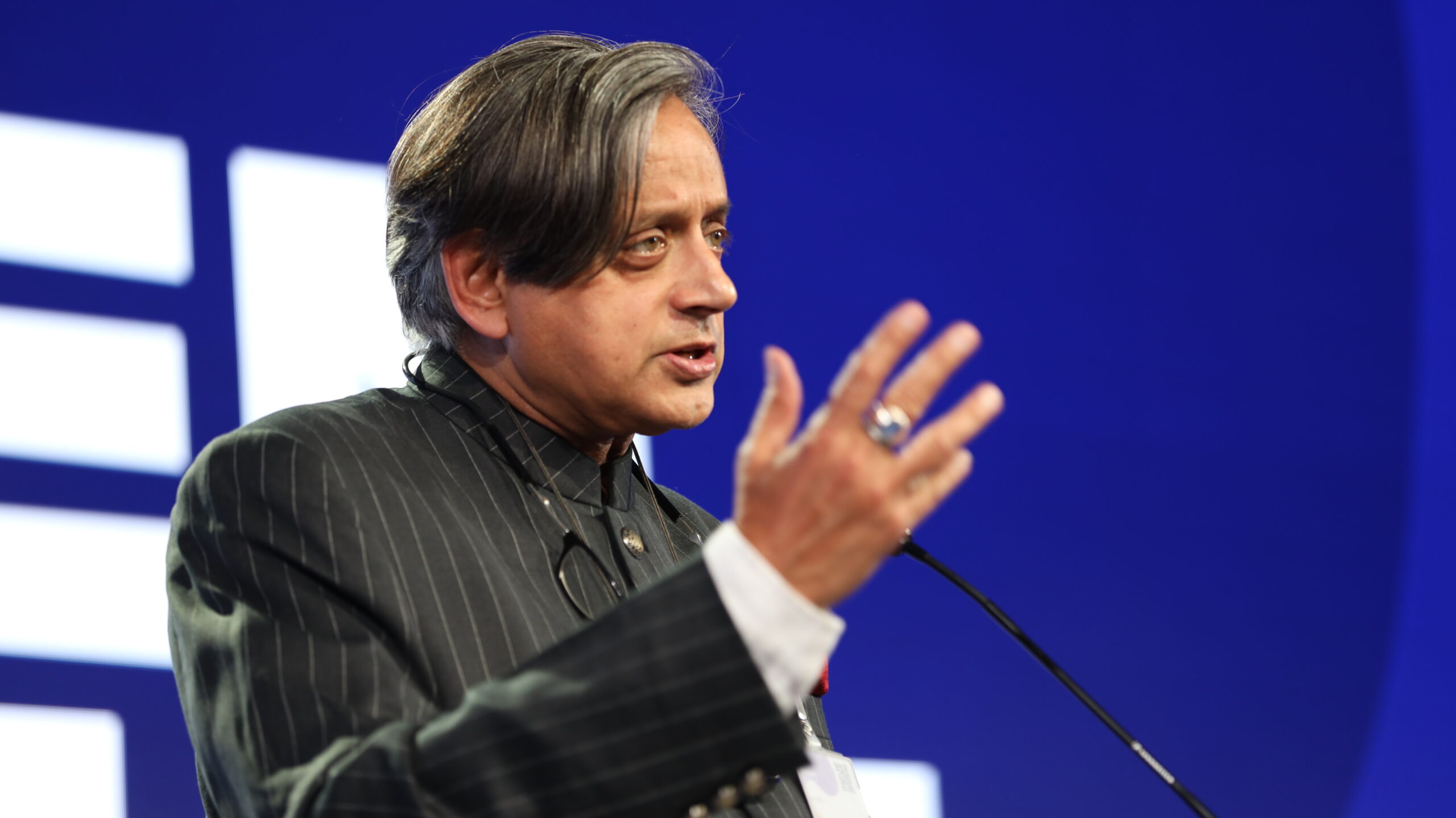
In Conversation with Dr. Shashi Tharoor
At a time when the global order is being reshaped by shifting power centres, technological disruption, climate urgency, and ideological polarization, few voices carry the intellectual clarity and global perspective of Dr. Shashi Tharoor. A diplomat, parliamentarian, author, and one of India’s most articulate global thinkers, Dr. Tharoor has spent decades engaging with the world’s most pressing questions—from multilateralism and democracy to culture, identity, and India’s place in a rapidly transforming international system.
In this wide-ranging and deeply reflective conversation with Danish Shaikh, Editor at The International Wire, Dr. Tharoor goes beyond headlines and soundbites to examine the deeper currents shaping our era. From the realities of a multipolar world and the future of global institutions, to digital sovereignty, climate leadership, migration, education, and the enduring power of pluralism, he offers a vision of India not merely as a rising power, but as a bridge-builder, norm-shaper, and moral voice in global affairs. Central to his thinking is the idea of the “well-formed mind”—a belief that critical thinking, empathy, and intellectual openness will define both India’s success and humanity’s survival in the decades ahead.
This interview is not just a discussion about India’s future; it is a meditation on how nations, societies, and individuals must adapt in an age of complexity—without losing their soul.
The Global Order: Multipolarity vs. Chaos
Question: Does a multipolar world bring more stability, or are we just entering an era of “organized chaos”?
Response: We have transitioned from the rigid bipolarity of the Cold War to a world that resembles the World Wide Web — a networked, multi-aligned landscape. While some see “chaos,” I see a transition where power is no longer concentrated in a few hands but distributed. Stability today doesn’t come from a single “policeman” but from a larger “high table” where more voices — including India’s — have a seat. It is not chaos; it is a more inclusive, albeit complex, rebalancing.
Strategic Partnerships: Alliances vs. Autonomy
Question: Should India prioritize formal alliances or stick to issue-based partnerships?
Response: India’s strength lies in strategic autonomy. We have moved beyond the “non-alignment” of the past to a proactive “multi-alignment.” In a networked world, we should be able to work with the US on technology, Russia on defence, and the Global South on development. We don’t need a “marriage certificate” (a formal alliance) to have a meaningful relationship; issue-based partnerships allow us to protect our national interest without becoming a vassal state.
Soft Power: The Greatest Asset
Question: In an age of AI and deepfakes, can “Soft Power” still be a country’s greatest asset?
Response: Soft power is not about conquering others; it is about being yourself and being attractive to others. While AI and deepfakes pose challenges to truth, they cannot replace the authenticity of culture, pluralism, and the “Indian story.” A country’s “brand” — including Bollywood, yoga, chicken tikka, democracy, and diverse voices — is a more enduring currency of influence than any algorithm. Soft power is what makes people want to work with you rather than being forced to.
Global Institutions: The 1945 Architecture
Question: Are global institutions like the UN still relevant, or are they relics of a bygone era?
Response: The UN is a patient where all doctors agree on the diagnosis but cannot agree on the prescription. The diagnosis is clear: the Security Council reflects the world of 1945, not 2026. It is absurd that the world’s most populous nation and fifth-largest economy (India) is not a permanent member. However, the UN remains the only “town hall” we have. We must reform it to make it relevant, or risk it becoming seen as a talk shop that the world eventually bypasses.
The Future: India’s Global Signature by 2040
Question: What will be India’s “global signature” by the year 2040?
Response: By 2040, India’s signature should be that of a “leading power” rather than just a “balancing power.” This means being a bridge-builder between the East and West, and a voice for the Global South. Our signature will be defined by our ability to provide a “well-formed mind” (not just a well-educated one) to our global workforce and by our leadership in climate diplomacy and digital public infrastructure.
Advice for Young Indians
Question: What is your one piece of advice for young Indians preparing for a global future?
Response: Focus on developing a “well-formed mind.” In an era where information is available at a click, what matters is the ability to think critically, synthesize information, and adapt to change. Don’t just learn a trade; learn how to learn. The world of tomorrow will value those who can navigate different cultures and technologies with empathy and intellectual curiosity.
Climate Change: Leadership, Not Just Liability
Question: Should the Global South prioritize economic growth over climate commitments?
Response: This is a false choice. The Global South is not a victim pleading for charity; it is a laboratory for innovation. From India’s solar parks to Brazil’s forest monitoring, we are proving that green growth is the only sustainable growth. However, the developed world must move beyond “sermons” to “support,” fulfilling their promises on technology transfer and climate finance. We seek partnerships based on shared survival, not a new form of ecological colonialism.
Digital Sovereignty: Avoiding “Digital Raj”
Question: Is the world entering a new era of “Digital Colonialism”?
Response: We must be wary of what I call “Digital Colonialism 2.0,” where data, platforms, and algorithms replace the East India Company. India must champion digital sovereignty. This doesn’t mean isolation—we are a democracy, not a “Great Firewall” state—but it means building our own Digital Public Infrastructure (DPI) like the India Stack. We must ensure our citizens’ data isn’t just a raw material for foreign tech giants, but a national asset for our own development.
Migration: A Force Multiplier
Question: Is the “Brain Drain” still a threat to developing nations?
Response: I prefer to see it as “Brain Gain” or “Brain Circulation.” Migration is not just a policy debate; it is a human story of aspiration. However, it must be a choice, not a necessity. When our brightest leave because of unemployment or lack of opportunity at home, it is a signal for internal reform. We must build an India where staying is as attractive as leaving, while ensuring that those who do go are treated with dignity abroad.
Language: The Tool and the Weapon
Question: Should India move away from English to reclaim its colonial-free identity?
Response: We should discard the mindset of slavery, not the language of the world. English in India is no longer a colonial hangover; it is an Indian language. We have taken the “Queen’s English” and made it our own—a tool for global trade, a bridge between our diverse states, and a weapon for justice. To reject English is to disarm ourselves in the global marketplace. Let us be rooted in our mother tongues, but proficient in the world’s lingua franca.
Democracy: The Threat of Lineage
Question: What is the biggest internal threat to Indian democracy today?
Response: Beyond the noise of partisanship, the real threat is dynastic politics. When leadership becomes a birthright rather than a merit-based achievement, the quality of governance suffers. We must trade “dynasty for meritocracy” across all parties. A healthy democracy requires internal party elections and a level playing field so that the “tea-seller” or the “scholar” has the same opportunity as the “son of the soil.”
Space Exploration: The New Frontier of Diplomacy
Question: Why should a developing nation spend on space missions like Gaganyaan?
Response: Space is not a luxury; it is a strategic necessity. Missions like Gaganyaan are powerful symbols of our ambition, but they also have practical dividends—from satellite-based agriculture to disaster management. Furthermore, it is a vital tool of space diplomacy, signaling that India is a partner for the future, not just a recipient of the past. Our “reach for the stars” inspires a generation to pursue science and innovation.
Pluralism: The Soul of India
Question: Can India remain secular in an increasingly polarized world?
Response: Pluralism is not just a constitutional choice; it is the very DNA of our civilization. India’s strength has always been its ability to be “one land of many truths.” Secularism in India doesn’t mean the absence of religion, but the “equality of all religions” (Sarva Dharma Sambhava). To challenge this pluralism is to challenge the very idea of India. We must reclaim Hinduism from the narrowness of “Hindutva” and return to its inclusive, humane roots.
Global Health: The Pandemic Treaty
Question: What is the most important lesson from the COVID-19 pandemic?
Response: That we are only as safe as the most vulnerable among us. While India’s “Vaccine Maitri” was a shining example of leadership, the world’s overall response was marred by “vaccine nationalism.” We urgently need a Global Pandemic Treaty—a legal framework to ensure that when the next virus strikes, we don’t descend into “every nation for itself.” Health must be treated as a global public good, not a commercial commodity.
The Future of Work: The AI Challenge
Question: Will AI exacerbate the global inequality gap?
Response: AI is a double-edged sword. It can either bridge the gap or widen it into a chasm. For India, the challenge is to use AI to augment our human potential, not replace it. We must lead in AI ethics and standard-setting to ensure the technology is used for social inclusion—delivering healthcare and education to the last mile—rather than just concentrating wealth in a few tech hubs.
Education: The Well-Formed Mind
Question: Is the current education system preparing students for 2040?
Response: We are still too focused on the “well-filled mind”—memorizing facts that Google knows better. We need the “well-formed mind”—one that can synthesize, analyze, and adapt. The future belongs to those who can “unlearn and relearn.” We must shift from rote learning to critical thinking, ensuring our youth are not just “literate” but “educated” in the truest sense of the word.
Regional Stability: The Neighbourhood First
Question: Can India reach its global potential if its neighbourhood remains unstable?
Response: You can choose your friends, but you cannot choose your neighbours. India’s global rise is inextricably linked to the stability of South Asia. We must be the “economic engine” of the region, offering our neighbours a stake in our growth. A “Neighbourhood First” policy is not just diplomacy; it is an investment in our own security and prosperity.
Economic Reform: Beyond the Numbers
Question: Is GDP the best measure of a nation’s success?
Response: GDP tells you the price of everything and the value of nothing. While economic growth is essential to lift millions out of poverty, it must be inclusive growth. A successful nation is measured not just by its billionaires, but by its “human development” markers—healthcare, nutrition, and the dignity of its poorest citizens.
Heritage: Reclaiming the Narrative
Question: How should India deal with its colonial history?
Response: We must study it to understand it, not to be imprisoned by it. We should demand an “atonement” of the mind—a recognition of the damage done—but we must not let bitterness define our future. We reclaim our narrative by being a confident, modern nation that knows its history but isn’t defined by its wounds.
Final Thought: The Indian Dream
Question: What is the “Indian Dream”?
Response: The Indian Dream is the belief that a child born in the humblest of circumstances can, through talent and hard work, rise to the highest echelons of global leadership. It is a dream of pluralistic prosperity, where our diversity is not a problem to be solved, but a strength to be celebrated.
Tharoor on the “Well-Formed Mind”
In this talk, Dr. Tharoor elaborates on why the ability to think critically is far more important for the future than the traditional “rote learning” found in many educational systems.

An author, politician and former international diplomat, Dr. Shashi Tharoor straddles several worlds of experience. At present a fourth-term Member of Parliament, he represents the parliamentary constituency of Thiruvananthapuram, Kerala, in the Lok Sabha. A proud member of the Indian National Congress (INC), he has served as a Minister of State for External Affairs and Minister of State for Human Resource Development in the Government of India during the second term of the United Progressive Alliance. At present the chairperson of the Parliamentary Standing Committee on External Affairs, he has previously chaired the Parliamentary Standing Committees on External Affairs (2014-19), Information Technology (2019-21) and Chemicals & Fertilizers (2021-24).


