


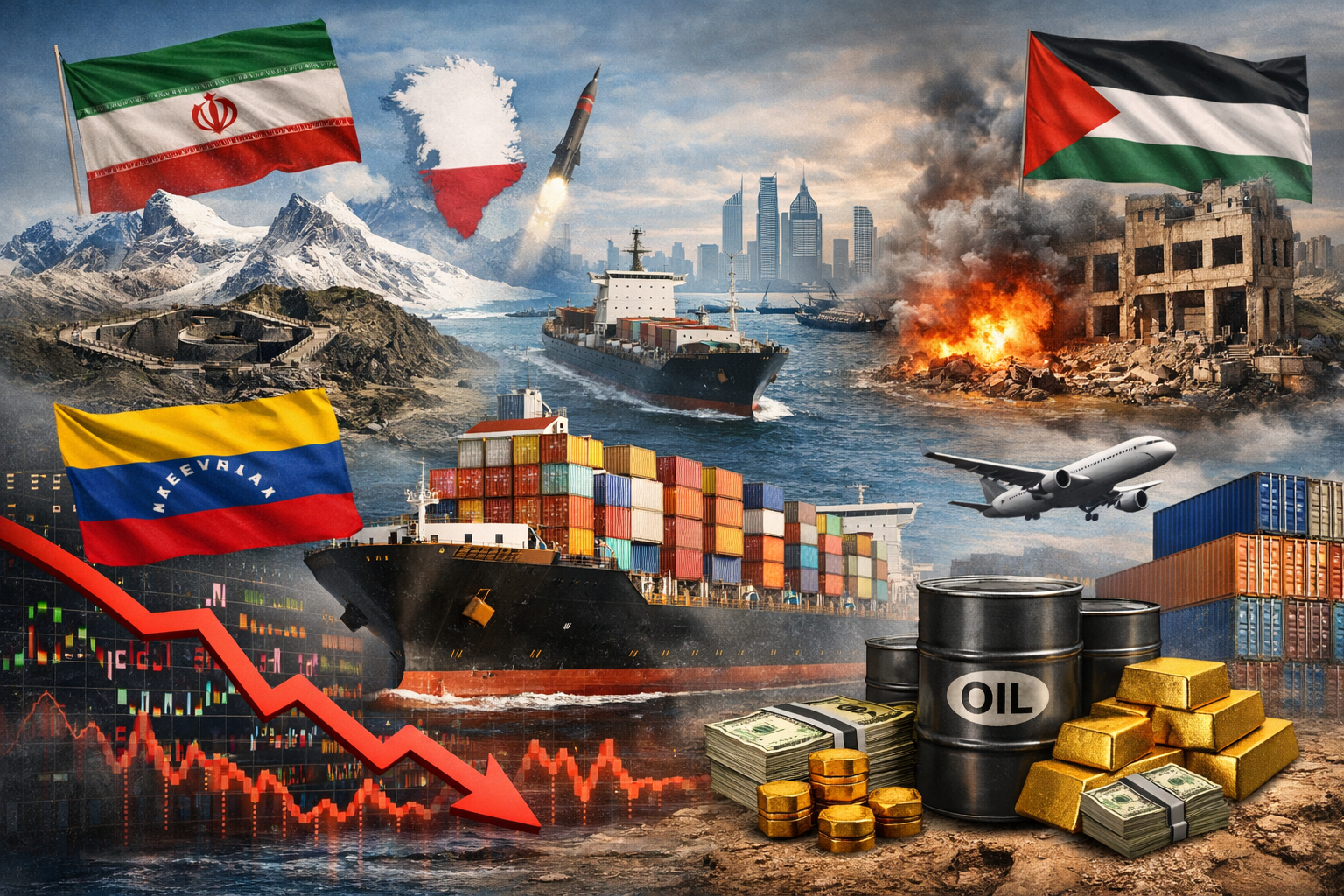
In 2026, the global economy is no longer driven only by interest rates, inflation data, and corporate earnings.
It is driven by geopolitics.
Political flashpoints are increasingly shaping the cost of energy, the flow of trade, currency stability, investor confidence, and even the strategic decisions of multinational corporations. And unlike past decades—when global markets absorbed political events as temporary “noise”—today’s world is different.
Because the global system is no longer stable.
We are entering an era of permanent geopolitical risk, where multiple conflicts overlap: territorial disputes, proxy wars, sanctions regimes, cyber warfare, and new forms of economic coercion. The result is not one big crisis—but many medium crises that continuously keep the world unstable.
Even the IMF has warned that tariff escalation and geopolitical tensions can materially harm global growth and investment.
This article explores how four major geopolitical hotspots—Greenland, Venezuela, Iran, and Palestine/Gaza—are likely to shape markets, corporations, and business strategy in 2026.
Not in theory.
But in practical terms: pricing, logistics, energy, investments, consumer sentiment, and corporate risk.
The Big Pattern of 2026: Geopolitics Is Becoming an Economic Tool
The defining reality of 2026 is this:
Politics is no longer separate from economics — politics is using economics as a weapon.
Sanctions, tariffs, export bans, investment restrictions, financial access control, and supply chain leverage are becoming regular instruments of national power.
And what markets hate most is not bad news.
Markets hate uncertainty—because uncertainty destroys forecasting.
That means even without all-out war, the mere threat of escalation (or retaliatory moves) creates a risk premium across asset classes.
This year’s geopolitical structure is also different because:
- the world is more fragmented into blocs
- trade is increasingly politicised
- shipping routes are less secure
- technology is more restricted
- capital flows are more cautious
So we are not just watching conflicts.
We are watching economic shocks created by political decisions.
1) Greenland: The New Strategic Frontier That Can Trigger Trade War Shocks
Greenland may sound distant to many investors—but in 2026, it has become a new symbol of global strategic conflict.
Recent market movements show how quickly Greenland-related tensions spilled into equity declines and safe-haven buying, with investors moving into gold and silver.
Why Greenland matters economically
Greenland is not just ice and geography. It is:
- a strategic Arctic position
- a defense/security asset
- a future shipping frontier (Arctic routes)
- rich in critical minerals/rare earths (strategic supply chains)
That makes it a geopolitical asset in the same category as:
- Taiwan (semiconductors)
- Middle East (energy chokepoints)
- Ukraine (security of Europe + grain + military balance)
The market impact channel: Tariffs and retaliation risk
What makes Greenland dangerous for markets is not the island itself—it is the mechanism being used.
When territorial or strategic goals become linked to tariffs, markets begin pricing a world where:
- trade rules can shift overnight
- retaliation becomes routine
- global supply chains get interrupted
- investor sentiment collapses
Reuters and other outlets have reported market volatility linked to tariff threats tied to the Greenland dispute.
Who gets hit first in markets
- European equities (especially exporters)
- automotive stocks and industrials
- defense sector volatility
- shipping/logistics uncertainty
- safe haven assets benefit (gold)
Company-level impact
If the Greenland tension turns into an EU–US tariff standoff, companies will face:
- uncertainty in pricing
- sudden import taxes
- disruption in procurement
- hesitancy in investment and expansion
The key point: Greenland becomes the symbol of a larger era:
Economic coercion becoming normalised.
2) Venezuela: Resource Politics, Border Risk, and the Oil Narrative
Venezuela matters not only because it has oil.
It matters because it sits at the intersection of:
- sanctions regimes
- political instability
- regional border tensions (especially involving Guyana)
- global energy supply fragility
In the Venezuela–Guyana dispute, the consequences stretch into oil markets and investment risk.
How Venezuela impacts markets in 2026
The Venezuela story impacts 2026 markets through three channels:
A) Sanctions and export flows
Changes in sanctions enforcement instantly reshape:
- global oil supply
- refinery inputs
- tanker flows
- price volatility
B) Guyana and offshore oil
Guyana’s rapid offshore growth makes this region even more valuable—and therefore more contested. Analysts have discussed how U.S. involvement can reshape risk perceptions and investment outlook in Guyana’s oil sector.
C) Political volatility = unreliable production
Even without major conflict, Venezuela’s instability means:
- less predictable output
- higher risk premiums
- more regional uncertainty
Corporate winners and losers
Winners
- energy trading firms (volatility rewards traders)
- defense/security contractors
- regional logistics providers
Losers
- energy-intensive manufacturing
- airlines and shipping firms (fuel volatility)
- insurers
3) Iran: The Global Oil “Red Button” and Strait of Hormuz Risk
Iran is the most important geopolitical “market lever” in 2026.
Because it directly affects the world’s most sensitive economic foundation:
Energy flows.
Even when markets appear calm, the Iran factor is always in the background because Iran holds a strategic pressure point: the Strait of Hormuz.
RUSI has discussed that Hormuz remains one of Iran’s key deterrent levers in an escalation environment.
What Iran means to markets
Iran escalation doesn’t need full-scale war to shock markets.
All it takes is any of the following:
- threat to tankers
- disruption to shipping insurance
- increased military activity near Hormuz
- sabotage incidents
- escalation involving Israel/US
Even if oil doesn’t explode upward immediately, the risk premium spreads everywhere:
- freight costs
- shipping delays
- insurance premiums
- inflation expectations
S&P Global has also assessed scenarios where prolonged US–Iran tensions can stress regional resilience—even if credit impact may remain contained in certain scenarios.
Industries most exposed
- airlines
- shipping lines
- petrochemicals
- logistics
- emerging market currencies
- global consumer goods (through inflation)
What businesses do in response
When Iran risk rises, businesses typically:
- increase inventory buffers
- add alternative suppliers
- hedge fuel exposure
- renegotiate shipping contracts
- build redundancy even at higher cost
This creates a paradox:
Geopolitical risk forces companies to “buy safety” — which increases costs and reduces efficiency.
4) Palestine/Gaza: Conflict That Spills Into Trade, Shipping, and Global Political Risk
The Gaza war and wider conflict environment is no longer purely a regional humanitarian crisis.
It has become:
- a geopolitical polariser
- a driver of regional tensions
- a trigger for shipping disruption
- a reputational risk for corporations
One clear economic spillover has been the Red Sea shipping disruption, which forced many companies and shipping lines to reroute around the Cape of Good Hope, raising costs and delaying deliveries.
How Gaza impacts markets in 2026
Not through “stocks falling because war exists.”
But through:
A) Red Sea disruption and supply chain inflation
The IMF has explained the Red Sea attacks reduced Suez traffic and increased delivery times by 10+ days, affecting businesses with limited inventories.
Reuters has reported on major shipping group CMA CGM scaling back Suez sailings again due to geopolitical risk and uncertainty.
That means:
- longer delivery cycles
- higher costs
- delayed production
- inventory pressure
B) Insurance premiums
War zones multiply costs:
- marine war risk insurance
- cargo insurance
- crew risk premiums
C) Consumer and reputational pressure
The Gaza conflict has raised reputational complexity for:
- consumer brands
- tech firms
- financial institutions
- logistics providers
Companies face pressure from:
- boycotts
- employee activism
- political scrutiny
This is the new corporate reality:
Modern conflict creates financial risk AND reputational risk at the same time.
What This Means for Markets in 2026 (Asset-by-Asset Impact)
1) Energy markets: More volatility than direction
Oil may not permanently rise, but it becomes more unstable.
Even Reuters has pointed out that Middle East conflict is not always producing the massive oil spikes it once did—suggesting markets have adapted.
But that does not mean oil risk is gone.
It means:
- supply is more diversified
- reserves and US production play stabilising roles
- demand cycles are changing
Yet geopolitical flashpoints still cause volatility—which impacts:
- inflation
- consumer spending
- central bank behavior
- corporate margins
2) Shipping/logistics: Higher cost baseline
Even if Red Sea tensions reduce, global shipping has entered a new era:
- rerouting is normal
- conflict risk is priced into contracts
- shipping resilience costs money
That raises the cost of globalisation.
3) Equities: Winners and losers split sharply
Geopolitical risk does not crash all markets equally.
It creates:
- dispersion
- sector rotation
- country divergence
Typical equity winners
- defense contractors
- cybersecurity firms
- energy producers
- commodities/miners
- domestic manufacturing
Typical equity losers
- export-heavy industrials
- automotive manufacturing
- airlines
- companies dependent on cheap supply chains
4) Safe-haven assets: Gold benefits from anxiety
Markets don’t buy gold because they love gold.
They buy gold because they don’t trust the world.
Recent market reactions to geopolitical tariff shocks have driven gold/silver to record highs.
What This Means for Companies (Boardroom Strategy in 2026)
If you’re a CEO or business leader in 2026, the message is clear:
geopolitics is now part of the operating model.
The 6 boardroom decisions every company is forced to revisit
- Supply chain concentration
- Is China-only / EU-only / Middle East-only exposure too risky?
- Inventory strategy
- JIT (Just-in-Time) becomes less reliable
- JIC (Just-in-Case) becomes more common
- Pricing power
- Can you pass cost increases to customers?
- Insurance and risk
- higher premiums
- more exclusions
- Currency exposure
- more FX volatility
- stronger USD cycles during crises
- Reputation management
- geopolitics affects brand trust
Conclusion: 2026 Will Reward Resilient Companies, Not Just Efficient Ones
The global political landscape in 2026 is not one crisis.
It is a collection of flashpoints that create continuous global pressure.
- Greenland represents trade coercion
- Venezuela represents resource geopolitics
- Iran represents energy chokepoint risk
- Palestine/Gaza represents regional spillover + shipping disruption + reputation risk
The result is a new economic reality:
Markets will move less on earnings and more on geopolitical shocks.
Businesses will compete less on cheapness and more on resilience.
Countries will fight less with armies and more with supply chains.
In the 2026 economy, winners will be those who treat geopolitical risk not as a news headline—but as a financial model.
Law, Power, and the Limits of Institutions: A Conversation on Governance in a Fragmenting World


