


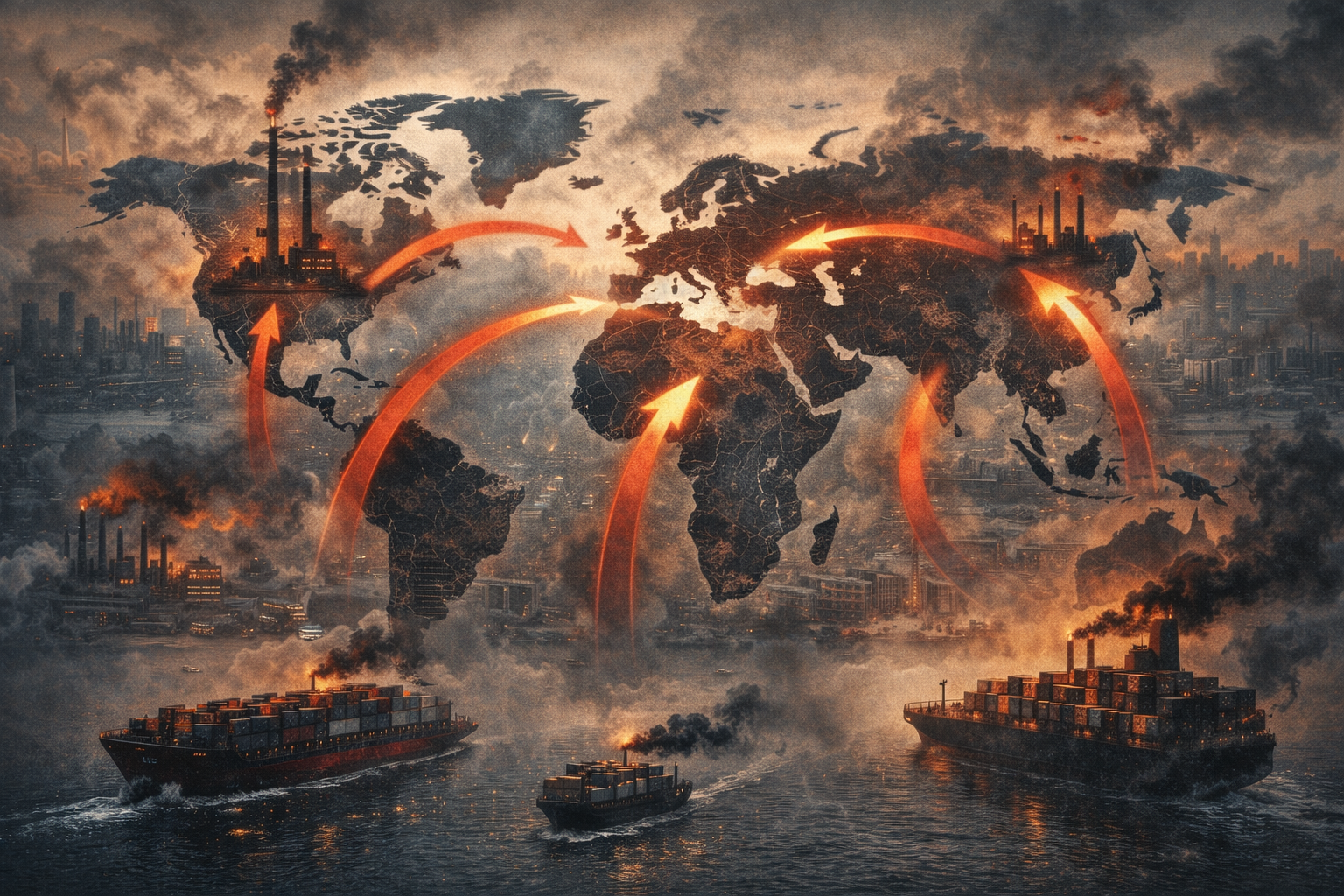
Global Pollution Politics: How Countries Shift Emissions Without Cutting Them
Global emissions have become the central metric by which governments judge their climate performance. Yet behind headline reductions lies a quieter, less visible trend: pollution is often shifted rather than eliminated. As countries tighten domestic regulations, emissions increasingly reappear elsewhere—embedded in imports, outsourced supply chains, or reclassified across borders.
This analysis examines six ways states manage to lower reported emissions without reducing global pollution. From carbon leakage and offshoring to accounting practices and regulatory arbitrage, the politics of climate action often reward territorial compliance over systemic impact.
The result is a paradox at the heart of global climate governance: national success can coexist with collective failure. Understanding how emissions are displaced rather than cut is essential to assessing whether current climate strategies address the problem—or merely move it.
This is the core reality of modern climate politics: countries can appear greener without becoming cleaner.
Pollution as Policy: Why Optics Matter More Than Outcomes
The politics of pollution allows states to signal progress without paying the full economic or electoral price of genuine transition.
Rather than restructuring energy systems, revising industrial supply chains, or reducing consumption, governments often choose the less disruptive route:
- shift dirty production abroad
- meet targets through accounting frameworks
- purchase offsets instead of cutting emissions
- reframe responsibilities in negotiations
The result is climate governance that rewards compliance optics — not necessarily environmental outcomes.
Case Study I: The EU–China Emissions Loop
The relationship between the European Union and China is one of the clearest examples of how emissions are displaced rather than reduced.
Over the past two decades, many EU countries have reported declining domestic emissions, reinforcing claims of climate leadership. Yet a significant portion of that decline coincided with the offshoring of carbon-intensive manufacturing to China and other industrial hubs.
Europe still consumes:
- electronics
- machinery and industrial inputs
- consumer products
- textiles and manufactured goods
But emissions are counted where goods are produced, not where they are consumed. That distinction creates a political advantage for both sides:
- Europe presents cleaner national emissions profiles
- China argues its emissions reflect production for global demand
The atmosphere, however, does not recognise national accounting rules.
Emissions embedded in trade remain emissions — regardless of geography.
Carbon Border Measures: Climate Tool or Trade Weapon?
Mechanisms like the EU’s Carbon Border Adjustment Mechanism (CBAM) attempt to correct the imbalance by pricing carbon in imports. But they also risk becoming instruments of strategic pressure — turning environmental governance into trade leverage.
Outcome: Pollution isn’t eliminated — it is rerouted, reclassified, and politicised.
Case Study II: The Global South and the Development Defence
In the Global South, pollution politics is shaped less by outsourcing and more by bargaining.
Many developing states argue — with historical justification — that climate constraints imposed by advanced economies function as a brake on development. After all, industrialised nations accumulated wealth during periods of unregulated emissions.
This creates a powerful negotiating posture:
- emphasis on historical responsibility
- arguments around per-capita emissions
- framing emissions cuts as conditional on finance, technology transfer, and extended timelines
Climate compliance becomes less a shared obligation and more a transactional process.
Domestically, this stance shields governments from the social and political costs of rapid transition: higher fuel prices, job losses in legacy industries, and infrastructure strain. Internationally, it shifts burden back to advanced economies.
But this approach carries its own strategic trap.
The longer action is delayed, the more climate damage accumulates in regions with:
- weaker resilience infrastructure
- vulnerable populations
- fragile food and water systems
The Paradox of Vulnerability
The politics of pollution produces a perverse incentive: those most exposed to climate harm are politically incentivised to delay action.
Outcome: Emissions become a tool of negotiation, not reduction.
Case Study III: Carbon Markets and “Paper Decarbonisation”
Carbon markets sit at the intersection of environmental ambition and political convenience.
Offset schemes allow governments and firms to compensate for emissions by purchasing credits tied to:
- forest conservation
- renewable projects
- methane capture
- “future” or “avoided” emissions
In theory, this lowers transition costs and accelerates progress. In practice, carbon markets often enable paper decarbonisation — meeting targets without reducing emissions at source.
The problem is structural:
- credits may be difficult to verify
- projects may not be “additional” (they might have happened anyway)
- permanence is uncertain (forests can burn, policies can change)
For policymakers, carbon markets are politically attractive because they preserve continuity in sensitive sectors such as:
- aviation
- cement and steel
- agriculture
- fossil fuel subsidies
Instead of becoming a hard constraint, pollution becomes a tradable variable.
Outcome: Emissions continue at home while reductions are claimed elsewhere.
Strategic Blind Spots: Selective Pressure in Environmental Governance
Environmental enforcement is also shaped by geopolitics.
Pollution standards are applied unevenly depending on strategic alignment:
- allies receive flexibility
- rivals face scrutiny
- environmental clauses increasingly overlap with strategic competition
Climate policy becomes entangled with trade policy, sanctions logic, and power rivalry. That blurring weakens trust in global climate governance. When pollution control looks like a tool of leverage rather than a shared obligation, international cooperation becomes harder to sustain.
Outcome: Climate diplomacy turns into another arena of strategic competition.
Assessment: Managing Narratives, Not Emissions
The persistence of global pollution is not primarily a failure of knowledge or technology. It is a failure of political alignment.
Governments have become sophisticated at managing environmental narratives through:
- outsourcing production
- carbon accounting frameworks
- offset markets
- diplomatic framing of responsibility
The politics of pollution offers short-term stability — economic continuity, electoral safety, diplomatic flexibility. But it does so by pushing the real costs into the future, when they will be:
- higher
- harder to manage
- less evenly distributed
Until pollution is treated less as a negotiable statistic and more as a material limit shared across borders, climate action will remain performative rather than transformative.


