


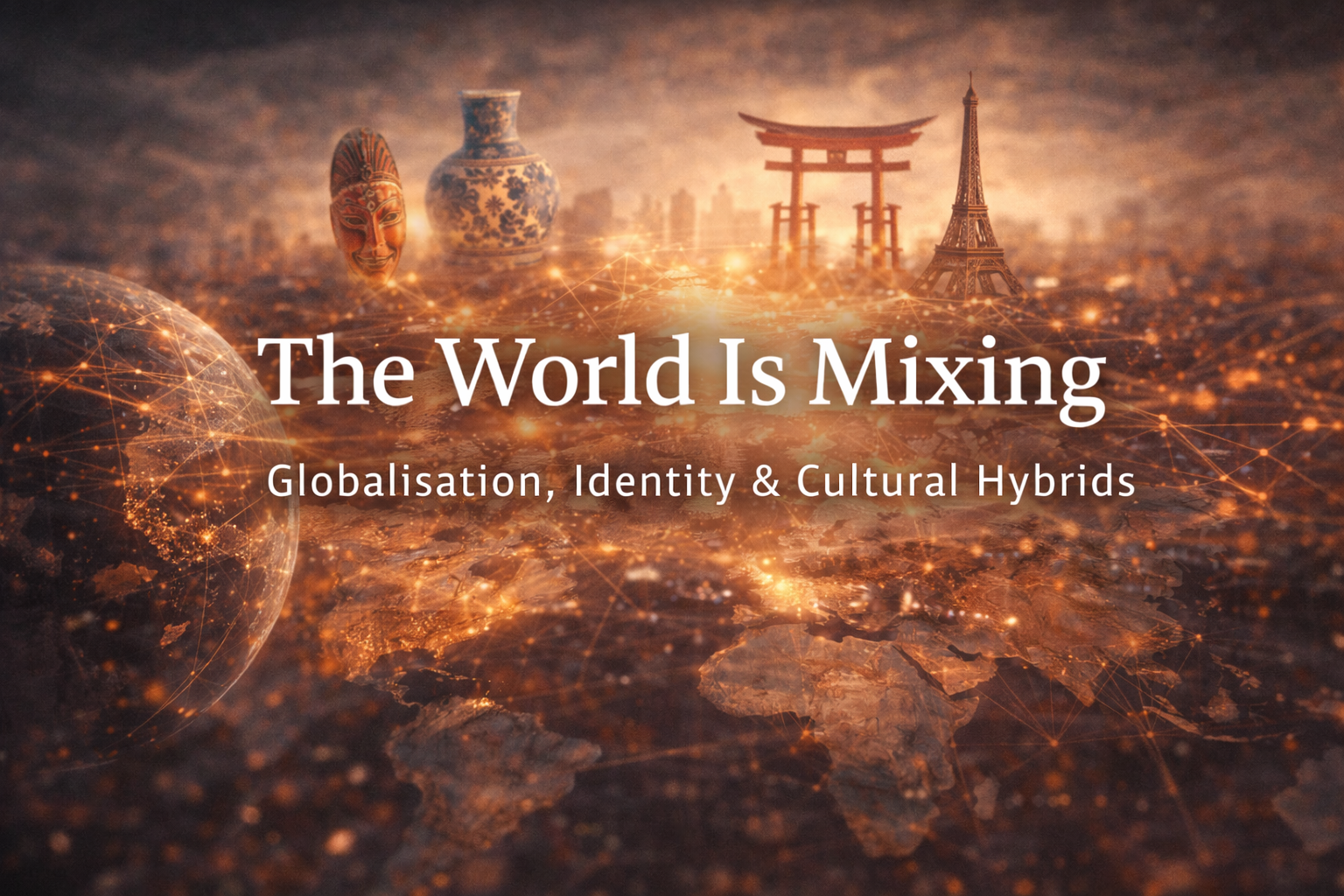
The Future of Identity in a Globalised World
Cultural Hybridity, Layered Identity and the Rise of the Hybrid Professional
For most of human history, identity was anchored to geography. Language, work culture, religion, and values were shaped by birthplace. Culture was inherited, stable, and slow to change.
That era is ending.
Today, globalisation is not merely economic — it is deeply personal. Identity itself is undergoing reconfiguration.
As cultural theorist Stuart Hall famously wrote:
“Identity is never singular but multiply constructed across intersecting and antagonistic discourses.”
In the 21st century, that insight has become visible everywhere.
Globalisation & Identity: From Roots to Cultural Layering
Globalisation has moved beyond trade agreements and capital flows. It now produces cultural hybridity, layered identity, and new forms of global citizenship.
People increasingly hold:
- A local cultural identity
- A professional global identity
- A digital identity shaped by borderless media
This is not cultural replacement. It is cultural layering.
Nobel laureate Joseph Stiglitz reminds us:
“Globalization is not a monolithic force but an evolving set of consequences — some good, some bad and some unintended.”
The unintended consequence? A generation defined by identity fluidity, not fixed categories.
We are witnessing a tension between cultural convergence vs divergence — global norms spreading, yet local identities asserting themselves more strongly than ever.
Migration & Education: The Engine of Identity Reconfiguration
Migration drives transnational identity and diaspora identity. Professionals who move abroad undergo deep cultural adaptation.
This produces:
- Bicultural identity
- Third culture individuals (TCIs)
- Cross-border professionals with high intercultural competence
But migration today is not permanent exile. It is often brain circulation, followed by reverse migration.
Graduates from the international education pipeline return home embedded in elite global networks. They bring:
- Global mindset
- Hybrid leadership instincts
- KPI-driven thinking
- Structured communication styles
Yet reintegration can produce reintegration shock — a clash between global habits and local expectations.
Globalisation reshapes not only careers, but belonging itself.
As Jawaharlal Nehru observed:
“Culture is the widening of the mind and of the spirit.”
For many diaspora professionals, that widening becomes permanent.
Cultural Hybridity in the Workplace
If migration reshapes identity slowly, multinational companies accelerate it.
The global workplace is a laboratory of organisational behaviour transfer and institutional culture export.
Multinational corporate culture often standardises:
- English-first corporate systems
- Global performance culture
- Structured feedback mechanisms
- Governance diffusion
- Workplace norm standardisation
This is corporate soft power in action.
Inside multinational teams, cultural friction emerges around:
- Authority and hierarchy
- Direct vs indirect communication
- Speed vs consensus decision-making
Over time, professionals develop cultural intelligence (CQ) — the ability to adapt across cultural environments.
The result? Hybrid management styles and cross-cultural leadership models.
Globalisation no longer just moves products.
It transfers behaviour.
Multinational Companies as Cultural Forces
Silicon Valley exports speed and innovation culture.
European firms export compliance and governance traditions.
Japanese firms export discipline and long-term planning.
This is organisational behaviour transfer at scale.
Many professionals become global not by migrating — but by working inside systems designed for global performance.
Corporate systems quietly shape values, communication norms, and leadership models. This is globalisation at the micro level.
Global Cities and Identity Evolution
Cultural transformation does not stop at office doors.
Global cities become hubs of:
- Talent mobility
- Urban cosmopolitanism
- Knowledge economy hubs
- International districts
- Lifestyle globalisation
As global business arrives, cities often develop parallel city cultures:
- The traditional local city
- The global corporate city
This phenomenon — sometimes described as corporate urbanism — reshapes social life, consumption habits, and aspiration models.
Identity becomes spatially layered, not just psychologically layered.
Cultural Hybridity: Strength and Strain
The rise of hybrid professionals produces real advantages:
- Broader worldview
- Reduced prejudice
- Stronger innovation
- Greater intercultural competence
- Adaptive leadership
This is the promise of post-national identity and global citizenship.
Yet there are pressures:
- Belonging crises
- Cultural dilution fears
- Generational tensions
- Social remapping within families
- Identity fatigue
Globalisation creates opportunity — but also emotional complexity.
The Rise of Hybrid Leadership
The future belongs to leaders who embody:
- Cultural intelligence
- Hybrid management styles
- Cross-cultural fluency
- Layered identity awareness
Hybrid leadership is not about abandoning roots. It is about navigating multiple systems without losing coherence.
In this world, identity is not erased.
It is edited.
The Future: Not One Culture, But Many in One Person
The world is not becoming culturally identical.
It is becoming culturally layered.
A person may carry:
- One culture at home
- Another at work
- A third shaped by digital networks
Globalisation is not homogenisation. It is identity reconfiguration.
Understanding how globalisation reshapes culture is central to understanding the future of societies, organisations, and leadership itself.
The most valuable skill of the coming decade may not be technical expertise alone.
It may be the ability to operate across identities — without losing one’s own.
That is the true meaning of cultural hybridity in the modern age.
January 2026: A Month in Review — Crises, Confrontation, and a World Reordering
- Iraq After Saddam: Regime Collapse, Occupation and the Long Shadow of State Failure
- The World Is Not Watching a Crisis Unfold — It Is Watching a Redesign
- What If the Biggest Hole in Global Climate Policy Isn’t Coal or Oil — It’s War?
- Diplomacy Is Not About Choosing Sides – It Is About Protecting Interests
- War in the Cloud


