


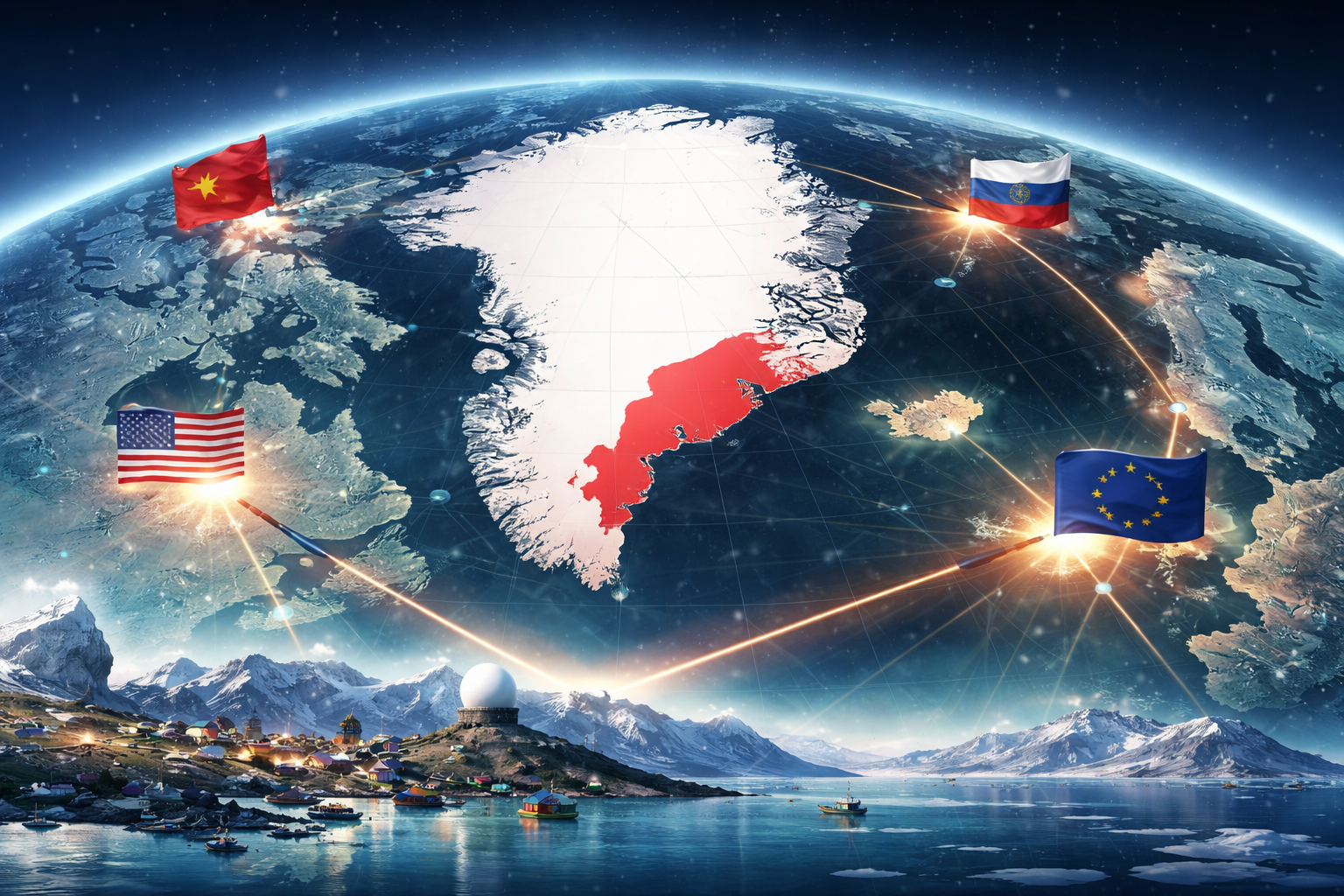
Greenland, the world’s largest island, is not just a remote Arctic landmass of ice and tundra, it is a political and strategic symbol of how 21st-century geopolitics intersects with questions of identity, autonomy, resources and great-power competition.
In recent years, Greenland’s political discourse has shifted from internal issues like fisheries and social welfare to questions of national self-determination and international alliances. At the same time, the island’s strategic location and natural riches have placed its politics at the centre of a broader geopolitical chessboard involving the United States, Europe, Russia, and China.
This article explores Greenland’s political system, the evolution of self-government, the independence debate, domestic party dynamics, and how external geopolitical interest is reshaping internal politics.
A Unique Political System: Autonomy within the Danish Realm
Greenland is an autonomous territory within the Kingdom of Denmark, governed under the Self-Government Act of 2009, which expanded powers beyond the earlier 1979 Home Rule system.
Democratic Structure
Greenland functions as a parliamentary representative democracy with:
- A head of government (prime minister),
- A unicameral legislature called Inatsisartut with 31 members,
- Governments typically formed by coalitions in a multi-party landscape.
Although Greenland manages most domestic issues — including education, healthcare, policing and economic policy — foreign policy, defence, security, and monetary matters remain with Denmark. Copenhagen also maintains ultimate authority in international affairs.
Greenlanders hold Danish citizenship, and the island is part of the broader North Atlantic Treaty Organization (NATO)through Denmark, though it is not a member of the European Union.
From the outset, autonomy has been a key part of Greenlandic politics, preserved in successive constitutional statutes and referendums.
The Independence Debate: Self-Determination vs. Pragmatism
While almost all major political parties officially support the idea of eventual independence from Denmark, there is significant disagreement over the timing and strategy.
In Greenland’s 2025 parliamentary election, the centre-right Demokraatit party — which favours a gradual path to independence — emerged as the largest party, tripling its parliamentary seats. Its leader, Jens-Frederik Nielsen, has emphasised building Greenland’s economy and institutions before attempting full independence. The pro-independence party Naleraq also gained ground, calling for faster self-determination, but they differ sharply on pace and tactics.
For many Greenlanders, independence remains a long-term aspiration but economic dependence on Danish subsidies and questions of defence capability are central constraints in the debate.
Political Parties and Domestic Issues
Greenland’s party politics revolve around questions of independence, economic development and social policy:
- Demokraatit — Centre-right, business-oriented, pragmatic about independence.
- Naleraq — Pro-independence party with a more assertive timeline.
- Inuit Ataqatigiit — Democratic socialist, environmentally oriented and historically pro-independence.
These parties, among others, negotiate coalition governments due to the island’s proportional representation system. Domestic concerns — from healthcare and fisheries to infrastructure and climate adaptation — often dominate legislative agendas.
Geopolitics on the Arctic Frontline
Even as internal politics evolve, external geopolitical interest is surging. Greenland’s vast territory is rich in rare earth minerals and potential hydrocarbon resources, assets that have made it a focal point for global powers.
Melting Arctic ice is also opening new strategic sea lanes and trade routes, amplifying Greenland’s importance in international security discussions.
In 2026, this geopolitical significance played out tangibly:
- The United States expressed renewed interest in greater strategic collaboration — even raising controversial talk about acquisition — prompting diplomatic pushback from Denmark and unified Greenlandic political resistance.
- Denmark responded by deploying extra troops and expanding Operation Arctic Endurance, a military exercise and presence operation, to reinforce Arctic security and sovereignty.
- Denmark’s prime minister reiterated that Greenland’s sovereignty is non-negotiable, emphasizing dialogue and respect for territorial integrity within NATO and allied forums.
- The European Union has moved to deepen cooperation with Greenland, exploring enhanced financial support and strategic partnerships while respecting Greenland’s autonomy — a move that reflects the broader EU interest in Arctic security and economic ties.
- Russia has weighed in rhetorically, framing Greenland’s status as tied to colonial legacies, though Moscow claims no territorial ambitions.
These developments illustrate that Greenland’s politics cannot be understood solely through internal governance — they are now inextricably linked to global power competition in the Arctic.
Identity, History and the Shadow of Colonialism
Political debates in Greenland are also shaped by history: the legacy of colonialism under Danish rule continues to influence national identity and aspirations for self-determination. Commentators note that collective memory — including past policies of cultural imposition — still fuels modern nationalism and demands for autonomy.
Representation of Greenlandic culture, language and rights remains a core political theme, underscoring that constitutional autonomy is also a question of identity and self-respect.
What Comes Next? Elections, Resources and Strategic Choice
Looking ahead, Greenland faces a unique political crossroads:
- Economically, diversification beyond reliance on Danish subsidies remains urgent, with debates on resource extraction, foreign investment and sustainable development.
- Constitutionally, the question of full independence — when and how — continues to shape political platforms and public debate.
- Strategically, Greenland’s politics are increasingly embedded in the Arctic power rivalries between major states and regional alliances.
As the island’s parliament evolves and its parties negotiate coalitions sensitive to both domestic desires and external pressures, Greenlandic politics exemplifies how small nations can occupy an outsized space in global politics — especially where geography, identity, and geostrategy intersect.
Conclusion: A Territory at the Strategic Crossroads
Greenland today is more than an autonomous territory within the Danish realm; it is a political actor navigating internal aspirations for self-determination, continental power interests, and the geopolitical currents of the Arctic age. Its politics reflect not just the choices of a small democracy, but the larger strategic recalibrations shaping global power in the 21st century.
Iran at the Edge: Protest, War, and the Future of the Islamic Republic


