


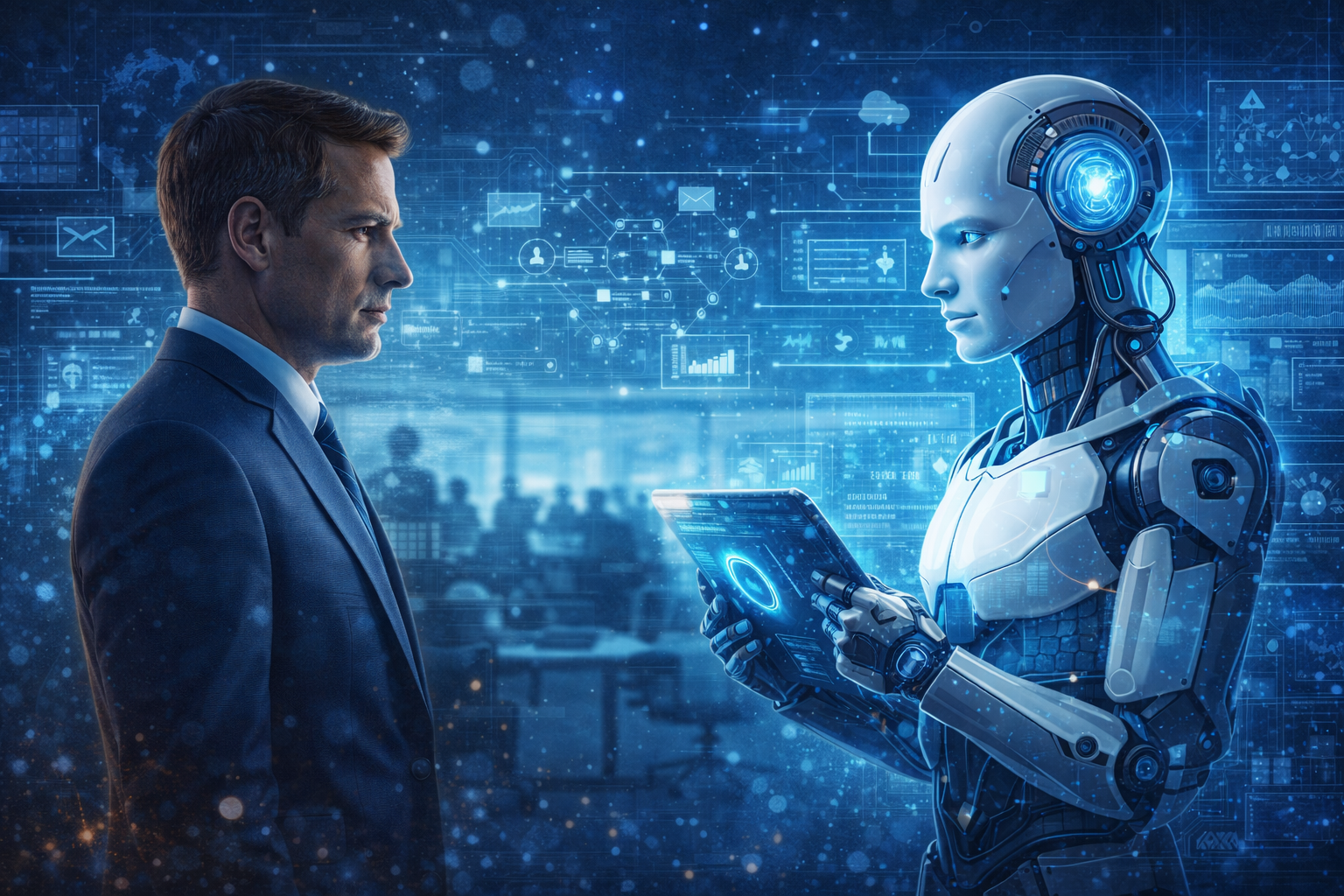
Is Artificial Intelligence about to take your job?
That was the unspoken question hanging over the India AI Impact Summit 2026 in New Delhi, India this February where presidents, prime ministers, tech billionaires, and UN leadership confronted the future of work in real time.
Their answers weren’t identical.
But together, they reveal how the world’s most powerful decision-makers see the AI revolution unfolding.
And what it means for you.
“AI Will Not Take Away Jobs”
Opening with confidence, Mukesh Ambani, Chairman, Reliance Industries, declared at the summit:
“We will prove that AI will not take away jobs. Rather, it will create new high-skill work opportunities.”
It’s a bold claim.
Supporters of this view argue that every technological revolution initially disrupts employment — but ultimately creates more value and new industries.
The printing press disrupted scribes.
Computers disrupted typists.
The internet disrupted retail.
Yet the global economy expanded each time.
But is AI different?
“Some Jobs Will Be Lost”
Former UK Prime Minister Rishi Sunak struck a more cautious note in Delhi:
“Some jobs will be lost. I think many more will be redesigned. I think history shows us that societies flourish when we manage that transition well.”
That final phrase is where the real story lies.
When we manage that transition well.
AI doesn’t automatically create prosperity. Institutions do.
If governments fail to retrain workers, modernize education, and build safety nets, automation can amplify inequality instead of opportunity.
“We Will Find Better Ones”
From inside the AI industry, confidence remains high.
Sam Altman, CEO, OpenAI, told the summit audience:
“AI will definitely impact the job market, but we always find new things to do, and I have no doubt we will find lots of better ones this time.”
“Better ones” implies higher productivity, creative leverage, and cognitive augmentation.
AI is already:
- Assisting doctors in diagnostics
- Helping lawyers draft briefs
- Supporting coders
- Accelerating research
The question isn’t just about replacement.
It’s about redesign.
Jobs That Didn’t Exist 20 Years Ago
Alphabet CEO Sundar Pichai reminded the Delhi audience how quickly labor markets evolve:
“AI will undeniably reshape the workforce, automating some roles, evolving others, and creating entirely new careers. 20 years ago, the concept of a professional YouTube creator didn’t exist. Today, there are millions around the world.”
Two decades ago:
There were no app developers.
No influencer marketing industry.
No cloud architects.
Entire economies can emerge within a generation.
AI may create professions we cannot yet name.
The Bigger Fear: Who Controls AI?
But the summit wasn’t just about jobs.
It was about power.
UN Secretary-General Antonio Guterres warned:
“The future of AI cannot be decided by a handful of countries, or left to the whims of a few billionaires.”
AI now influences:
- Defense systems
- Financial markets
- Energy grids
- Healthcare diagnostics
- Public administration
This is no longer just a tech story.
It is geopolitical infrastructure.
AI as a National Advantage
French President Emmanuel Macron framed AI as a civilizational accelerator:
“Artificial Intelligence will be an enabler for our humanity to innovate faster, to disrupt healthcare, energy, mobility, agriculture, and public services for the good of mankind.”
Countries that integrate AI into public systems will move faster.
Those that delay may fall behind.
Why India Matters
The summit in Delhi also highlighted India’s strategic ambition.
Adobe CEO Shantanu Narayen observed:
“Implications of AI in India will be greater than in other countries.”
And Prime Minister Narendra Modi made the intent unmistakable:
“Artificial intelligence marks a transformative chapter in human history. India is not just a part of the AI revolution, but is leading and shaping it.”
India’s scale, digital infrastructure, startup growth, and engineering workforce position it uniquely in the AI race.
If AI deployment accelerates across public services and industries, India could influence not just markets — but global AI norms.
Leaders and The Real Divide
The Delhi summit made one thing clear:
The future of work will not be decided by AI alone.
It will be decided by:
• Policy choices
• Education systems
• Workforce retraining
• Governance models
• Global coordination
Technology moves fast.
Institutions move slower.
The gap between the two will define the next decade.
And the AI revolution is already underway.
AI vs the C-Suite: The Silent Power Shift Inside Modern Companies
- Iraq After Saddam: Regime Collapse, Occupation and the Long Shadow of State Failure
- The World Is Not Watching a Crisis Unfold — It Is Watching a Redesign
- What If the Biggest Hole in Global Climate Policy Isn’t Coal or Oil — It’s War?
- Diplomacy Is Not About Choosing Sides – It Is About Protecting Interests
- War in the Cloud


