


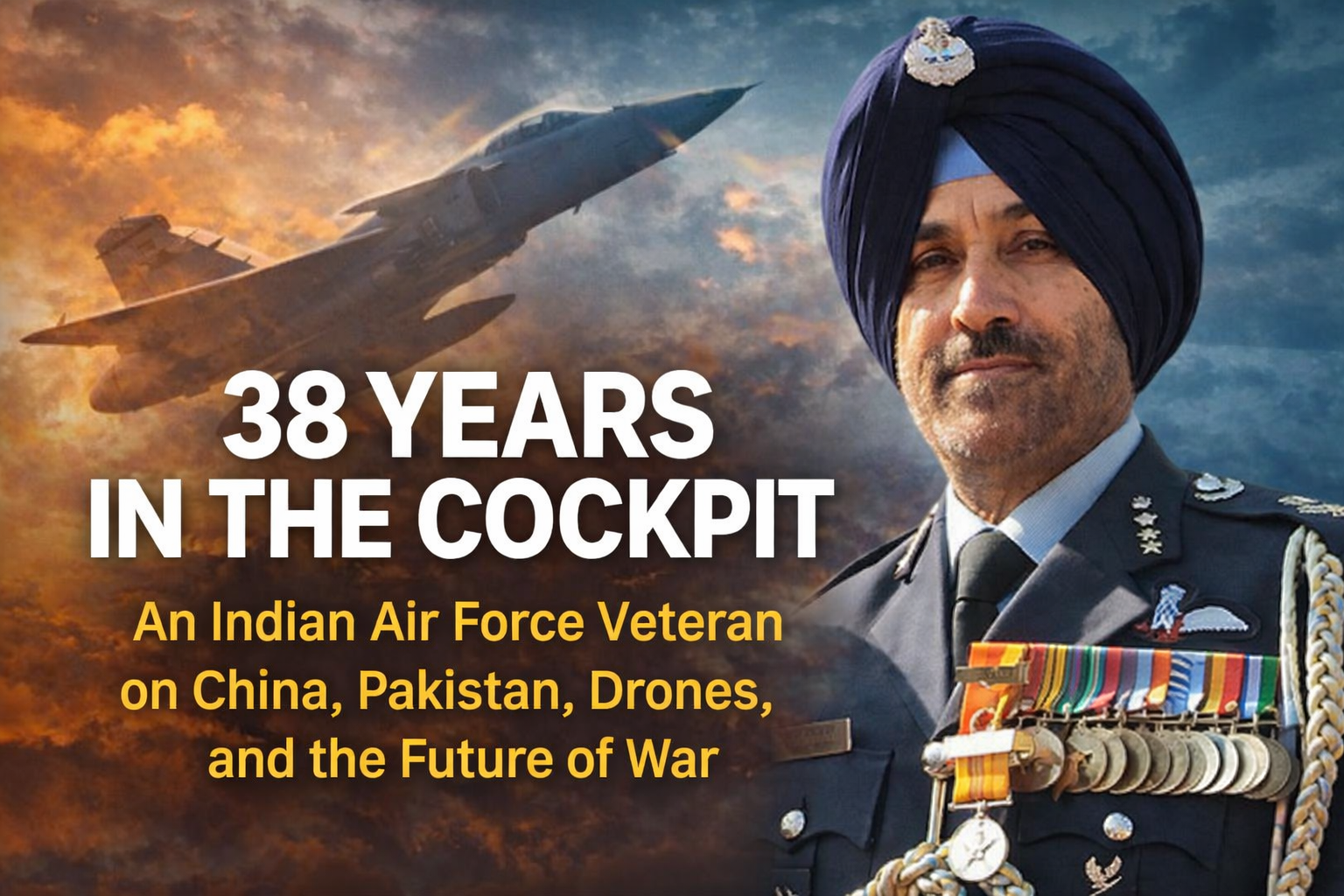
Air Marshal GS Bedi on the IAF, drones, China, Pakistan, space warfare, and the future of Indian air power
In conversation with Air Marshal GS Bedi (Retd.), AVSM, VSM, Former Director General, Inspection & Flight Safety, Indian Air Force | Former Senior Air Staff Officer, Eastern Air Command, Distinguished Fellow, Centre for Air Power Studies & CLAWS | 3,700+ Hours Flying | Fighter Combat Leader Interviewed by Danish Shaikh, Editor, The International Wire
In the architecture of national power, few instruments are as simultaneously visible and opaque as air power. Visible because the fighter jet — screaming over a contested frontier at low altitude, launching a precision strike deep inside adversary territory, establishing air superiority over a battlefield — is among the most dramatic expressions of state power in the modern era. Opaque because the doctrine, the capability, the gaps, and the strategic logic that govern its use are among the most carefully guarded dimensions of any nation’s defence establishment.
Air Marshal GS Bedi spent 38 years inside that architecture — as a fighter pilot, a combat leader, a qualified flying instructor, a base commander, a peacekeeping mission commander in the Democratic Republic of Congo, the Senior Air Staff Officer of Eastern Air Command, and finally as Director General of Inspection and Flight Safety for the entire Indian Air Force. He accumulated over 3,700 flying hours, participated in active conflict, and chaired policy committees whose decisions shaped the operational posture of one of the world’s largest and most complex air forces.
Since retiring in April 2022, he has not retreated from the arena. He is a Distinguished Fellow at the Centre for Air Power Studies and the Centre for Land Warfare Studies, advises multiple defence technology companies at the cutting edge of drone technology, space capability, and quantum systems, and has been one of the most consistent and direct public voices on the gaps between India’s security requirements and its current capability — particularly in the domain of counter-UAV systems, where he has argued that private industry has not merely an opportunity but a national obligation to act.
The drone revolution has changed warfare more fundamentally in three years than air power technology changed in the previous three decades. India’s response — in doctrine, in procurement, in industrial capacity — needs to match the pace of that change. It has not yet done so.
His intervention on the China-Bangladesh UAV manufacturing partnership — pointing out that a country sharing 4,096 km of border exclusively with India would be the primary theatre for any UAV capability so developed — is characteristic of his analytical style: precise, direct, strategically grounded, and uncomfortable to ignore.
In this exclusive interview with Danish Shaikh, Editor of The International Wire, Air Marshal Bedi speaks with authority and candour about the IAF’s two-front challenge, the drone revolution and India’s counter-UAV gap, the growing Chinese air threat along the LAC, the lessons of Balakot, India’s space warfare capability, the Atmanirbhar Bharat defence programme’s progress and limitations, the Iran crisis and its implications for Indian strategy, and what India’s air power doctrine needs to become to meet the challenges of the next decade.
What follows is a rigorous, technically grounded, and strategically frank conversation — from the cockpit to the command centre — about what it means to defend India’s skies in an era when the nature of aerial threat is being transformed faster than any institution can comfortably absorb.
38 YEARS IN THE COCKPIT AND COMMAND
Air Marshal Bedi, you were commissioned as a fighter pilot on 8 June 1984 and retired as an Air Marshal in April 2022 — 38 years of continuous service spanning the transformation of the IAF from a largely Soviet-equipped force to one of the world’s most complex and capable air forces. What was the IAF when you joined, and what had it become when you left — and what was the most fundamental change you witnessed across that arc?
When I was commissioned in 1984, the IAF was predominantly a Soviet-equipped, platform-centric force, focused on manned fighters, massed formations, and visual or semi-visual engagements, with limited networking and rudimentary precision. By the time I retired in 2022, it had become a far more networked, sensor-rich, and multi-domain force, operating beyond-visual-range air combat, precision strike, space-based enablers, and integrated air defence within a joint framework. The most fundamental change I witnessed was the shift from platform-centric thinking to network- and information-centric operations, where data, connectivity, and decision speed matter as much as the aircraft themselves.
You have logged over 3,700 hours of flying, are a qualified flying instructor, and served as a fighter combat leader. For those outside the military, describe what that flying experience gives you — as a strategist, as a commander, and as an analyst — that no amount of classroom education or policy study can replicate.
Flying 3,700-plus hours in fighters teaches you something no classroom can: the unforgiving nature of time, energy, and risk in three dimensions. It hardwires discipline, situational awareness, and respect for physics in a way that directly informs strategy and command decisions. As a strategist and analyst, that experience acts as a constant reality check — you instinctively know what is tactically feasible, what is survivable, and what looks good only on PowerPoint.
You served in an active conflict during your career. Without compromising operational details you cannot discuss, what does actual combat experience change about how an officer thinks about war, deterrence, and the cost of military action — compared to the officers who have studied these questions only in theory?
Actual combat removes any romanticism about war; it replaces theory with the cold arithmetic of lives, time, and odds. It makes you far more cautious about escalation and collateral damage, but also more decisive when force is genuinely required because you understand the cost of hesitation. Officers who have seen combat tend to view deterrence less as rhetoric and more as a delicate balance between credible capability, political resolve, and the very real human cost of using that capability.
THE INDIAN AIR FORCE: CAPABILITY, GAPS & THE TWO-FRONT CHALLENGE
India faces what strategists describe as a two-front challenge — the possibility of simultaneous or sequential military pressure from both Pakistan and China. The IAF is the instrument most immediately relevant to both fronts. In your honest assessment, is the IAF currently sized, equipped, and structured to manage that challenge — and where are the most significant capability gaps?
For a genuine two-front contingency, the IAF is doing its best with what it has, but it is not optimally sized or equipped for sustained, high-intensity operations against both Pakistan and China simultaneously. The fighter strength is below authorised levels, the air defence grid and ISR coverage still have gaps, and munitions stockpiles for a long war remain a concern. The most significant gaps are: inadequate fighter squadron strength, limited numbers of force-multipliers (AWACS, tankers, ISR platforms).
The IAF’s fighter fleet has been declining in squadron strength for years, with retirements outpacing inductions. The Tejas programme has moved forward, but the target of 42 squadrons remains distant. How serious is that numerical deficit — and is quantity still relevant in the era of fifth-generation air combat, or has qualitative superiority per platform become the decisive metric?
The numerical deficit is serious because air power is about persistence as much as performance; you need enough squadrons to rotate, absorb attrition, and maintain pressure. The IAF today operates around 29–31 fighter squadrons against an authorised strength of 42, and that gap cannot be wished away. Quality per platform — sensors, weapons, stealth, networking — is increasingly decisive, but quantity still has a quality of its own; you need both mass and sophistication to credibly deter on two fronts.
India’s air defence architecture — ground-based air defence, the integration of the S-400, and the question of interoperability between different systems and services — has become increasingly complex. How would you assess its current state, and what are the critical vulnerabilities an adversary would seek to exploit first?
India’s air defence architecture is far more capable than it was a decade ago, with systems like the S-400 adding much-needed depth, but it is also more complex and therefore more demanding to integrate. Critical vulnerabilities an adversary would target first include our sensors and networks (radars, data links, communications), the seams between different systems and services, and high-value nodes such as AWACS, air bases, and command-and-control centres. The challenge is to move from a collection of strong individual systems to a truly fused, resilient, all-weather, multi-layered air defence network.
You served as Director General of Inspection and Flight Safety for the IAF — responsible for supervising the operational health and aerospace safety of the entire force. The IAF has faced serious criticism over its accident and loss rates, including the loss of the Chief of Defence Staff in a helicopter accident. What are the structural causes of those safety challenges, and what would a serious reform of aerospace safety culture in the IAF require?
Safety challenges in the IAF arose from high utilisation of ageing platforms, which are being replaced now with latest acquisitions, and sometimes an operational culture that still rewards “mission first” more visibly than “safety always.” A serious reform of aerospace safety would require three things: uncompromising data-driven safety oversight, a just but transparent reporting culture, and leadership that treats safety performance as co-equal with operational performance in promotions and appointments.
The IAF has been a consistent advocate for greater jointness — integrated theatre commands, combined operations planning, and a CDS-driven architecture that reduces inter-service duplication. As someone who served at the most senior levels, how is that integration actually progressing, and where does institutional resistance still prevent the jointness that India’s security environment demands?
Jointness has improved — we now plan and exercise far more with the Army and Navy than in earlier decades — but the move to fully integrated theatre commands is still work in progress. To meet our security environment, we need joint planning, joint capability development, and joint training to become the norm, not the exception.
DRONES, COUNTER-UAV & THE NEW BATTLEFIELD
You have written forcefully about China’s plans to boost UAV manufacturing capacity in Bangladesh — with a 4,096km India-Bangladesh border and obvious implications for India’s security. How serious is the China-Bangladesh UAV partnership as a strategic threat, and what should India’s response be — diplomatically, militarily, and industrially?
The China–Bangladesh UAV partnership is strategically serious because it embeds Chinese technology and influence on a border that is 4,096 km long and exclusively with India. A local UAV manufacturing base in Bangladesh, with Chinese technology transfer, can over time create surveillance and strike options along our eastern and northeastern approaches that complicate our air defence posture. India’s response must be threefold: diplomatically, to communicate red lines and raise the cost of militarised use; militarily, to strengthen ISR and counter-UAV coverage in the east; and industrially, to accelerate our own UAV and counter-UAV ecosystem so we are not reacting from a position of weakness.
You have argued that India needs credible counter-UAV capability across all domains, and that private industry has both an opportunity and an obligation to build it. What is the current state of India’s counter-UAV ecosystem — and what are the specific gaps between what PSUs can deliver and what the threat environment demands?
India’s counter-UAV ecosystem is improving, with DRDO–industry collaborations and some promising private solutions, but it is still patchy and skewed towards point defence rather than theatre-level, layered coverage. PSUs can deliver large, capital-intensive systems, but they tend to be slower, less agile, and less open to rapid iteration than the threat environment requires. The gaps lie in rapid deployment, scalable production, AI-enabled detection and targeting, and the ability to integrate multiple sensors and effectors — hard-kill and soft-kill — into a common operating picture across services.
The conflicts in Ukraine and the Middle East have demonstrated that cheap commercial drones, first-person view racing drones, and loitering munitions have fundamentally changed the tactical equation on the battlefield — making traditional armoured formations, artillery positions, and even air defence assets extraordinarily vulnerable. How has the IAF adapted its doctrine, training, and procurement to this new reality?
The IAF has begun adapting its doctrine and training by incorporating counter-drone scenarios into exercises, investing in electronic warfare, and experimenting with its own UAVs and loitering munitions. But the scale and speed of the drone revolution — as seen in Ukraine and the Middle East — means we are still catching up; doctrine, procurement, and training cycles remain slower than the innovation cycles of cheap commercial drones and FPV systems. We need to normalise the assumption that every battlefield — including airbases and logistics hubs — is permanently under drone and loitering munition threat.
Q4. Drone swarms — coordinated attacks by multiple autonomous or semi-autonomous UAVs — represent a challenge that traditional air defence systems were not designed to counter. India has already experienced drone attacks on the Jammu Air Force station in 2021. What does a credible defence against drone swarm attacks look like, and what would it cost to build?
A credible defence against drone swarms must be layered, automated, and scalable: early warning sensors, electronic warfare, directed-energy weapons, point-defence guns and missiles, all tied together by AI-assisted command-and-control. It is not cheap, because you are essentially replicating an air defence system scaled down and sped up for very small, very numerous targets; the real cost, however, is in the sensors, networking, and software that must process huge target sets in real time. India will have to prioritise protecting critical assets and corridors rather than attempting blanket coverage.
The line between military and civilian drone technology has effectively dissolved — a DJI Phantom modified with a grenade is a weapon system. How should India regulate the civilian drone ecosystem in ways that preserve its enormous commercial potential while closing the security vulnerabilities it creates?
The dissolution of the military–civilian drone boundary demands a regulatory framework that is permissive for genuine commercial use but unforgiving of security lapses. That means robust registration, geo-fencing, mandatory remote ID, graded no-fly zones, and strict penalties for violations, coupled with incentives for industry to build security features as a default. If we do not secure the civil drone ecosystem, every urban and border area will offer adversaries a menu of exploitable vulnerabilities.
Beyond the immediate tactical threat, what is the strategic significance of the drone revolution for India’s defence posture? Does it fundamentally change the calculus of deterrence — making sub-conventional conflict more attractive for adversaries, lowering the threshold for attacks, and complicating escalation management in ways that the current doctrine has not fully absorbed?
Strategically, the drone revolution lowers the cost and risk of initiating violence, which can make sub-conventional conflict more attractive to our adversaries. Small, deniable, disposable systems make it easier to harass, probe, and test our responses without crossing traditional thresholds. Unless our doctrine explicitly addresses drone-enabled grey-zone tactics and escalation control, we will find ourselves reacting piecemeal to a continuous spectrum of low-cost provocations.
CHINA: AIR POWER, THE LAC & THE STRATEGIC COMPETITION
You served as Senior Air Staff Officer of Eastern Air Command — the command covering the entire northeastern frontier with China, including Arunachal Pradesh, Sikkim, and the Siliguri Corridor. Having commanded at that level, how do you assess China’s air power development along the Tibetan Plateau, and how has the military balance in the air domain along the LAC changed since Galwan?
From the vantage point of Eastern Air Command, China’s air power along the Tibetan Plateau has become progressively more capable since Galwan, with better bases, hardened shelters, and more modern aircraft deployed forward. While altitude still imposes performance penalties on their fighters, their overall capacity for sustained operations near the LAC has improved. The balance has shifted from primarily defensive posturing to a mix that now includes credible offensive options against our airbases, logistics, and ground forces.
China’s J-20 fifth-generation fighter is now operational in meaningful numbers, and China is developing the J-35 for carrier operations. India’s fifth-generation programme — the AMCA — is years from operational deployment. How does India manage the growing qualitative gap in air combat capability against China in the interim period?
China’s fielding of the J-20 and progress on the J-35, combined with its large fourth-generation fleet, creates a qualitative and quantitative challenge that India cannot fully match in the near term. In the interim, we must rely on superior training, tactics, integration with ground-based air defence, and optimised use of our geography, while accelerating the AMCA and other force-multipliers. The gap can be managed, but only if we are brutally realistic about timelines and avoid further delays in indigenous programmes and critical imports.
China has invested massively in high-altitude infrastructure — roads, railways, logistics bases, and forward air bases on the Tibetan Plateau — that have transformed its ability to sustain high-tempo air operations along the LAC. Has that infrastructure investment fundamentally changed India’s defensive calculus in the air domain?
Chinese high-altitude infrastructure — roads, rail, logistics hubs, and airbases — has fundamentally improved their ability to surge and sustain air operations along the LAC. For India, this means we must plan for faster Chinese mobilisation, higher sortie rates, and the possibility of coordinated, multi-axis pressure. Our defensive calculus must therefore include dispersed basing, rapid repair capability, hardened infrastructure, and pre-positioned stocks to sustain high-tempo operations of our own.
The People’s Liberation Army Air Force has been transforming from a predominantly defensive force to a force capable of sustained offensive power projection. What does that transformation mean for India’s threat assessment, and what are the specific PLAAF capabilities that concern you most?
The PLAAF’s transformation into an offensive, power-projection force means India must think beyond border skirmishes and prepare for deeper, more complex air campaigns. Capabilities that concern me most are: integrated air defence networks, long-range precision strike, electronic warfare, and the ability to coordinate air, missile, and cyber operations as a single package. Together, these can stress our air bases, networks, and decision-making in the opening hours of a conflict.
Electronic warfare, cyber operations, and the jamming and spoofing of GPS and communications networks have become integral to Chinese military doctrine. India’s dependence on GPS and satellite communications for precision navigation and strike is significant. How vulnerable are IAF operations to Chinese electronic warfare, and what is being done to address that vulnerability?
Chinese doctrine gives heavy weight to electronic and cyber warfare, including jamming, spoofing, and attacks on satellite-based services. The IAF’s growing dependence on satellite navigation and communications does create vulnerabilities, especially for precision strike and networked operations. We are addressing this through hardened communications, alternative navigation aids, and greater EW training, but the reality is that we must be prepared to fight in a degraded-space, degraded-GPS environment from day one.
PAKISTAN: AIR POWER, F-16S & THE ESCALATION LADDER
The Balakot airstrikes of February 2019 and the aerial engagement that followed — in which India lost a MiG-21 Bison and Pakistan lost an F-16 — was the first air combat between nuclear-armed states in history. As someone with deep expertise in air operations, what were the key lessons of that engagement for the IAF — operationally, tactically, and in terms of escalation management?
Balakot and the subsequent engagement were a watershed: they showed that calibrated air power could be employed against a nuclear-armed adversary without automatic escalation to full-scale war. Operationally, it highlighted the importance of robust ISR, precision weapons, and clear political–military communication. Tactically, it underscored the need for better situational awareness, electronic warfare, and platform modernisation to ensure that legacy aircraft are not pushed beyond the risk threshold.
The United States’ decision to supply Pakistan with upgraded F-16s and associated weapons systems has consistently drawn Indian protest. What is the actual operational significance of those platforms in the India-Pakistan air balance — and how should India factor the F-16 fleet into its threat assessment and operational planning?
Pakistan’s upgraded F-16s, with modern radar and BVR missiles, remain its most capable air combat platforms and must be treated as such in our planning. Their presence complicates our air campaign design, especially in contested airspace near the border, but they do not negate our broader advantages in numbers, diversity of platforms, and strategic depth. The right response is not panic, but continued investment in our own BVR capability, electronic warfare, and integrated air defence.
Pakistan’s air force has been modernising with Chinese support — the JF-17 Thunder programme, the J-10C acquisition, and now the broader China-Pakistan defence relationship that encompasses missiles, air defence, and potentially electronic warfare. How is the IAF assessing and responding to the progressive Sinification of Pakistan’s air power?
Pakistan’s modernisation with Chinese support — JF-17, J-10C, and associated systems — is part of a larger pattern of “Sinification” that brings PLAAF tactics, training, and technology into the subcontinent. The IAF must treat this as a combined China–Pakistan air ecosystem, not two separate problems, because interoperability between them will grow over time. That means our countermeasures, EW libraries, and operational concepts must account for Chinese-origin systems on both fronts.
India and Pakistan are both nuclear-armed states with air delivery as one of the primary vectors for nuclear weapons. How does the nuclear dimension affect IAF operational planning — the no-first-use policy, the targeting doctrine, and the challenge of maintaining credible conventional air power options without inadvertently crossing the nuclear threshold?
The nuclear dimension imposes hard political limits on target selection, depth of penetration, and duration of high-intensity operations. Our no-first-use policy and strict civilian control ensure that conventional air operations are deliberately separated from nuclear planning, but the risk of misperception remains. The IAF must therefore design conventional options that are militarily effective yet carefully calibrated in scale and messaging, to avoid inadvertently triggering nuclear signalling or panic.
SPACE, SATELLITES & THE NEXT DOMAIN OF CONFLICT
You have been actively involved in the field of indigenous space capabilities. Space has become the fourth domain of military competition alongside land, sea, and air. Where does India currently stand in military space capability — and what are the most critical gaps relative to China’s rapidly expanding space warfare programme?
India has built respectable military space capabilities in ISR, communications, and navigation, but we lag China in the breadth, redundancy, and militarisation of space assets. Our key gaps are in persistent, high-resolution surveillance, dedicated military communications constellations, space situational awareness, and resilience measures like redundancy and rapid replacement. As our forces become more networked, the cost of these gaps in a crisis will only grow.
China demonstrated an anti-satellite weapon capability in 2007, destroying one of its own weather satellites and generating a debris field that still threatens orbital operations. India conducted its own ASAT test in 2019 under Mission Shakti. What are the escalation dynamics of space warfare — and is there a credible deterrence framework for protecting India’s space assets, which its military is increasingly dependent on?
Space warfare carries high escalation risks because attacks on satellites can be ambiguous in origin and can affect multiple countries due to debris and shared services. Mission Shakti demonstrated a basic ASAT capability, but deterrence in space cannot rest on kinetic kill alone; it must include norms, signalling, and credible non-kinetic options. Protecting our space assets will require a mix of hardening, dispersion, rapid reconstitution, and clear communication that attacks on critical space systems will invite serious, multi-domain responses.
The integration of space-based assets — ISR satellites, communications satellites, GPS navigation, and space-based early warning — into every level of military operations means that degrading an adversary’s space capability is increasingly the first priority in any major conflict. How is the IAF integrating space into its operational planning, and what happens to IAF operations if key satellite systems are degraded or destroyed in the opening hours of a conflict?
The IAF is increasingly integrating space into planning through reliance on ISR, navigation, and communication satellites, but we must plan on the assumption that some of these will be degraded or lost early in a conflict. That means building backup terrestrial and airborne systems, rehearsing “space-off” modes of operation, and ensuring that mission-critical functions do not have single points of failure in orbit. If key satellites are taken out, tempo will drop, targeting will become less precise, and decision cycles will slow — unless we have prepared alternatives well in advance.
You are Vice President of Business Development for the Air Force at Synergy Quantum — working on quantum technologies for defence. How close is quantum communication, quantum sensing, and quantum computing to operational deployment in Indian military systems — and what are the specific military applications that matter most?
Quantum technologies are approaching the threshold of operational relevance, but wide deployment is still some years away; however, their trajectory is clear. Quantum communication promises highly secure links, quantum sensing can revolutionise detection and navigation, and quantum computing will eventually transform cryptography and optimisation problems. For India, the priority is to build indigenous capacity, ensure we are not strategically surprised by adversary breakthroughs, and identify concrete military use cases where early quantum adoption gives disproportionate advantage. We have to be ready for the Q-Day and invest in Post Quantum Cryptogrphy big time.
INDIGENOUS DEFENCE PRODUCTION & ATMANIRBHAR BHARAT
Atmanirbhar Bharat — self-reliance in defence production — has been a central policy priority since 2020, with positive indigenisation lists, defence export targets, and increased investment in DRDO and DPSUs. As someone now advising multiple defence technology companies, how would you rate the actual progress — the gap between the policy ambition and the industrial reality?
Atmanirbhar Bharat has unquestionably shifted intent and momentum in favour of indigenous defence production, with positive indigenisation lists and growing exports. However, there is still a gap between policy ambition and industrial reality: timelines slip, production scales slowly, and critical subsystems remain import-dependent. I would rate progress as meaningful but incomplete — the direction is right, the pace is still insufficient for our threat environment.
India’s defence procurement system has been a persistent source of frustration for decades — slow, risk-averse, plagued by requirements creep, and consistently favouring foreign suppliers despite indigenisation mandates. What are the two or three structural reforms that would have the greatest impact on procurement speed and quality — and why have they not happened yet?
The biggest procurement reforms would be: a genuinely empowered, professional acquisition cadre; clear, stable qualitative requirements; and time-bound decision-making with accountability. These have not fully materialised because they challenge entrenched bureaucratic processes, distribute power away from legacy structures, and expose decision-makers to perceived risk. Until we treat time as a critical operational parameter, our procedures will continue to prioritise procedural comfort over strategic urgency.
The private sector’s role in Indian defence is growing, with companies like Tata Advanced Systems, Mahindra Defence, L&T, and a new generation of defence start-ups entering the ecosystem. But the gap between prototype demonstration and series production at military-grade quality and scale remains significant. What needs to change for Indian private defence industry to genuinely compete with global Tier 1 primes?
For private industry to scale from prototypes to series production, three things must change: predictable order books, fair access to testing and certification infrastructure, and genuine level-playing-field competition with DPSUs. Start-ups and private firms cannot invest in production lines for military-grade systems on the basis of sporadic, small orders. If we want them to become global Tier 1 competitors, we must back successful prototypes with long-term, performance-based contracts.
You have been explicit that private industry has not just an opportunity but an obligation to build counter-UAV capability. That framing — obligation — is unusual in a market economy. What is your argument for why defence technology companies should invest in areas where firm government orders do not yet exist?
I argue that private industry has an obligation — not just an opportunity — in counter-UAV because this is a national security problem unfolding faster than traditional procurement cycles can handle. If firms wait for perfect clarity and guaranteed orders, the threat will outrun our response and our soldiers and citizens will pay the price. In areas like counter-UAV, the moral and strategic logic for anticipatory investment is as strong as the commercial logic.
India has set an ambitious defence export target — $5 billion by 2025, now revised to $6 billion. Given the current state of indigenous capability, which platforms and systems does India have the genuine potential to export competitively, and which export ambitions are aspirational rather than achievable in the near term?
India has competitive export potential in systems like artillery guns, missiles, UAVs, electronic warfare equipment, and some naval platforms, where we have operationally proven designs at attractive cost. Aspirational exports — such as complex manned fighters or large, integrated air defence systems — will take longer, because they demand decades of ecosystem maturity and support infrastructure. Our export strategy must align with where we are genuinely strong today, while investing steadily to expand that list over time.
THE IRAN CRISIS & INDIA’S STRATEGIC POSITIONING
The elimination of Iran’s Supreme Leader and the resulting power vacuum in Tehran has created the most acute Middle East crisis in decades — with direct implications for India’s energy security, the Chabahar Port investment, and the safety of the Indian diaspora in the Gulf. From a strategic and military perspective, how should India be positioning itself in this crisis?
Even though the new leadership is in place, in the current Iran crisis, India must balance three imperatives: protecting energy security, safeguarding the diaspora, and preserving strategic autonomy. Militarily, we should be quietly updating contingency plans for evacuation, sea-lane security, and limited force protection, while diplomatically avoiding entanglement in regional polarisation. Our posture should be one of active neutrality: ready to protect our interests, but not aligned as a proxy for any external power.
Iran’s proxy network — Hezbollah remnants, Houthi forces, Iraqi PMF — is now operating without coherent central command, creating an environment of unpredictable asymmetric threat. What is the risk to Indian assets and interests in the region from these decentralised actors, and what does India’s security and intelligence posture need to look like in response?
Decentralised Iranian-linked proxies increase the unpredictability of asymmetric threats to Indian assets — shipping, infrastructure, and personnel — in the wider region. Our response must hinge on better intelligence fusion, close coordination with friendly Gulf states, and visible but measured maritime security deployments. We should neither underestimate nor overdramatise the risk, but ensure that any attack on Indian interests triggers a calibrated, credible response.
The Strait of Hormuz is the critical chokepoint for Indian energy imports. What is the IAF’s role — actual and potential — in any Indian contingency planning around energy security in the Gulf, and what capabilities would India need to protect its maritime economic interests in a scenario of significant regional conflict?
The Strait of Hormuz is a vital artery for India’s energy imports, and any disruption there has direct economic and security consequences. The IAF’s role is primarily in ISR, air cover for maritime forces, and long-range support to any evacuation or force-protection operations. To protect our maritime economic interests in a high-threat scenario, we would need more aerial tankers, long-range maritime patrol aircraft, and integrated air–sea operational plans with the Navy.
INDIA AS AN AIR POWER: DOCTRINE, STRATEGY & THE FUTURE
India has traditionally been characterised as a reactive rather than a proactive air power — responding to events rather than shaping them. The Balakot strikes represented a departure from that tradition. Is India developing a more assertive air power doctrine, and what are the implications — strategic, political, and operational — of that shift?
Balakot signalled a shift towards a more proactive air power doctrine, where calibrated strikes are used to shape the environment rather than merely respond to it. This has strategic benefits — it strengthens deterrence by punishment — but it also raises the bar on intelligence, precision, and escalation management. Politically and operationally, we must ensure that such assertiveness is backed by robust preparation, clear messaging, and credible follow-on options.
The concept of Air Superiority — establishing control of the airspace above the battlefield — is the foundation of modern air power doctrine. In a conflict with China along the Tibetan Plateau, can India establish and sustain air superiority over the contested zone, given China’s infrastructure advantages, its surface-to-air missile density, and its growing fifth-generation capability?
Establishing and sustaining air superiority over the Tibetan Plateau against China will be extremely challenging, given their infrastructure, SAM density, and fifth-generation assets. Rather than seeking absolute control, our realistic objective should be local, temporary air superiority over critical sectors and time windows. Achieving that will require integrated operations with ground-based air defence, robust EW, and careful selection of when and where we contest the air battle.
Precision strike — the ability to hit specific targets with minimal collateral damage — has transformed the political calculus of air power, making it more usable in limited conflict scenarios than in the era of carpet bombing. How has the IAF developed its precision strike capability, and where do the most significant gaps remain?
The IAF has significantly improved its precision strike capability through PGMs, better ISR, and platforms like the Rafale, but gaps remain in stockpiles, targeting data, and all-weather, day–night capability across the entire fleet. Precision is not just about weapons; it is about end-to-end kill chains — sensors, networks, weapons, and battle damage assessment. Our focus now should be on making precision scalable and sustainable over time, not just available for a few high-profile missions.
Long-range strike — the ability to reach targets deep inside adversary territory — is the most politically sensitive aspect of air power development. India’s Rafale acquisitions, the development of air-launched cruise missiles, and the potential integration of hypersonic weapons are all moving in this direction. What is India’s actual long-range strike doctrine — and is it credible as a deterrent?
India’s long-range strike doctrine is deliberately understated in public, but it is based on the ability to hold distant, high-value targets at risk with aircraft, cruise missiles, and potentially hypersonic systems. Credibility here depends less on declaratory posture and more on demonstrated readiness, survivability of launch platforms, and the resilience of command-and-control under attack. Long-range strike is as much a political tool as a military one, and it must be used — or signalled — with great caution.
You are now a Distinguished Fellow at the Centre for Air Power Studies and CLAWS, an author, and a speaker engaging with the next generation of Indian strategic thinkers. What is the most important conceptual gap in Indian air power thinking — the question that India’s strategic community is not asking seriously enough — and what would a genuinely comprehensive Indian air power strategy look like?
The biggest conceptual gap in Indian air power thinking is that we still often treat air power as episodic “support” rather than a continuous, central instrument of statecraft and deterrence. A genuinely comprehensive air power strategy would integrate air, space, and cyber; align force structure with clear political objectives; and prioritise readiness, sustainability, and industrial depth as much as headline platforms. It would also invest heavily in human capital — training, doctrine, and wargaming — to ensure that our technology is matched by our thinking.
CLOSING: LEADERSHIP, AVIATION SAFETY & THE ROAD AHEAD
You have described your leadership philosophy as built on staff motivation, involvement in decision-making, clarity in communication, and easy interpersonal relations — qualities that might seem more corporate than military. In an institution as hierarchical and discipline-dependent as the IAF, how do you actually implement that philosophy, and where does it come into productive tension with the chain of command?
My leadership philosophy — motivation, involvement, clarity, and easy interpersonal relations — may sound corporate, but in a high-risk profession it is essential. You cannot demand discipline and courage in the air if people do not trust you on the ground. Implementing this in a hierarchical force means being firm on standards and rank, but flexible in listening, explaining decisions, and empowering subordinates within clear boundaries.
Your tenure as Director General of Inspection and Flight Safety — responsible for the operational health and aerospace safety of the IAF — came at a time of significant scrutiny of India’s military aviation safety record. What is the most important safety culture change that the IAF still needs to make, and what resists it?
The most important safety culture change the IAF still needs is to move from “blame and conceal” to “learn and share” when incidents occur. People must feel safe to report hazards and near-misses without fear of disproportionate punishment, while knowing that wilful negligence will still be dealt with firmly. What resists this is a mix of legacy attitudes, fear of reputational damage, and the natural human tendency to avoid uncomfortable truths.
You commanded peacekeeping operations in the Democratic Republic of Congo — one of the most complex and dangerous peacekeeping environments in the world. What did that experience teach you about the limits of military solutions to political problems, and how does it inform your thinking about India’s broader strategic approach to its security environment?
Commanding peacekeeping operations in the DRC drove home the limits of military power in solving fundamentally political problems. You can stabilise, deter, and protect, but you cannot substitute for governance, legitimacy, and reconciliation. That experience reinforces my belief that India’s strategic approach must combine credible hard power with diplomatic patience and economic engagement; force alone is never enough.
As someone who has spent nearly four decades in the IAF and is now advising defence technology companies, think tanks, and government bodies, what is the single most urgent investment India needs to make in its air power — not the most glamorous, not the most politically visible, but the one that would do most to close the gap between India’s security requirements and its current capability?
The single most urgent investment India needs in its air power is not a specific aircraft, but a resilient, integrated C4ISR backbone — command, control, communications, computers, intelligence, surveillance, and reconnaissance. Without that, even the best platforms cannot deliver their full potential; with it, even legacy platforms become more effective. It is less glamorous than a new fighter, but far more decisive for closing the gap between our requirements and our capability.
Finally, Air Marshal Bedi — after 38 years of flying, commanding, and now advising at the intersection of air power, technology, and strategy, what does India still fundamentally misunderstand about its own air power requirements — and what gives you confidence that it is capable of the strategic and industrial transformation that the next decade demands?
India still tends to underestimate how central sustained, high-readiness air power is to modern deterrence, and overestimates what can be achieved with occasional, symbolic use. Yet I remain confident because our human capital is strong, our industry is awakening, and our strategic community is asking tougher questions than a decade ago. If we match that intellectual clarity with institutional courage and industrial seriousness, the next decade can be one of genuine transformation.

The Air Marshal was commissioned as a Fighter Pilot in Jun 1984. He has over 3700 hrs of accident free flying on MiG 21 and Mirage 2000 aircraft. He was awarded Vayu Sena Medal (Gallantry) in the Kargil conflict. He is a graduate of the Defence Services Staff College Wellington and an alumni of the National Defence College, New Delhi.
He has commanded a Fighter Squadron and a front line Fighter Base. He has served in many prestigious appointments, like the Air Adviser at the High Commission of India, London, Air Officer Commanding Jammu & Kashmir, Assistant Chief of the Air Staff Operations (Offensive) and Personnel (Officers). He was the Senior Air Staff Officer of two operational Commands and the Director General (Inspection and Safety) at Air HQ from where he retired on 30 Apr 2022.
In the recognition of his distinguished service, he was awarded the Ati Vishisht Seva Medal and Vishisht Seva Medal.
The World Is Not Watching a Crisis Unfold — It Is Watching a Redesign


