


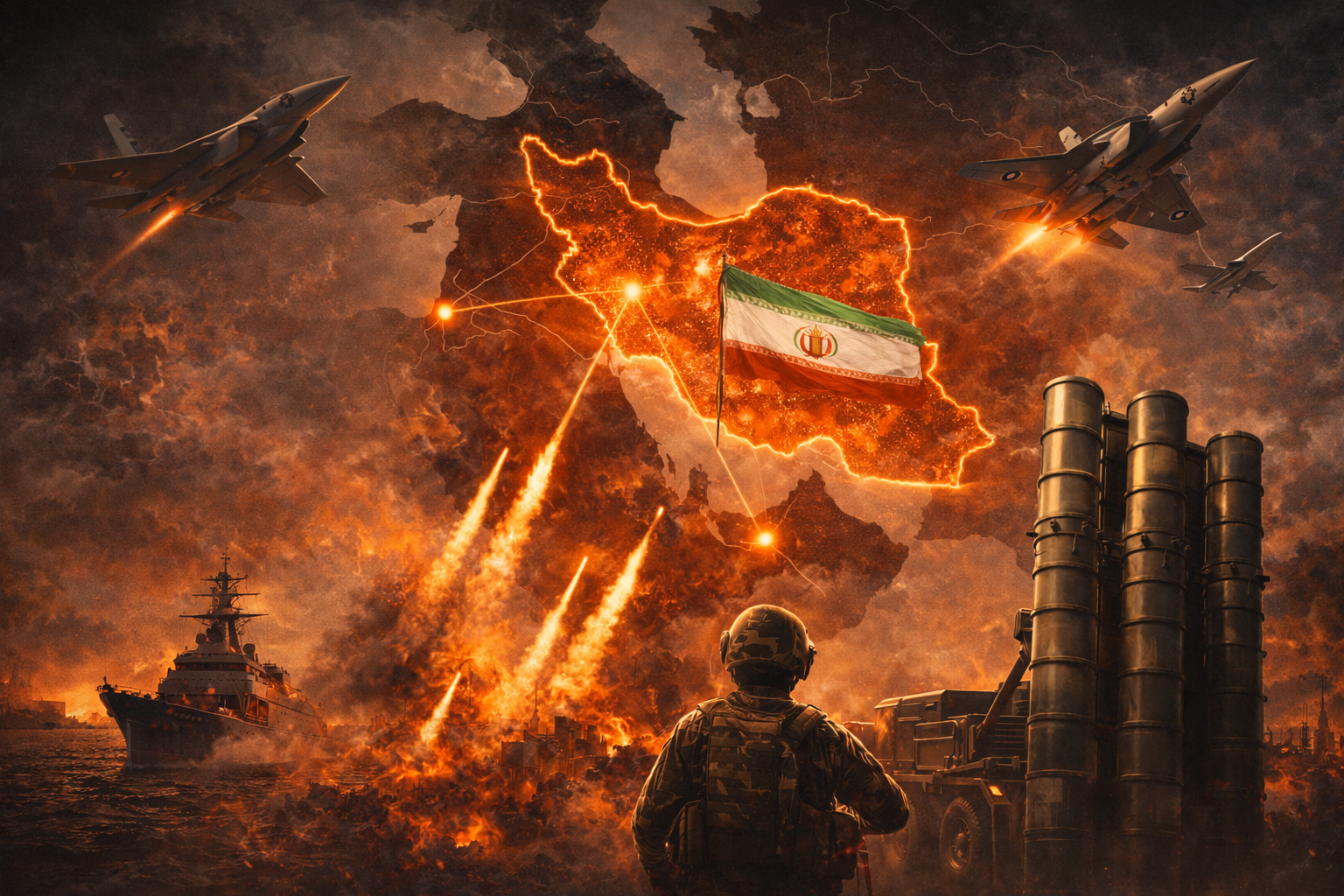
Iran’s military doctrine has never been built on matching adversaries aircraft for aircraft, it has been built on making the price of any attack unbearably high
The Asymmetric Imperative
Any honest military assessment of Iran‘s conventional air power capability relative to that of the United States or Israel arrives at the same conclusion quickly: there is no comparison. The United States Air Force operates the world’s most technologically advanced military aviation force, with fifth-generation F-22 and F-35 fighters, B-2 stealth bombers capable of striking any target on earth, and a strike package capability — the combination of electronic warfare, suppression of enemy air defences, precision strike, and intelligence integration — that no other military in the world approaches. The Israeli Air Force, while smaller, is widely regarded as the most operationally experienced and technically capable in the region, with F-35I Adir fighters, advanced air-launched munitions, and a combat record across decades of Middle East operations.
Iran’s air force, by contrast, is equipped largely with ageing aircraft — F-14 Tomcats and F-4 Phantoms originally purchased from the United States before 1979, Russian-supplied MiG-29s and Su-24s, and domestically produced aircraft of limited combat capability. It has received no significant new combat aircraft since the revolution. Its operational readiness is constrained by spare parts shortages, maintenance limitations, and the difficulty of training pilots on aircraft whose avionics are decades behind current standards.
And yet the question of whether Iran can ‘withstand’ American and Israeli air power is not answered by this comparison, because it poses the wrong question. Iran’s military doctrine has never been built on winning a conventional air campaign. It has been built on something more strategically sophisticated and more difficult to neutralise: the ability to raise the cost of any military action to levels that make sustained operations politically, economically, and militarily unacceptable.
Section I: The Missile Programme — Iran’s Primary Deterrent
Iran’s most significant military capability is not its air force but its ballistic and cruise missile programme — one of the largest and most diverse in the world outside the major nuclear powers. The programme has been developed over four decades as a deliberate counter to American and Israeli air power: if Iran cannot compete in the air, it can threaten to impose costs through surface-to-surface strikes that air power cannot reliably prevent.
The programme encompasses short-range ballistic missiles (the Shahab-1 and -2, with ranges of 300-500km), medium-range missiles (the Shahab-3 and its derivatives, with ranges of 1,300-2,000km, sufficient to strike Israel from Iranian territory), and increasingly sophisticated precision-guided munitions including the Emad, Ghadr, and Sejjil missiles that have demonstrated improved accuracy in operational deployments. In April 2024, Iran launched approximately 300 drones, cruise missiles, and ballistic missiles at Israel in the first direct Iranian attack on Israeli territory — demonstrating both the scale of the arsenal and the ability to saturate air defence systems.
The strategic logic of the missile programme is deterrence through cost imposition. Iran cannot prevent Israeli or American air strikes. But it can credibly threaten to respond to those strikes with salvos that impose significant damage on Israeli urban centres, Gulf state infrastructure, and American military facilities across the region. The threat does not need to be militarily decisive to be politically effective — it needs only to be credible enough that decision-makers in Tel Aviv and Washington calculate that the cost of military action against Iran exceeds the benefit.
Section II: Air Defence — The Layered Shield
Iran’s air defence architecture has been significantly improved in recent years, though it still contains serious vulnerabilities relative to the air forces it is defending against. The acquisition of the Russian S-300 system — delayed for years by sanctions and Russian political calculations, eventually delivered in 2016 — provided a capable long-range surface-to-air missile capability that can engage targets at high altitude and significant range. Iran has complemented the S-300 with domestically developed systems including the Bavar-373 (claimed to be comparable to the S-300), the Khordad-15 (which Iran claims shot down an American RQ-4 Global Hawk drone in 2019), and shorter-range systems for point defence of critical facilities.
The limitations of Iran’s air defence are significant. The S-300 and Bavar-373 systems, however capable in their own right, are vulnerable to the electronic warfare capabilities of American and Israeli aircraft, which have spent decades developing techniques for suppressing and deceiving surface-to-air missile systems. Israel’s F-35 has a stealth signature that makes it extremely difficult to detect with the radar systems integrated into Iran’s air defence network. And the sheer geographic scale of Iran — the second largest country in the Middle East — means that comprehensive air defence coverage across all strategic facilities would require a density of systems that Iran does not possess.
The April 2024 Israeli strike package that targeted Iranian air defence radars in Isfahan illustrated this vulnerability: Israeli aircraft penetrated Iranian air space, struck their targets, and departed without loss — a demonstration that whatever deterrent value Iran’s air defence possesses, it cannot reliably prevent a determined strike by advanced military aircraft.
Section III: Naval Strategy and the Strait of Hormuz
Iran’s naval doctrine in the Persian Gulf is built around a concept that military analysts call ‘anti-access/area denial’ (A2/AD) — the use of a combination of mines, fast attack craft, anti-ship missiles, and submarine threats to prevent a superior naval force from operating freely in the confined waters of the Gulf. The Islamic Revolutionary Guard Corps Navy, which operates separately from the regular Iranian Navy, specialises in the use of large numbers of small, fast patrol boats — capable of swarming and overwhelming conventional naval responses — alongside shore-based anti-ship missiles and the option of mining the Strait of Hormuz.
The strategic significance of the Strait is difficult to overstate. At its narrowest, the Strait is 33 kilometres wide, with the navigable shipping channel only three to four kilometres wide in each direction. Approximately 17 million barrels of oil pass through the Strait daily — roughly 20% of global oil consumption — along with significant volumes of LNG and other petrochemicals. Any Iranian military action that closed or seriously threatened the Strait would trigger an immediate global energy shock of the first order.
Iran’s ability to actually close the Strait in the face of determined American naval action is debated by military analysts. The US Fifth Fleet, based in Bahrain, has the operational capacity to keep the Strait open against any Iranian action that falls short of all-out war. But ‘keeping the Strait open’ in a conflict environment is not the same as maintaining the normal, unconstrained flow of tanker traffic — and the insurance costs, routing changes, and shipping reluctance that would result from even a credible threat to the Strait would have significant economic consequences well before any physical closure occurred.
Section IV: The Drone Programme
Iran’s investment in drone technology has emerged as one of its most strategically significant military developments of the past decade. The Shahed-136 loitering munition — which achieved global attention through its large-scale use by Russia in Ukraine — is an Iranian-designed system that combines low cost, long range, and a reasonable terminal accuracy to create a weapon that can be produced in very large quantities and deployed in saturation attacks. Iran has supplied hundreds of these systems to Russia, demonstrating both the production capacity and the export potential of the programme.
The drone programme’s significance for Iran’s own military posture is that it provides a cheap, scalable means of projecting precision strike capability across the region — complementing the ballistic missile programme with a lower-cost option that can be produced domestically and is more difficult to attribute than a ballistic missile strike. Iranian-supplied drones have been used by Houthi forces in Yemen, by Iraqi militia groups, and in Iran’s own April 2024 strike on Israel.
Section V: Asymmetric Warfare Doctrine
The overarching framework within which all of these capabilities are integrated is Iran’s asymmetric warfare doctrine — the strategic approach that has guided the IRGC’s development of military capabilities since the 1980s. The doctrine’s core insight is that Iran cannot win a conventional war against the United States or Israel, and that attempting to do so would be strategically irrational. Instead, the goal is to make any military conflict with Iran so costly — in terms of regional destabilisation, energy market disruption, proxy escalation, and the risk of casualty-imposing asymmetric responses — that the decision to initiate or sustain such a conflict is politically untenable.
This doctrine has several operational expressions. The threat of Strait of Hormuz closure raises the economic cost of conflict to global proportions. The missile programme raises the cost in terms of Israeli and Gulf state civilian exposure to direct attack. The proxy network raises the cost by creating the risk of multi-front escalation across the region. The drone programme provides a cheap, scalable means of imposing ongoing harassment costs. Together, these elements are designed not to defeat American or Israeli military power but to deter its use by ensuring that the costs of using it are prohibitive.
Iran’s military doctrine is not designed to win wars. It is designed to make wars too expensive to fight — to ensure that any adversary contemplating military action against Iran must calculate not just whether they can win, but whether the price of winning is worth paying.
Conclusion: Deterrence by Cost Imposition
The honest military assessment of Iran’s position is that it cannot, in any conventional sense, match the air power of the United States or Israel. Its air force is outmatched, its air defence is penetrable by advanced military aircraft, and its conventional military capabilities are significantly inferior to those of its principal adversaries.
But this assessment misses the strategic question that matters. Iran’s military doctrine does not attempt to match American or Israeli air power. It attempts to raise the cost of using that air power to levels that make sustained military campaigns politically unsustainable. Whether it succeeds in this depends not on military metrics but on the political calculations of American and Israeli leaders about whether the regional disruption, energy market consequences, and ongoing harassment costs of a sustained military campaign against Iran are worth the strategic objectives being pursued.
The evidence from the current crisis — in which significant Israeli military action has been taken without triggering an Iranian conventional military response that Israel cannot manage — suggests that the asymmetric deterrent has not fully achieved its intended effect. But the test of that deterrent may come not in the initial phase of military action but in the sustained political and economic costs that accumulate over months and years — in energy prices, in regional instability, in the ongoing harassment of American and allied forces, and in the proxy escalation that Iran can sustain at far lower cost than its adversaries can manage.
Why Every American President Ends Up Fighting the Same Wars


