


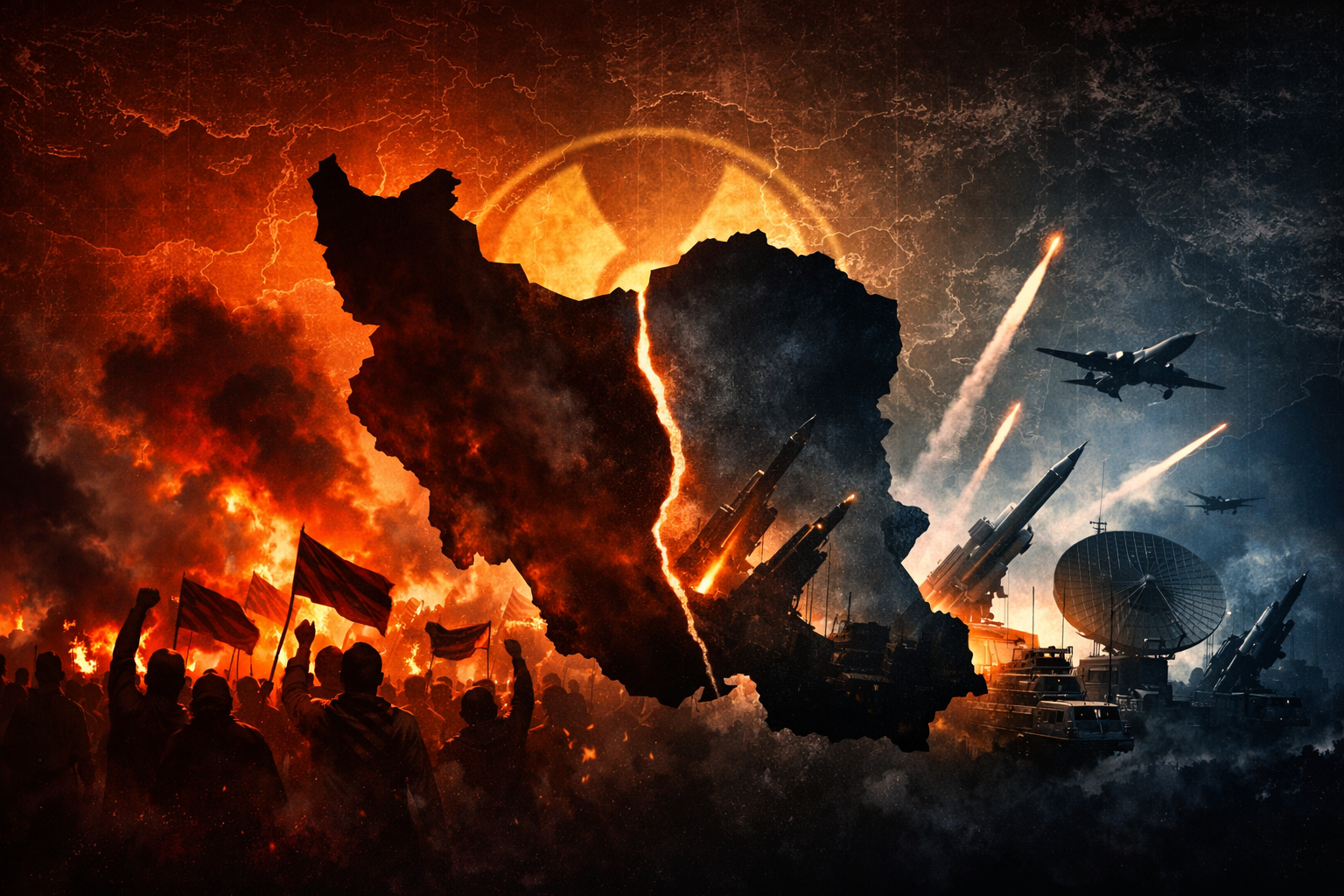
Iran is once again at the centre of a regional and global confrontation—caught between internal pressure and external threat. But unlike many moments in its modern history, Tehran now faces a uniquely dangerous convergence: a stressed economy, recurring protest cycles, escalating regional hostility, and a nuclear program that has reached a near irreversible threshold. Iran is not merely dealing with one crisis; it is dealing with multiple crises that amplify each other.
To understand Iran’s future—whether it falls, adapts, or rises—we must analyze Iran as both a state and a regime. States operate through institutions, geography, and national security needs. Regimes operate through legitimacy, coercion, networks of loyalty, and political survival. Today Iran is fighting on both levels: preserving the Iranian state while protecting the Islamic Republic’s power structure.
This article breaks Iran’s current dilemma into three interlinked dimensions: External (defense, nuclear and alliances), Internal (protests and potential outcomes), and Hybrid (war plus unrest simultaneously).
External: Iran’s Defense Posture, Nuclear Threshold, and the Axis of Reliance
1) What does Iran’s defence actually look like?
Iran’s defense strategy is built on one central idea: Iran cannot win a direct conventional war against the United States or Israel, so it must deter them through asymmetric warfare.
That strategy has four pillars:
(a) Missile power as deterrence
Iran’s missile program is its single most important conventional deterrent. Iran has built a large inventory of ballistic missiles and cruise missiles capable of striking throughout the Middle East and potentially beyond. The commonly reported maximum range for Iran’s longest-range missiles is around 2,000 km, which puts Israel, the Gulf, Turkey, and parts of southeastern Europe within potential reach.
(b) Air defense as survival infrastructure
Iran’s air defenses are a mix of domestic systems and imported platforms. But Iran’s air defense advantage is not that it is impenetrable—it is that it is layered, dispersed, and hard to fully neutralize quickly.
Still, Iran faces a reality: against advanced Israeli and American airpower, Iran can resist and absorb, but cannot guarantee full protection.
(c) Naval threat in the Gulf
Iran cannot “defeat” the US Navy, but it can threaten shipping through:
- small fast-attack craft
- mines
- drones
- anti-ship missiles
- swarm tactics
This is why Iran’s Gulf posture is not about naval victory—it’s about disruption.
(d) Proxies and partners
Iran’s external defense includes groups beyond its borders. This is not optional—it is strategic doctrine. Iran has long relied on affiliated networks sometimes called the “Axis of Resistance.”
2) Which countries can Iran realistically attack?
Iran can strike directly (missiles/drones) or indirectly (proxies).
Direct strike reach includes
- Israel
- Saudi Arabia
- UAE
- Qatar
- Bahrain
- Kuwait
- Iraq
- Jordan
- Turkey
- US bases across the region
Iran can also strike commercial shipping and energy infrastructure in the Gulf, which is often strategically more impactful than hitting military targets.
3) Who can attack Iran—and can Iran defend itself?
The key external threats to Iran are:
Israel
Israel’s primary capability is precision, intelligence-driven strikes—especially against nuclear infrastructure.
United States
The US threat is escalation dominance: stealth, long-range strikes, naval dominance, cyber, and sustained air campaigns.
Regional rivals (secondary)
Gulf states are not likely to initiate direct war, but could support coalitions, provide basing, intelligence, air defense integration, and political legitimacy.
Can Iran defend?
Iran can absorb punishment and respond. It can retaliate against US assets in the region and against Israel. But Iran’s defense is fundamentally built on making any strike on Iran costly, not impossible.
Nuclear: The Capability That Changes Everything
What is Iran’s nuclear capability today?
Iran has accumulated a large stockpile of uranium enriched up to 60%, which is extremely close to weapons-grade. In May 2025, the IAEA reported Iran’s inventory of 60% enriched uranium, and since then the standoff over inspections has worsened.
In January 2026 reporting, the IAEA chief warned that Iran’s refusal to provide reporting/inspection access cannot continue indefinitely, and Iran has not accounted for around 440.9 kg enriched to 60% in the IAEA reporting context.
What does that mean?
It means Iran is not simply “developing” nuclear capability. Iran is approaching a status where it becomes:
- a threshold nuclear power
- capable of rapid breakout if leadership decides
Important:
This doesn’t mean Iran has a bomb. It means it has the material pathway that makes the bomb decision primarily political.
Who would Iran rely on in a crisis?
Iran’s “reliable allies” differ from conventional alliances like NATO.
Iran’s support ecosystem includes:
Russia
Useful for diplomacy, weapons tech cooperation, and shared anti-West posture.
China
More important economically than militarily. China’s interest is stability and energy flows—not ideological defense of Iran.
Proxies / aligned groups
Hezbollah historically has been Iran’s strongest external deterrent layer, while other groups such as the Houthis and Iraqi militias broaden pressure points.
But here is the major shift: Iran’s proxy network faces attrition, military pressure, and political backlash across multiple fronts. This weakens Iran’s external deterrence at the margins.
Internal: What are the protests about, and what happens next?
1) What is the protest about?
Protests in Iran tend to appear like separate waves, but they are connected by one underlying reality: a crisis of dignity + economics + political exclusion.
- inflation
- currency collapse
- unemployment
- corruption
- repression
- women’s freedoms and morality policing
Recent reporting indicates protests linked to economic deterioration and government crackdowns, with high death toll claims and mass arrests in some waves.
These protest cycles have become a permanent feature, not an exception.
2) What are the potential outcomes?
Iran has four realistic internal outcomes:
Outcome A: Suppression + survival (most likely short term)
The state crushes protests, arrests organizers, and restores surface control.
Outcome B: Controlled reform (least likely)
Regime offers limited reforms: easing social restrictions, economic adjustments, more policing professionalism.
But real reform threatens regime ideology and security structure, so it is structurally difficult.
Outcome C: Elite split
This is the most dangerous scenario for the Islamic Republic: fractures within IRGC, clerical establishment, or ruling coalition.
Outcome D: Regime transformation
Not necessarily “collapse,” but a new governance model may emerge if the system breaks.
3) Can Iran end this non-violently?
A nonviolent path exists—but it requires something regimes hate: sharing power.
A plausible nonviolent resolution would involve:
- releasing political prisoners
- relaxing morality enforcement
- opening credible elections
- economic anti-corruption steps
- reducing militarization of governance
But regimes usually only do this when:
- coercion no longer works, or
- elites fear total collapse.
Iran’s leadership has historically shown preference for coercion first.
Hybrid Scenario: What if Iran faces war and protests?
This is Iran’s nightmare scenario.
If internal protests and external war coincide, Iran faces a strategic fork:
Option 1: Rally-around-the-flag
External attack can strengthen nationalism temporarily. Even many anti-regime citizens may oppose foreign strikes.
Option 2: Protest becomes rebellion
If strikes cripple the economy, disrupt services, and expose regime vulnerability, protest movements can accelerate.
Option 3: Security overload
Internal unrest consumes manpower. External conflict requires mobilization. The state becomes overstretched.
This is where regimes historically become fragile.
Lessons from Iranian history: Will Iran fall or rise?
Iran’s modern history offers three powerful lessons:
Lesson 1: Iran collapses suddenly—not gradually
The Shah’s system looked stable until it wasn’t. Iran tends to shift through rapid political breaks, not slow democratic evolution.
Lesson 2: External pressure strengthens the security state
Sanctions and threats often empower hardliners, justify repression, and weaken civil society’s space.
Lesson 3: Iranians are resilient—but regimes are not eternal
Iran’s national identity is strong. But the Islamic Republic’s legitimacy has been degrading.
So: Will Iran fall or rise?
Iran won’t fall simply because people protest. Regimes survive protests all the time.
Iran falls under a rare combination:
- elite fragmentation
- security failure
- economic collapse
- war shock
- loss of ideological legitimacy
If that combination emerges, Iran could experience a historic transformation.
But Iran could also rise—in a different way:
- by modernizing governance
- stabilizing the economy
- rebalancing ideology and pragmatism
- becoming a permanent threshold nuclear state
- leveraging geography + nationalism to endure
In short:
Iran’s future is not about technology or nukes. It is about legitimacy and execution—just like states, companies, and empires.
Conclusion: Iran 2026–2030 Scenarios
The likely scenario through 2026–2027 is:
- internal unrest cycles continue
- regime survives through coercion
- nuclear capability inches closer to irreversibility
- external pressure increases
- risk of miscalculation rises
Iran won’t end in one dramatic moment unless the hybrid scenario occurs: internal revolt + external war + elite split.
That is the triple shock that changes history.
Iran vs North Korea: Two Nuclear Proliferation Paths
- Iraq After Saddam: Regime Collapse, Occupation and the Long Shadow of State Failure
- The World Is Not Watching a Crisis Unfold — It Is Watching a Redesign
- What If the Biggest Hole in Global Climate Policy Isn’t Coal or Oil — It’s War?
- Diplomacy Is Not About Choosing Sides – It Is About Protecting Interests
- War in the Cloud


