


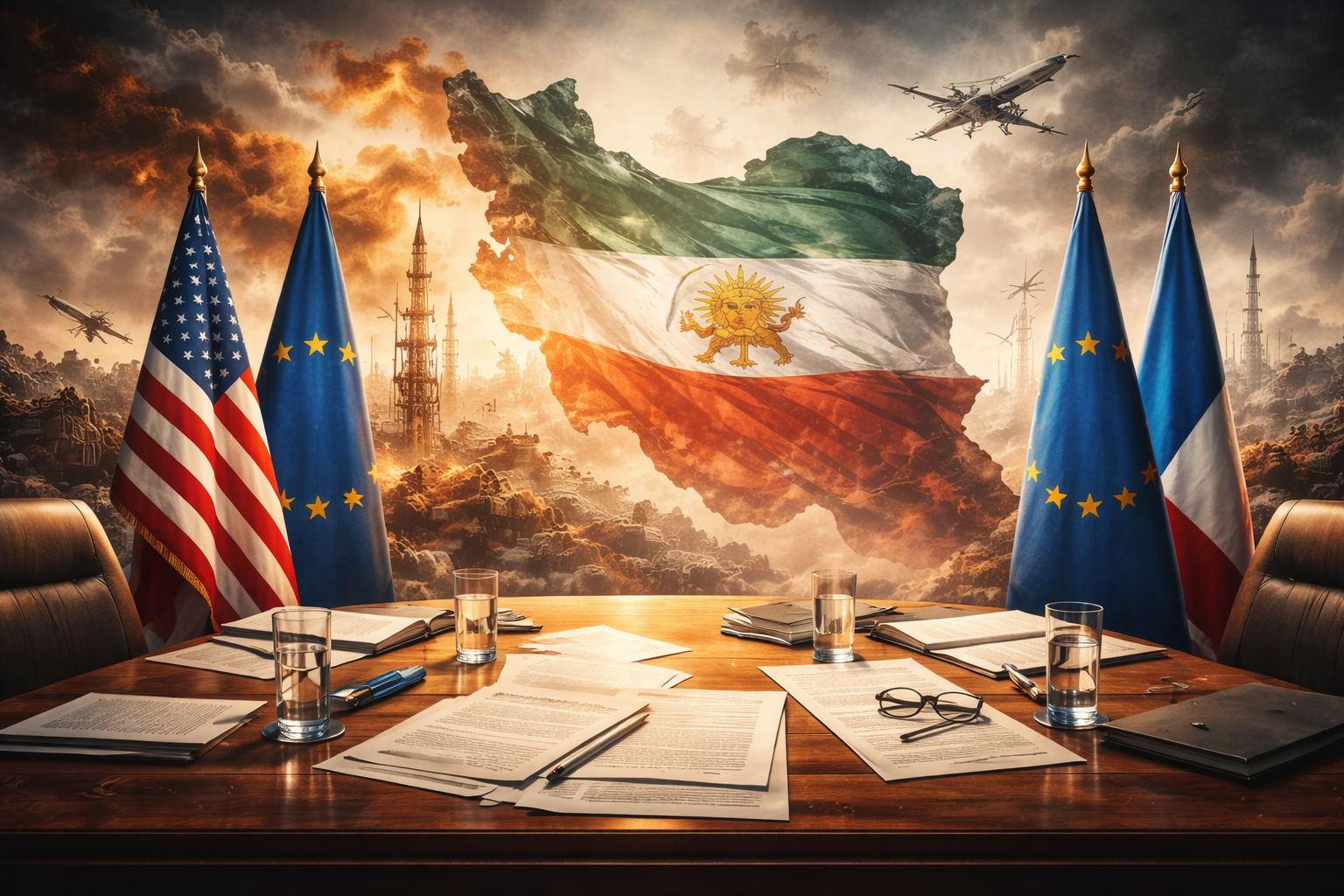
The political conditions for diplomacy have rarely been less favourable but the history of Iran’s nuclear negotiations suggests that conflict rarely ends the conversation permanently
“The history of Iran’s nuclear diplomacy offers one consistent lesson: the conversation never entirely ends.”
Diplomacy in the Shadow of War
The conventional wisdom holds that wars end diplomacy. In practice, the relationship between military conflict and diplomatic engagement is more complex: wars create new pressures, new incentives, and sometimes new political conditions that make agreements possible that were not achievable before. The most significant arms control agreements of the Cold War were often preceded by acute crises — the Cuban Missile Crisis preceded the Limited Test Ban Treaty; the Vietnam War preceded the Nixon-era détente with the Soviet Union and the opening to China. Military escalation does not eliminate the conditions for negotiation. It sometimes creates them.
The current crisis in Iran presents this dynamic in an acute form. The elimination of Supreme Leader Khamenei, the degradation of Iran’s regional proxy infrastructure, the damage to its nuclear programme, and the resulting political uncertainty in Tehran have simultaneously made negotiations more difficult — there is no clear Iranian interlocutor with the authority to conclude an agreement — and potentially more necessary, because the alternative to a negotiated resolution to the nuclear question is the most dangerous proliferation scenario in the region’s history.
This analysis examines the history of nuclear diplomacy with Iran, the reasons previous agreements failed, the trust deficit that characterises the current environment, the regional dynamics that complicate any agreement, and the conditions under which negotiations might realistically restart.
Section I: The History of Nuclear Diplomacy with Iran
The Origins of the Nuclear Programme
Iran’s nuclear programme predates the Islamic Republic. The Shah’s government began developing nuclear infrastructure in the 1970s with American support, as part of the Atoms for Peace programme. The original programme was civilian — power generation for a rapidly industrialising economy — but the Shah also expressed interest in acquiring a latent nuclear weapons capability. The 1979 revolution initially suspended the programme, but it was revived in the mid-1980s, during the Iran-Iraq War, when the experience of Saddam Hussein’s chemical weapons use reinforced the strategic case for Iran developing a deterrent capability.
The programme developed largely clandestinely through the 1980s and 1990s, with significant assistance from the A.Q. Khan network — the Pakistani nuclear scientist’s proliferation enterprise, which sold uranium enrichment technology to Iran, Libya, North Korea, and other states. The extent of Iran’s programme only became publicly known in 2002, when the National Council of Resistance of Iran — an opposition organisation — revealed the existence of previously undisclosed facilities at Natanz and Arak.
The EU3 Negotiations (2003–2005)
The revelation of the undisclosed facilities triggered the first sustained international diplomatic effort to constrain Iran’s nuclear programme. The European Union’s three largest member states — France, Germany, and the United Kingdom — undertook direct negotiations with Iran from 2003, achieving the Tehran Declaration of October 2003, in which Iran agreed to suspend uranium enrichment and submit to enhanced IAEA inspections. The negotiations continued through 2004, producing the Paris Agreement in November 2004, which extended the suspension.
The EU3 negotiations ultimately failed to produce a permanent agreement. Iran suspended its suspension in August 2005 under the newly elected government of Mahmoud Ahmadinejad, resuming enrichment at Isfahan. The failure reflected both the limits of what the Europeans could offer without American participation and the domestic political dynamics in Tehran, where the nuclear programme had become a symbol of national sovereignty that no government could be seen to surrender entirely.
The JCPOA — Achievement and Collapse
The most significant diplomatic achievement in the Iran nuclear file was the Joint Comprehensive Plan of Action, negotiated between Iran and the P5+1 (the five permanent UN Security Council members plus Germany) and signed in Vienna in July 2015. The JCPOA was the product of two years of intensive negotiations, facilitated by the election of Hassan Rouhani as Iranian president in 2013 and the Obama administration’s strategic decision to prioritise a negotiated settlement over military options.
The agreement was technically sophisticated: it imposed a 15-year cap on Iran’s enrichment levels (to 3.67%, well below weapons-grade), reduced Iran’s stockpile of enriched uranium by 97%, required the modification of the Arak heavy water reactor to prevent plutonium production, established an intrusive inspection regime giving the IAEA access to declared and undeclared sites, and in return lifted nuclear-related sanctions that had severely damaged the Iranian economy.
The JCPOA was not the permanent solution its architects hoped for. The Donald Trump administration withdrew from the agreement in May 2018, calling it ‘the worst deal ever negotiated’ and reimposing comprehensive sanctions. Iran initially maintained its compliance for a year while waiting to see whether the European parties could compensate for the loss of American participation, then began a systematic violation of the agreement’s enrichment limits from May 2019. By 2021, Iran’s enrichment levels had risen from 3.67% to 60% — a level with no civilian justification — and its stockpile of enriched uranium had grown to quantities far exceeding the JCPOA limits.
The Failed JCPOA Revival
The Biden administration entered office in 2021 committed to rejoining the JCPOA, and indirect negotiations in Vienna through 2021-2022 came close to a restored agreement on multiple occasions. But the talks were complicated by Iranian demands that went beyond the original JCPOA framework, by American domestic political constraints that made significant concessions politically costly, and ultimately by the outbreak of protest in Iran in 2022 following Mahsa Amini’s death, which made it politically impossible for the Biden administration to conclude an agreement that would have lifted sanctions on a government engaged in mass repression of its own population.
Section II: The Trust Deficit
The accumulated history of failed agreements, mutual violations, and competing narratives about responsibility for those failures has produced a trust deficit between Iran and the Western powers — particularly the United States — that represents the most fundamental obstacle to any future negotiated settlement.
From the Iranian perspective, the United States’ withdrawal from the JCPOA demonstrated that American commitments cannot be trusted across administrations — that an agreement painstakingly negotiated by one administration can be discarded by the next without consequence. This perception is not irrational. It reflects a genuine structural weakness in American foreign policy: the absence of treaty ratification by the Senate (the JCPOA was an executive agreement) meant that it had no domestic legal durability. Iranian officials and analysts drew the obvious lesson: any future agreement that is not constitutionally entrenched in American law is not a reliable guarantee.
From the American and European perspective, Iran’s systematic expansion of its nuclear programme in the years after 2019 — particularly the acceleration to 60% enrichment, the reduction of IAEA inspector access, and the development of advanced centrifuges — demonstrated that Iran used the period of sanctions relief provided by the JCPOA to advance the very capabilities the agreement was designed to constrain, and retained the technical knowledge to reconstitute those capabilities rapidly when political conditions changed.
The trust deficit in Iran-Western nuclear diplomacy is not a misunderstanding to be resolved by better communication. It reflects a genuine divergence of interests that has been repeatedly confirmed by both sides’ actions — and any future agreement must be designed on the assumption that verification matters more than declarations of goodwill.
The current crisis has deepened this trust deficit further. The Israeli strikes on Iranian nuclear infrastructure — which the United States may or may not have actively supported or merely declined to prevent — have demonstrated that the Western powers’ ultimate response to Iranian nuclear progress is military rather than diplomatic. The Iranian conclusion from this experience is likely to be that nuclear weapons, rather than the JCPOA model of constrained enrichment, represent the only reliable deterrent against regime change or military action.
Section III: Regional Dynamics
The bilateral Iran-US nuclear relationship does not exist in isolation. It is embedded in a regional political environment in which multiple other actors have strong interests in the outcome of any negotiated settlement, and whose buy-in or opposition can determine whether an agreement is implementable.
The Gulf States
Saudi Arabia and the UAE have consistently opposed any nuclear agreement that does not address what they characterise as Iran’s broader destabilising regional behaviour — its support for proxy groups, its ballistic missile programme, and its interventionist policies in Yemen, Iraq, Lebanon, and Syria. The Gulf states’ objection to the JCPOA was not primarily about its nuclear provisions — which they largely accepted as technically adequate — but about what it did not address: the broader Iranian threat to regional order. Any future agreement that addresses only the nuclear file while leaving Iranian regional behaviour unchanged is likely to face the same Gulf state resistance.
Israel
Israel’s position on Iranian nuclear diplomacy has been consistently more sceptical than any other actor’s. Israel does not believe that a negotiated agreement with Iran can reliably prevent Iranian nuclear weapons development, because it does not trust verification mechanisms and does not believe that the Islamic Republic’s fundamental hostility to Israel can be managed through arms control. Israel’s military action in the current crisis — to the extent that it has targeted nuclear infrastructure — represents the operational expression of that scepticism.
China and Russia
China and Russia’s roles in any future Iran nuclear diplomacy are more complex than their historical P5+1 participation would suggest. Russia’s geopolitical relationship with the West has been fundamentally transformed by the Ukraine war, and Russia’s interest in Iranian military cooperation — including Iranian drone provision for the Ukraine campaign — creates incentives that directly conflict with the non-proliferation goals of any Iran nuclear agreement. China’s interest in Iranian energy and trade, and its broader geopolitical competition with the United States, similarly creates incentives that are not fully aligned with constraining Iranian nuclear development.
Section IV: Conditions Required for Negotiations to Restart
Given the depth of the trust deficit, the complexity of regional dynamics, and the uncertainties of the current Iranian political situation, what conditions would need to exist for substantive nuclear negotiations to restart?
The most fundamental requirement is a Iranian interlocutor with genuine authority. In the current crisis, the identity and authority of whoever governs Iran — whether a managed succession has produced a Supreme Leader with institutional legitimacy, or whether the IRGC is effectively in control, or whether genuine political fragmentation has occurred — is the primary determinant of whether a negotiating counterpart exists. An IRGC-dominated government might engage tactically with negotiations while having no intention of concluding a durable agreement. A reformist government might genuinely want an agreement but lack the domestic political authority to conclude one.
A second requirement is a re-evaluation of the American domestic political framework for nuclear agreements. The experience of the JCPOA — its negotiation under Obama, abandonment under Trump, attempted revival under Biden — suggests that executive agreements without Senate ratification have insufficient durability to sustain the long-term commitments that a comprehensive nuclear agreement requires. Any future agreement that is worth negotiating would need to be structured in a way that survives changes of administration — either through Senate ratification as a treaty (which would require a two-thirds majority that seems currently unavailable) or through some other mechanism of domestic legal entrenchment.
A third requirement is a broadening of the agenda. The history of JCPOA negotiations suggests that an agreement limited to the nuclear file — while leaving Iranian ballistic missile capabilities, regional proxy activities, and human rights record outside the framework — is unlikely to achieve the broad regional legitimacy that would make it durable. This broader agenda is also much harder to negotiate, because it requires Iran to make concessions on issues it regards as fundamental to its security and regional influence. But the alternative — a purely technical nuclear deal that does not address the broader sources of regional insecurity — has already failed once.
Conclusion: After the Guns
The history of Iran’s nuclear diplomacy offers one consistent lesson: the conversation never entirely ends. Even at the peak of sanctions pressure, even after the collapse of previous agreements, even amid acute military tension, diplomatic channels have always been maintained and the possibility of negotiated settlement has never been permanently closed.
The current crisis is, on every relevant metric, more severe than any previous episode in the Iran nuclear file. The trust deficit is deeper, the military action more extensive, the political uncertainty inside Iran more acute, and the regional stakes higher. But severity does not mean irresolvability. The conditions for negotiation — a legitimate Iranian interlocutor, a durable American commitment mechanism, a broader regional agenda, and the basic recognition by all parties that the alternative to a negotiated outcome is a proliferation scenario that serves no one’s interests — are all, in principle, achievable.
What the current moment makes clear is that achieving those conditions will require political choices of an order of difficulty that has not been mustered in the previous decades of Iran nuclear diplomacy. Diplomacy, as the history consistently shows, often returns only after military escalation has demonstrated its own limits. The question is whether the current escalation has reached — or is approaching — those limits, and whether any actor with the strategic vision and the political authority to restart the conversation is currently in a position to act.
Why Every American President Ends Up Fighting the Same Wars


