


On 28 February 2026, long-simmering tensions between Iran, the United States and Israel escalated into direct military confrontation. Coordinated strikes reportedly targeted senior Iranian leadership compounds and military infrastructure in Tehran, triggering retaliatory missile and drone launches across the Gulf theatre.
Civilian airspace was suspended across multiple states. Regional missile defence systems activated. Energy markets reacted immediately.
While political narratives focus on escalation and deterrence, the deeper structural question lies elsewhere: What happens to maritime trade, chokepoints and global energy stability when the Gulf becomes a live battlespace?
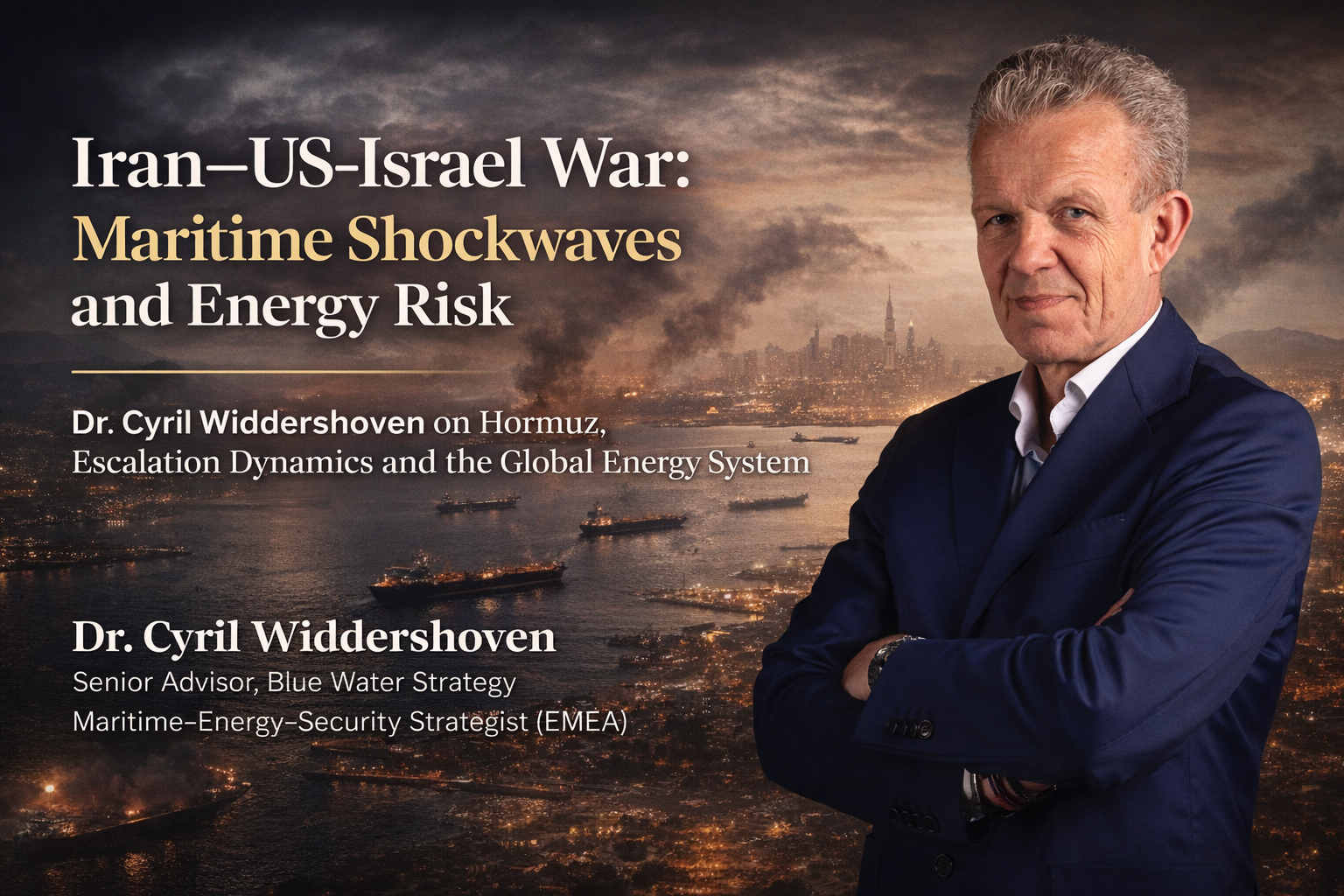
To unpack this, The International Wire spoke with Dr. Cyril Widdershoven, Senior Advisor at Blue Water Strategy and one of the Middle East’s foremost maritime-energy-security strategists. With decades of experience analysing EMEA geopolitical risk, Dr. Widdershoven specialises in chokepoint dynamics, energy infrastructure vulnerability and strategic supply-chain resilience.
In conversation with Danish Shaikh, Editor at The International Wire, Dr. Widdershoven offers a structural assessment of the conflict — from deterrence breakdown to Hormuz risk and global market repricing.
The Onset of the Conflict
How would you summarise the strategic drivers behind the recent joint U.S.–Israeli strikes on Iran?
When looking at the total, but functionally at the core of the conflict, this looks like a total picture linking three drivers:
nuclear timing
deterrence repair
domestic credibility.
Based on the current analysis, Washington clearly has concluded that diplomacy was stalling while Iran’s nuclear leverage was rising. The USA felt as if anyother option would have given Iran more time to act. At the same time, Israel has long treated the program as an existential clock, so this is why it is being framed as a pre-emptive strike, trying to reset the timeline by force. Both are also trying to re-impose escalation dominance after months in which deterrence signals and reactions from Tehran have been blurred. The fact that this happened amid ongoing indirect talks makes the message even sharper: “negotiations don’t buy immunity.” This should have been calculated in by Tehran, as this is the current strategy of the transactional Washington government, at least in the case of Iran. Still looking for the same in the Ukraine issue, however.
What does the coordination between Washington and Tel Aviv reveal about their strategic priorities now?
Without being present at the inner-circle discussions, it clearly signals to me that the two capitals are prioritising operational convergence over political distance. This means they have pushed aside any differences on tactics and sequencing, but now have decided they share a priority to prevent Iran from translating nuclear progress into strategic impunity. This also includes, not yet stated fully, Iran’s connections to proxies, destabilization in Iraq and Syria, but also Tehran’s missile and drone capabilities. Coordination also suggests a belief that a divided front invites Iranian calibrated escalation. Unity, at present, will be part of the weapon system.
How significant is this military escalation compared to past Iran–Israel or U.S.–Iran confrontations?
Until now, it is still not a full-scale war, at least no boots on the ground or full-scale attacks on Iran’s lifeline, energy sector assets. However, it is a step-change because it’s overt, joint, and region-wide in consequences. In the past, actions have been rather reliant on ambiguity, deniability, or limited lanes of escalation. The current situation is more like a theatre-wide stress test. It includes strikes, retaliatory salvos, airspace disruptions, and immediate knock-on effects in energy/shipping risk. This is to be taken into account, as it is qualitatively bigger than the “shadow boxing” scenarios before.
To what extent is this a conventional war versus a hybrid campaign involving proxies and infrastructure targets?
It’s already both, even though it’s not yet in full play. The opening phase has conventional characteristics, as we have seen airstrikes and direct missile/drone retaliation. However, the real “centre of gravity” is clearly hybrid: it involves attacks or pressure on bases, logistics nodes, and maritime signalling. At the same time, both sides have been linked to another option: weaponizing insurance and chokepoints. As I have stated over the last few months, Tehran doesn’t need a classic battlefield victory; it would only increase the cost curve and fracture the coalition’s political tolerance in the future.
How have diplomatic efforts — including recent indirect talks — influenced or failed to mitigate the current outbreak?
They arguably shaped the timing, but didn’t mitigate escalation. Reporting indicates talks showed movement yet no breakthrough, with maximalist positions still visible (notably on enrichment). When diplomacy becomes a clock-management exercise rather than a settlement, military planners treat it as a window—either to strike before constraints appear, or to strike because constraints never will.
Retaliation and Regional Escalation
Iran has launched widespread missile and drone attacks against U.S. bases and neighbouring states. What does this signal about Tehran’s defensive and offensive strategy?
Looking at the theory behind it all, it is clearly a doctrine of distributed retaliation. Until now, the message is clear: don’t respond only against Israel, but also take action across the U.S. footprint. This, for some, will be a surprise, especially when looking at Oman, and will involve regional partners to create political diffusion. Iran’s message is: “everyone feels risk, everyone pressures Washington.” The regime is also clearly trying to prove survivability: “You can hit us, but you can’t stop our ability to impose costs.” This is critical, especially since Tehran can’t win a conventional war, especially if the Arab countries participate as well. The regime, even without Khamenei, will try to survive at all costs.
How resilient are U.S. and allied defence postures across the Gulf in deterring or absorbing Iranian retaliation?
When looking at the military side, its posture is designed to absorb a lot. There is layered air and missile defence, dispersal, hardened sites, and other assets. However, on the political side, resilience is much thinner, which is also normal in democracies, but especially in Western societies. It needs to be acknowledged that even “intercepted” attacks can trigger domestic pressure or have a major impact on investors. At the same time, as most US bases in the region are with the host nation, there is a need for continued recalculations. The real question is not whether defences work tactically, but whether all the military defenses will be able to prevent a strategic narrative of vulnerability. For your info, this is also the case for Iran, or even the Arab countries that are being threatened, too.
What are the implications of missile strikes in Bahrain, Qatar, Kuwait, UAE, Jordan, and beyond?
Three implications:
- Host-nation sovereignty shock. As is always the case, all states want to stay out of the current conflict but are geographically unable to do so.
- Basing politics: it can be expected that there will be from society or governments of a host state to be facing increased opposition to US presence. The latter, again, will depend on whether US assets are being attacked alone, or whether these host countries are also attacked or take part in the end.
- Risk repricing: There will be an increase in costs on all levels, as airspace, ports, and energy facilities will be treated as contested infrastructure. Costs and risks will increase right now, even if real damage is limited.
Are we witnessing a regional war dynamic rather than a bilateral confrontation?
Yes, there is no doubt about it as the battlefield isn’t a border, but a network of bases, air corridors, chokepoints, and proxies. Over the last 24 hours, it has become extremely clear that multiple states’ territories and critical infrastructure are in play, which are only signs of regional war dynamics. The latter is also in place when regional leaders or regimes deny or avoid declaring one.
What are the risks of conflict spreading to Iraq, Syria, or Lebanon through proxy actors?
High. Iran’s proxies are on alert or already in play. In general, you should look at these theatres as escalation “cheap lanes”: where a player like Iran can maintain plausible deniability or pre-position capabilities. Also, these countries have a long history of tit-for-tat. The real risk, in the end, or the strategic risk to be managed, is misattribution. A situation in which one proxy strike that produces mass casualties can have the potential even to force a direct response, and at the same time result in a collapse of the remaining firebreaks.
Maritime, Energy, and Supply Chain Implications
How is this conflict affecting key energy corridors, particularly the Strait of Hormuz and adjacent maritime routes?
Hormuz is clearly a contested chokepoint right now. There are ample warning signals for ships, traffic disruption, and commercial hesitation. For all, the key point is not a total closure; you need the route to be unpriceable, as owners, charterers, and insurers decide to reroute and absorb flow drops.
Are risk premiums in global oil and LNG markets already reflecting the current situation?
There are some, mainly via anticipatory repricing and forward anxiety. There is clearly a so-called war premium in place, but price hikes will definitely be an option if disruption persists. The bigger move often comes when markets reopen after a weekend of escalation and when physical flows visibly stall. Right now, the market is still thinking we are in an Oil Glut Scenario, so there is not much risk. In reality, there is no glut, and there is no spare production capacity either (especially if the Gulf is closed). Hikes could be much higher in the coming weeks than most expect.
What are the systemic risks to global shipping, insurance costs, and port infrastructure?
The first systemic shock is often insurance and compliance, not hull losses. The latter will be seen in moves by war-risk insurers, as they increase prices and use cancellation clauses. Shipowners will be rerouting, delaying, or even refusing contracts. This will cause direct and indirect demurrage, missed laycans, and port congestion, all of which will put significant stress on regional and global supply chains.
Could alternative trade routes or insurance models emerge out of this crisis?
New or returning? For Arab countries, only partially. Crude oil and petroleum products have some flexibility (storage, rerouting, different crude slates), but Qatari LNG is geographically “stapled” to Hormuz. The only options in a real war scenario will be that there could be higher war-risk deductibles, Arab and other governments backing reinsurance, or ultimately, naval convoy-like risk mitigation. At the same time, short-haul shipping is used to avoid high-risk areas. However, all will increase prices, so the real result of the crisis is that it structurally reprices trade.
How might sovereign wealth funds and strategic investors recalibrate their energy and logistics portfolios in response?
I would definitely expect a move or pivot toward resilience assets. The interest in storage, midstream flexibility, non-Hormuz export optionality, and ports/logistics nodes (especially those that benefit from rerouting) will grow exponentially. At the same time, as we have seen before, SWFs also tend to dislike “binary chokepoint risk”. The result of the latter could be that they will opt to rebalance into infrastructure that monetises volatility. Main sectors here could be risk management, security tech, cyber-physical protection, and alternative corridors. It may also result in some flagship mega-projects being treated as needing a geopolitical stress premium.
Strategic and Geopolitical Cascades
What does this conflict reveal about U.S. grand strategy in the Middle East now?
After a full-scale Pax Americana era, we could now be looking at a strategy of selective dominance. There will be no emphasis on an open-ended occupation like commitment, but only a prevention of a nuclear-armed Iran, while also setting up structures to preserve freedom of navigation.
How might Russia and China respond to or exploit the evolving crisis?
They will most probably do their normal acts:
Narrative: paint the West as destabilising and hypocritical on sovereignty, especially when also linking it to Ukraine.
Diplomacy: position themselves as “responsible mediators” while extracting concessions elsewhere. However, they are going to need to face the fact that neither has been able to support their so-called allies.
Economics: benefit from volatility, as a crude oil crisis or an LNG shortage could be to Russia’s advantage at sea (the US could allow Russian oil sales to India and China). They could also use the current US military concentration in the Middle East to act somewhere else (Taiwan, Ukraine/Baltics)
Will this conflict reshape new military alliances or defence cooperation frameworks in the region?
There could be a “quiet NATO-isation” of air and missile defence, however this would need full-scale commitments of Arab governments, while the public at present doesn’t want it. However, it is once again shown that no single Gulf state can comfortably absorb sustained salvos on its own.
What are the long-term implications for nuclear non-proliferation and Iran’s nuclear ambitions?
There is a theoretical danger in play, which shows that strikes reinforce the belief that survival equals capability. The latter, when taken by an extremist regime or group, could harden proliferation incentives. At the same time, it should be realized that we can destroy or annihilate a nuclear system or sector, but are not able to remove the knowledge base and the political logic behind it.
Are there credible pathways to de-escalation, and what would those look like?
Yes, but on the one hand, aren’t we already too far up the escalation ladders? Will some parties still believe in negotiations, but if so, then they are narrow and transactional:
- A ceasefire-under-conditions
- A face-saving diplomatic package
The latter, especially after the Iranian attacks on Oman, doesn’t seem to be even possible anymore. Tehran also cannot ask for it; doing so would remove the framing it is using and destabilize the regime even further.
Future Outlook and Scenarios
What are the plausible scenarios for the next 3–6 months?
Short, violent spike → managed freeze
Rolling escalation
Wider theatre rupture
Could economic sanctions regimes shift during active hostilities?
Yes, for sure; however, war compresses legal creativity. Still, there is an opposite pressure, especially when energy prices spike, some actors quietly prefer enforcement “flexibility”.
How might global markets — especially energy and commodities — price in sustained conflict risk?
There are two possible layers to discuss:
- Immediate premium, mainly linked to flow disruption probability (oil, LNG, freight).
- Structural premium, when looking at maritime (shipping, insurers, refiners), if these parties see Gulf transit contested for longer, all goes up or is being rerouted after. The structural premium layer is the real macro change: it puts in place inflation, increases transport costs, and ultimately reshapes investment decisions.
What indicators should analysts watch to anticipate de-escalation versus deeper war?
The things to be watched:
- Shipping behaviour
- Insurance terms
- Proxy activation
- Diplomatic signals
In your view, what lessons might policymakers draw from this escalation for future crisis management?
The main lesson to be learned is that maritime and energy infrastructure are not “adjacent” to war—they are what should be seen or called the battlefield’s economic nervous system. All parties involved, but especially traders, shippers, ports, and financials, should start to understand that if you don’t plan for chokepoints, insurance, port resilience, and supply substitution, you will face instability. At the same time, if this is not in place, policymakers will quickly see that your military strategy will be undermined by commercial reality. Main message to take right now: “If you want deterrence, you need credibility not only in missiles, but also by being able to keep trade moving”.
Rapid-Fire: Strategic Insight
Prolonged regional war or short high-intensity confrontation?
At present, it will be a short, high-intensity first, then enter a high-risk “managed instability” phase.
Does Iran benefit more from escalation or calibrated retaliation now?
Calibrated retaliation: Tehran will need (not my choice!) to cause enough pain to deter. This should not be enough to unify everyone against it.
Is Hormuz genuinely at risk of closure?
At risk of practical closure via intimidation, insurer retreat, and commercial self-deterrence, which is already in place. A full-scale closure is very hard to maintain.
Are Gulf states more vulnerable militarily or politically?
Politically. Militaries can intercept enemy actions. However, governments need to manage public fear, investor confidence, and optics of sovereignty.
Has deterrence between Iran and Israel fundamentally broken down?
The situation has changed from “shadow deterrence” to “overt punishment deterrence”. It needs to be understood that this means it will be much more unstable, but also much more public.
Is the U.S. seeking regime pressure, deterrence restoration, or strategic reset?
Even if the media are saying something else, it is at present primarily about deterrence restoration. However, the outcome or byproduct of this is increased regime pressure. To expect a regime change in the coming days is not only aspirational but also depends on the Iranians themselves, the anti-regime groups, and the internal stability of some regime assets!
Could energy markets withstand a sustained 30–60 day disruption in Gulf flows?
They can survive, but it will not come cheaply. We need to expect sharp price spikes, in some countries, maybe even rationing dynamics. For sure, there will be a lot of political intervention, but this is most of the time without real results.
Are maritime insurance and shipping costs about to become the first economic shockwave?
Yes—this is often the first transmission mechanism. The latter already is in place, as we are looking at risk premium jumps and policy changes.
Is China likely to intervene diplomatically or remain distant?
I don’t expect China or Xi to intervene at all. Beijing’s position is not strong in this conflict at present. Xi definitely doesn’t want to be in the crosshairs of Trump in this conflict.
Single most important indicator to watch in the next two weeks?
Commercial shipping is moving; if it returns to normal through Hormuz, things will cool down. If trade is not moving, escalation has already achieved a strategic effect.
One word to describe the current moment in Middle East geopolitics?
Contested.

Dr Cyril Widdershoven is a geopolitical and energy strategist specialising in the intersection of maritime industries, global energy markets, and international security. He serves as Senior Advisor at Blue Water Strategy, where he advises shipping companies, ports, energy firms, investors, and policymakers on strategic foresight, geopolitical risk, and the future of global trade and energy systems.
With more than two decades of experience analysing energy geopolitics and infrastructure development, Widdershoven focuses on how geopolitical fragmentation, regulatory transformation, and technological disruption are reshaping maritime transport, logistics corridors, and energy supply chains. His work explores critical themes including shipping decarbonisation, alternative marine fuels, sovereign wealth fund investment strategies, maritime chokepoints, and the security implications of evolving global energy flows.
He is widely recognised for his forward-looking analysis of the strategic role of ports and shipping within broader geo-economic competition, particularly across Europe, the Middle East, the Mediterranean, and emerging energy corridors linking Africa and Asia. His research and commentary emphasise that vessels, ports, and energy infrastructure have become central instruments of national power and economic resilience.
Widdershoven regularly publishes opinion and analytical pieces on global energy and maritime developments and contributes to strategic dialogues involving industry leaders, government institutions, and international organisations. Through Blue Water Strategy, he supports board-level decision-making by integrating geopolitical foresight, market intelligence, and risk assessment into long-term investment and operational strategies.
Also Read: Ali Khamenei Death. Scenarios, Succession, and the Regional Fallout


