


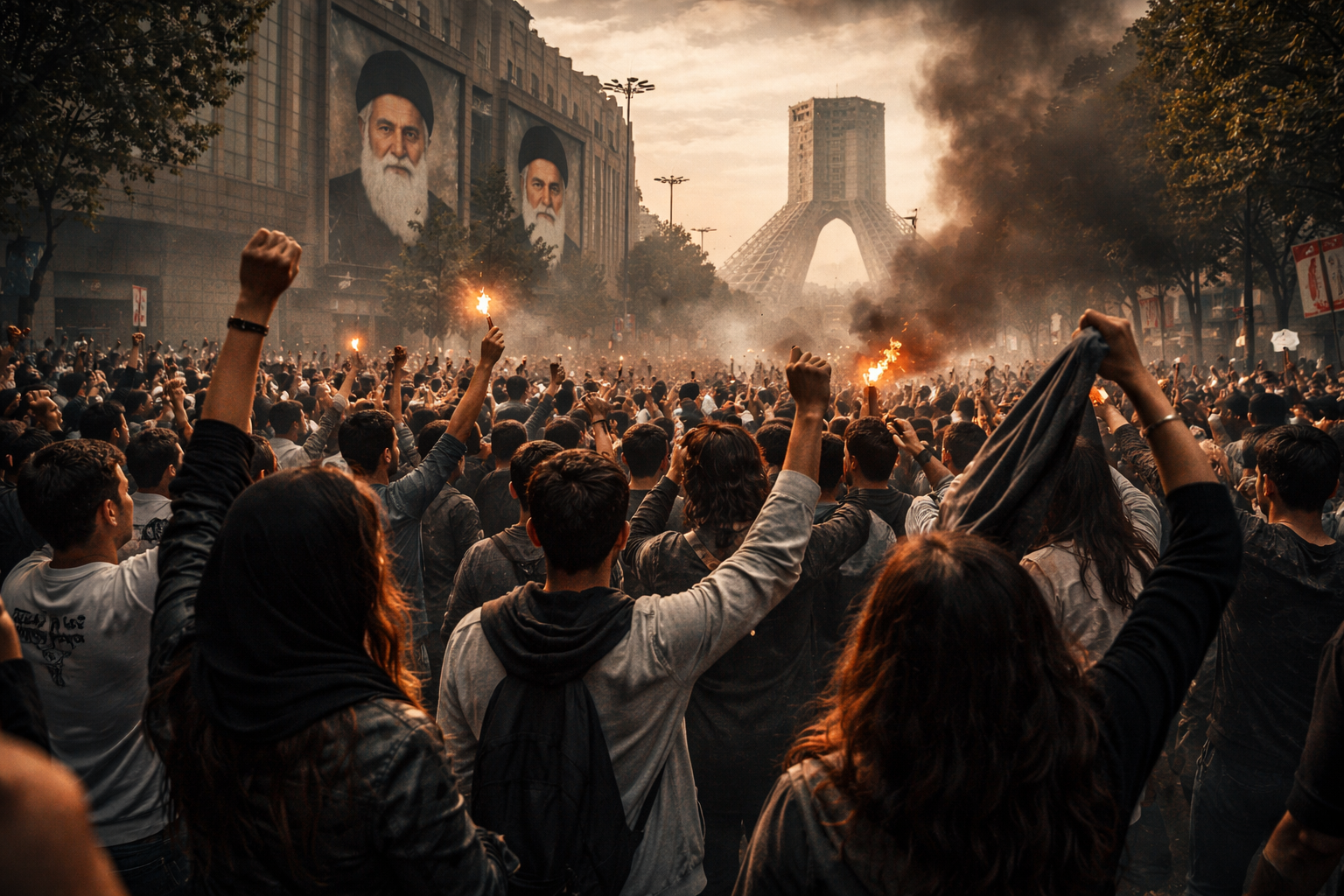
As Iran’s post-revolutionary generation comes of age, youth-led protests are reshaping the state’s relationship with society—and testing the durability of its founding narrative.
Iran’s youth protests are often described as episodic eruptions of dissent. Yet seen in historical perspective, they reflect a deeper and more structural shift: the erosion of a revolutionary compact forged more than four decades ago. The generation now at the forefront of protest did not experience the upheaval of 1979, nor does it derive political meaning from the sacrifices that once underpinned the Islamic Republic’s legitimacy.
This analysis traces how a political system built on revolutionary mobilisation has struggled to adapt to generational change. From Ayatollah Khomeini’s ability to mobilise popular consent to Ayatollah Ali Khamenei’s reliance on institutional control, the relationship between state and society has gradually transformed. Youth-led protests are not merely demands for reform; they signal a widening gap between the state’s founding narrative and contemporary social realities.
The question confronting Iran’s leadership is not whether protests can be contained, but whether legitimacy can be renewed in a system whose core identity was shaped by a generation now fading from political life.
Youth, Legitimacy, and the Reversal of Revolutionary Power in Iran
How the generation that once powered the Islamic Revolution is now challenging the Islamic Republic.
Iran’s modern political history cannot be understood without the role of its youth. In the late 1970s, young Iranians played a decisive part in dismantling the monarchy of Mohammad Reza Shah Pahlavi, rallying behind a cleric in exile, Ruhollah Khomeini, who promised justice, dignity, and political renewal.
More than four decades later, Iran’s youth remain at the centre of political unrest — but now their anger is directed at the Islamic Republic itself, led by Supreme Leader Ali Khamenei.
This reversal is not merely cyclical protest. It signals a deeper structural shift: the erosion of revolutionary legitimacy in a system that once derived authority from youthful mobilisation. The Islamic Republic was built on youth-driven revolt; today it is increasingly destabilised by youth-driven rejection.
How Khomeini Mobilised the Youth in 1979
Khomeini’s success in attracting young Iranians during the 1979 uprising rested on an unusually effective fusion of religious symbolism and political grievance.
The Shah’s regime — despite economic modernization — was widely perceived as:
- politically repressive
- socially unequal
- culturally alienating
- overly dependent on external powers
This perception resonated particularly among students and urban youth, who experienced the state not as modern and strong, but as closed, hierarchical, and detached from national identity.
Khomeini framed opposition to the monarchy as more than political competition. He presented it as a moral struggle and a form of national restoration. This framing allowed diverse groups to co-exist within the revolutionary coalition:
- Islamist networks
- leftist student organisations
- secular reformists
- anti-imperialist nationalists
For many young people, the revolution represented agency and inclusion, not clerical rule as an end goal.
Critically, Khomeini’s legitimacy at that stage was symbolic rather than institutional. He functioned as a unifying figure — not yet as a blueprint for permanent governance. Youth rallied around him as the voice capable of ending authoritarianism and reclaiming sovereignty.
After the Revolution: Consolidation and the Narrowing of Youth Agency
Following the Shah’s overthrow, the broad revolutionary coalition fractured rapidly.
The Islamic Republic moved to consolidate authority within clerical institutions and security structures, sidelining former allies and suppressing dissent. Youth mobilisation did not disappear — but it was increasingly redirected into state-managed channels rather than independent politics.
The Iran–Iraq War (1980–1988) temporarily restored a shared sense of purpose and sacrifice, particularly among young men. Yet it also deepened:
- militarisation of society
- ideological rigidity
- institutional dominance of the security state
Over time, revolutionary ideals hardened into doctrine, and legitimacy shifted away from popular participation toward political control.
For subsequent generations, the revolution stopped being lived history and became state narrative: taught, ritualised, and enforced — but rarely debated openly.
Today’s Youth Revolt: Disillusionment Without a Vanguard
“Iran’s youth are protesting not a policy failure, but a legitimacy gap.”
The character of youth dissent in Iran today differs fundamentally from the mobilisation of the 1970s.
Contemporary protests are not structured around a single charismatic leader, unified ideology, or revolutionary vanguard. Instead, they reflect widespread disillusionment shaped by:
- economic stagnation and limited opportunity
- social restrictions
- perceived corruption and elite insulation
- absence of political accountability
Where the 1979 generation saw the Islamic Republic as a corrective to authoritarian rule, many young Iranians today view it as authoritarianism in an alternative form — one that combines political constraint with moral enforcement.
Religious authority, once used to legitimise resistance and protect dignity, is increasingly experienced by youth as:
- coercive
- punitive
- disconnected from modern identity and lived reality
At the same time, modern dissent is shaped by digital culture and global connectivity. This decentralisation makes protests:
- more spontaneous
- harder to suppress through traditional repression
- but also harder to convert into sustained political organization
What emerges is a protest movement strong in cultural force, but structurally limited in its ability to impose political change.
From Revolutionary Strength to Structural Liability
The key analytical shift is this: youth moved from being the regime’s greatest asset to its most persistent threat.
Khomeini’s revolution succeeded because it aligned youthful energy with a credible promise of transformation. Today’s leadership governs a society in which the majority of the population has:
- no personal memory of the revolution
- little emotional attachment to revolutionary myths
- limited belief in its ideological framework
This generational disconnect matters because revolutionary legitimacy cannot remain permanent — it must be continuously reproduced. Yet the tools once used to mobilise youth (ideology, sacrifice, resistance, religious symbolism) now produce diminishing returns in a society shaped by economic pressure, demographic youth bulges, and global media culture.
Youth protest today is less about replacing one leader with another. It increasingly signals systemic estrangement — rejection of imposed authority itself rather than a desire to inherit it.
Assessment: The Crisis of Reproducing Legitimacy
“A revolutionary system built on memory struggles when memory no longer binds.”
Iran now faces a dilemma common to aging revolutionary systems: how does a revolutionary regime renew legitimacy without renewal of power?
The Islamic Republic’s founding narrative depends on the idea that it represents liberation, justice, and national dignity. But when a generation no longer recognises that story as authentic — or experiences it only through restriction and hardship — revolutionary legitimacy becomes difficult to sustain.
Whether today’s unrest will translate into structural change remains uncertain. But one reality is increasingly clear:
The Islamic Republic’s founding strength — its ability to mobilise the young — has become one of its most enduring vulnerabilities.


