


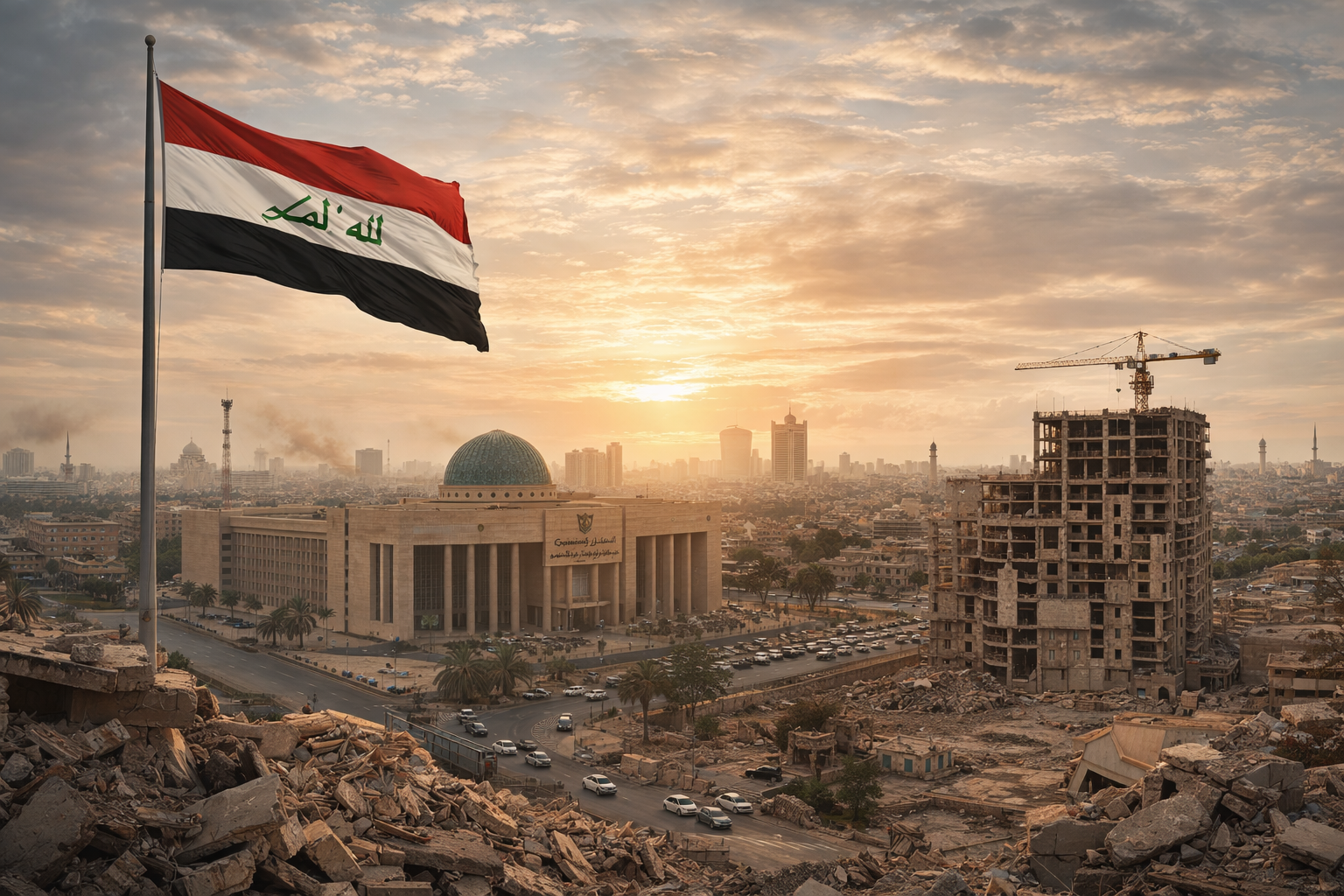
The fall of Saddam Hussein in 2003 marked one of the most consequential regime changes of the 21st century. Unlike Libya, Iraq’s transformation unfolded under full-scale foreign invasion, prolonged occupation and sectarian civil conflict.
More than two decades later, Iraq remains sovereign yet fragile — shaped by unresolved legacies of dictatorship, war and geopolitical competition.
This is Iraq before Saddam, under his rule, the breaking point, the invasion, his death, what followed — and what remains unsettled.
Pre-Saddam Iraq: Coups and Competing Ideologies (1932–1979)
Iraq gained independence in 1932 under a Hashemite monarchy. Political instability soon followed:
- 1958: Military coup overthrows the monarchy.
- 1963–1968: Ba’ath Party consolidation.
- Oil nationalisation in 1972 strengthens state revenues.
Iraq in the 1970s experienced rising oil wealth, infrastructure development and expanded education. But governance increasingly concentrated within the Ba’ath Party security apparatus.
By 1979, Saddam Hussein formally assumed the presidency.
The Saddam Era (1979–2003): Centralised Rule and Permanent Conflict
Under Saddam Hussein, Iraq became a tightly controlled security state.
Domestic Control
- Extensive intelligence networks
- Elimination of political rivals
- Suppression of Kurdish and Shi’a uprisings
- Cult of personality
Regional Wars
Iran–Iraq War (1980–1988)
An eight-year conflict with Iran devastated both economies.
Kuwait Invasion (1990)
Iraq’s invasion of Kuwait triggered the Gulf War and a U.S.-led coalition response.
After 1991, Iraq faced heavy UN sanctions, degrading infrastructure and weakening state capacity.
International Allegations: Weapons and Repression
Iraq was accused of:
- Possessing weapons of mass destruction (WMDs)
- Using chemical weapons (notably against Kurdish civilians in Halabja in 1988)
- Violating human rights
The WMD allegations became central to the 2003 invasion justification.
Subsequent investigations, including the Iraq Survey Group, found no active WMD stockpiles at the time of invasion — a fact that reshaped global perceptions of the war’s legitimacy.
The Boiling Point: 2003
In March 2003, a coalition led by the United States and the United Kingdom launched a military invasion of Iraq.
Baghdad fell within weeks. The Ba’athist state collapsed rapidly.
The breaking point, however, came after victory.
The Coalition Provisional Authority disbanded the Iraqi army and pursued de-Ba’athification — policies that dismantled existing institutions and contributed to insurgency.
Capture and Death
Saddam Hussein was captured in December 2003 near Tikrit. After trial by the Iraqi Special Tribunal, he was executed in December 2006.
His execution symbolised regime closure but deepened sectarian divisions. For some, it marked justice. For others, it intensified grievance narratives.
The Family After Saddam
Several sons were killed during or shortly after the invasion.
Daughters fled abroad, primarily to Jordan. Elements of the extended family remained politically marginal but symbolically relevant among certain Sunni constituencies.
The Ba’ath Party as a governing structure dissolved, though remnants fed insurgent networks.
Iraq Post-Saddam: Year-by-Year Trajectory
2003–2004: Occupation and Insurgency
US-led occupation authority governs. Sunni insurgency escalates. Abu Musab al-Zarqawi emerges as a militant leader.
2005: Elections and Constitution
Iraq adopts a new constitution. Sectarian politics institutionalised.
2006–2007: Civil War
Sectarian violence peaks. Baghdad neighborhoods fracture. US troop “surge” begins in 2007.
2008–2010: Relative Stabilisation
Violence declines. Prime Minister Nouri al-Maliki consolidates power.
2011: US Withdrawal
American combat troops withdraw. Power vacuum concerns intensify.
2014: Rise of ISIS
The group later known as Islamic State captures Mosul and large swathes of territory. Iraqi state authority collapses in parts of the north.
2015–2017: Counteroffensive
Iraqi forces, Kurdish units and international coalition defeat ISIS territorially.
2018–2019: Protest Movements
Mass demonstrations erupt against corruption and unemployment.
2020–2023: Political Paralysis
Repeated government formation crises. Iran-backed militias increase influence.
2024–2025: Managed Fragility
Oil exports stabilise revenues, but institutional reform remains limited.
Myths and Facts
Myth: Iraq was stable under Saddam.
Fact: Stability relied on coercion and suppression, not institutional resilience.
Myth: The 2003 invasion instantly democratised Iraq.
Fact: It dismantled state structures without sufficient reconstruction planning.
Myth: ISIS emerged independently of post-2003 dynamics.
Fact: Power vacuums and sectarian polarisation were key enabling factors.
What Remains Unsolved
- Militia integration into national forces
- Corruption within oil revenue management
- Sunni–Shi’a political trust deficit
- Kurdish autonomy disputes
- External influence from Iran and the United States
Iraq has elections. It has oil. It has sovereignty. But its institutions remain contested.
Regional and Global Impact
Iraq sits at the crossroads of Middle Eastern geopolitics:
- Strategic rivalry between Iran and the United States
- Energy market influence
- Counterterrorism coordination
- Kurdish regional autonomy
Its internal balance affects regional equilibrium.
Future Scenarios
1. Gradual Consolidation (Moderately Likely)
Incremental reform, stronger state authority, reduced militia autonomy.
2. Entrenched Hybrid State (Most Likely)
Formal government coexists with powerful non-state armed actors.
3. Renewed Fragmentation
Triggered by economic shock or contested elections.
4. Federal Deepening
Greater decentralisation formalised between Baghdad and regional authorities.
Strategic Conclusion
Iraq’s trajectory illustrates a broader lesson: regime removal does not equate to state reconstruction.
The fall of Saddam ended authoritarian continuity but triggered systemic rupture. More than two decades later, Iraq is neither failed nor fully stable — it is structurally transitional.
Its future will depend less on elections alone and more on whether parallel power centres are gradually absorbed into accountable institutions.
- Iraq After Saddam: Regime Collapse, Occupation and the Long Shadow of State Failure
- The World Is Not Watching a Crisis Unfold — It Is Watching a Redesign
- What If the Biggest Hole in Global Climate Policy Isn’t Coal or Oil — It’s War?
- Diplomacy Is Not About Choosing Sides – It Is About Protecting Interests
- War in the Cloud


