


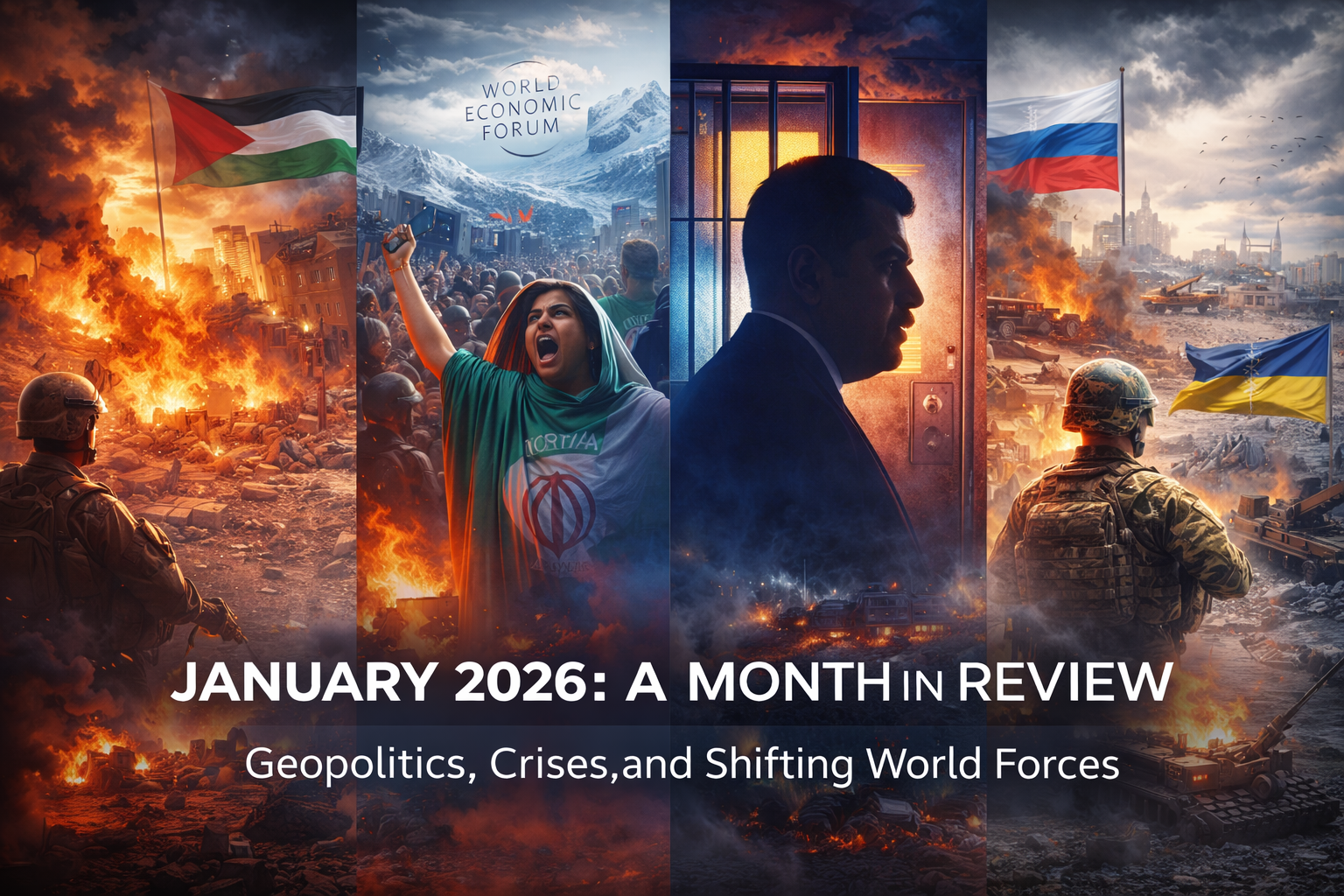
January 2026 opened with the international system under visible strain. Across continents, governments faced mounting domestic unrest, alliances were tested by unconventional diplomacy, and long-running conflicts showed little sign of resolution. From Arctic geopolitics and Middle Eastern war zones to European battlefields and Latin American shockwaves, the first month of the year offered a clear message: 2026 will not be a year of stability, but of strategic recalibration.
What follows is a comprehensive review of the most consequential global developments in January and why they matter for the months ahead.
1. Greenland and the Return of Hard-Edged Transatlantic Politics
One of January’s most unexpected flashpoints emerged in the Arctic. Renewed rhetoric from Donald Trump regarding Greenland—an autonomous territory of Denmark—triggered a diplomatic crisis that rattled NATO capitals.
Framing Greenland as a strategic asset vital to U.S. security and Arctic dominance, Trump suggested that economic pressure—or “alternative arrangements”—could not be ruled out. The remarks, delivered amid broader criticism of European defense spending, ignited alarm across the NATO alliance.
Although Washington later softened its stance following coordinated diplomatic pushback from Denmark, Norway, the EU, and NATO leadership, the episode left behind deeper mistrust.
Why it matters:
Greenland has moved from peripheral geography to geopolitical litmus test. The incident underscored growing uncertainty about alliance predictability and reinforced the Arctic’s emergence as a strategic theatre in great-power competition.
2. Davos 2026: Economics in the Shadow of Geopolitics
The World Economic Forum (19–23 January) reflected a global mood of unease. While official themes focused on innovation, growth, and investment in people, geopolitical instability dominated both formal panels and private meetings.
Trump’s Greenland remarks, combined with his proposal for a U.S.-led “Board of Peace” as an alternative to the UN, shifted attention from economic coordination to institutional fragmentation. European leaders expressed concern over U.S. unpredictability, while emerging economies questioned whether existing global governance structures still served their interests.
Why it matters:
Davos 2026 highlighted a defining paradox of the global economy: capital seeks stability, but politics is becoming more volatile. Business leaders increasingly accept that geopolitics is now a permanent variable, not a temporary disruption.
3. Iran: Protests, Repression, and Regional Shockwaves
Iran’s domestic crisis deepened dramatically in January. Protests that began in late 2025 over inflation, unemployment, and political repression spread nationwide. Security forces responded with force, culminating in the widely reported Fardis massacre, where dozens of civilians were killed.
Authorities imposed nationwide internet blackouts and mass arrests, drawing condemnation from the United Nations Human Rights Council and sparking solidarity protests across the Iranian diaspora worldwide.
Why it matters:
Iran’s instability has regional and global implications. Prolonged unrest risks further sanctions, energy market volatility, and escalation with regional rivals. Tehran’s internal pressure may harden its external posture—or eventually force recalibration.
4. Israel–Palestine: A War Without an Off-Ramp
January saw no meaningful de-escalation in the Gaza Strip conflict. Israeli military operations continued amid humanitarian catastrophe, while ceasefire negotiations remained stalled despite mediation by Qatar, Egypt, and the United States.
The Israeli government maintained that military pressure was necessary to dismantle Hamas, while international criticism intensified over civilian casualties and aid restrictions. Pro-Palestinian protests expanded across Europe, North America, and parts of Asia, increasing domestic pressure on Western governments.
Why it matters:
The conflict is reshaping Middle Eastern diplomacy. It has strained U.S. relations with Arab partners, radicalized public opinion, and weakened Western moral authority on human rights. Without a political horizon, the war risks becoming a chronic destabilizer throughout 2026.
5. Russia–Ukraine: A Frozen War with Global Costs
Nearly four years into full-scale war, fighting between Russia and Ukraine remained intense but strategically static. January brought renewed missile strikes, incremental territorial gains, and deepening war fatigue on both sides.
Western military aid continued, though debates over sustainability intensified in Europe and the United States. Moscow, meanwhile, leaned further into war-economy mobilization and partnerships with non-Western states.
Why it matters:
The Ukraine war has become structural rather than episodic. Its continuation affects global energy markets, defense spending, food security, and alliance politics. A decisive breakthrough appears unlikely in 2026—making endurance, not victory, the central variable.
6. Venezuela Shock: Maduro Arrest Sends Regional Tremors
One of January’s most dramatic developments came from Latin America, where Nicolás Maduro was unexpectedly detained while traveling abroad under an international legal process linked to long-standing criminal and human rights allegations.
The arrest triggered immediate political shockwaves. Supporters decried it as foreign interference, while opposition groups hailed it as historic accountability. Regional governments scrambled to assess implications for stability in Venezuela and the broader region.
Why it matters:
Maduro’s arrest—whether it leads to prosecution or diplomatic stalemate—sets a precedent. It signals that political immunity is no longer guaranteed and could reshape how authoritarian leaders calculate risk when traveling internationally.
7. U.S. Domestic Politics and Global Signal Drift
January reinforced how tightly U.S. domestic politics are now intertwined with global diplomacy. Trump’s rhetorical style—combining populist messaging with strategic ambiguity—generated uncertainty among allies and opportunities for rivals.
Legal challenges and policy reversals at home further complicated foreign policy consistency, leaving partners unsure whether U.S. commitments were durable or transactional.
Why it matters:
In 2026, U.S. credibility may hinge less on power than predictability. Allies are already hedging—diversifying partnerships and reducing reliance on Washington alone.
8. Culture, Sport, and Politics Collide
As preparations for the FIFA World Cup 2026 intensified, political controversies spilled into sport. Visa restrictions and diplomatic tensions raised questions about participation and access for certain nations, underscoring how global events increasingly reflect political fault lines.
Why it matters:
Sport has become an extension of diplomacy. Cultural platforms are now arenas where geopolitical disputes play out—often with greater public visibility than formal negotiations.
What January 2026 Reveals About the Year Ahead
Several patterns are already clear:
Fragmentation Over Consensus
Alliances remain intact, but trust is thinner and coordination harder.
Domestic Crises, Global Consequences
Iran, Venezuela, and Gaza show how internal conflicts rapidly internationalize.
Institutions Under Pressure
From the UN to NATO to global trade forums, legitimacy is being questioned.
Multipolar Reality Deepens
States are hedging, diversifying partners, and reducing dependence on any single power.
Conclusion: A World No Longer Waiting for Stability
January 2026 did not offer resolution—it offered clarity. The international system is entering a phase defined less by rules and more by resilience, power balancing, and strategic improvisation.
For governments, businesses, and societies alike, the lesson is stark: uncertainty is no longer a phase, it is the operating environment.
How states adapt to this reality will define not just 2026, but the trajectory of the global order beyond it.


