


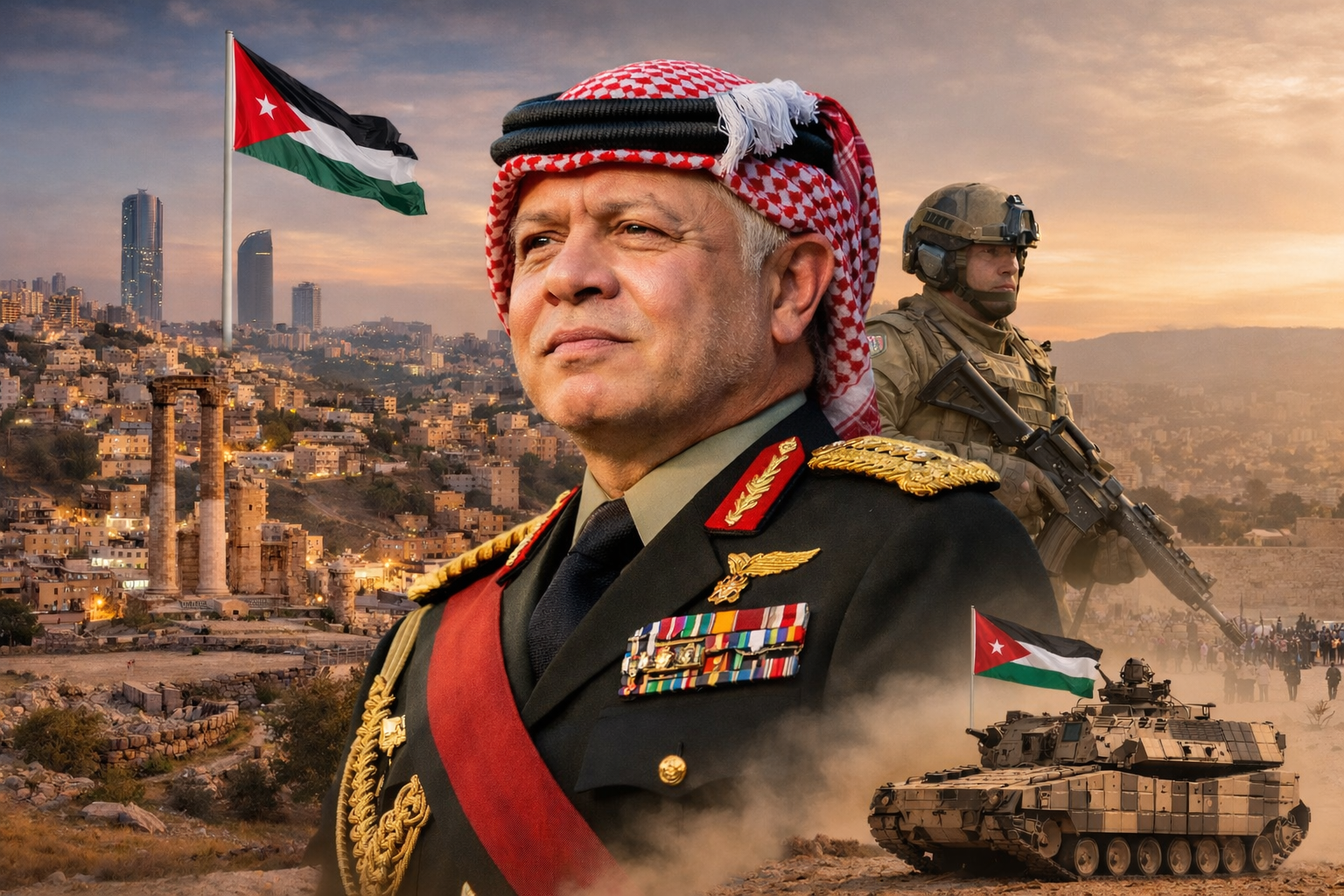
In a Middle East defined by regime change, proxy conflict and economic volatility, Jordan has maintained a reputation for continuity. It is neither oil-rich nor militarily dominant. Yet it remains one of the region’s most strategically consequential states — a security partner, diplomatic intermediary and political buffer between fault lines.
Jordan’s positioning today is the product of disciplined balancing: between reform and restraint, alliance and autonomy, domestic pressure and regional responsibility. Its challenge is not survival in the immediate sense. It is sustainability over the long term.
A Monarchy Built on Managed Evolution
Under Abdullah II of Jordan, who ascended the throne in 1999, the Hashemite monarchy has prioritised incremental reform and institutional resilience. The kingdom’s political model blends traditional tribal legitimacy with modern state administration.
Unlike republics that experienced abrupt rupture during the Arab Spring, Jordan adopted a strategy of controlled adjustment:
- Constitutional amendments expanding parliamentary oversight
- Electoral law reforms aimed at strengthening political parties
- Decentralisation initiatives
- Security recalibration without systemic overhaul
The monarchy retains executive authority, yet it has preserved a narrative of responsiveness rather than repression. Stability, in Jordan’s political culture, is framed as a public good.
The Economic Constraint: A Structural Vulnerability
Jordan’s greatest challenge is economic rather than political.
The kingdom lacks the hydrocarbons that cushion fiscal pressures in neighbouring Gulf states. It imports the majority of its energy. It is one of the most water-scarce countries in the world. And it has absorbed successive waves of refugees — Palestinian, Iraqi and Syrian — placing additional strain on public services.
Key indicators illustrate the pressure:
- High public debt relative to GDP
- Persistent youth unemployment
- Sluggish private-sector growth
- Dependence on foreign assistance
The International Monetary Fund has supported reform programmes focused on fiscal discipline, subsidy rationalisation and tax restructuring. While macroeconomic stability has improved in some respects, public frustration has occasionally surfaced through protests tied to cost-of-living pressures.
Jordan’s economic positioning today is defined by necessity-driven diversification:
- Renewable energy expansion
- Digital entrepreneurship initiatives
- Tourism recovery strategies
- Logistics and trade corridor development
Yet growth remains constrained by regional uncertainty and limited domestic demand.
A Security State by Geography
Jordan’s borders define its strategic importance.
It sits between:
- Israel and the West Bank
- Syria to the north
- Iraq to the east
- Saudi Arabia to the south
This geography makes Jordan a frontline buffer state.
It has maintained a peace treaty with Israel since 1994, positioning itself as a key interlocutor in Israeli–Palestinian diplomacy. At the same time, the monarchy holds custodianship over Islamic holy sites in Jerusalem — a responsibility that carries domestic sensitivity.
Jordan’s intelligence services and armed forces are widely regarded as professional and disciplined. Cooperation with the United States remains central to its defence architecture, particularly in counterterrorism operations.
Security has been prioritised not as a temporary measure but as a structural pillar of governance.
Refugee Management and Social Cohesion
Jordan hosts one of the highest refugee-to-citizen ratios in the world. Syrian displacement alone placed significant demands on housing, employment and infrastructure.
Yet the kingdom avoided systemic destabilisation.
International aid has been critical, but so has social management:
- Integration without formal naturalisation in many cases
- Gradual labour market inclusion
- International burden-sharing diplomacy
The risk lies not in immediate unrest, but in long-term socioeconomic strain.
Diplomacy in a Multipolar Era
Jordan’s foreign policy rests on moderation.
It maintains:
- Strategic ties with Washington
- Economic partnerships with Gulf states
- Diplomatic engagement with European actors
- Cautious positioning toward regional power competition
The kingdom does not seek dominance. It seeks relevance.
In recent years, Amman has supported de-escalation initiatives across regional flashpoints, emphasising dialogue over confrontation. This approach has allowed Jordan to retain access to multiple diplomatic channels without becoming a proxy arena.
Domestic Political Dynamics: Reform Without Rupture
Political reform in Jordan has been evolutionary.
Recent electoral reforms aim to encourage party-based competition rather than purely tribal representation. However, political parties remain relatively weak, and turnout levels vary.
The central dilemma is clear:
- Expand participation without accelerating polarisation.
- Preserve stability without generating stagnation.
Jordan’s youth demographic presents both opportunity and risk. A large under-30 population seeks employment, mobility and representation. Without sufficient economic absorption, political apathy could evolve into disengagement or frustration.
Resource Scarcity: The Silent Threat
Water scarcity remains one of Jordan’s most acute structural challenges. Climate pressures compound demographic demand.
Policy responses include:
- Desalination agreements
- Water-sharing arrangements
- Investment in solar energy to offset import dependency
Unlike more visible political crises, resource stress operates gradually — but its long-term implications are profound.
Jordan in 2026: Strategic Themes
Jordan’s positioning today can be understood through four strategic lenses:
1. Stability as Diplomatic Capital
In a region of volatility, reliability enhances influence.
2. Economic Reform as National Imperative
Sustainable growth is not optional; it is existential.
3. Security Without Isolation
Close Western alignment coexists with regional engagement.
4. Incremental Reform as Political Doctrine
Transformation is managed, not revolutionary.
Risks on the Horizon
Jordan’s vulnerabilities are not dramatic but cumulative:
- Prolonged economic stagnation
- Reduced external aid flows
- Regional escalation impacting borders
- Generational impatience
None of these individually threaten collapse. Together, they test endurance.
Strategic Outlook
Jordan is unlikely to pivot sharply in foreign policy or domestic governance. Its model is one of calibration.
The monarchy’s survival has historically depended on three pillars:
- Tribal and institutional legitimacy
- External alliances
- Social stability through gradual reform
If economic diversification accelerates and youth employment improves, Jordan’s balancing act may hold.
If growth lags while demographic pressures intensify, the strain will be quieter — but persistent.
Conclusion
Jordan does not dominate headlines. It does not command the oil leverage of Gulf monarchies or the demographic scale of larger Arab states.
Yet its positioning matters.
It remains a hinge state — between war and peace, reform and rigidity, East and West.
In a fractured regional order, endurance itself becomes strategy.
- Pakistan and the Afghan War: From Strategic Depth to Regional Escalation
- Who Really Profits From War With Iran?
- The War the World Is Not Watching
- The Great Corporate Reset: Why 2026 Is the Year Companies Stopped Hiring Humans
- Jordan’s Strategic Balancing Act: Stability, Strain and Statecraft in a Fractured Region
North Korea and China – How China Balances Supporting and Restraining North Korea


