


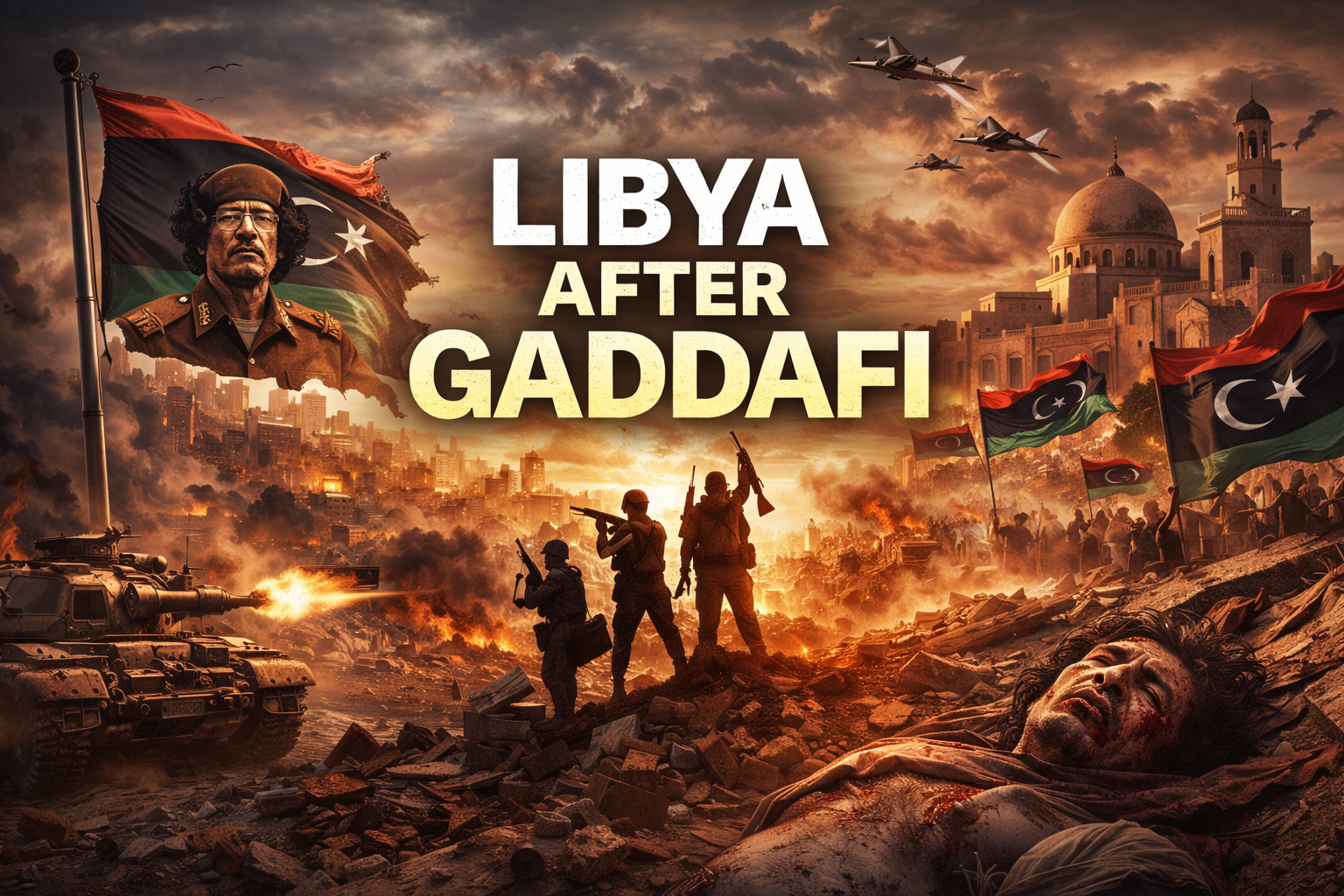
Few modern states illustrate the volatility of regime collapse as starkly as Libya. The fall of Muammar Gaddafi in 2011 ended four decades of authoritarian rule — but it did not deliver stability. Instead, Libya entered a prolonged phase of fragmentation, rival governments and foreign intervention that continues to shape North Africa’s geopolitical landscape.
Fourteen years on, questions such as “Who controls Libya today?”, “Is Libya stable in 2026?”, and “What is the latest Libya political crisis update?” remain central to understanding the country’s uncertain trajectory.
This is Libya’s story — before Gaddafi, under his rule, the revolution, the aftermath, and the strategic outlook for 2026 and beyond.
Pre-Gaddafi Libya: Monarchy, Oil and Uneven Development (1951–1969)
Libya gained independence in 1951 under King Idris I, ruling a federal monarchy. Oil discoveries in the late 1950s transformed the country’s economic potential, placing Libya on the map as a future energy exporter.
Yet wealth distribution remained uneven — a structural imbalance that continues to influence debates about Libya oil revenue distribution and regional marginalisation.
Key characteristics:
- Weak central institutions
- Heavy Western influence
- Limited political participation
- Regional disparities between Tripolitania, Cyrenaica and Fezzan
Discontent among young military officers grew — setting the stage for a coup that would redefine Libya’s political economy.
The Gaddafi Era (1969–2011): Oil Nationalism and Centralised Control
In 1969, a young army officer, Muammar Gaddafi, overthrew King Idris in a bloodless coup.
Gaddafi dismantled the monarchy and introduced his “Jamahiriya” system rule by “people’s committees” outlined in his Green Book. In practice, Libya became a highly centralised security state.
Economic Model: Oil Power and State Control
Libya’s transformation into a hydrocarbon state defined its modern history. Today’s debates around Libya oil production update, Libya oil exports news, and the role of the National Oil Corporation trace back to this era.
- Oil nationalisation
- Subsidised welfare state
- State-controlled economy
- Low external debt
Political Reality
- No political parties
- Suppression of dissent
- Intelligence-heavy governance
- Personalised rule
International Allegations and Sanctions
Libya faced accusations of sponsoring terrorism, including the 1988 Lockerbie bombing of Pan Am Flight 103 over Scotland. Sanctions followed, constraining the economy and reshaping Libya’s foreign relations.
In 2003, Libya accepted responsibility for the actions of its officials and paid compensation, leading to gradual diplomatic rehabilitation. Western oil companies returned. By the late 2000s, Libya had re-entered the international system.
Yet internally, institutional resilience remained weak — a vulnerability exposed in 2011.
The Boiling Point: 2011 and the Arab Spring
Inspired by uprisings in Tunisia and Egypt, protests erupted in Benghazi in February 2011. The regime responded with force. What began as demonstrations escalated into armed rebellion.
Tribal divisions, regional grievances and security defections intensified the crisis, creating what analysts now describe as the beginning of the modern Libya civil war timeline.
The breaking point came when Gaddafi vowed to crush opposition “house by house.” International alarm grew rapidly.
International Intervention and NATO’s Role
In March 2011, the United Nations Security Council passed Resolution 1973, authorising “all necessary measures” to protect civilians.
A NATO-led coalition — including the United States, France and the United Kingdom — launched airstrikes.
Supporters argue intervention prevented a massacre in Benghazi. Critics contend it exceeded its civilian protection mandate and facilitated regime change without a post-war stabilisation plan — a debate central to ongoing analysis of foreign powers in Libya conflict and Libya UN mediation efforts.
The immediate result: rapid collapse of central authority.
The Death of Gaddafi and Institutional Vacuum
On 20 October 2011, Gaddafi was captured near Sirte and killed by rebel fighters.
His death marked the symbolic end of the old regime — but not the construction of a functioning state.
Libya lost authority without building durable institutions — a reality that still defines the Libya security situation today.
Post-Gaddafi Libya: Rival Governments and Fragmentation
2012–2013: Transitional Optimism
Elections were held. A General National Congress formed. Militias retained autonomy.
2014: Dual Governments Emerge
The country split between:
- The House of Representatives in Tobruk
- The General National Congress in Tripoli
The question of Libya rival governments and divided sovereignty became structural.
2015: UN Mediation
The Libyan Political Agreement created the Government of National Accord (GNA), though implementation faltered.
2016–2019: Armed Consolidation
Eastern commander Khalifa Haftar consolidated power in the east. Armed groups competed for oil terminals — highlighting the strategic centrality of Libya oil infrastructure security.
2019–2020: Battle for Tripoli
Haftar’s offensive on the capital drew in external actors. Turkey intervened militarily in support of the Tripoli-based government. Russia-linked contractors were reportedly active in the east — reinforcing Libya’s role in broader Mediterranean security and great-power competition.
A ceasefire followed in 2020.
2021–2025: Transitional Governments and Delayed Elections
An interim Government of National Unity was formed. Yet elections were repeatedly postponed due to legal and security disputes.
By 2026, Libya remains divided between eastern and western administrations. Oil production continues, but revenues remain politicised — shaping concerns about Libya economic outlook 2026 and sovereign risk.
Large-scale fighting has decreased, yet the Libya political crisis 2026 persists in institutional form.
What Remains Unsolved
- Constitutional framework
- Unified national army
- Militia disarmament
- Oil revenue distribution
- Electoral legitimacy
- Accountability for wartime abuses
The core issue is institutional vacuum — the absence of a unified, enforceable political settlement.
Regional and Global Implications
Libya’s instability has consequences beyond its borders.
It affects:
- Mediterranean migration routes
- European energy security
- North African stability
- External power competition
- Global oil markets
For investors and policymakers tracking Libya oil production forecast and Libya energy investment risks, political fragmentation remains the principal variable.
Future Outlook: Scenarios for 2026 and Beyond
- Managed Stalemate (Most Likely)
Dual governance continues. Oil exports sustain minimal stability. No unified elections. - Gradual Institutional Consolidation
UN-backed constitutional settlement enables elections and limited reunification. - Renewed Conflict
Triggered by disputed elections or an oil revenue crisis. - Decentralised Federal Model
Regions gain autonomy while maintaining nominal national structure.
Strategic Conclusion
Libya’s trajectory underscores a central lesson of regime change: removing authority is easier than constructing legitimacy.
The country is neither in constant nationwide war nor politically stable. It exists in suspended equilibrium — a fragmented state sustained by oil exports but constrained by divided sovereignty.
Whether Libya moves toward consolidation or renewed crisis will depend less on personalities and more on the institutional settlement that has so far remained elusive.
Who controls Libya today?
Libya is divided between rival eastern and western administrations. The Tripoli-based government holds international recognition, while eastern authorities maintain military control over significant territory and oil infrastructure.
Is Libya still in civil war?
Large-scale civil war has subsided since the 2020 ceasefire, but political fragmentation and militia activity continue.
What is Libya’s oil production in 2026?
Libya produces approximately 1 to 1.3 million barrels per day, though output fluctuates due to political disputes and infrastructure shutdowns.
Why are elections delayed in Libya?
Disagreements over constitutional rules, candidate eligibility and security arrangements have repeatedly postponed national elections.
What role does oil play in Libya’s political crisis?
Oil revenues fund state institutions but also drive power struggles between rival authorities competing for fiscal control.
Which foreign countries are involved in Libya?
Turkey, Russia, several European states and Gulf actors maintain varying levels of political or military involvement.
Is Libya safe in 2026?
Security varies by region. Major cities are relatively stable, but militia influence and political uncertainty persist.
What is the outlook for Libya’s economy?
Libya’s economic outlook depends heavily on stable oil exports, political reconciliation and institutional reform.
Could Libya reunify politically?
A UN-backed constitutional settlement could enable reunification, but progress remains slow.
Why does Libya matter internationally?
Libya influences Mediterranean migration routes, European energy security and regional stability in North Africa.


