


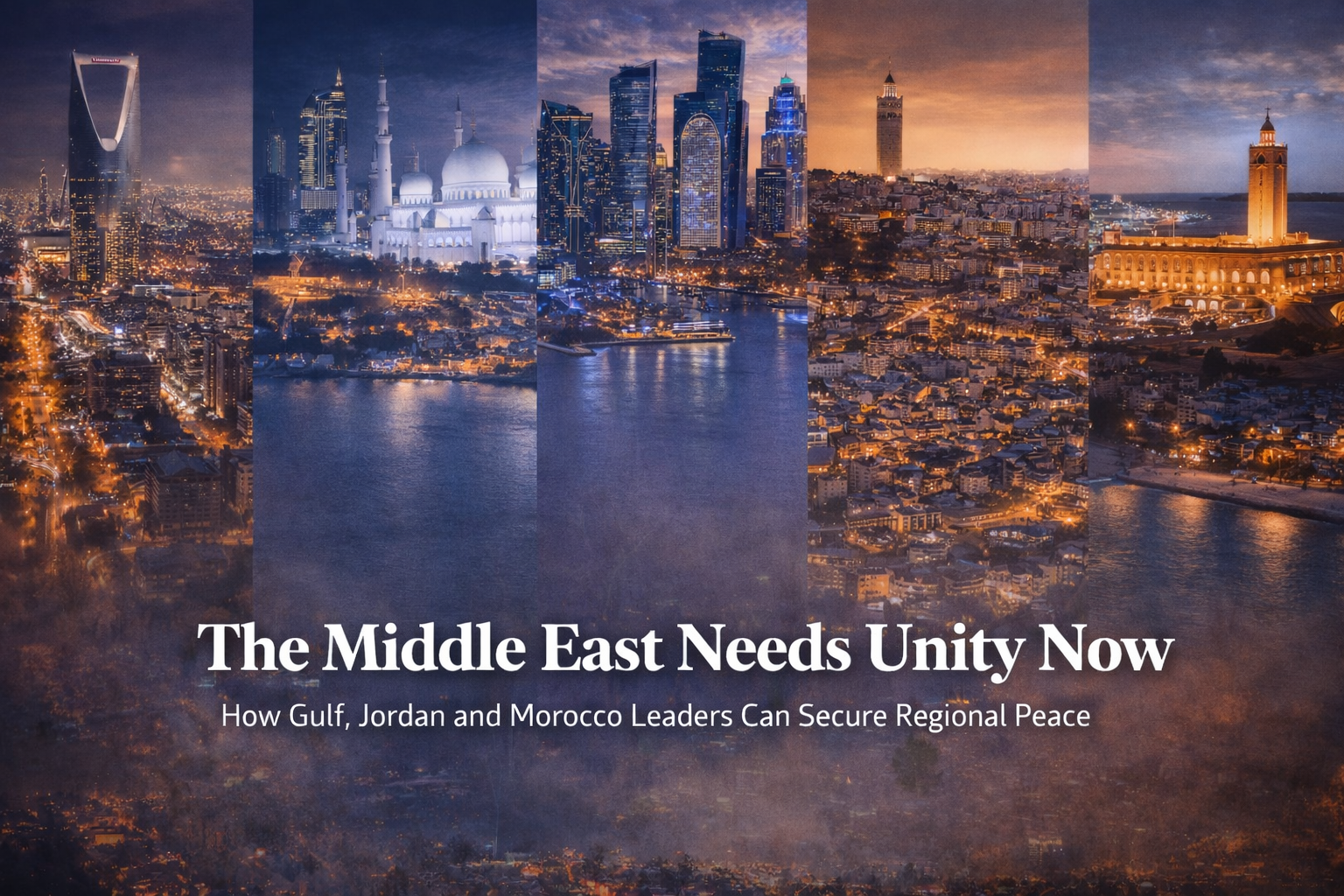
The Middle East stands at a fragile crossroads.
Escalating tensions, leadership shocks, proxy rivalries, and economic uncertainty have created a climate where miscalculation could prove costly. In moments like this, fragmentation is easy. Stability requires leadership.
Today, that leadership increasingly rests with the Gulf — alongside steady Arab monarchies such as Jordan and Morocco — whose rulers have demonstrated strategic restraint, diplomatic maturity, and a long-term vision for peace.
Countries such as Saudi Arabia, United Arab Emirates, and Qatar have emerged as anchors of economic and diplomatic influence. At the same time, Jordan and Morocco continue to play stabilizing roles through balanced diplomacy and historical legitimacy.
In a volatile environment, unity among these states is not symbolic — it is strategic.
Saudi Arabia: Strategic Weight and Transformation
Under Crown Prince Mohammed bin Salman, Saudi Arabia has redefined its regional posture.
Vision 2030 is more than an economic diversification plan — it reflects an understanding that sustainable prosperity requires regional calm. Economic transformation cannot thrive in an environment of prolonged conflict.
A Gulf policy expert recently noted:
“Saudi Arabia’s modernization drive ties its future to regional stability. Escalation is economically irrational.”
Riyadh’s recent diplomatic recalibrations — including renewed dialogue with former rivals — demonstrate an emphasis on de-escalation over confrontation.
The UAE: Stability Through Multi-Alignment
Under President Mohamed bin Zayed Al Nahyan, the UAE has championed a foreign policy rooted in balance.
Abu Dhabi’s approach emphasizes:
- Economic diplomacy
- Strategic neutrality where possible
- Humanitarian engagement
- Long-term security partnerships
An Emirati analyst summarized the philosophy succinctly:
“Peace is not passive. It requires consistent engagement across divides.”
By maintaining open lines with global powers and regional actors alike, the UAE has positioned itself as a diplomatic bridge in times of tension.
Qatar: Mediation as Influence
Qatar has built its influence through mediation. Under Emir Tamim bin Hamad Al Thani, Doha has facilitated talks in conflicts where communication channels were otherwise frozen.
A regional diplomat observed:
“In crises, access is power. Qatar’s ability to speak to multiple sides makes it indispensable.”
This mediation model reduces temperature when escalation threatens.
Dubai: Prosperity as a Stabilizer
Within the UAE, Mohammed bin Rashid Al Maktoum has transformed Dubai into a global economic hub.
Trade, tourism, finance, and logistics create interdependence. Economic interdependence reduces incentives for conflict.
Dubai’s model demonstrates that prosperity can serve as a buffer against instability.
Jordan: A Pillar of Moderation
Beyond the Gulf, Abdullah II of Jordan has long positioned Jordan as a voice of moderation.
Strategically located between major regional fault lines, Jordan has maintained internal stability while advocating diplomatic solutions to regional crises. The kingdom has consistently emphasized dialogue, counter-extremism cooperation, and humanitarian responsibility — particularly during waves of refugee influx from neighboring conflicts.
A Middle East policy scholar described Jordan’s role this way:
“Jordan operates as the region’s pressure valve — steady, pragmatic, and deeply aware of the cost of instability.”
King Abdullah II’s diplomatic engagement across Western capitals and Arab states reinforces Jordan’s bridging function.
Morocco: Stability Through Reform and Balance
In North Africa, Mohammed VI has advanced gradual reform while maintaining institutional continuity.
Morocco’s leadership has focused on:
- Religious moderation
- Economic modernization
- Strategic African partnerships
- Controlled political evolution
Morocco’s religious authority — rooted in the monarchy’s historical legitimacy — provides an additional layer of stability in a region often vulnerable to ideological polarization.
A North African analyst commented:
“Morocco’s approach blends tradition with reform, offering a model of evolutionary stability rather than revolutionary upheaval.”
Why Unified Leadership Matters Now
The Middle East’s interconnected challenges — security, energy markets, trade routes, and humanitarian pressures — cannot be managed in isolation.
A coordinated approach among:
- Saudi Arabia
- The UAE
- Qatar
- Jordan
- Morocco
creates a stabilizing arc stretching from the Gulf to North Africa.
Collectively, these states possess:
- Diplomatic leverage
- Economic capital
- Religious legitimacy
- Security partnerships
- Global investment networks
Their unity can:
- Calm markets during volatility
- Offer mediation channels in crises
- Counter extremism
- Provide reconstruction investment in fragile states
Leadership with Dignity and Grace
Leadership style shapes outcomes.
Mohammed bin Salman’s reform-driven ambition,
Mohamed bin Zayed’s strategic calculation,
Tamim bin Hamad Al Thani’s mediation diplomacy,
Mohammed bin Rashid Al Maktoum’s economic vision,
King Abdullah II’s moderation,
King Mohammed VI’s measured reform —
together represent a generation of leaders who understand that influence today is built through stability, not spectacle.
A Gulf academic noted:
“The future of the Middle East depends less on confrontation and more on coordinated calm.”
A Coalition of Stability
Unity does not erase differences. But coordination reduces risk.
In times of uncertainty, the Middle East does not need fragmentation. It needs leadership coalitions capable of lowering tensions, encouraging dialogue, and prioritizing long-term development over short-term rivalry.
The Gulf states, alongside Jordan and Morocco, are uniquely positioned to shape that path.
The region stands at a decisive moment.
If stability prevails, it will not happen by chance.
It will happen because steady hands chose unity over division — and peace over escalation.
Also Read: Death of Mahmoud Ahmadinejad


