


Conflict, Currency, Climate and Culture in a Fragmenting Order
February 2026 confirmed what January foreshadowed: the international system is not stabilising, it is adjusting.
If January exposed fractures from Greenland diplomacy to Iran’s internal unrest and Maduro’s arrest. February demonstrated how quickly those fractures can widen, shift, or harden. Military signalling intensified in the Middle East, economic volatility resurfaced in commodity markets, and political theatre in Washington and New Delhi shaped global narratives.
At the same time, seemingly peripheral events — from extreme weather in North America to technology launches and cultural releases — reflected a deeper truth: geopolitics now intersects with everything.
Below is The International Wire’s comprehensive review of February 2026.
Middle East: Escalation by Signal, Not Declaration
Israel–Gaza: Entrenchment Without Resolution
Following January’s stalled ceasefire talks, fighting in the Gaza Strip continued through February. The Israel government maintained its military posture, arguing that operational pressure remained necessary to dismantle Hamas’ remaining capabilities.
International pressure intensified. Several European capitals called for a defined political horizon, while humanitarian agencies warned of worsening conditions. Yet no durable diplomatic breakthrough emerged.
February’s shift was tonal rather than territorial: Washington’s messaging grew firmer on civilian protections, but operational realities changed little.
Iran: Protest Fatigue Meets Strategic Posturing
Domestic unrest in Iran, which deepened in January following the Fardis crackdown, did not dissipate in February. Instead, protests became more localised and economically focused. Authorities alternated between repression and controlled messaging around potential economic reforms.
Simultaneously, Western officials signalled exploratory backchannel discussions over sanctions relief and nuclear transparency — though no formal negotiation framework was announced.
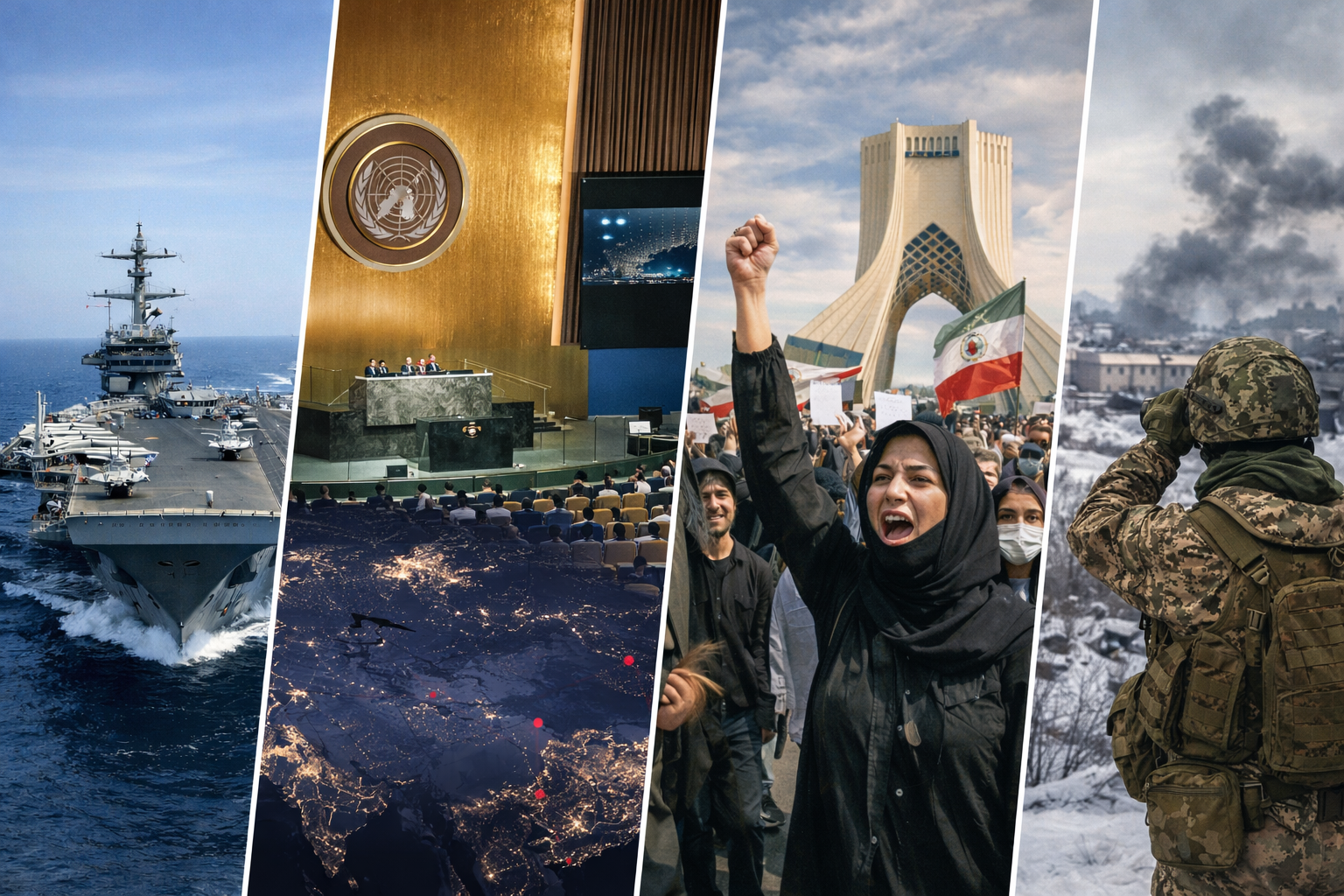
Satellite imagery and regional intelligence reporting also pointed to increased U.S. naval positioning in the Gulf and eastern Mediterranean, reinforcing deterrence amid speculation of proxy escalation.
Why it matters: February revealed a pattern of calibrated signalling — military movement without formal escalation, negotiation rumours without formal talks. The region remains combustible, but actors are managing the edge rather than crossing it.
Washington: The State of the Union and Global Signalling
February’s most globally watched political moment was the U.S. State of the Union address. President Donald Trump used the speech to reinforce themes first visible in January: economic nationalism, defence leverage, and institutional scepticism.
While Greenland was not revisited explicitly, Arctic security and burden-sharing within NATO were referenced indirectly. Allies listened closely for signs of doctrinal shift. What they received instead was strategic ambiguity — reassurance framed through transactional language.
Meanwhile, U.S. naval deployments in proximity to the Middle East were widely interpreted as deterrent positioning rather than prelude to intervention.
Continuity from January:
January’s uncertainty over alliance predictability did not dissipate; February institutionalised it.
India: Fiscal Balancing and Strategic Messaging
Prime Minister Narendra Modi entered February facing familiar trade-offs: sustaining growth while managing fiscal pressure.
India’s February budget emphasised infrastructure spending and manufacturing competitiveness, while maintaining targeted tax adjustments to balance revenue gaps. Markets responded cautiously but without panic.
New Delhi’s external messaging remained pragmatic — maintaining strategic autonomy amid intensifying U.S.–China rivalry.
Why it matters:
India’s economic positioning in early 2026 signals a state intent on insulating itself from global volatility rather than amplifying it.
Russia–Ukraine: Endurance as Strategy
The war between Russia and Ukraine remained strategically static but tactically intense.
Winter conditions slowed large-scale manoeuvres, yet missile exchanges and drone warfare persisted. European debates over long-term funding mechanisms sharpened, though no abrupt aid reversals occurred.
February confirmed January’s assessment: the conflict has become structural. Neither collapse nor breakthrough appears imminent.
Markets: Gold, Inflation and Corporate Signals
February saw renewed attention on gold prices as investors hedged against geopolitical risk and inflation uncertainty. Safe-haven flows increased modestly following Middle East tensions and U.S. fiscal debates.
Corporate volatility also drew attention. Shares of Netflix and Dell moved sharply following earnings guidance adjustments, while technology firms linked to AI research — including Anthropic — featured prominently in policy discussions about model governance.
Emerging theme:
Geopolitical risk premiums are no longer episodic — they are embedded into asset pricing.
Climate and Disruption: The Blizzard Warnings
Severe winter storms across parts of the United States triggered blizzard warnings affecting millions. Transportation networks stalled temporarily, reinforcing climate volatility as an economic variable.
Extreme weather did not dominate global headlines — but it disrupted supply chains, energy usage, and insurance models.
In a year already marked by geopolitical instability, climate remains the most consistent destabiliser.
Sport, Technology and Soft Power
Preparations accelerated for the 2026 Winter Olympics, where infrastructure readiness and diplomatic participation remain under quiet scrutiny.
In technology, Samsung’s unveiling of the S26 Ultra drew consumer attention amid broader debates about semiconductor supply chains and AI integration.
Sport continued to mirror politics. The UEFA Champions League and T20 Cricket World Cup became platforms where visa politics and sponsorship alignments subtly reflected geopolitical alignments.
Latin America: After the Maduro Shock
January’s detention of Nicolás Maduro continued to reverberate across Latin America. February brought diplomatic manoeuvring, legal appeals, and uncertainty over succession dynamics in Caracas.
Regional governments avoided overt intervention, but private consultations intensified. The precedent set in January now enters its most consequential phase: durability.
What February Reveals
1. Deterrence Without Diplomacy
Military movements substitute for negotiation frameworks.
2. Markets Expect Instability
Gold, inflation narratives, and technology volatility suggest risk normalisation.
3. Institutions Strain Quietly
From NATO burden-sharing to EU funding debates, coordination persists but friction grows.
4. Domestic Politics Shape Global Signals
Washington, Tehran, New Delhi and Caracas illustrate how internal pressures drive external posture.
Conclusion: Adjustment, Not Collapse
If January was about shock, February was about adaptation.
No single rupture defined the month. Instead, 2026’s emerging character became clearer: states are neither retreating nor resolving conflicts — they are managing instability in increments.
The international order is not dissolving. It is recalibrating under stress.
March will test whether signalling gives way to substance — or whether the world remains suspended between deterrence and diplomacy.


