


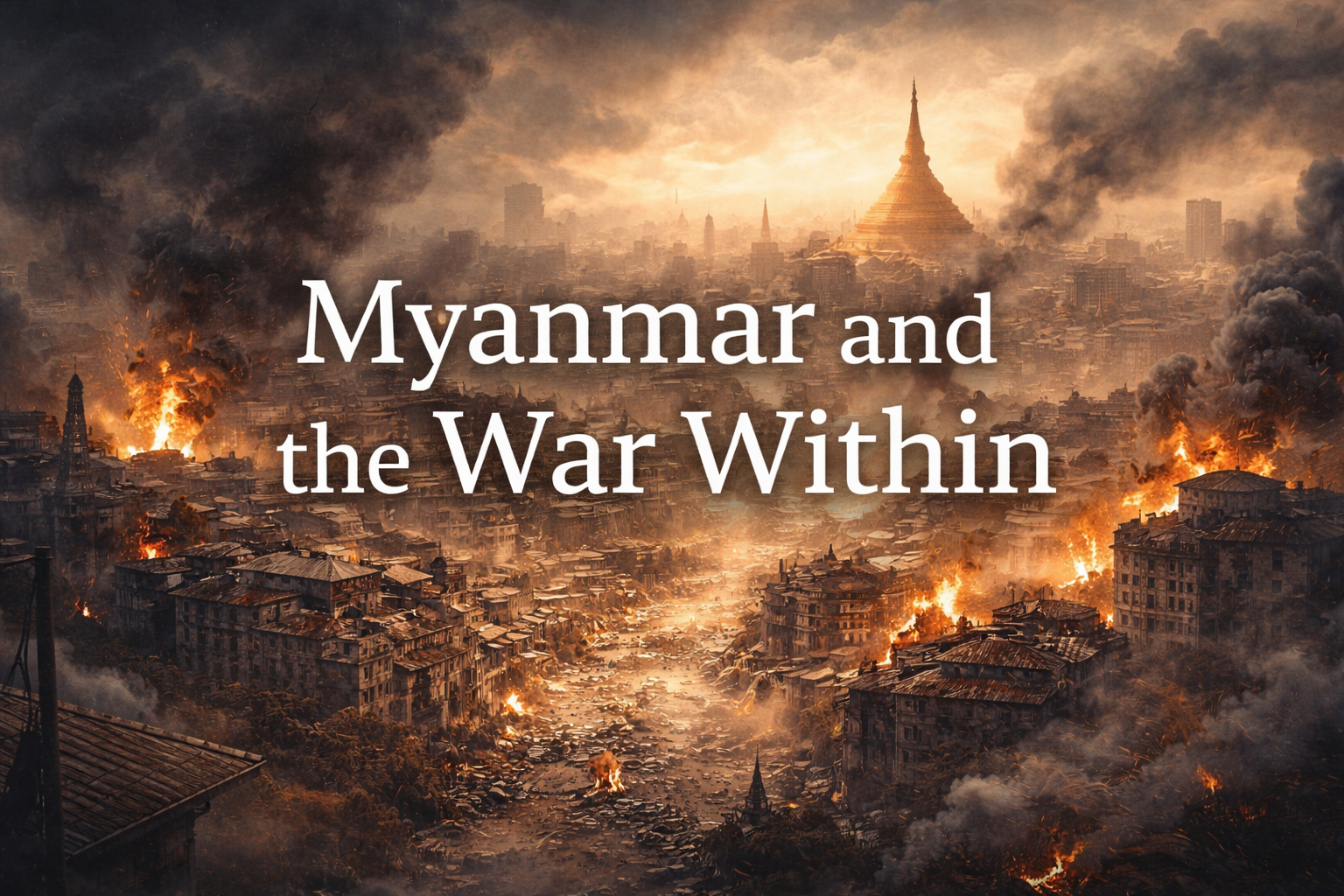
How a military coup became a nationwide internal war — and why the state itself is now contested
Myanmar is no longer facing a political crisis in the conventional sense. What began as/navigation/ as a military coup in February 2021 has evolved into a nationwide internal war, fought simultaneously across ethnic, ideological, and territorial lines. The conflict is no longer about the removal or restoration of a single government. It is about who holds authority inside the state itself—and whether the state can still function as a coherent entity.
Since the military overthrew the elected government led by Aung San Suu Kyi, violence has escalated far beyond Myanmar’s earlier cycles of repression and resistance. What distinguishes the current conflict is not only its intensity, but its reach. Fighting now spans large parts of the country, drawing in the military, long-standing ethnic armed organisations, newly formed resistance groups, and civilians trapped between repression, retaliation, and mass displacement.
Myanmar’s war is not being fought on a single front, nor by a unified opposition. Instead, it has entered a phase of deep fragmentation, where power is contested locally, legitimacy is disputed nationally, and control shifts unevenly across regions. The result is not a stalemate between generals and protesters—but a prolonged struggle over the very foundations of the state.
This is no longer a coup aftermath.
It is a war within Myanmar itself.
From Coup to Countrywide Conflict
The coup initially triggered widespread, largely peaceful resistance. Mass demonstrations, civil disobedience campaigns, and strikes paralysed major cities and disrupted state institutions. The military response was swift and uncompromising: lethal force, mass arrests, and systematic repression were deployed against unarmed civilians.
As violence intensified, the logic of resistance changed.
By late 2021, opposition began to militarise. Large sections of the population concluded that protest alone could not dislodge the junta. Armed resistance expanded rapidly, and the emergence of People’s Defence Forces marked a decisive turning point.
What had been a political confrontation became an armed struggle — layered onto Myanmar’s pre-existing landscape of ethnic insurgencies. The Tatmadaw suddenly faced not a single enemy, but a constellation of adversaries, each with different motivations, territorial bases, and operational strategies.
A State Built on Fragile Foundations
Myanmar’s internal war cannot be understood without its historical foundations. Since independence, the country has struggled to reconcile central authority with ethnic diversity. Multiple ethnic groups have fought for autonomy, federal arrangements, or independence for decades — often controlling territory beyond the reach of the central state.
For years, the military justified its dominance as necessary to preserve national unity. The coup, ironically, accelerated the fragmentation it claimed to prevent.
Ethnic armed organisations that once maintained uneasy ceasefires have increasingly aligned — formally or tacitly — with anti-junta forces. In several regions, cooperation between EAOs and PDFs has reduced the military’s ability to project authority. The state is weakened not through secession alone, but through the slow hollowing out of central control.
Myanmar is now experiencing a structural shift: power is moving from the centre to armed local realities.
The Military’s Calculus — and Its Limits
Myanmar’s generals appear to have assumed that decisive force would crush opposition quickly, as it had in the past. That assumption has proven flawed.
The Tatmadaw retains major advantages:
- heavy weaponry and artillery
- air power
- formal command structures and institutional continuity
But it is facing an adversary that is decentralised, adaptive, and embedded within local communities. This makes the conflict harder to “solve” with conventional dominance.
In response, the military has increasingly relied on scorched-earth tactics: airstrikes, village burnings, mass detentions, and large-scale displacement. These tactics may deny territory temporarily, but they also deepen long-term resistance by alienating populations and destroying any remaining legitimacy.
Control is now measured less by governance or administration and more by the capacity to conduct punitive raids.
This is coercion without consolidation — and its sustainability is uncertain.
A Fractured Opposition and the Question of the Post-Junta State
Despite shared opposition to military rule, Myanmar’s resistance is not unified.
Political visions diverge:
- some seek a return to pre-coup constitutional arrangements
- others view the war as an opening to restructure Myanmar into a deeper federal or confederal model
- ethnic armed organisations pursue agendas shaped by decades of conflict, betrayal, and negotiated survival
Coordination exists — but unevenly. The absence of a single political authority or unified command structure complicates the transformation of battlefield momentum into a credible alternative state.
This fragmentation also weakens opposition claims in international diplomacy, even as domestic legitimacy and territorial influence expand.
Myanmar’s conflict is therefore not simply a battle for power.
It is a contested process of state redefinition.
Regional and International Constraints
Myanmar’s war unfolds in a region where stability is often prioritised over intervention. Neighbouring states remain cautious, avoiding deep involvement that could destabilise borders or set uncomfortable precedents.
Diplomatic efforts have produced statements and frameworks, but limited enforcement capacity. Meanwhile:
- sanctions constrain the junta economically
- humanitarian access remains restricted
- displacement grows
- aid delivery becomes politicised and fragmented
The junta’s strategic posture suggests survival is prioritised over legitimacy. It appears to calculate that it can outlast resistance and external pressure alike — treating time not as enemy, but as weapon.
The conflict persists not because solutions are unknown, but because incentives for compromise are absent.
A War Without a Clear Endgame
Myanmar is now locked in a war of attrition — not only militarily, but institutionally.
The longer the conflict continues:
- state capacity declines
- economic collapse deepens
- social trust fractures
- armed governance replaces civil administration in many areas
Even a decisive outcome — on either side — would leave behind a damaged political landscape defined by trauma, fragmentation, and contested authority.
The deeper danger is normalisation. As conflict becomes routine, settlement becomes less imaginable. Negotiation is displaced by local deals, shifting frontlines, and survival governance. Myanmar risks entering a permanent state of semi-war.
Conclusion: A Country in Suspension
Myanmar today exists in a state of suspension — neither fully governed nor fully collapsed. Power is contested, legitimacy is fractured, and violence has become systemic rather than exceptional.
The military’s attempt to reassert control has instead exposed the limits of force in a country shaped by diversity, historic distrust, and unresolved identity conflict.
Whether Myanmar emerges from this war as:
- a reconstituted federal state
- a fragmented territory of armed zones
- or an entrenched military system with permanent insurgency
remains uncertain.
What is clear is this: the conflict is no longer only about who governs Myanmar — it is about what Myanmar is allowed to become.
Until that question is resolved, the war within will continue to define the country’s future.
January 2026: A Month in Review — Crises, Confrontation, and a World Reordering
- Iraq After Saddam: Regime Collapse, Occupation and the Long Shadow of State Failure
- The World Is Not Watching a Crisis Unfold — It Is Watching a Redesign
- What If the Biggest Hole in Global Climate Policy Isn’t Coal or Oil — It’s War?
- Diplomacy Is Not About Choosing Sides – It Is About Protecting Interests
- War in the Cloud


