


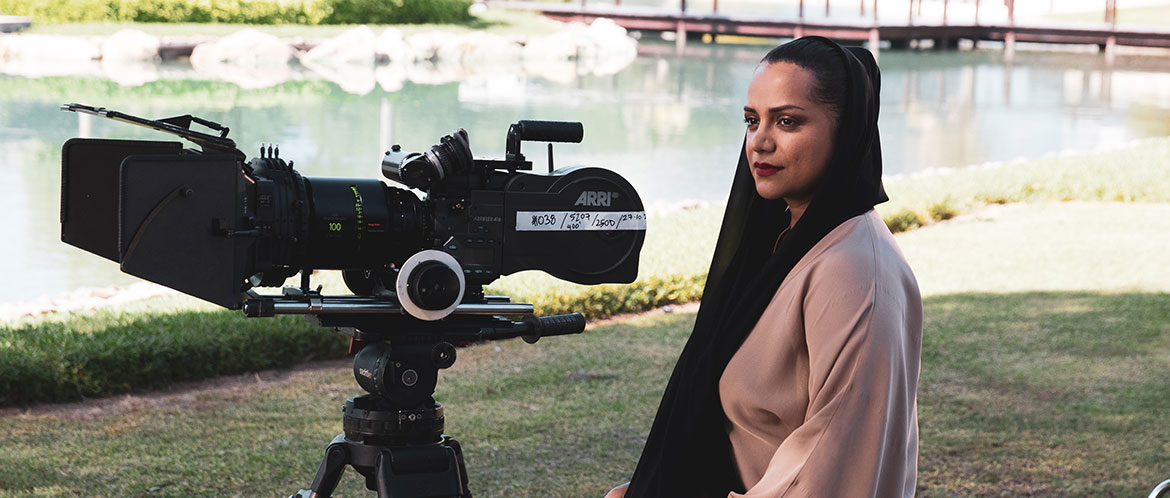
The rise of cinema in the United Arab Emirates has unfolded alongside the emergence of a new generation of filmmakers determined to define their own cultural narrative. Among the most prominent voices in this evolution is Nayla Al Khaja, widely recognised as one of the UAE’s pioneering filmmakers and a leading figure in shaping the country’s developing film ecosystem.
Over the past two decades, Al Khaja’s work has explored themes of identity, psychological tension, and cultural authenticity, often situating intimate personal narratives within broader social contexts. Her films have travelled internationally while remaining firmly rooted in the emotional realities of Emirati life.
In this conversation with Danish Shaikh, Editor at The International Wire, Al Khaja reflects on the creative discipline behind filmmaking, the responsibilities of cultural representation, and the challenges of building a sustainable cinematic infrastructure in an emerging industry. The discussion also explores how regional filmmakers can balance global ambition with local authenticity as Gulf cinema continues to mature.
In conversation with Danish Shaikh, Editor at The International Wire
Creative Origins and Intellectual Formation
Your career has unfolded at a time when the UAE’s film ecosystem was still emerging. Did you see yourself as building within a system, or building the system itself?
When I began, the film ecosystem in the UAE was still taking shape, so in many ways we were growing alongside it. Each short film, feature, and theatrical release felt like another step forward for the industry. I did not set out with the idea of building a system, but I understood that continuing to create and push forward could help widen opportunities for others. Over time, it became both about making my own work and contributing, in a small way, to the development of a local film culture that was still emerging.
How did your early exposure to international cinema influence the kind of stories you felt compelled to tell locally?
International cinema showed me that culture specific stories can still be universally powerful. Watching films from Europe, Asia, and the United States taught me that authenticity travels. It gave me the confidence to tell Emirati stories without softening or simplifying them for global audiences. I wanted to present our emotional depth, our contradictions, and our silence in a raw and honest way, knowing that truth connects across borders.
Was filmmaking, for you, an act of expression first, or an act of discipline and craft?
It began as expression, a need to communicate what I could not say in ordinary life. But very quickly I realized that expression without discipline does not sustain itself. Filmmaking is deeply technical, collaborative, and demanding. Craft gives emotion structure. Discipline turns instinct into impact. For me, it has always been the marriage between the two that defines meaningful cinema.
Looking back at your earliest work, what limitations—technical, cultural, or institutional—most shaped your creative instincts?
The limitations were everywhere, limited funding, limited crew experience, limited understanding of what Emirati cinema could be. Culturally, there were taboos around certain themes, especially psychological tension, grief, or identity. Instead of seeing these as barriers, I used them as creative tension. Constraints forced me to become resourceful, precise, and emotionally bold. When you do not have scale, you lean into atmosphere and performance. That shaped my visual and narrative style.
How did formal training abroad change your understanding of storytelling once you returned to the region?
Training abroad refined my language as a filmmaker. It gave me structure, theory, and exposure to global standards of production. But returning home reminded me that technique alone is not enough. Storytelling must be rooted in lived experience. The combination of international discipline and regional authenticity became central to my work. It allowed me to think globally while remaining unapologetically local.
Storytelling, Identity, and Universality
Your films often sit at the intersection of personal narrative and broader social context. How do you decide what remains intimate and what must be universal?
I begin with what feels emotionally true on a personal level. If something resonates deeply and honestly within me, it usually carries a universal core. The intimate details, the rituals, the silences, the family dynamics, remain specific because that specificity is what makes them believable. The emotion beneath them, grief, fear, love, identity, is what becomes universal. I never start by trying to universalize a story. I start by protecting its honesty.
Do you believe cinema has a responsibility to represent society accurately, or truthfully—even if the two diverge?
I believe cinema has a responsibility to be truthful. Accuracy can sometimes mean presenting facts or surface realities, but truth often lives deeper than that. It may not capture every aspect of society, yet it captures an emotional or psychological reality that feels authentic. As filmmakers, we interpret reality through a lens. That lens must be sincere, even if it is subjective.
How do you approach portraying cultural specificity without turning it into explanation for external audiences?
I refuse to over explain. Culture should be experienced, not translated. I trust the audience to enter the world of the film and absorb its codes naturally. When we pause to explain ourselves too much, we dilute the rhythm of storytelling. Emotional clarity is more important than cultural explanation. If the emotional stakes are clear, the audience will follow, even if some details remain unfamiliar.
What role does silence, restraint, or ambiguity play in your storytelling choices?
Silence is one of the most powerful forms of dialogue. What a character does not say can reveal more than a monologue. Restraint creates tension, and ambiguity invites the audience to participate rather than passively consume. I am drawn to psychological spaces where meaning unfolds slowly. I do not feel the need to resolve every question. Sometimes leaving space is more honest than forcing closure.
Has your understanding of “authentic representation” evolved as your audience has grown more global?
Yes, but not in the way one might expect. As my audience has expanded internationally, I have felt even more committed to authenticity. The more global the platform, the more important it becomes to protect the integrity of where the story comes from. Authentic representation is not about making culture accessible, it is about remaining faithful to its emotional truth. When that truth is strong, it travels naturally.
Craft, Process, and Creative Leadership
How do you balance creative control with collaboration on set, particularly as productions scale in size and complexity?
For me, leadership is clarity. When the vision is clearly defined, collaboration becomes stronger, not weaker. As productions grow in scale, the key is trusting department heads while protecting the emotional core of the story. I am firm about tone, performance, and thematic direction, but I remain open to ideas that elevate the work. Collaboration is not about surrendering control, it is about aligning everyone toward the same intention.
As both director and producer, how do you decide when to protect a creative vision and when to adapt it to practical constraints?
Experience teaches you which elements are essential and which are flexible. I protect what defines the soul of the film, the emotional arc, the character psychology, the key visual language. Practical constraints often require adaptation in execution, not in meaning. Being a producer has helped me understand that limitations can sharpen creativity rather than weaken it.
What distinguishes directing actors in emotionally demanding material from directing technical execution?
Directing actors requires emotional presence and trust. You are guiding vulnerability, not machinery. It demands sensitivity and psychological awareness. Technical execution, on the other hand, requires precision and structure. Both require focus, but they operate in different spaces, one emotional, one logistical. The challenge is moving fluidly between the two without losing the rhythm of the scene.
How do you prepare for a project differently now compared to earlier in your career?
Earlier in my career, preparation was driven by instinct and ambition. Now it is driven by clarity and intention. I spend more time refining character psychology, visual tone, and sound design before stepping on set. I ask deeper questions and anticipate obstacles earlier. Preparation has become less about proving something and more about understanding something.
What part of the filmmaking process remains the most intellectually demanding for you?
Structuring the narrative. Ensuring that emotional progression feels organic while maintaining tension requires constant mental recalibration. Editing is especially demanding because it forces you to confront the film honestly. It is where instinct meets analysis. Balancing rhythm, silence, pacing, and meaning in a coherent form remains the most intellectually rigorous part of the process for me.
Building Institutions and Creative Infrastructure
You’ve been involved not only in making films, but in building platforms for others. What gaps in the ecosystem motivated that shift?
When I started, there were limited pathways for emerging filmmakers, especially women. There was talent, but not enough structure, mentorship, or access to industry networks. I realized that if we wanted a sustainable film culture, we could not rely on isolated successes. We needed platforms, training, and opportunities that allowed new voices to grow. That shift came from understanding that building an ecosystem is as important as building a film.
How do mentorship and institutional support differ in a young film industry compared to a mature one?
In a young industry, mentorship is often personal and informal. It depends heavily on individuals taking initiative. Institutions are still learning how to support artists in a strategic way. In a mature industry, structures are clearer, funding channels are established, and mentorship programs are embedded within the system. In emerging markets, mentorship requires more commitment because you are not just guiding talent, you are helping shape the framework itself.
What misunderstandings do outsiders often have about filmmaking in the Gulf region?
One common misunderstanding is that the Gulf only produces commercial or surface level narratives. There is a growing appetite for complex, layered storytelling that reflects real psychological and social realities. Another misconception is that resources automatically solve creative challenges. While infrastructure is growing, artistic depth comes from cultural experience, not budget. The region is still defining its cinematic identity, and that process is nuanced and evolving.
How important is institutional patience in developing a sustainable creative economy?
Institutional patience is critical. Film culture does not develop overnight. It requires consistent support, long term investment, and trust in artistic experimentation. Sustainable creative economies are built on resilience and continuity. When institutions understand that growth is gradual and nonlinear, they create space for authentic voices to mature rather than forcing immediate commercial returns.
From your experience, what enables creative talent to remain rooted locally while operating globally?
Confidence in one’s identity. When filmmakers understand their cultural foundation, they can engage with global audiences without dilution. Access to international collaboration, festivals, and markets is essential, but it must not come at the cost of authenticity. The balance lies in combining global standards of craft with local emotional truth. When those two coexist, talent can thrive both at home and abroad.
Industry, Technology, and the Future of Cinema
How have digital platforms and changing viewing habits altered the way you think about audience engagement?
Digital platforms have shortened attention spans but expanded access. Audiences are more exposed, more informed, and more selective. I think more consciously now about how to hold attention without compromising depth. Engagement today is not only about the screen, it extends to conversations, social presence, and cultural relevance. But at its core, emotional authenticity still determines whether a story stays with people.
Do you see short-form storytelling as complementary to cinema, or as a fundamentally different discipline?
It is complementary, but it operates with a different rhythm. Short form demands immediacy and precision. Cinema allows for immersion and gradual emotional build. Both require craft, but the architecture of storytelling shifts depending on duration. I see short form as a laboratory for experimentation, while feature filmmaking remains a space for layered psychological exploration.
How do you evaluate new technologies—such as virtual production or AI tools—without allowing them to overwhelm narrative intent?
Technology should serve the story, never replace it. I approach new tools with curiosity but also with discipline. Virtual production and AI can expand creative possibilities, but they must enhance atmosphere, efficiency, or storytelling clarity. The emotional arc of a character remains central. If technology distracts from that, it becomes noise rather than innovation.
What does sustainability mean in filmmaking today: creatively, financially, and institutionally?
Creatively, sustainability means developing voices that can grow over time rather than producing one off successes. Financially, it requires responsible budgeting and long term planning. Institutionally, it means creating frameworks that consistently support talent and production, not just during moments of visibility. Sustainable filmmaking is about continuity, not spectacle.
Looking ahead, what kinds of stories do you believe the next phase of regional cinema must be willing to confront?
The next phase must confront complexity without fear. Stories about identity, generational tension, mental health, power dynamics, and moral ambiguity. Regional cinema must move beyond surface narratives and embrace layered psychological storytelling. Audiences are ready for nuance. To evolve, we must be willing to explore uncomfortable truths while remaining rooted in our cultural reality.
Rapid Fire
Script or improvisation?
Script, but with room for instinct.
Festival circuit or direct audience reach?
Both, the festival circuit shapes discourse, direct audience reach sustains impact.
Director as author or director as conductor?
Director as author.
Visual storytelling or dialogue-driven scenes?
Visual storytelling. Silence speaks.
Constraint or freedom?
Constraint. It sharpens creativity.
Local stories or borderless narratives?
Local stories that resonate beyond borders.
Preparation or instinct?
Preparation guided by instinct.
Film as art or film as industry?
There is room for both.
Longevity or experimentation?
Longevity through thoughtful experimentation.
One word that best defines meaningful cinema today?
Truth.

Nayla Al Khaja is the first female film director in the United Arab Emirates. Her debut feature film, Three, premiered on February 1, 2024, across the MENA region.
Her upcoming project, “BAAB” is a fantasy horror just wrapped production February 2025, with a musical score by two-time Oscar winner AR Rahman and Rogier Stoffers ASC as the Cinematographer. Set to be released in theatres early 2026.
Nayla’s films often balance horror and beauty, characterized by rich, moody color palettes and intricate set designs. Her work explores themes like social stigmas and personal transformation through layered visual storytelling.
She has been a speaker at the London Speakers Bureau, advocating for women’s presence in the film industry.
Nayla also directs TV commercials for brands such as Mercedes, Nike, Nestlé, Neutrogena, and Nivea, and has worked with clients like Annie Leibovitz and Roger Federer. She was appointed as the behind-the-scenes director for the film “Star Trek 3” by the Dubai Government.
With over two decades of experience running a production company, Nayla brings a balanced perspective to her projects, understanding both creative and fiscal aspects. She speaks four international languages, which helps in managing complex and sensitive projects globally.
Nayla was also the brand ambassador and endorser for companies including Apple, Samsung, Oppo, Honor, Du Telecommunication, Porsche, Infiniti, Benq, LG, Canon, Gucci, Chopard, Damas Jewelry, Estée Lauder, Tag Heuer, Kare, Nissan Petrol Emirates NBD, and Emirates Airline.
India to the World: Building Predictable Sales Engines in the Age of Execution


