


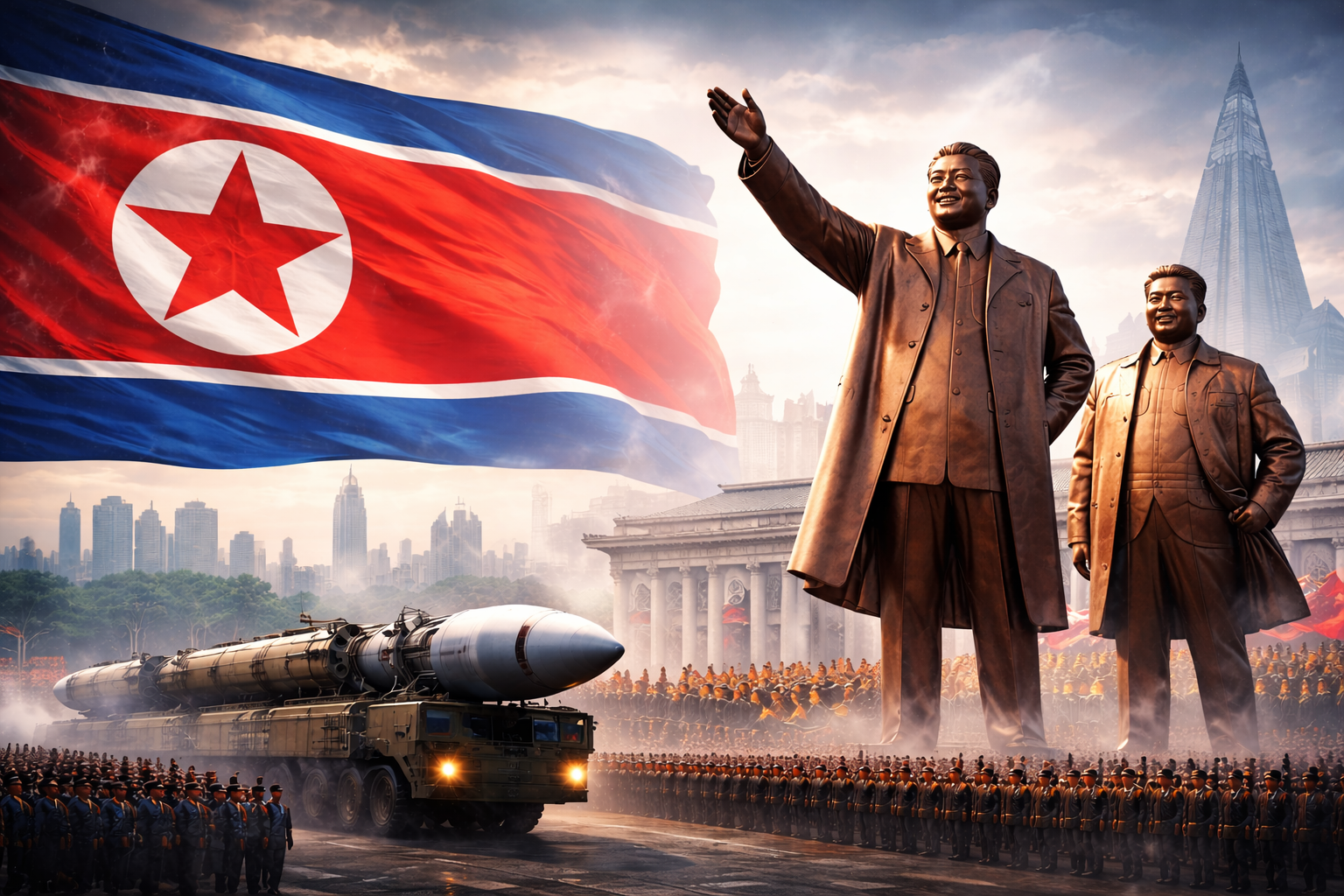
By conventional measures of state failure — economic collapse, diplomatic isolation, succession crises, mass famine — North Korea should have fallen decades ago.
Instead, the Democratic People’s Republic of Korea (DPRK) has become the most durable hereditary dictatorship in modern history: three generations of rule, more than 75 years of continuity, and no meaningful institutional alternative waiting in the wings.
Its survival is not an anomaly.
It is a structural challenge to prevailing theories of authoritarian collapse.
At the core of this puzzle lies a contradiction:
absolute power creates vulnerability — yet the Kim dynasty converted that vulnerability into a survival system.
The Strategic Tension: Deterrence Has Replaced Denuclearisation
External leadership perspectives reflect how the international community gradually adjusted to this reality.
Former U.S. President George W. Bush framed North Korea as one of the most dangerous types of regimes — arguing that the greatest threat emerges when highly repressive governments acquire weapons of mass destruction.
Years later, Donald Trump emphasised personal diplomacy, highlighting his rapport with Kim Jong-un and demonstrating the oscillation between confrontation and engagement that has defined Washington’s approach.
South Korean President Lee Jae-myung acknowledged a harder truth: denuclearisation is unlikely in the near term — implicitly recognising that nuclear weapons are embedded in regime survival logic.
Meanwhile, Kim Jong-un has declared that North Korea will never again be subject to nuclear coercion — framing atomic capability not as leverage, but as permanent insurance.
Together, these positions reveal the new operating reality:
Deterrence has replaced denuclearisation.
Engineered Survival: The Architecture of a Dynastic State
North Korea is a fusion of hereditary dictatorship and dynastic authoritarianism — a deeply personalist regime where loyalty flows vertically and institutions exist to reinforce leader supremacy.
Unlike other authoritarian systems, it does not build resilient institutions.
It deliberately prevents them.
Structural Characteristics
- Extreme power centralisation
- Institutional hollowing
- Absence of autonomous political bodies
- Elite purges as coup-proofing
- Embedded political repression architecture
- Security-state governance
Rather than stability through strength, the regime produces durability through controlled fragility.
This results in:
- Managed insecurity
- Institutionalised crisis
- Crisis-based legitimacy
- Systemic absence of alternatives
North Korea prevents collapse not through institutional depth — but through elimination of substitutes.
The Kim Dynasty: 75 Years of Survival
Kim Il-sung (1948–1994): Designing Isolation
The founding leader built the structural blueprint still visible today.
Through Juche ideology (“self-reliance”), economic weakness was reframed as moral strength. Isolation became virtue. Sanctions became proof of foreign hostility.
He embedded surveillance through:
- Ministry of State Security
- Ministry of People’s Security
- Korean People’s Army political authority
- Songbun hereditary classification system
From inception, the system was designed to prevent rival power centres.
Duration: 46 years.
Kim Jong-il (1994–2011): Surviving Collapse
The Arduous March famine (1994–1998) brought catastrophic economic contraction and mass starvation. Many predicted regime failure.
Instead, the regime strengthened.
Through Songun (military-first policy), Kim prioritised defence institutions and accelerated nuclear development — transforming nuclear capability into a survival doctrine.
Even amid famine, information control remained intact. Informal markets were tolerated but monitored.
The regime endured its weakest moment — and emerged nuclear-capable.
Kim Jong-un (2011–Present): Consolidation and Nuclear Entrenchment
When Kim Jong-un assumed power at 27, analysts questioned his durability.
He responded with ruthless consolidation:
- Execution of Jang Song-taek (2013)
- Systematic purges
- Military leadership reshuffles
Between 2013 and 2017, North Korea accelerated nuclear and missile testing. By 2017, it declared its deterrent complete.
Nuclear weapons became irreversible regime insurance.
Intervention became strategically prohibitive.
Why North Korea Hasn’t Collapsed
1. Institutional Weakness as Protection
No autonomous institutions exist to replace the ruling family.
Weak institutions protect dynastic continuity.
2. Managed Elite Fear
Regular purges prevent coordination. Fear substitutes for consensus.
3. Sanctions Adaptation
Sanctions were intended to fracture elites.
Instead, they produced:
- Sanctions resilience
- Elite insulation from hardship
- Authoritarian learning
- Illicit revenue diversification
The population absorbed pain. The elite remained shielded.
Strategic miscalculations included:
- Underestimating China’s buffer-state priorities
- Misreading containment vs collapse incentives
- Assuming economic suffering triggers political revolt
Sanctions constrained growth — but did not threaten survival.
Policy quietly shifted from “collapse” to “containment.”
Cyber Strategy and the Shadow Economy
North Korea modernised survival through digital asymmetry.
The Reconnaissance General Bureau oversees:
- State-sponsored cyber operations
- Cryptocurrency theft networks
- Digital sanctions evasion
- Hybrid warfare finance
- Shadow-state revenue systems
Cyber operations reportedly generated billions — allowing operation beyond traditional sanctions architecture.
This is sovereign survival through cyber asymmetry.
The Dictator’s Paradox
Political theory helps explain endurance:
- The dictator’s dilemma: total information control limits reliable feedback
- Selectorate theory: survival depends on rewarding a narrow winning coalition
- Coup-proofing through elite fragmentation
- Political isolation engineering
- Information monopoly state design
- Controlled scarcity governance
North Korea institutionalised crisis as governance.
Permanent threat narrative.
Continuous mobilisation.
Managed instability.
The regime functions under pressure — not prosperity.
Nuclear Doctrine: Existential, Not Tactical
North Korea’s nuclear programme operates as:
- Strategic deterrence
- Asymmetric deterrence
- Escalation dominance signalling
- Strategic prohibitive cost creation
- Irreversible entrenchment
Nuclear weapons are not bargaining chips.
They are structural insurance.
Denuclearisation fails because it asks the regime to surrender its survival guarantee.
Strategic Synthesis: Three Pillars of Endurance
North Korea rests on three integrated foundations:
- Managed insecurity at elite level
- Total information monopoly at societal level
- Irreversible nuclear deterrence at international level
Where most authoritarian systems rely on economic performance for legitimacy, North Korea redefined legitimacy as resistance.
It survives not through prosperity — but through pressure endurance.
Final Strategic Insight
North Korea should not exist in its current form.
Yet it does.
The regime converted vulnerability into architecture.
Weakness into insulation.
Isolation into doctrine.
Crisis into permanence.
The world predicted collapse.
North Korea engineered survival.
The remaining question is not why it exists — but whether a system designed for endurance rather than reform can survive beyond the current generation.
For now, the structure remains entrenched.
“Dynastic rule in a modern state depends less on ideology than on controlled uncertainty.”
Why hasn’t North Korea collapsed despite sanctions?
North Korea survives sanctions through multiple mechanisms: China provides essential lifeline (90% of trade), RGB cyber operations generate hundreds of millions annually, dual economy (state/informal markets) provides survival goods, and population expectations are managed through information control. The regime prioritizes elite and military stability over population welfare, insulating leadership from economic pain. Sanctions contained some capabilities but didn’t change fundamental regime behavior.
How many generations has the Kim dynasty ruled North Korea?
The Kim dynasty has ruled for three generations spanning 75+ years: Kim Il-sung (1948-1994, 46 years), Kim Jong-il (1994-2011, 17 years), and Kim Jong-un (2011-present, 13+ years). This makes it the longest-surviving hereditary dictatorship in modern communist and authoritarian history, having successfully transferred power twice without systemic collapse.
What is the Reconnaissance General Bureau (RGB)?
The RGB is North Korea’s primary external intelligence agency, created in 2009. It conducts espionage, covert operations, sanctions evasion, cyber warfare, and illicit finance generation. RGB-linked groups have stolen an estimated $2+ billion via cryptocurrency hacks and other cyber operations, directly funding weapons programs and regime survival despite international sanctions.
Will North Korea give up nuclear weapons?
North Korea will almost certainly never voluntarily surrender nuclear weapons. The regime observed what happened to Libya (Gaddafi killed after giving up WMD), Iraq (Saddam executed after disarmament), and Ukraine (invaded despite security guarantees). Nuclear weapons provide ultimate survival guarantee, deterrence against regime change, international legitimacy, and coercive diplomacy tool. Benefits of denuclearization (temporary, reversible) cannot outweigh permanent security of nuclear deterrent.
How does North Korea control information?
North Korea operates the world’s most comprehensive information control system: foreign media banned (penalty: execution/labor camp), internet access limited to ~1,000 elite individuals, domestic intranet completely censored, international phone calls prohibited, borders sealed, and all media state-controlled. Information isn’t merely censored—it’s actively manufactured to create alternate reality where hardship is patriotic sacrifice and isolation is strength.
Why did Kim Jong-un execute his uncle Jang Song-taek?
Jang Song-taek’s execution (2013) served multiple purposes: demonstrated Kim Jong-un’s willingness to kill even powerful family members, eliminated potential rival with independent power base, sent message to elites that no position guarantees safety, and consolidated personal authority during vulnerable early succession period. The brutality and publicity were strategic signals, not emotional decisions.
What is the Songbun system?
Songbun is North Korea’s hereditary social classification system dividing population into three main classes: core (25-30%, regime loyalists), wavering (40-50%, neutral), and hostile (25-30%, families with wrong history). Classification is inherited and determines employment, education, residence, and food access. This creates permanent elite class whose privileges depend on regime survival, structurally binding them to Kim dynasty.
How does China support North Korea?
China provides critical survival lifeline despite officially supporting sanctions: accounts for 90%+ of DPRK’s limited trade, supplies energy and food during shortages, processes financial transactions through Chinese banks, and allows border commerce to continue. China’s strategic calculation: fear of North Korean collapse (refugee crisis, U.S.-allied unified Korea on border) outweighs concerns about nuclear program. Buffer state value justifies minimum support preventing collapse.
What would happen if Kim Jong-un died suddenly?
Sudden death without clear succession would create significant instability: no designated heir apparent, no institutional mechanism for power transfer, potential military factionalism, possible elite power struggle, and risk of external intervention during chaos. However, regime has proven resilient through previous transitions, and military/security apparatus likely would consolidate around senior leadership to prevent collapse rather than pursue independent power.
How does North Korea fund its nuclear program under sanctions?
North Korea funds weapons programs through multiple revenue streams: RGB cyber operations (estimated $2+ billion stolen 2017-2023), sanctions evasion networks (ship-to-ship transfers, front companies), weapons sales to conflict zones, limited trade with China and Russia, and cryptocurrency laundering. Sanctions reduced revenue but cyber capabilities and illicit networks provide hundreds of millions annually sufficient for continued weapons development.
North Korea and China – How China Balances Supporting and Restraining North Korea


