


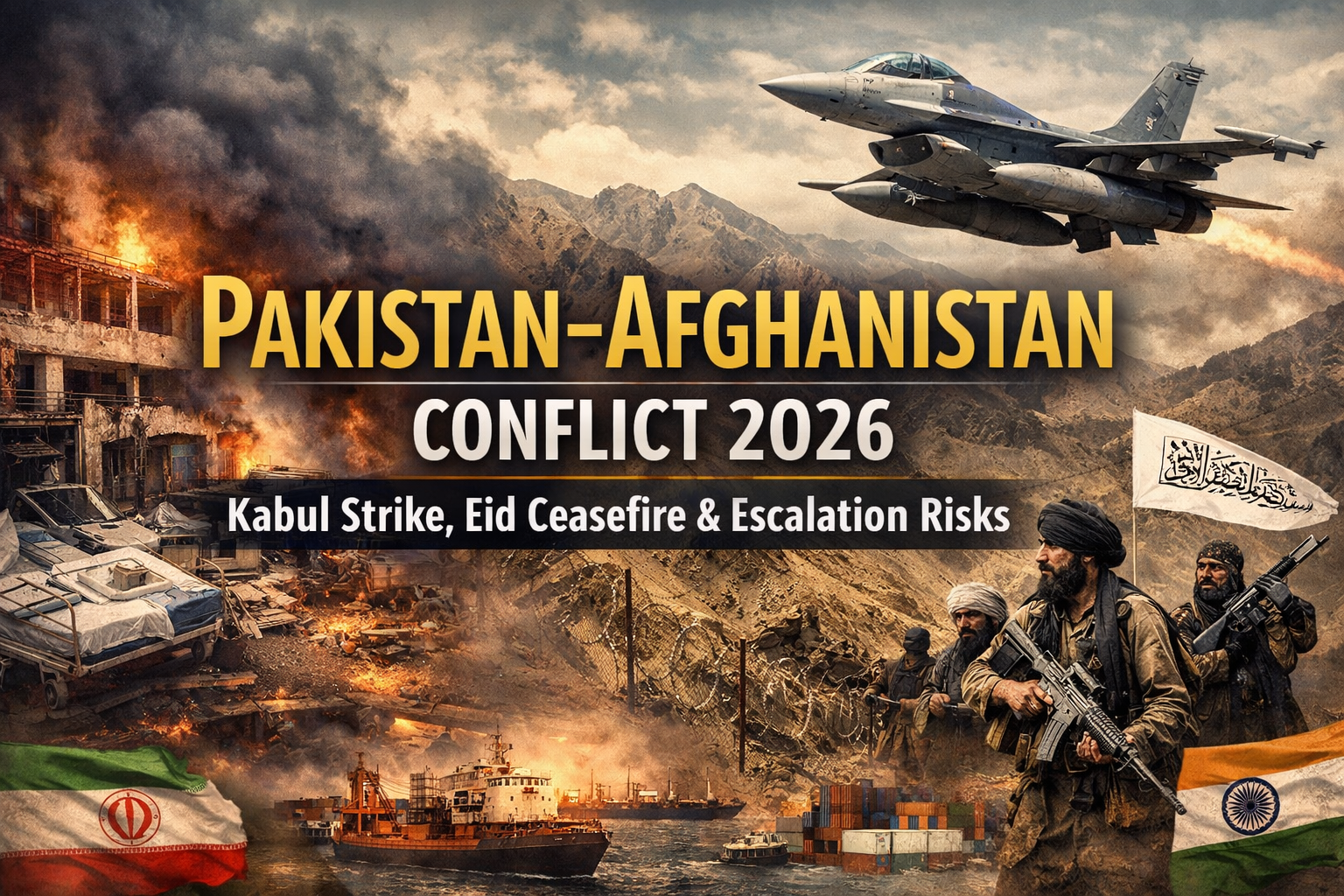
The deadliest Pakistan-Afghanistan confrontation in modern history — what triggered it, what it means, and where it is heading
The Short Answer: What Is Happening Between Pakistan and Afghanistan?
In March 2026, Pakistan launched airstrikes targeting what it described as militant infrastructure inside Afghanistan. Afghan authorities say the strikes killed more than 400 people, including patients at a Kabul rehabilitation hospital. A temporary Eid ceasefire has since paused fighting — but the structural conflict driving escalation remains entirely unresolved.
What began as a decades-long proxy conflict between Pakistan and Afghanistan has entered a new and more dangerous phase. The airstrike on the Omid rehabilitation hospital in Kabul — which Pakistani officials insist targeted militant assets — represents the most lethal known direct military action Pakistan has taken on Afghan territory. It has reshaped the political landscape of an already volatile bilateral relationship and triggered international calls for accountability that neither government has so far fully addressed.
This analysis examines the origins of the current escalation, the significance of the Kabul hospital strike, the fragile Eid ceasefire, the three most likely scenarios for what comes next, and the broader regional and global implications of a conflict that most international observers are only now beginning to take seriously.
| 400+ Reported fatalities from Pakistan’s airstrike on Kabul — the deadliest Pakistan-Afghanistan confrontation in recent history Afghan authorities reported over 400 deaths from the strike on the Omid rehabilitation hospital in Kabul in March 2026. Pakistan disputes the civilian characterisation, insisting the strike targeted militant infrastructure. The UN and international organisations have called for an independent investigation. Figures remain actively contested. |
Section I: Strategic Depth — The Doctrine That Is Now Backfiring
Pakistan’s relationship with Afghanistan has long been framed by the concept of ‘strategic depth’ — a military-strategic doctrine that emerged in Pakistani security thinking during the Cold War and the Soviet-Afghan conflict of the 1980s. At its core, strategic depth meant ensuring that Afghanistan remained a friendly or at minimum pliable state: one that would not allow India to open a second front against Pakistan from the west, and one that would provide operational space for Pakistani military assets in the event of a major war.
To pursue this objective, Pakistan’s Inter-Services Intelligence directorate cultivated relationships with Afghan militant factions over decades — relationships that evolved through the anti-Soviet jihad, the civil war that followed, the rise of the Taliban in the 1990s, and the post-2001 period in which Pakistan was simultaneously a partner in the American-led coalition and, according to multiple intelligence assessments, a covert patron of the very insurgency that coalition was fighting.
The Taliban’s return to power in August 2021 was widely expected, in Islamabad’s strategic calculations, to vindicate the doctrine. An Afghan Taliban government would, Pakistani planners assumed, represent the strategic depth they had spent four decades cultivating — a friendly neighbourhood that would reduce the threat environment on Pakistan’s western border and deny India the influence it had built during the Republic years.
| “The fundamental miscalculation in Pakistan’s strategic depth doctrine was treating the Afghan Taliban as a client that shared Pakistan’s strategic interests. In reality, the Taliban are an ideologically defined movement with their own agenda — and that agenda does not include serving as a buffer for Pakistani security.” — Dr. Husain Haqqani Former Pakistani Ambassador to the United States; Senior Fellow, Hudson Institute |
That assumption has been systematically disappointed. The Afghan Taliban government has not become an instrument of Pakistani security interests. It has not taken meaningful action to neutralise the Tehrik-i-Taliban Pakistan — the TTP, an allied but operationally independent militant organisation that the Afghan Taliban regards as a legitimate resistance movement against Pakistani state authority. And it has, according to Pakistani security officials, provided sanctuary to TTP leadership and operational infrastructure that Pakistan holds directly responsible for a sustained and intensifying campaign of attacks inside Pakistani territory.
Since the Taliban’s return to power in 2021, the TTP has killed more Pakistani military and security personnel than in any comparable period in the insurgency’s history. Major attacks on Pakistani military posts, police stations, and civilian infrastructure in Khyber Pakhtunkhwa and Balochistan have demonstrated an operational capability that Pakistani officials attribute directly to the TTP’s ability to plan, train, and regroup from Afghan territory without effective interdiction.
The strategic depth doctrine, designed to give Pakistan a secure western flank, has instead produced a western border that is more violent, more contested, and more diplomatically intractable than at any point in recent Pakistani history. The Kabul hospital strike is the most dramatic expression of Pakistan’s decision to substitute military escalation for the failed logic of strategic depth.
Strategic depth was supposed to give Pakistan a secure west. What it has produced is a western front more violent and more contested than any Pakistani strategic planner anticipated.
Section II: The Kabul Hospital Strike — What We Know and What Is Disputed
The central event defining the current crisis is the airstrike on the Omid rehabilitation hospital in Kabul. Based on available reporting from Afghan authorities, international organisations, and Pakistani government statements, the following can be established with reasonable confidence — alongside the significant factual disputes that remain unresolved.
What Afghan Authorities Say
Afghan officials, led by Taliban defence ministry spokesman Enayatullah Khwarazmi, reported that Pakistani airstrikes struck civilian areas of Kabul, including the Omid rehabilitation hospital that primarily served drug addiction patients undergoing treatment. The Afghan government’s reported death toll exceeds 400, with additional hundreds injured. Afghan authorities describe the strike as a deliberate or reckless attack on civilian infrastructure and have characterised it as a war crime requiring international accountability.
What Pakistan Says
Pakistani military and government spokespeople have denied that the hospital was an intentional target. Pakistan’s official position is that strikes were directed at TTP militant infrastructure and that the location was being used as a militant operations base. Pakistan has presented the operation as a legitimate counter-terrorism action under its right of self-defence against non-state actors operating from Afghan territory. Islamabad has not accepted the Afghan death toll figure and characterises international criticism as based on misinformation propagated by the Taliban government.
What International Bodies Say
The United Nations Assistance Mission in Afghanistan (UNAMA), the International Committee of the Red Cross, and multiple human rights organisations have called for an independent investigation into the strike. None has yet issued a definitive assessment of responsibility or intent. The Washington Post and other international outlets have reported from the scene, corroborating the substantial death toll while noting the difficulty of independently verifying specific targeting decisions. The international community’s response has been notably restrained in publicly assigning blame — reflecting the geopolitical complexity of publicly confronting Pakistan, a nuclear-armed state, over military actions conducted in the name of counter-terrorism.
| “When a country with nuclear weapons conducts airstrikes that kill hundreds of civilians — regardless of the stated justification — the international community faces a test of whether the rules of armed conflict apply universally or selectively. The response so far suggests selective application, which sets a dangerous precedent.” — Dr. Moeed Yusuf Former National Security Adviser to the Prime Minister of Pakistan; currently Senior Research Fellow, Stimson Centre |
Beyond the immediate death toll, the significance of the hospital strike lies in what it represents as an escalation decision. Pakistan has previously conducted cross-border artillery strikes and ground incursions in contested border areas. Conducting a strike in Kabul — the Afghan capital — represents a qualitatively different action: one that puts Pakistan in the position of having conducted the most lethal military action against Afghanistan by any external power since the American-led military campaign in the years after 2001.
The political consequences within Afghanistan are significant. The Taliban government, which has maintained an ambiguous relationship with Pakistan since returning to power — acknowledging Pakistani interests while refusing to suppress the TTP — faces intense internal pressure to respond. Its legitimacy in the eyes of the Afghan population depends in part on its willingness to defend Afghan sovereignty against external military action. Accepting Pakistani strikes without retaliation or accountability undermines its domestic standing.
Section III: The Eid Ceasefire — What It Means and What It Does Not
Following the Kabul strike and the subsequent wave of retaliatory action and counter-action along the Pakistan-Afghanistan border, diplomatic intervention by Saudi Arabia, Qatar, and Turkey produced a temporary ceasefire agreement timed to coincide with the Eid al-Fitr holiday period. Simultaneously, the TTP announced a three-day ceasefire — the first significant lull in TTP operations inside Pakistan in several weeks.
The ceasefire represents a genuine, if fragile, achievement of regional diplomacy. The involvement of Saudi Arabia reflects its longstanding role as a backstop mediator between Pakistan and Afghanistan; Qatar brings its experience as an intermediary with the Taliban; and Turkey adds multilateral legitimacy. The three-way mediation framework mirrors, in some respects, the diplomatic architecture that has managed other regional flash points.
Why the Ceasefire Happened
- Both sides recognised the escalation risk of continued military action following the Kabul strike
- Regional powers — particularly Saudi Arabia and Qatar — applied significant diplomatic pressure
- Eid al-Fitr provided a politically available and culturally significant moment for a pause
- Operational exhaustion on both sides following sustained fighting made a pause operationally convenient
What the Ceasefire Does Not Resolve
- Pakistan’s stated objective of neutralising TTP infrastructure in Afghanistan — unchanged and unachieved
- Afghanistan’s refusal to accept Pakistani military operations on its territory as legitimate
- The Durand Line border dispute, unresolved since partition, which the Taliban government explicitly rejects
- The Taliban’s ideological reluctance to take coercive action against the TTP, despite Pakistani demands
- The outstanding accountability question over the Kabul hospital strike
| “A ceasefire in the context of a conflict this structurally driven is best understood as a timeout rather than a resolution. The conditions that produced the escalation are all still present. When the timeout ends — and it will end — the parties return to the same environment with the same unresolved issues and higher levels of mistrust.” — Dr. Asfandyar Mir Senior Expert, United States Institute of Peace; specialist in South Asian militant organisations |
The most analytically significant feature of the TTP ceasefire announcement is what it implies about the relationship between the Afghan Taliban and the TTP. The TTP declared a ceasefire, not the Afghan Taliban government. This reinforces the assessment that the Afghan Taliban’s control over TTP operations is limited and that the two organisations — while ideologically aligned — maintain operationally separate command structures. Pakistan’s demand that the Taliban ‘neutralise’ the TTP treats that relationship as more direct and more controllable than it appears to be in practice.
The TTP announced its own ceasefire — not the Afghan government. That distinction matters enormously. It suggests that Pakistan’s demand for Taliban suppression of the TTP misreads the nature of the relationship between them.
Section IV: Three Scenarios — What Happens Next
The Eid ceasefire has paused but not resolved the underlying conflict. Based on the structural drivers of the Pakistan-Afghanistan confrontation, three scenarios represent the most analytically credible trajectories for the coming months.
| SCENARIO 1: Return to Calibrated Escalation — MOST LIKELY Pakistan resumes targeted airstrikes and artillery operations against specific TTP-related targets in Afghanistan, maintaining a policy of using military pressure to compel Afghan Taliban action without seeking all-out war. Afghanistan responds selectively — diplomatic protests, limited military responses in border areas — avoiding escalation to direct confrontation. Violence stabilises at a higher baseline than the pre-2026 level but falls short of sustained interstate conflict. This mirrors past patterns but with greater intensity, wider geographic scope, and higher casualty rates. |
| SCENARIO 2: Sustained Cross-Border Conflict — ELEVATED RISK The Kabul hospital strike triggers Afghan Taliban retaliation against Pakistani military and government targets that exceeds the calibrated model. TTP attacks inside Pakistan intensify with Afghan Taliban acquiescence or support. The border becomes a live conflict zone rather than a contested line. International mediation faces resistance as domestic political pressure in both countries hardens negotiating positions. This scenario would represent a structural transformation — from episodic crisis to sustained low-intensity interstate conflict. |
| SCENARIO 3: Fragmentation and Multi-Actor Conflict — MOST DANGEROUS Multiple militant factions exploit the conflict to expand operations. State control weakens in Pakistani border provinces, particularly Khyber Pakhtunkhwa and parts of Balochistan. The Afghan Taliban’s internal coherence fractures under pressure, enabling more independent action by local commanders. The conflict ceases to be bilateral and becomes multi-actor. External powers with interests in the region — China (CPEC investment), Russia (Central Asia stability), Iran (Baloch militant groups), India (strategic opportunity) — begin positioning to influence outcomes. At this point, escalation dynamics become genuinely unpredictable. |
The structural factors that make scenarios 2 and 3 more likely than historical precedent might suggest are: the severity of the Kabul strike, which has raised retaliation pressure within Afghanistan to levels not seen in previous cycles; the Taliban government’s domestic legitimacy challenge, which makes accepting Pakistani military actions without response more politically costly; and the decay of the back-channel communication architecture that previously managed Pakistan-Afghanistan tensions below the public threshold.
Section V: The Regional Dimension — Iran, India, China, and the Wider Stakes
The Iran-Pakistan Intersection
The Pakistan-Afghanistan conflict is occurring simultaneously with significant regional turbulence linked to the ongoing military confrontation involving Iran. While the two conflicts are operationally distinct, they interact through several channels that amplify their individual effects.
Iran shares borders with both Pakistan and Afghanistan. Iranian intelligence services have historically maintained relationships with militant networks on both sides of those borders. Iran and Pakistan have their own bilateral tensions — including previous cross-border strikes between the two countries in January 2024 over militant groups on their shared border. The cumulative effect of simultaneous instability across the Pakistan-Afghanistan-Iran triangle represents a degree of regional security stress that the South Asian security architecture is not designed to manage.
India’s Strategic Calculation
India has a significant interest in observing the Pakistan-Afghanistan conflict with close attention. Any degradation of Pakistani state capacity — military, economic, or political — arising from the Afghan conflict changes India’s strategic calculus on its western front. Indian intelligence services have historically maintained relationships with Afghan governments, including the Taliban administration, and Indian infrastructure projects in Afghanistan give Delhi a presence in the country that Pakistan has consistently sought to limit. The current conflict environment creates both risks (spillover instability affecting India’s own security) and strategic opportunities that New Delhi will be calculating carefully.
| “India watches the Pakistan-Afghanistan conflict through a strategic lens. Every Pakistani military resource committed to the western front is a resource not available for the eastern front. That arithmetic doesn’t drive Indian policy, but it is part of the calculus.” — Harsh V. Pant Vice President for Studies, Observer Research Foundation, New Delhi; Professor of International Relations, King’s College London |
China’s CPEC Vulnerability
China’s significant economic investment in Pakistan — the China-Pakistan Economic Corridor (CPEC), a flagship Belt and Road Initiative project involving infrastructure, energy, and industrial development worth tens of billions of dollars — creates a direct Chinese stake in Pakistani stability. CPEC projects pass through areas of Balochistan that are already subject to militant attacks. A deteriorating security situation in Pakistan’s border regions directly threatens the Chinese workforce and infrastructure involved in those projects — and raises the cost and risk profile of CPEC investment more broadly. China has been privately pressing Pakistan for improved security guarantees for CPEC workers. The Afghanistan conflict complicates that calculation significantly.
The Energy and Trade Dimension
Pakistan is a critical logistics and trade corridor connecting China, Central Asia, and the broader South Asian region. Pakistani instability — beyond its immediate security consequences — has measurable effects on regional trade and investment confidence. The cumulative effect of simultaneously stressed conflict environments (the Middle East via Iran, South Asia via Pakistan-Afghanistan) on global energy and trade flows is not yet fully priced into economic forecasts, but it represents a genuine and growing tail risk for the global economy.
| $62 Billion Estimated total value of China-Pakistan Economic Corridor (CPEC) investment CPEC represents the largest single Chinese infrastructure investment in any country under the Belt and Road Initiative. A sustained deterioration of security in Pakistan’s border regions directly threatens CPEC project timelines, costs, and personnel safety — giving Beijing a significant and direct stake in the Pakistan-Afghanistan conflict’s resolution. |
Section VI: The Global Economic Risk Dimension
Unlike high-visibility disruptions such as the Red Sea shipping crisis — where the economic impact is immediate and directly traceable through freight rate data — the Pakistan-Afghanistan conflict affects the global economy through more diffuse and slower-acting channels. This makes it easier to under-price in short-term risk assessments while the cumulative pressure builds.
Sovereign Risk and Investment Confidence
Pakistan entered 2026 in a state of significant economic fragility: elevated debt levels requiring IMF programme support, persistent inflation, a current account deficit requiring careful management, and a currency that has experienced dramatic depreciation over the past several years. A sustained security deterioration adds a sovereign risk premium to Pakistan’s borrowing costs at precisely the moment when those costs are already constraining its fiscal policy options. Foreign direct investment — already depressed by political instability — faces additional deterrence from a conflict environment that makes long-term project commitments in Pakistan significantly riskier.
Regional Supply Chain Effects
Pakistan sits at the intersection of several significant trade corridors: between Central Asia and the Indian Ocean; between China and the Arabian Sea; and as a potential future transit route for gas and energy from the resource-rich but landlocked states of Central Asia. Sustained insecurity in Pakistan’s border regions raises the cost and risk of logistics operations through those corridors in ways that affect regional supply chain economics, even for transactions that do not directly involve Pakistani territory.
Layered Regional Disruption
The most significant economic risk from the Pakistan-Afghanistan conflict is not the crisis in isolation — it is the crisis in combination. A world simultaneously managing Middle East energy market disruption (from the Iran conflict), Red Sea maritime security disruption, and South Asia security deterioration is a world in which multiple simultaneous risk factors are compressing the economic margins of the global system in ways that individual risk assessments do not fully capture.
The risk is not one crisis — it is the combination. When multiple regional conflicts intensify simultaneously, they stress the same global economic and security systems at the same time. The cumulative effect is greater than the sum of the parts.
Frequently Asked Questions
| Why did Pakistan airstrike Kabul in March 2026? Pakistan conducted airstrikes targeting what it described as Tehrik-i-Taliban Pakistan (TTP) militant infrastructure inside Afghanistan. Pakistani security officials have cited a sustained campaign of TTP attacks inside Pakistan — killing hundreds of military and civilian personnel — as justification for cross-border military action. Afghanistan disputes Pakistan’s characterisation and reports that the strikes hit civilian areas including a rehabilitation hospital in Kabul, killing over 400 people. |
| How many people were killed in the Pakistan airstrike on Kabul? Afghan authorities reported over 400 deaths, with additional hundreds injured, from Pakistan’s airstrike on the Omid rehabilitation hospital in Kabul in March 2026. Pakistan disputes the civilian characterisation of those killed and denies targeting the hospital intentionally. The figures remain contested and an independent international investigation has been called for but not yet conducted. Media outlets including The Washington Post and The Guardian have reported from the scene and corroborated significant civilian casualties. |
| What is the TTP and why does it matter in the Pakistan-Afghanistan conflict? The Tehrik-i-Taliban Pakistan (TTP) — also called the Pakistani Taliban — is a militant organisation that has conducted a sustained insurgency against the Pakistani state since 2007. The TTP is ideologically aligned with the Afghan Taliban but operationally distinct. Since the Afghan Taliban returned to power in 2021, the TTP has intensified attacks inside Pakistan and is believed to operate from bases in Afghan territory. Pakistan’s demand that the Afghan Taliban suppress the TTP is the central driver of the current bilateral crisis. |
| Is there a ceasefire between Pakistan and Afghanistan? Yes — Pakistan and Afghanistan reached a temporary ceasefire agreement timed to coincide with Eid al-Fitr in 2026, mediated by Saudi Arabia, Qatar, and Turkey. Simultaneously, the TTP announced its own three-day ceasefire. However, the ceasefire is described by analysts as an operational pause rather than a resolution — none of the structural drivers of the conflict (TTP sanctuaries, Durand Line disputes, mistrust) have been addressed. |
| Could the Pakistan-Afghanistan conflict escalate into a full-scale war? Most analysts assess full-scale conventional war as unlikely but not impossible. The more probable trajectory is sustained low-intensity cross-border conflict — episodic strikes, militant attacks, and border clashes — at a higher intensity than previous cycles. The risk of uncontrolled escalation increases if the Afghan Taliban faces sufficient domestic pressure to conduct visible retaliation against Pakistan, or if TTP attacks inside Pakistan reach a scale that compels a more decisive Pakistani military response. |
| What is Pakistan’s ‘strategic depth’ doctrine and has it failed? Strategic depth is Pakistan’s long-standing security doctrine that seeks to ensure Afghanistan remains a friendly or neutral state, preventing India from opening a western front and providing Pakistan with territorial fallback in the event of conflict. Many analysts now assess the doctrine as having failed in its current application: the Afghan Taliban’s return to power did not produce Pakistani-aligned governance; the TTP has intensified rather than reduced attacks; and Pakistan now faces a more hostile western border than at any point in recent decades. |
| How does the Pakistan-Afghanistan conflict affect China? China has significant economic exposure to Pakistan through the China-Pakistan Economic Corridor (CPEC), a flagship Belt and Road project estimated at $62 billion involving infrastructure and energy projects across Pakistan, including in border areas affected by militant violence. Sustained insecurity in Pakistan threatens CPEC project timelines and worker safety, and raises the cost profile of Chinese investment in the region. Beijing is understood to be pressing Islamabad for improved security guarantees for Chinese personnel. |
| What role is India playing in the Pakistan-Afghanistan conflict? India is an observer with strategic interests rather than a direct participant. India has historically maintained relationships with Afghan governments, including the current Taliban administration, through trade, infrastructure investment, and diplomatic engagement. Pakistani security officials are alert to the possibility of Indian intelligence activity in Afghanistan — a concern that contributes to Pakistan’s sensitivity about Afghan territory being used for hostile operations. India’s official position is non-interference, but the conflict’s trajectory is being closely monitored in New Delhi. |
| What is the Durand Line and why is it disputed? The Durand Line is the approximately 2,640-kilometre border between Pakistan and Afghanistan established by British India and the Afghan emirate in 1893. Afghanistan has never formally accepted the Durand Line as its international boundary, and the Afghan Taliban government explicitly rejects it. The line divides Pashtun tribal areas and communities that historically did not recognise it as a meaningful boundary. Pakistani military planners regard the Durand Line as the settled international boundary; Afghan governments across all political systems have consistently refused to formally ratify that position. |
| How does the Pakistan-Afghanistan conflict connect to the Iran situation? The Pakistan-Afghanistan conflict intersects with broader regional instability linked to the ongoing Iran conflict through several channels: competition for diplomatic and military bandwidth among global powers; shared militant networks that operate across multiple borders; and the cumulative effect on regional energy and trade flows of simultaneous instability across the Middle East and South Asia. While the two conflicts are operationally distinct, they compound each other’s destabilising effects on the broader regional security architecture. |
Conclusion: From Shadow War to an Uncertain New Phase
The Kabul hospital strike, the TTP’s sustained campaign inside Pakistan, and the fragile Eid ceasefire together signal that the Pakistan-Afghanistan conflict has entered a qualitatively different phase — one in which the established patterns of managed hostility are giving way to something more volatile and less predictable.
For most of the past four decades, Pakistan’s relationship with Afghanistan was managed through controlled instability — proxy relationships, intelligence operations, and calibrated support for militant factions that gave Islamabad leverage without requiring direct military confrontation. The Kabul strike has crossed a threshold in that management approach. Whether it proves to be an exceptional escalation that both sides pull back from, or a new baseline for the conflict’s trajectory, will be one of the defining questions of South Asian security in 2026.
Several developments in the coming weeks will be particularly significant as leading indicators of the conflict’s direction: whether the post-Eid ceasefire holds beyond its nominal duration; whether Pakistan conducts additional strikes inside Afghanistan; whether the Afghan Taliban faces sufficient domestic pressure to take actions against TTP that are visible enough to give Pakistan diplomatic cover for restraint; and whether the international mediation architecture — Saudi Arabia, Qatar, Turkey — can translate the ceasefire pause into a substantive process.
Beyond the bilateral dynamic, the Pakistan-Afghanistan conflict matters for reasons that extend well beyond the region. It is one of multiple simultaneous destabilisation processes — in the Middle East, in the Sahel, in Eastern Europe, in the South China Sea — that are each individually serious and collectively unprecedented in their concurrence. The global security architecture that was designed to manage crises sequentially is being asked to manage them simultaneously. That architecture is under stress.
| “We are in a period where the post-Cold War security architecture is being tested by the sheer simultaneity of crises it is being asked to manage. Pakistan-Afghanistan is not just a bilateral problem. It is one of the stress tests that will determine whether that architecture holds or fractures.” — Dr. Marvin Weinbaum Director, Afghanistan Pakistan Studies, Middle East Institute; former State Department intelligence analyst for Pakistan and Afghanistan |
The risk that analysts and policymakers need to track most carefully is not any single escalation event — a second strike, a major retaliation, a collapsed ceasefire. It is the cumulative, compounding effect of multiple regional conflicts intensifying simultaneously, interacting indirectly, and straining the economic and diplomatic systems designed to contain them. Pakistan-Afghanistan is a significant piece of that larger picture. And that picture, in March 2026, is one that demands sustained attention.
The War the World Is Not Watching


