


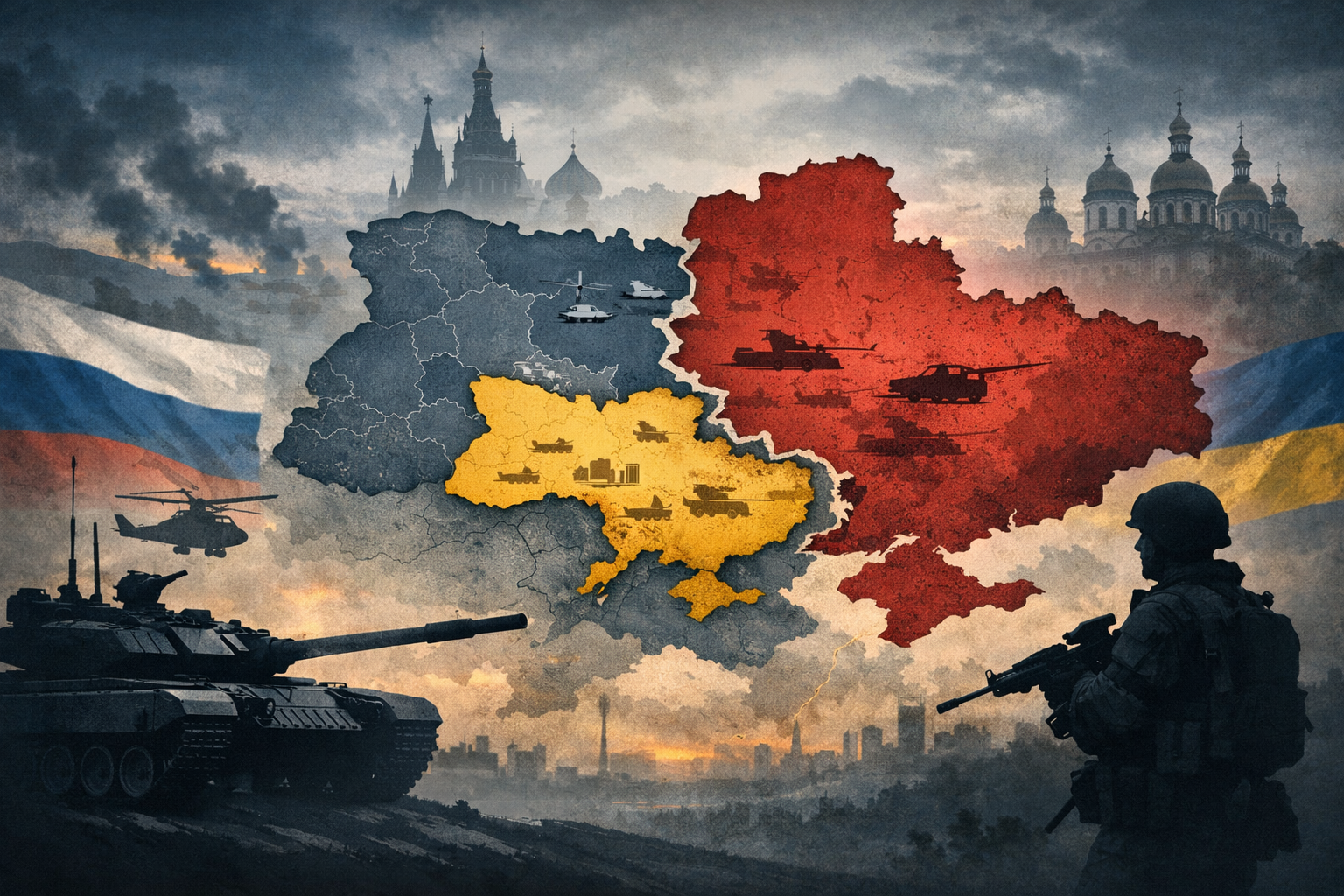
As the war grinds on, the central question is no longer how it began—but whether it unfolded as intended.
The war in Ukraine is often framed as a single, catastrophic miscalculation—an overreach born of flawed assumptions and poor intelligence. Yet as the conflict grinds on, that explanation appears increasingly incomplete. What began as a swift campaign has evolved into a prolonged confrontation reshaping Europe’s security order, global energy markets, and the logic of great-power rivalry.
This analysis examines whether Russia’s invasion of Ukraine reflects a fundamental strategic failure—or a deliberate, if costly, recalibration of power. By looking beyond battlefield outcomes to political objectives, risk tolerance, and long-term intent, the question shifts from why the war did not end quickly to what Moscow may have been prepared to absorb from the start.
Understanding this distinction matters. It determines whether the conflict is best interpreted as an error to be corrected—or a strategy whose consequences were anticipated, if not fully controllable.
“The central question is no longer how the war began, but whether its costs were anticipated.”
From the earliest days of Russia’s full-scale invasion of Ukraine in February 2022, a dominant narrative quickly hardened across Western capitals: Moscow had miscalculated. Russian forces stalled outside Kyiv. Logistics collapsed into chaos. Elite units suffered heavy losses. Ukraine did not fall. The campaign looked less like a masterplan and more like a textbook case of strategic hubris — a powerful state underestimating a weaker neighbour while exaggerating its own competence.
Yet as the war has dragged on, that conclusion has become less secure. Russia has neither withdrawn nor collapsed. Its economy — though constrained — has adapted. Its military posture has shifted from rapid manoeuvre to attritional warfare. Political authority in Moscow has held. These realities force a more uncomfortable question:
Was the invasion simply a catastrophic error — or was Russia pursuing a longer, harsher strategy from the outset that outsiders misunderstood?
The answer matters, because it shapes what the endgame can realistically look like — and whether this war can end at all.
“What looks like miscalculation on the battlefield may reflect a broader strategic tolerance for loss.”
The Case for Miscalculation
There is substantial evidence that Russia misjudged the opening phase of the invasion — strategically, operationally, and politically.
Militarily, the initial plan appeared built around speed. Russian forces advanced along multiple axes, including a direct thrust toward Kyiv, suggesting confidence that Ukraine’s leadership could be quickly paralysed or removed. That outcome did not occur.
Instead, Ukraine’s resistance proved more resilient and coordinated than anticipated, supported by rapid external intelligence and military assistance. Russian logistics were overstretched, command systems rigid, and morale problems surfaced unusually early. Within weeks, Moscow abandoned its Kyiv push entirely — a decision difficult to reconcile with a carefully designed long-term occupation blueprint.
Politically, Russia also seems to have underestimated Ukrainian national cohesion. Instead of fragmenting along linguistic or regional lines, Ukrainian identity consolidated. The invasion produced not disintegration, but unity. President Volodymyr Zelenskyy — widely dismissed before the war — emerged as a symbol of state survival and national mobilisation.
Internationally, Russia misread the scale and durability of Western coordination. Sanctions arrived quickly, at scale, and with persistence. Military assistance intensified rather than faded. The Western response proved far less hesitant than Moscow appears to have expected.
From this perspective, the invasion resembles a gamble based on flawed assumptions: that Ukraine was weak, the West divided, and time automatically favoured Russia.
The Case for Strategy
And yet, the miscalculation explanation alone does not fully account for what followed.
Even if Russia failed to achieve its maximal objectives, it has demonstrated a willingness to absorb costs far beyond what many states would tolerate after a failed campaign. This suggests that the Kremlin’s strategic horizon may be longer — and colder — than early analysis assumed.
From Moscow’s viewpoint, this war is not simply about Ukraine. It is about reshaping the European security order that emerged after the Cold War. President Vladimir Putin has repeatedly framed the conflict as a response to NATO expansion and Western encroachment, portraying it domestically as existential and defensive.
Within that framing, prolonged confrontation is not failure. It is a condition.
Militarily, Russia has shifted into a model of attrition that leverages strategic depth, manpower, and industrial scaling. Over time, this has included:
- mass mobilisation and force replenishment
- expanded arms production
- deeper integration of the defence economy
- fortification of defensive lines and layered positions
Economically, the state reoriented trade flows, stabilised key sectors, and prioritised war production over consumer expansion. Political authority tightened further as dissent was suppressed and the conflict merged into a national endurance narrative.
These are not the signals of a regime rushing toward exit. They point to leadership that expects a sustained confrontation — and is structuring the state around it.
A War Reframed After Failure
The most credible conclusion sits between the extremes.
Russia appears to have miscalculated the opening phase — but also had the capacity and willingness to pivot once miscalculation became undeniable. In other words, the war likely began as an optimistic gamble for fast dominance and became, through adaptation, a longer war of endurance.
This distinction is essential.
Russia’s persistence is not proof that the original plan was sound. It is proof that the leadership decided that withdrawal was worse than escalation.
Retreat would carry major political risks: regime credibility, elite cohesion, internal legitimacy, and the foundational image of Russia as a great power. Continuation, by contrast, can be framed domestically as national resistance against external pressure — a narrative that converts a failed quick war into a heroic long struggle.
In short: the invasion was miscalculated, but the continuation is strategic.
What This Means for the Future of the War
If the war were purely the outcome of miscalculation, it could be expected to end once costs become unsustainable. If it were fully strategic from the outset, compromise might never be possible.
The reality — error followed by strategic recalibration — produces a more troubling implication: the war can persist even without prospects of decisive victory.
Russia has already adjusted objectives downward without abandoning the conflict itself. Ukraine views territorial integrity and national survival as indivisible. External actors reinforce the stalemate by sustaining Ukraine’s capacity to fight while Russia maintains its own war posture.
Under these conditions, war continues not because victory is imminent, but because defeat is politically unacceptable.
Conclusion: Not a Mistake Being Corrected — a Reality Being Endured
Russia’s invasion of Ukraine was neither a flawless strategy nor merely a blunder. It was a miscalculated gamble that hardened into strategic confrontation.
The Kremlin underestimated Ukrainian resistance, overestimated speed, and misread the international response. But once those errors became clear, it chose endurance over retreat — transforming a failed lightning campaign into a grinding conflict with global consequences.
Understanding that transformation is essential, because it suggests the war will not end through exhaustion alone. It will end only when the strategic calculus — on one side or the other — changes fundamentally.
Until then, the war is not simply a mistake being corrected.
It is a reality being endured.
Also Read: Russia’s Grinding War in Ukraine


