


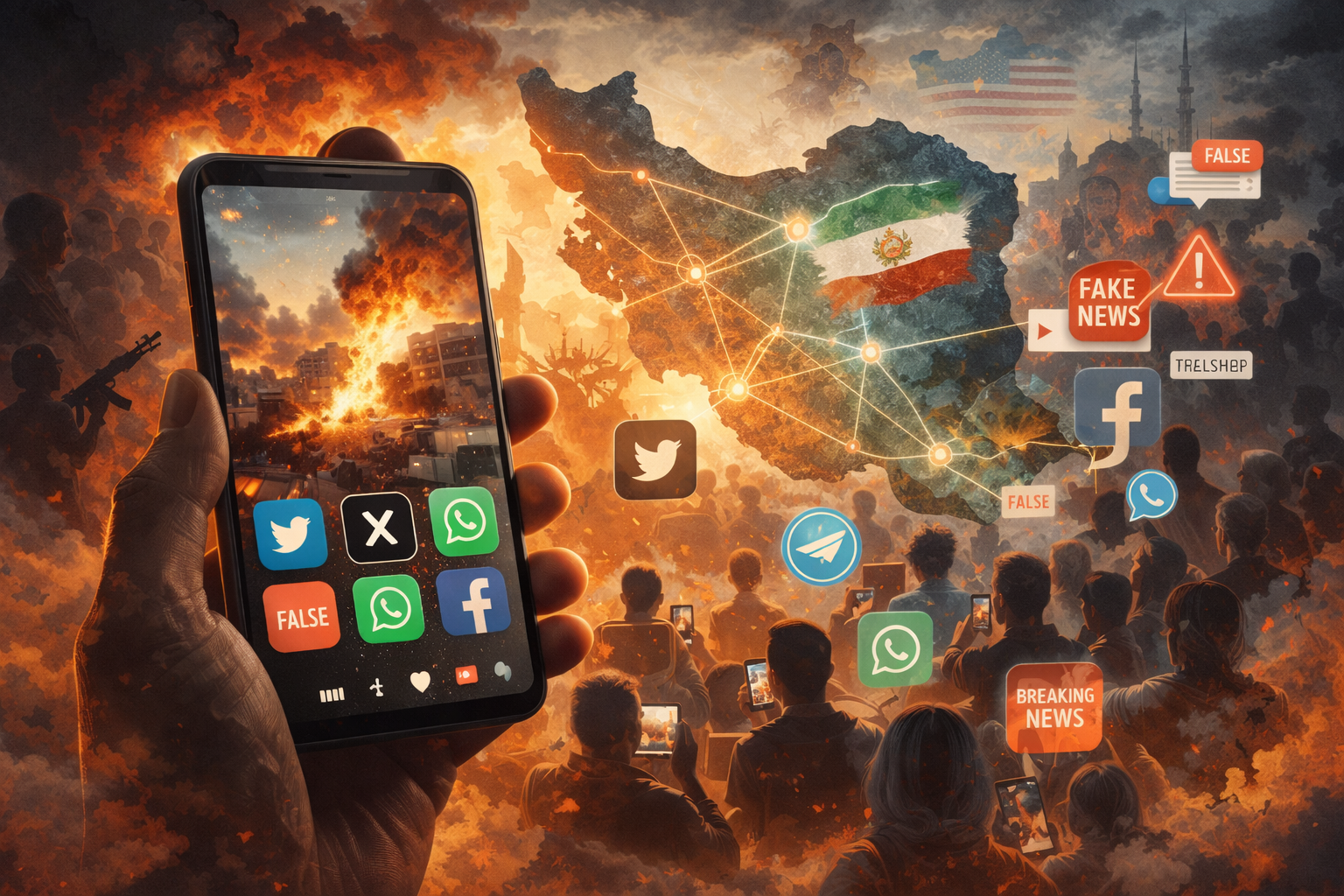
The battle for global perception is fought on X, Telegram, TikTok and YouTube and its outcomes can determine diplomatic support, military alliances and public legitimacy
“Missiles and drones determine the battlefield outcome, but the narrative battle on social media increasingly shapes the political consequences of war.”
When the Battlefield Extends to Your Phone
Modern warfare has always required narrative management — the communication of purpose, the justification of sacrifice, the construction of legitimacy for acts that would otherwise be judged purely by their human cost. What has changed in the twenty-first century, and changed most dramatically in the current generation of conflicts, is the speed and decentralisation of that narrative contest. Where governments once controlled the information environment with relative effectiveness through broadcast media and censorship, the smartphone, the satellite connection, and the social media platform have distributed the capacity to shape public perception to an almost unlimited number of actors — states, non-state groups, diaspora communities, individual journalists, activists, and ordinary witnesses.
The conflict involving Iran and its adversaries is being fought simultaneously on multiple narrative fronts: Iranian state media projecting images of national resilience and foreign aggression; Israeli and American official communications making the strategic case for their military actions; the Iranian diaspora broadcasting their own interpretation through Persian-language social media networks; international journalists and activists attempting to document events that all parties have reasons to obscure; and foreign governments and political movements injecting their own narratives for their own purposes.
This analysis examines how those narrative contests operate, what they are competing to establish, how misinformation spreads and is countered in this environment, what role the diaspora plays as a distinct actor, and what the evidence suggests about whether the information war is actually shaping the diplomatic and political outcomes of the conflict.
Section I: The Rise of Digital Warfare
From Broadcast to Networked Information
The transformation of war’s information environment has been gradual but now appears to be qualitatively complete. The 1991 Gulf War was the first televised war in the modern sense — CNN’s live coverage of Baghdad being bombed introduced a global audience to real-time war reporting and created the concept of the ‘CNN effect’: the idea that sustained media coverage of human suffering could create political pressure for intervention or restraint that governments could not entirely resist.
The Iraq War of 2003 added the first significant layer of networked, citizen-generated content: blogs, embedded reporters with unprecedented access, and early digital photography that circumvented military public affairs channels. Abu Ghraib — the photographs of prisoner abuse at the US-run prison in Iraq — was the first major case in which social media-adjacent distribution (the images were circulated by email and early web platforms before mainstream media picked them up) transformed a local military incident into a global political crisis.
By the time of the Arab Spring in 2010-2012, social media platforms had become genuine instruments of political mobilisation — with Twitter, Facebook, and YouTube playing roles in the organisation of protests in Tunisia, Egypt, Libya, and Syria that governments were initially ill-equipped to counter. The Islamic Republic of Iran had already experienced the Green Movement of 2009, in which social media played an organising and amplifying role that the government subsequently worked to contain through internet throttling, platform blocking, and the development of its own domestic internet architecture (the ‘National Information Network’ or intranet).
The Current Information Environment
The information environment surrounding the current Iran conflict is operating in a context where all major actors have learned from two decades of social media warfare. Iranian state media — Press TV, IRNA, Tasnim News, Fars News — operates a sophisticated multilingual social media presence designed to project the regime’s narrative to international audiences. The IRGC maintains its own social media accounts. Israeli government communications are professionally managed across multiple languages and platforms. American government and military communications have their own extensive social media operations.
Simultaneously, the platforms themselves have become contested battlegrounds: X (formerly Twitter) is used heavily by both journalists and government accounts; Telegram, which is less amenable to content moderation, has become the primary platform for the most unfiltered distribution of conflict imagery, including material from all sides that would be removed from more moderated platforms; TikTok is the dominant platform for reaching younger global audiences; and YouTube hosts a vast archive of conflict-related video content with widely varying degrees of reliability.
Section II: Competing Narratives Online
The Iranian State Narrative
The Islamic Republic’s core narrative in the current conflict has several consistent elements: the framing of the conflict as foreign aggression against a sovereign state; the emphasis on Iranian civilian casualties from strikes on infrastructure and populated areas; the projection of IRGC and military resilience; and the consistent invocation of anti-imperialist and anti-Zionist frameworks that are designed to appeal to audiences in the Global South, in Muslim-majority countries, and in Western left-wing movements.
This narrative is delivered through a media infrastructure that has been built over decades. Press TV operates in English and is distributed internationally; Hispan TV serves Spanish-speaking audiences; Al-Alam operates in Arabic. These channels pursue distribution on social media platforms with professional consistency, and their content is amplified by networks of supportive accounts — some organic, some coordinated — across the platforms.
The Israeli and American Narrative
Israeli and American official communications have focused consistently on the counter-proliferation rationale for military action: the argument that Iran’s nuclear programme represents an existential threat that justified pre-emptive action, and that the strikes have degraded capabilities that would otherwise have been used for mass destruction. The elimination of IRGC leadership has been framed as a counter-terrorism operation targeting individuals directly responsible for attacks on Israeli and American targets.
These narratives are projected through official government social media accounts, through briefings to mainstream Western media, and through the extensive networks of think tanks, security analysts, and former officials who comment on conflict events across television and digital platforms. The advantage this machinery provides is credibility with mainstream Western audiences and access to the most influential media platforms. Its limitation is that it is largely ineffective with audiences outside the Western media ecosystem.
The Diaspora Narrative
The Iranian diaspora — particularly the component that is actively opposed to the Islamic Republic — has become one of the most significant narrative actors in the current conflict. Persian-language social media, primarily on X, Instagram, and Telegram, constitutes an information ecosystem that reaches millions of Iranians both in the diaspora and inside Iran (through VPN access). Diaspora activists and journalists provide real-time Persian-language commentary on the conflict, share documentary evidence of events inside Iran that state media suppresses, and amplify messages from inside the country.
This diaspora narrative is not monolithic. It includes a range of perspectives — from those who support military action against the Islamic Republic as a necessary step toward regime change, to those who oppose the strikes on humanitarian grounds while supporting the democratic opposition, to monarchists, to republicans, to socialists. The common thread is opposition to the Islamic Republic, but the disagreements about what should replace it and what means are acceptable to get there are significant and sometimes acrimonious.
Section III: Propaganda, Misinformation and Verification
The Speed-Accuracy Trade-Off
The defining challenge of conflict-era social media is the fundamental tension between speed and accuracy. In a conflict environment, all parties have strong incentives to project favourable narratives immediately, before counterfactuals can be established. Images, videos, and statistics are shared at a pace that overwhelms the capacity for verification. Misinformation that reaches millions of people in the first hours of an event is not effectively corrected by accurate information published days later, because the correction never achieves the same audience or the same emotional impact.
The current Iran conflict has generated specific categories of misinformation that have been identified by open-source intelligence analysts and verification organisations. Recycled footage — videos from previous conflicts, sometimes years old, repurposed and shared as documentation of current events — has circulated widely on all sides. Casualty figures from all parties are unverifiable in real time and are consistently presented in ways that serve the presenting party’s narrative. Images of damage to infrastructure are routinely attributed to the ‘wrong’ actor — damage from Iranian missiles attributed to Israeli strikes, and vice versa.
The Role of Open-Source Intelligence
One of the genuinely new features of twenty-first century conflict reporting is the growth of open-source intelligence (OSINT) — the systematic use of publicly available satellite imagery, flight tracking data, ship tracking systems, social media geolocation, and other open data sources to independently verify or refute claims made by conflict parties. Organisations like Bellingcat, which pioneered OSINT methodology in the context of the Ukraine and Syria conflicts, have developed analytical techniques that can establish the location, timing, and often the responsibility for specific conflict events with a degree of confidence that was impossible a decade ago.
OSINT has genuine value as a check on misinformation — it has exposed false flag operations, refuted government denials of specific strikes, and provided independent verification of casualty claims. Its limitations are that it requires significant analytical expertise, that it operates more slowly than the initial misinformation it is trying to correct, and that its conclusions, however rigorously established, do not reach the audiences that have already accepted the false narrative.
Section IV: The Role of Diaspora Networks
The Iranian diaspora’s role in the information environment of the current conflict deserves separate analysis because it is qualitatively different from either state media or Western journalism. Diaspora networks are defined by a combination of linguistic access (Persian-language content that reaches inside Iran), emotional investment (personal connections to people and places in the conflict zone), political orientation (broadly opposed to the Islamic Republic, though with significant internal disagreements), and transnational reach (connecting Iranians in dozens of countries simultaneously).
The diaspora’s information infrastructure includes: Persian-language satellite channels broadcasting from London (Iran International, Manoto), Los Angeles (various channels), and other diaspora hubs; Persian-language podcasts and YouTube channels with substantial audiences; individual journalists and activists with large social media followings; and grassroots networks of ordinary diaspora members sharing content through WhatsApp groups and family networks.
This infrastructure has genuine value in providing Persian-language audiences with information and analysis that Iranian state media suppresses. Iran International, in particular, has invested in professional journalism and has broken significant stories about internal events in Iran that would otherwise not have reached international audiences. The diaspora networks were critical amplifiers of the 2022 Mahsa Amini uprising, helping to sustain international attention on the protest movement and providing platforms for voices from inside Iran.
The diaspora’s most important contribution to the information environment is not its political advocacy but its Persian-language journalism — the provision of verified, professional news content to audiences inside Iran who cannot access it through domestic channels.
The diaspora networks’ limitations are also significant. The most politically engaged diaspora content is advocacy rather than journalism — shaped by the understandable desire for regime change rather than the obligation of verification and balance. The line between reporting what is happening and projecting what the diaspora wants to happen is sometimes not clearly drawn, and content that serves the narrative of regime vulnerability or popular uprising has circulated widely without adequate verification.
Section V: Information Warfare and Global Opinion
The ultimate question about social media’s role in the Iran conflict is whether the narrative contest is actually shaping outcomes — in diplomacy, in alliance formation, in the willingness of third-party states to impose or relax pressure, and in the domestic political dynamics of the countries directly involved.
The evidence is mixed. In the Western democracies most directly relevant to the conflict’s outcome — the United States, the United Kingdom, Germany, France — public opinion is significantly influenced by social media, and that public opinion in turn constrains governments’ room for manoeuvre. The social media documentation of civilian casualties and humanitarian consequences of military strikes has generated political pressure on Western governments that constrains their public support for the military campaign, even when their private strategic assessment may support it.
In the Global South — the countries of Asia, Africa, and Latin America whose diplomatic positions in international institutions matter for the legitimacy dimension of the conflict — the Iranian state’s anti-imperialist narrative has found receptive audiences that the Israeli and American narrative machines have not effectively countered. The vote patterns in the UN General Assembly on resolutions related to the conflict reflect a genuine divergence of global opinion that social media dynamics have helped to sustain.
Inside Iran, the information environment remains heavily contested but not controlled. VPN usage has surged during the current crisis, and Iranians are accessing both diaspora media and international platforms in large numbers. The Islamic Republic’s domestic narrative — presenting the conflict as foreign aggression that has united the nation — is challenged by the diaspora narrative and by the personal communications of Iranians sharing information through encrypted messaging. The effect on public opinion inside Iran is difficult to assess but is clearly not zero.
Conclusion: The Battle for Perception
The information war around the Iran conflict will not determine its military outcome. Missiles and drones operate in the physical world, and their effects are real regardless of how they are narrated. But the information war does determine the political context in which military decisions are made, sustained, and eventually ended. Governments make decisions about escalation, negotiation, and ceasefire in political environments shaped partly by their own populations’ perception of events — and those perceptions are increasingly constructed through social media ecosystems that no government fully controls.
The most important insight that the current conflict’s information environment offers is that narrative advantage is not fixed. It shifts with events, with verification, with the appearance of new evidence, and with the credibility accumulated or lost by different actors over time. State media that has consistently misrepresented events loses credibility with audiences who have independent access to information. Diaspora media that advocates too visibly loses the credibility of journalism. Open-source intelligence that verifies its claims consistently gains authority that partisan sources cannot replicate.
In this environment, the actors who are most likely to shape global perception over the long term are not those with the most sophisticated propaganda operations but those with the most rigorous commitment to factual accuracy — a conclusion that is both analytically obvious and practically difficult to implement in a conflict environment where the pressure to project favourable narratives is intense and immediate.
Why Every American President Ends Up Fighting the Same Wars


