


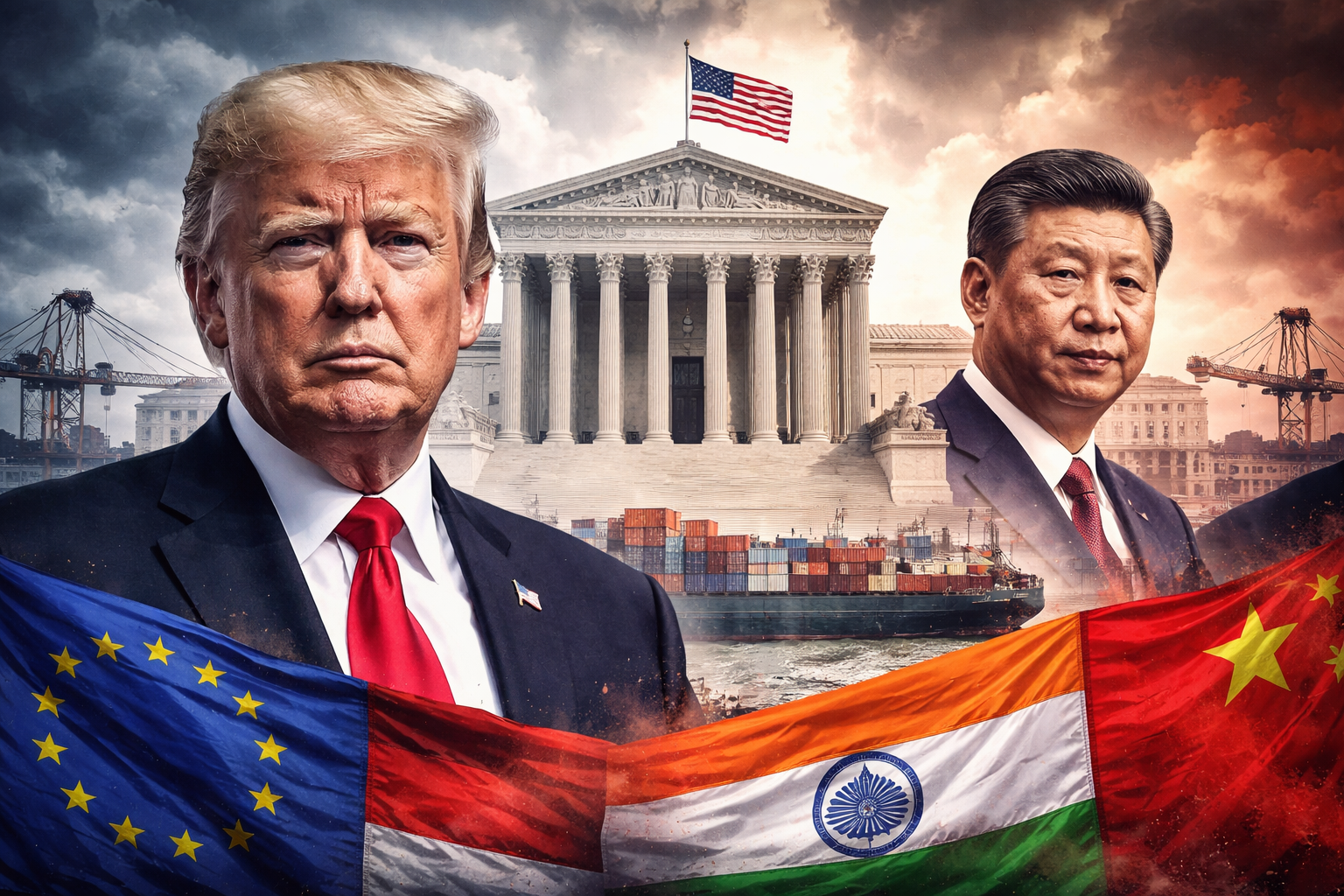
The United States has entered a new phase of constitutional and economic confrontation — one that is reverberating far beyond Washington.
In a landmark ruling, the U.S. Supreme Court curtailed former President Donald Trump’s sweeping use of emergency powers to impose global tariffs, reasserting congressional authority over trade taxation. Within hours, Trump responded with a new 15% global tariff using alternative statutory authority — escalating the battle from legal rebuke to political counterpunch.
This is no longer just a trade dispute.
It is a defining moment about executive power, judicial restraint, economic nationalism, and America’s credibility in a rapidly fragmenting global order.
The Supreme Court Draws a Line
The Court ruled that the 1977 International Emergency Economic Powers Act (IEEPA) does not grant unlimited authority to impose broad, across-the-board tariffs. While presidents have long exercised expansive trade powers, the justices signaled that emergency statutes cannot be stretched into permanent economic governance tools.
The message was clear:
Congress controls tariff authority unless it explicitly delegates that power.
The ruling marks one of the most significant judicial checks on executive trade authority in decades. It reinforces a structural principle — that even in moments of economic rivalry, constitutional boundaries remain intact.
But the story did not end there.
Trump’s 15% Tariff Escalation
Rather than retreat, Trump pivoted.
Using alternative statutory mechanisms — including Section 122 authorities — he announced a temporary 15% global tariff on imports. The move aims to preserve his economic leverage strategy while navigating around the Court’s constraints.
Markets reacted cautiously. Governments responded diplomatically but nervously. Businesses began recalculating supply chains yet again.
The underlying signal was unmistakable:
Trade policy remains volatile — and executive ambition has not been restrained by judicial correction.
Why This Matters Beyond Washington
Tariffs are not abstract policy tools. They ripple outward.
Europe
European leaders, already navigating energy transition costs and post-pandemic economic recalibration, face renewed uncertainty in transatlantic trade. Strategic autonomy debates intensify as Brussels reassesses long-term dependency on unpredictable U.S. tariff policy.
India
Under Prime Minister Narendra Modi, India has positioned itself as a supply chain alternative to China. The tariff shock complicates ongoing trade negotiations but also reinforces India’s strategic importance in U.S. economic realignment efforts.
New Delhi’s response has been measured — studying the implications while continuing bilateral discussions.
China
For Beijing, the episode reinforces long-held arguments about American unpredictability in trade governance. U.S.–China economic competition already shapes global supply chains, technology policy, and semiconductor strategy. Tariff instability only deepens decoupling pressures.
Latin America, Africa, and Asia
Export-driven economies in Latin America — including Brazil — and manufacturing hubs across Asia must now navigate tariff recalculations that may shift investment flows once again.
In Africa, where infrastructure investment and trade access are central to development strategies, global trade fragmentation complicates growth prospects.
Executive Power vs Institutional Constraint
This tariff confrontation is not only economic.
It is constitutional.
The Supreme Court’s intervention signals that the judiciary is prepared to limit expansive interpretations of emergency economic authority. That matters deeply in a polarized political climate where executive action often substitutes for legislative compromise.
The broader question now becomes:
How far can future presidents — Republican or Democrat — stretch statutory language to enact sweeping economic measures?
The Court has reasserted itself as a stabilizing institutional actor. Whether that stabilizing role holds amid political backlash remains to be seen.
Trade Policy as Political Identity
Under Trump, tariffs became more than economic tools. They symbolized sovereignty, industrial revival, and resistance to globalization.
Under Joe Biden, trade policy maintained elements of strategic competition with China while attempting to restore alliance coordination.
Under Barack Obama, trade liberalization emphasized multilateral agreements like the Trans-Pacific Partnership.
Three administrations. Three theories of American power.
The oscillation itself introduces volatility into global expectations.
The Broader Strategic Context
This legal-economic episode unfolds against a world marked by:
- Ongoing tensions with Iran under Supreme Leader Ali Khamenei
- Persistent nuclear deterrence postures from Kim Jong-un
- Post-Iraq and Afghanistan recalibration of U.S. troop deployments
- Renewed intelligence scrutiny involving agencies like the FBI and CIA
- Continued institutional trust debates following controversies such as the Jeffrey Epstein case
Each of these elements intersects with one central variable: American institutional credibility.
Trade volatility feeds into that equation.
Markets vs Politics
Financial markets dislike unpredictability more than high tariffs.
What businesses seek is clarity — predictable rules, durable frameworks, and legislative consensus. Instead, they now face:
- Judicial review of executive authority
- Rapid policy reversals
- Temporary tariff measures with unclear longevity
- Escalation rhetoric
Global corporations must hedge not only economic risk but political risk.
That reality reshapes investment patterns.
The Institutional Test
The deeper issue may not be tariffs.
It is institutional resilience.
Can the Supreme Court maintain authority amid political pressure?
Can Congress reclaim trade oversight without paralysis?
Can executive ambition operate within constitutional limits without undermining governance credibility?
America’s influence depends not only on military strength or economic size — but on institutional durability.
Allies assess reliability.
Adversaries assess cohesion.
Investors assess predictability.
The Emerging Pattern: Controlled Fragmentation
The United States is not retreating from global leadership.
But it is renegotiating the terms of that leadership — through tariffs, court rulings, strategic competition, and domestic polarization.
The tariff episode underscores a broader transformation:
- Economic nationalism coexists with global interdependence.
- Executive assertiveness meets judicial boundary-setting.
- Political identity increasingly shapes trade architecture.
This pattern will likely persist into future administrations.
Conclusion: A Trade Shock With Constitutional Consequences
The Supreme Court’s ruling against Trump’s emergency tariff authority did not end the trade confrontation.
It reframed it.
The immediate 15% tariff escalation ensures continued volatility. But the longer-term significance lies in the constitutional boundary the Court attempted to draw.
Trade policy is now a three-way negotiation between:
- Executive ambition
- Legislative authority
- Judicial oversight
Meanwhile, Europe recalibrates, India positions strategically, China recalculates, and global markets hedge risk.
The world is watching not only tariff rates — but institutional coherence.
Because in the 21st century, power is measured not just by leverage — but by legitimacy.
And legitimacy begins at home.
Why GDPR Was Created: Restoring Control in the Digital Age
- Iraq After Saddam: Regime Collapse, Occupation and the Long Shadow of State Failure
- The World Is Not Watching a Crisis Unfold — It Is Watching a Redesign
- What If the Biggest Hole in Global Climate Policy Isn’t Coal or Oil — It’s War?
- Diplomacy Is Not About Choosing Sides – It Is About Protecting Interests
- War in the Cloud


