


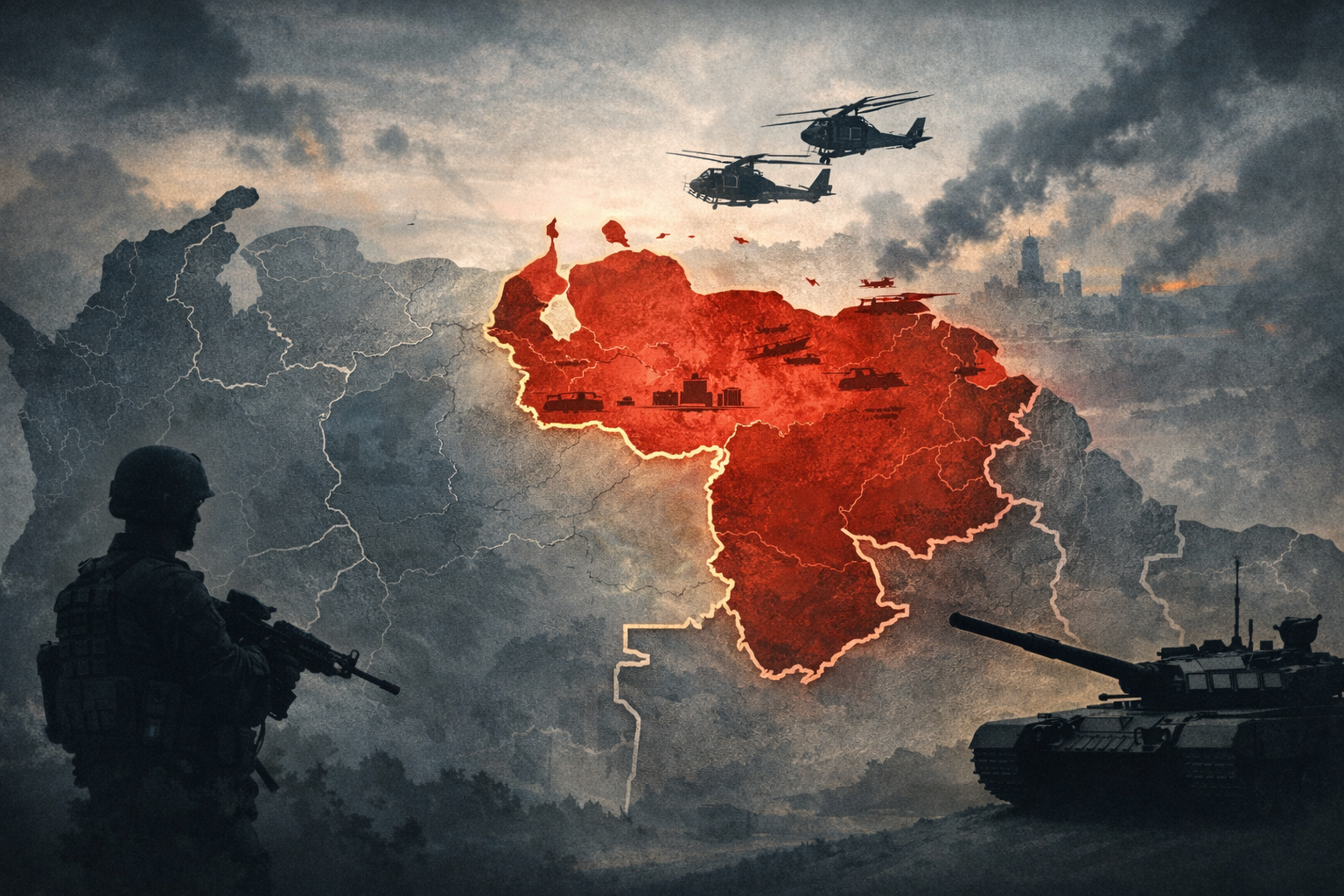
U.S. Military Intervention in Venezuela: Legality, Precedent, and the Risks of Normalising Force
Calls for military intervention in Venezuela resurface periodically, often framed as a response to political collapse, humanitarian distress, or regional instability. Yet history suggests that such interventions rarely remain confined to their stated objectives. In Latin America, where sovereignty and non-intervention are deeply embedded norms, the implications of any external military action extend far beyond Venezuela itself.
This analysis examines the risks and precedents surrounding the idea of military intervention in Venezuela. Rather than treating intervention as a binary choice—action or inaction—it situates the debate within a longer regional and international context shaped by past interventions, legal constraints, and unintended consequences.
“Military intervention rarely ends where it begins.”
The central question is not simply whether intervention is feasible, but whether it would stabilise Venezuela or entrench new forms of instability—political, economic, and geopolitical—across the region.
The reported U.S. military operation in Venezuela in early January 2026 — culminating in the capture and removal of President Nicolás Maduro — is more than a regional shock. It is a major stress test for the contemporary international order and its core constraint: that the use of force must remain exceptional, rule-bound, and internationally justified.
Whatever one thinks of Maduro’s rule, the strategic importance of the operation lies less in the individual removed than in what the act communicates: a lower political and normative threshold for intervention. The central question is not whether the intervention can be defended rhetorically after the fact, but whether its logic becomes exportable — and therefore destabilising beyond Venezuela.
Legality: A Difficult Fit Under International Rules
The modern rules governing force are narrow by design. They generally permit armed action only in self-defence or through multilateral authorization. The Venezuela intervention, as described, does not cleanly fit those categories. It has been framed as a form of enforcement linked to alleged criminal activity and illegitimacy claims. Yet from a legal perspective, using military force to seize a sitting head of state on sovereign territory resembles regime change, not law enforcement.
This distinction matters. Enforcement implies jurisdiction and consent. Intervention implies coercion. Even when criminal allegations are real, they do not automatically create a legal right to unilateral military action. In effect, the operation signals not a reinterpretation of existing rules but a willingness to bypass them when strategic or political conditions allow.
Precedent: Why This Matters More Than Venezuela
If legality is the immediate debate, precedent is the long-term danger.
International norms survive not because they are never violated, but because violations remain rare and costly. When a powerful state intervenes militarily on the basis of alleged criminality, weak governance, or disputed legitimacy, it introduces a dangerous subjectivity into what was meant to be a narrow legal domain. The principle becomes elastic: intervention can be justified whenever a target is painted as beyond legitimacy.
That logic is replicable. If normalised, other states can cite similar justifications in contested regions worldwide — whether against separatist areas, rival-backed governments, or neighbours accused of harbouring criminals or militants. Over time, the line between defensive force and discretionary coercion collapses. What remains is not rule-based restraint, but precedent-based permission.
Domestic Politics: Plausible, But Not Provable
The timing has fuelled speculation that domestic political incentives played a role. Historically, leaders under internal pressure have sometimes sought external action to signal strength and shift attention. But analytically, this “diversion” argument must remain a hypothesis unless direct evidence establishes a causal link.
Still, context matters. The operation occurred amid intense polarization and heightened scrutiny of executive decision-making. That ensures legitimacy debates will be amplified. Even if the decision was strategically motivated, the domestic environment shapes interpretation: supporters frame it as decisive leadership; critics frame it as escalation without constraint. Both narratives deepen political division — and increase uncertainty about how future interventions might be triggered.
Regional Impact: Sovereignty Anxiety Across Latin America
In Latin America, the operation reactivates a historical sensitivity: sovereignty and the fear of external determination of political outcomes.
Even governments opposed to Maduro face a strategic problem. Once unilateral intervention becomes thinkable, no state can fully assume immunity from coercion under shifting political labels. The operational fallout could include displacement, economic disruption, and security spillover. But the deeper impact is political: the perception that the region’s internal outcomes remain contingent on external power.
This constrains regional autonomy and polarises alignments. Some will view the intervention as correction; others as humiliation. Both readings weaken the possibility of coordinated regional diplomacy.
Global Systemic Effects: Selective Enforcement Weakens Compliance
The broader systemic impact is equally significant. For states already sceptical of international law, Venezuela reinforces the argument that rules are applied unevenly: strict for some, flexible for others.
That perception weakens incentives for compliance elsewhere. If restraint is optional for powerful actors, then restraint becomes harder to sell as a universal principle. This is how rule erosion spreads: not through formal collapse, but through selective breaches that establish new normal behaviour.
The operation therefore sends a message beyond Venezuela: the limits on force are no longer guaranteed by consensus, only by the distribution of power.
Strategic Signaling: Resources and the Problem of Interpretation
Finally, energy and resources shape international interpretation, even if they were not the primary motive. When intervention coincides with major resource geography, the narrative becomes inseparable from strategic extraction and leverage. That undermines any claim that the action was purely principle-based and strengthens suspicion that power and access remain decisive in global politics.
In international affairs, interpretation becomes reality. Once framed as resource-linked intervention, credibility costs rise sharply — and future cooperation becomes harder.
Conclusion: A Turning Point or a Dangerous Template?
The Venezuela intervention is not merely a foreign-policy episode. It may be a marker of systemic strain: weakening multilateral constraint, collapsing consensus on force, and the growing normalisation of discretionary intervention.
Its long-term significance will depend on whether it remains exceptional — or becomes a template. If it becomes a template, global order shifts toward a more permissive and fragmented world, where sovereignty is increasingly conditional and the use of force becomes easier to justify after the fact.


