


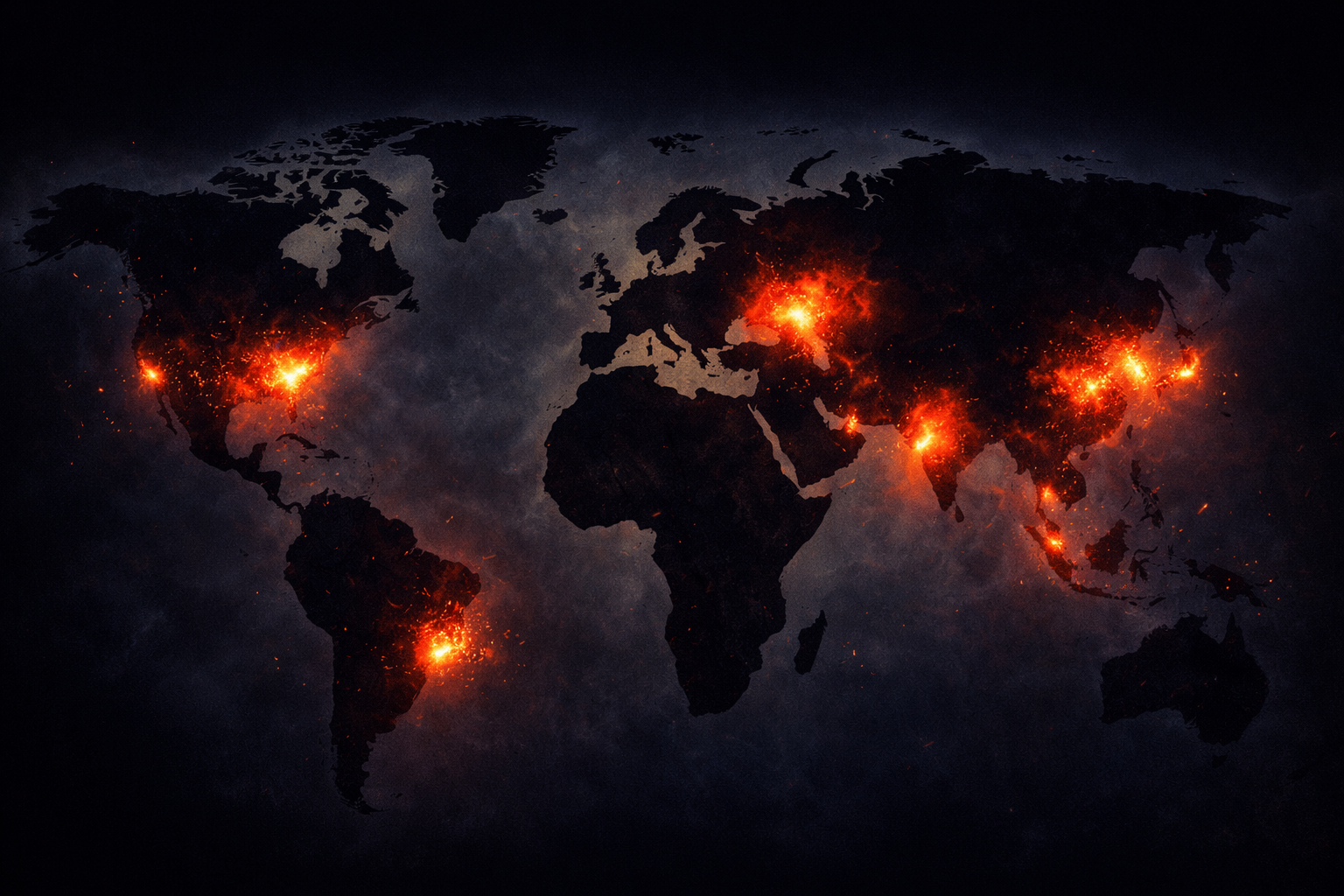
A strategic assessment of the six rivalries most likely to escalate into armed conflict and the forces that may still prevent them
A World on Multiple Edges
There is a particular kind of silence that precedes storms. Not the silence of peace, but the silence of held breath — of nations watching each other across disputed lines, calculating, waiting, measuring the other’s resolve and their own capacity to prevail. That silence has become the defining condition of international relations in 2026.
The post-Cold War order — imperfect, often hypocritical, but broadly stabilising — has been eroding for more than a decade. The assumption that underpinned it, that great power competition had been displaced by great power cooperation within a liberal international framework, has not survived contact with reality. Russia’s full-scale invasion of Ukraine in 2022 confirmed what many strategists had long suspected: that the rules-based international order was a condition created and sustained by American power, and that when that power is perceived to be retreating, the rules begin to dissolve.
The consequences are visible across every region of the world. In the Indo-Pacific, China’s military build-up and increasingly assertive posture toward Taiwan have generated a level of great power tension not seen since the Cold War. On the Korean Peninsula, the technical state of war that has persisted since 1953 is being sustained by a North Korean regime now widely assessed to possess deliverable nuclear weapons. In the Middle East, the elimination of Iran’s Supreme Leader and the resulting power vacuum in Tehran have created a crisis whose trajectory no analyst can confidently predict. Along the Himalayan frontier, India and China have been locked in a military standoff since the lethal Galwan Valley clash of 2020. And in Kashmir, the unresolved dispute between two nuclear-armed neighbours continues to generate regular episodes of violence.
We are not living in a pre-war world. We are living in a multi-crisis world — where several wars are simultaneously possible, and where the deterrence mechanisms that prevented the worst outcomes of the twentieth century are under more pressure than at any point since 1945.
This is not a world in which war is inevitable. Nuclear deterrence, economic interdependence, and the sheer destructive capacity of modern military forces all create powerful incentives for restraint. But it is a world in which the number of potential ignition points has increased sharply, the reliability of escalation management has declined, and the gap between rivalry and war has narrowed in ways that should concern every serious observer of international affairs.
This analysis examines the six most dangerous flashpoints in the current international system — the rivalries where the combination of unresolved disputes, military build-up, domestic political pressures, and declining diplomatic guardrails creates the greatest risk of escalation to armed conflict. It then examines the structural forces driving the global increase in geopolitical tension, and the factors that continue to make war — even in the most fraught rivalries — an outcome that most actors work to avoid.
The Architecture of Danger: Why the World Became More Dangerous
Understanding the current geopolitical risk environment requires understanding what changed — and when. The answer is not a single event but a structural shift that has been building since approximately 2008, when the global financial crisis disrupted the narrative of Western economic dominance, Russia’s invasion of Georgia signalled a new willingness to use force in the post-Soviet space, and China’s assertion at the G20 that the global financial architecture required fundamental reform announced a new phase of great power ambition.
What has emerged since then is a world characterised by four interconnected dynamics that together create a structurally more dangerous international environment than the one that existed for most of the post-Cold War period.
The End of Unipolarity
The United States remains the world’s most powerful state by most conventional measures — military capability, technological leadership, the reserve currency status of the dollar, and the reach of its alliance network. But the unipolar moment — the period in the 1990s when American primacy was so overwhelming that no rival could meaningfully contest it — is over. China’s GDP has grown from approximately 12 percent of American GDP in 2000 to over 75 percent in purchasing power parity terms by 2024. Its military spending has increased nearly tenfold since 2000. Russia, despite its economic weakness relative to either the US or China, has demonstrated a willingness to use military force that the post-Cold War order had assumed it lacked.
In a multipolar world, the deterrence calculations that prevented great power conflict in the unipolar era become more complex. Multiple powers are simultaneously testing the limits of what rivals will accept — in Taiwan, in Ukraine, in the South China Sea, along the LAC — and the signals sent by the responses of the defending powers are ambiguous in ways they were not when American primacy was unchallenged.
The Weaponisation of Economic Interdependence
The theory that economic interdependence prevents war — that nations deeply integrated in each other’s supply chains would not risk the mutual destruction of conflict — was one of the foundational assumptions of the post-Cold War order. It has not been disproved, but it has been severely complicated. The use of sanctions, export controls, technology denial, and financial warfare as instruments of geopolitical competition has demonstrated that economic interdependence can be weaponised as readily as it can constrain violence. The US-China technology war — restrictions on semiconductor exports, investment screening, and the progressive decoupling of critical supply chains — is the most consequential example of this dynamic, but it is not the only one.
Nationalism and Territorial Revisionism
In China, Russia, India, Pakistan, Iran, and North Korea — in different ways and with different intensities — political leaderships have found nationalism to be the most reliable source of domestic legitimacy in an era of economic uncertainty and social stress. Nationalism generates territorial claims, feeds historical grievances, and creates domestic political incentives that make compromise more costly for leaders. The Chinese Communist Party’s claim to Taiwan, Putin’s assertion that Ukraine is not a real country, Pakistan’s position on Kashmir — each of these is partly a genuine strategic conviction and partly a domestic political resource that cannot easily be abandoned without political cost.
The Technology Revolution in Military Affairs
Hypersonic missiles, drone swarms, autonomous weapons, cyber warfare, and space-based military assets have transformed the military balance across every major rivalry in ways that have not yet been fully absorbed into deterrence doctrine or strategic planning. Technologies that once belonged exclusively to great powers are now accessible to middle powers and sub-state actors. The speed of modern missile systems has compressed decision-making timelines to minutes, reducing the space for diplomacy in a crisis. And the increasing autonomy of weapons systems raises the prospect — not yet realised but increasingly plausible — of escalation driven by machine decision-making rather than human intent.
The Six Most Dangerous Flashpoints
The following assessments are based on a combination of factors: the existence of an unresolved territorial or political dispute; the military capability and stated intentions of the parties involved; the domestic political dynamics that shape leadership decision-making; the presence or absence of functioning diplomatic channels; and the degree to which escalation management mechanisms are robust, degraded, or absent.
| FLASHPOINT 01 EXTREME RISK China — Taiwan Parties: People’s Republic of China, Taiwan (Republic of China), United States of America The Taiwan Strait is the single most dangerous flashpoint in the current international system — the place where the two largest economies and two most capable militaries in the world are most likely to come into direct conflict. China views Taiwan as a breakaway province whose eventual unification with the mainland is a matter of non-negotiable national destiny. Taiwan functions as an independent democracy with its own government, military, and foreign relationships. The United States is committed by the Taiwan Relations Act to providing Taiwan with defensive arms and has repeatedly signalled — with increasing directness under successive administrations — that it would defend Taiwan militarily against a Chinese invasion. Key Risk Factors: • Taiwan produces over 90% of the world’s most advanced semiconductor chips — a dependency that makes its status a matter of global economic security, not merely regional politics • China’s military modernisation has been explicitly oriented toward a Taiwan invasion scenario since at least 2015, with the PLA developing the doctrine, capability, and logistical infrastructure for a cross-strait amphibious operation • Xi Jinping has made Taiwan unification a central component of the ‘China Dream’ narrative, creating domestic political pressure that constrains flexibility • The United States’ strategic ambiguity doctrine — never explicitly committing to defend Taiwan militarily — has been repeatedly tested and is increasingly seen in Beijing as a bluff that Washington cannot afford to call • A Taiwan conflict would immediately threaten the global semiconductor supply chain, triggering economic consequences estimated by some analysts at over $2 trillion in GDP impact — yet this mutual assured economic destruction has not demonstrably slowed Chinese military preparations • Any conflict would likely involve US-China direct military engagement, with unpredictable escalation dynamics and nuclear overtones |
| FLASHPOINT 02 EXTREME RISK Russia — NATO Parties: Russian Federation, NATO Member States (32 countries), Ukraine Russia’s full-scale invasion of Ukraine in February 2022 fundamentally altered the European security architecture. For the first time since the Second World War, a major European power is engaged in large-scale conventional warfare against a neighbouring state, and the alliance system designed to prevent exactly this scenario is providing the defending state with weapons, intelligence, and economic support while stopping just short of direct military intervention. The question that European and American policymakers have been managing — with considerable anxiety — since February 2022 is how to prevent the conflict from escalating beyond Ukrainian territory into a direct Russia-NATO confrontation. Key Risk Factors: • Russia has explicitly threatened nuclear weapon use in response to NATO intervention, and Putin has repeatedly invoked Russia’s nuclear doctrine to deter Western military engagement • NATO’s eastern flank — Estonia, Latvia, Lithuania, and Poland — borders Russia or Russian-aligned Belarus, and any spillover of fighting into NATO territory would trigger Article 5 collective defence obligations • Russian military doctrine explicitly contemplates the use of tactical nuclear weapons as an escalation management tool — the so-called ‘escalate to de-escalate’ concept — creating a scenario in which conventional military setbacks could produce a nuclear response • Ukraine’s use of Western-supplied long-range missiles against targets inside Russian territory has pushed the conflict progressively closer to the threshold of direct Russia-NATO confrontation • A leadership crisis or succession struggle in Moscow could produce decisions that are less calculated and more dangerous than those of a stable authoritarian government |
| FLASHPOINT 03 EXTREME RISK Iran — Israel (and Regional Powers) Parties: Iran, Israel, United States, Hezbollah (Lebanon), Houthi Movement (Yemen), Hamas (Gaza), Saudi Arabia, UAE The Middle East is currently in its most acute crisis in four decades. The October 2023 Hamas attack on Israel, the subsequent Israeli military campaign in Gaza, the escalation to Lebanon and the near-destruction of Hezbollah as an organised military force, and the unprecedented Israeli and American strikes on Iranian territory — culminating in the death of Iran’s Supreme Leader and the destruction of significant parts of Iran’s nuclear infrastructure — have produced a regional environment of extraordinary volatility. Iran is now in a political transition whose trajectory is deeply uncertain, its nuclear programme has been set back but not eliminated, and its proxy network has been severely degraded but not destroyed. Key Risk Factors: • Iran’s political transition following the Supreme Leader’s death creates a power vacuum in which hardliners, reformists, and the IRGC are competing for dominance — and in which a new leadership may feel the need to demonstrate strength through military action • Iran’s nuclear programme, though damaged, retains significant capability, and the incentive to accelerate toward an actual weapon — as the ultimate deterrent against further strikes — has never been stronger • Israel’s security doctrine does not permit a nuclear-armed Iran, creating an existential red line that may produce further preemptive action regardless of diplomatic progress • The Strait of Hormuz, through which approximately 20% of globally traded oil passes, remains vulnerable to Iranian interdiction — an action that would trigger global economic shock • Iran’s proxy networks — Hezbollah remnants, Houthi forces, Iraqi PMF — are now operating without coherent central command, increasing the risk of uncontrolled escalation • The United States remains deeply involved militarily in the region, and any Iranian action against American forces or interests could trigger a direct US-Iran war |
| FLASHPOINT 04 HIGH RISK India — Pakistan Parties: Republic of India, Islamic Republic of Pakistan, with potential involvement of People’s Republic of China The India-Pakistan rivalry is the world’s most persistently dangerous bilateral relationship — two nuclear-armed states with an unresolved territorial dispute at the core of their national identities, a history of four wars, and an active Line of Control across which violence never fully stops. The 2016 surgical strikes and the 2019 Balakot airstrikes demonstrated that India has adopted a more muscular deterrence posture — willing to conduct cross-border military operations in response to terrorist attacks attributed to Pakistan-based groups. Pakistan’s response to Balakot — a counter-air operation that resulted in the downing of an Indian aircraft and a brief aerial engagement — demonstrated that Pakistan would respond militarily, taking both sides to an escalation threshold that neither fully understood how to manage. Key Risk Factors: • Both states possess nuclear weapons, with Pakistan maintaining a first-use doctrine and a lower nuclear threshold than India — a combination that creates an asymmetric escalation risk • Pakistan’s tactical nuclear weapons — short-range battlefield nuclear missiles — are designed specifically to neutralise India’s conventional military advantage, creating a scenario in which conventional Indian military action could produce a nuclear response • The China-Pakistan alignment provides Pakistan with strategic depth and, increasingly, advanced military technology — including potentially relevant missile systems — that complicate India’s deterrence calculations • The 2019 Balakot episode demonstrated that the ‘escalation ladder’ between the two states is not as stable as strategic theorists assumed — both sides escalated rapidly to air power engagement without clear protocols for de-escalation • Pakistan’s domestic instability — political crisis, economic fragility, and civil-military tensions — could produce decisions driven by internal pressures rather than strategic calculation • Another major terrorist attack on Indian soil attributed to Pakistan-based groups could create domestic political pressure in India for a military response that exceeds the surgical strike template |
| FLASHPOINT 05 HIGH RISK North Korea — South Korea (and the United States) Parties: Democratic People’s Republic of Korea, Republic of Korea, United States of America, Japan The Korean Peninsula has been technically in a state of war since 1950, with an armistice rather than a peace treaty marking the end of active hostilities in 1953. North Korea has since developed a nuclear arsenal — now estimated at 40 to 50 warheads with growing capability — and a ballistic missile programme capable of striking the continental United States. Kim Jong-un has codified into North Korean law the right to use nuclear weapons pre-emptively, dramatically lowering the nuclear threshold and creating a scenario in which conventional military escalation could produce a nuclear response. Key Risk Factors: • North Korea’s nuclear doctrine now includes explicit pre-emptive use conditions, eliminating the ambiguity that previously provided some deterrence stability • North Korea has provided artillery shells and other military assistance to Russia in exchange for technology transfers that may have accelerated its ballistic missile programme • Any conventional military conflict on the peninsula would risk rapid escalation to nuclear use given North Korea’s explicit doctrine, creating the prospect of nuclear war on a densely populated peninsula adjacent to China and Japan • South Korea’s political debate has increasingly included serious discussion of indigenous nuclear weapons development — a development that would fundamentally destabilise the regional nuclear architecture • The US-South Korea alliance, which underpins conventional deterrence on the peninsula, has been a target of questioning from American political figures, creating uncertainty about its robustness in a crisis • A succession crisis or internal instability in North Korea could produce dangerous unpredictability from a nuclear-armed state |
| FLASHPOINT 06 HIGH RISK China — India Parties: People’s Republic of China, Republic of India, with indirect involvement of United States and Pakistan The Galwan Valley clash of June 2020 — in which Indian and Chinese soldiers fought with improvised weapons at high altitude, resulting in the deaths of at least 20 Indian soldiers and an undisclosed number of Chinese casualties — marked the end of a decades-long assumption that the India-China border would remain a managed competition rather than a genuine military confrontation. Since Galwan, both sides have dramatically accelerated military infrastructure development along the Line of Actual Control, repositioned large formations, and adopted a new pattern of confrontation and partial disengagement that has stabilised the situation without resolving it. Key Risk Factors: • China’s military infrastructure along the Tibetan Plateau — roads, railways, logistics bases, and forward airfields — has transformed its ability to sustain high-intensity operations at altitude, eliminating the logistical advantage that India previously relied on • India faces a two-front challenge — China on the northern and northeastern frontier, Pakistan on the western border — with a military not designed or resourced for simultaneous high-intensity operations on both axes • The progressive India-US strategic alignment, including the Quad framework and bilateral defence cooperation, is viewed in Beijing as part of a containment strategy, potentially making China more rather than less willing to test India militarily • Both states are nuclear powers, but neither has explicit first-use doctrine, and the nuclear dimension of a China-India conflict is less well understood — and less war-gamed — than the India-Pakistan nuclear dynamic • The Line of Actual Control is not formally demarcated, meaning that patrol clashes and territorial disputes can occur without either side necessarily intending escalation • China’s ongoing territorial assertiveness — in the South China Sea, toward Taiwan, along the LAC — suggests a strategic appetite for opportunistic gains that has not been diminished by the costs of the post-Galwan freeze |
Risk Matrix: Comparing the Flashpoints
The following assessment compares the six flashpoints across four dimensions: proximity to conflict, escalation risk, global impact if conflict occurs, and the robustness of current deterrence mechanisms.
| Flashpoint | Conflict Risk | Global Impact if War |
| China – Taiwan | EXTREME | Catastrophic — global semiconductor collapse, US-China war |
| Russia – NATO | EXTREME | Catastrophic — nuclear risk, European war, Article 5 activation |
| Iran – Israel | EXTREME (current) | Severe — energy shock, regional war, nuclear proliferation |
| India – Pakistan | HIGH | Severe — nuclear exchange risk, regional economic collapse |
| North Korea – South Korea | HIGH | Catastrophic — nuclear use risk, peninsula devastation |
| China – India | HIGH | Severe — global supply chain disruption, Asian power conflict |
The Role of Alliances and Deterrence
The most important reason the six rivalries described above have not yet produced major wars is deterrence — the calculation by potential aggressors that the costs of military action outweigh the expected gains. But deterrence is not a static condition. It is a dynamic relationship between capabilities, intentions, and credibility that must be continuously maintained and is subject to miscalculation, degradation, and sudden collapse.
Nuclear Deterrence: Still the Most Powerful Constraint
Nuclear deterrence remains the single most important factor preventing conflict between nuclear-armed states. The prospect of nuclear escalation creates a profound constraint on conventional military adventurism — no leadership that rationally values the survival of its state can contemplate military action that risks nuclear retaliation. This logic has operated, imperfectly but effectively, across every major-power rivalry since 1945.
The problem in the current environment is that nuclear deterrence is being tested in ways that strain its traditional logic. Russia’s use of nuclear threats as a tool of coercive diplomacy in Ukraine — threatening nuclear use not in response to nuclear attack but in response to conventional military setbacks — represents a significant expansion of the conditions under which nuclear weapons might be used. North Korea’s explicit pre-emptive use doctrine eliminates the ambiguity that previously allowed deterrence to function. And the proliferation of tactical nuclear weapons in multiple arsenals creates scenarios of ‘limited’ nuclear use that the deterrence literature has historically struggled to model convincingly.
Alliance Systems: Credibility Under Stress
The US alliance system — NATO in Europe, bilateral alliances with Japan, South Korea, Australia, and the Philippines in the Indo-Pacific, and the quasi-alliance relationship with Taiwan — is the primary structural mechanism through which American power deters adversary aggression. Its effectiveness depends entirely on its credibility: the belief by potential aggressors that the United States would actually honour its commitments under fire.
That credibility has been subjected to more sustained questioning in the past decade than at any point since the 1970s. American political figures have openly questioned the value of NATO commitments. The withdrawal from Afghanistan in 2021 — whatever its strategic merits — sent signals about American resolve that were read carefully in Beijing, Moscow, and Pyongyang. And the domestic political environment in the United States has made the alliance system a subject of partisan debate in a way that was previously unthinkable.
The result is a deterrence environment in which adversaries are continuously testing the proposition that American alliance commitments are real — probing, calculating, and waiting for evidence that the answer is no.
Deterrence is not a wall. It is a calculation — and calculations change when capabilities shift, when credibility is questioned, and when leaders under domestic pressure begin to see military action as a solution to political problems.
The Escalation Management Problem
Perhaps the most underappreciated risk in the current environment is not that any of these rivalries will produce deliberate war, but that one will produce accidental or inadvertent escalation — a crisis that neither side intended to become a war, managed badly, producing outcomes that neither side wanted. The compressed decision-making timelines of modern missile systems, the opacity of AI-assisted targeting and intelligence systems, and the decline of the diplomatic communication channels that managed Cold War crises all contribute to an environment in which miscalculation is more likely than at any previous point in the nuclear era.
Economic Competition and Technological Rivalry as Conflict Drivers
Modern geopolitical conflict is rarely purely military. It is embedded in a broader competition for economic advantage, technological leadership, and the institutional frameworks that govern international trade, finance, and investment. Understanding the military flashpoints described above requires understanding the economic and technological competition that shapes them.
The Semiconductor War
No single technological competition better illustrates the intersection of economic and military rivalry than the global contest for semiconductor supremacy. Taiwan’s TSMC produces over 90 percent of the world’s most advanced chips — the components on which artificial intelligence, advanced weapons systems, telecommunications, and virtually every aspect of the modern economy depend. China’s inability to produce chips at the leading edge of performance, combined with American export controls designed to maintain that gap, has created a technological chokepoint that both sides understand to be strategically decisive.
For China, the semiconductor gap is an existential strategic vulnerability — a dependency that could be exploited in a conflict and that constrains its ability to modernise its military. This creates a military incentive to gain control of Taiwan’s semiconductor capacity that exists alongside and reinforces the political claim to Taiwan. For the United States, maintaining the technological gap is a central element of its broader strategy of managing China’s rise — which is why the export controls on advanced chips and chip-making equipment have been tightened progressively since 2022, despite the economic costs to American technology companies.
The AI Military Revolution
Artificial intelligence is beginning to transform military capability in ways that will reshape every one of the flashpoints described in this analysis. AI-assisted targeting, autonomous drone swarms, predictive logistics, signals intelligence analysis, and decision-support systems are all being developed and deployed at pace by the major military powers. The competition is particularly intense between the United States and China, but Russia, India, and Israel are also significant actors.
The military AI revolution creates several new risk dimensions. First, it accelerates the pace of conflict, compressing human decision-making timelines in ways that reduce the space for diplomatic intervention in a crisis. Second, it creates new forms of strategic opacity — AI systems may make decisions whose logic human operators cannot fully trace or predict. Third, it lowers the cost of certain forms of military action — drone strikes, cyber operations, information warfare — making them more likely to be used as instruments of coercion below the threshold of conventional war, but with escalatory potential that is difficult to control.
Why Wars Still Don’t Always Happen: The Case for Cautious Optimism
The analysis above makes for sobering reading. But it would be analytically incomplete — and strategically unhelpful — without an equally serious examination of the forces that continue to make war, even among deeply hostile rivals, an outcome that most actors work to avoid.
The Mutual Assured Destruction of Modern Economic Integration
Despite the weaponisation of economic interdependence described earlier, the sheer depth of economic integration in the global system continues to create powerful incentives against conflict. A Taiwan war would not merely disrupt semiconductor supply — it would trigger financial market collapses, supply chain disruptions, and economic contractions that would affect the Chinese economy as severely as the American one. Russia’s economy has been damaged, though not destroyed, by the sanctions imposed after 2022 — but the prospect of full Western economic isolation would be catastrophic for a Chinese economy far more integrated into global trade. The economic costs of major conflict are now sufficiently understood, at leadership level, to function as a genuine deterrent even in the absence of other constraints.
Back-Channel Diplomacy and Crisis Communication
The institutionalised diplomacy of the post-Cold War era — multilateral frameworks, formal arms control agreements, regular heads-of-state communication — has been significantly degraded. But back-channel communication between adversaries has not disappeared. The United States and China maintain multiple informal channels of military-to-military communication designed precisely to manage the risk of accidental escalation. India and Pakistan, despite the deterioration of their official relationship, retain some mechanisms for rapid communication in crisis. And the experience of navigating repeated crises without war has created, in the decision-making establishments of all the major powers, a body of institutional knowledge about where the red lines are and what happens when they are approached.
The Chastening Effect of Ukraine
Russia’s experience in Ukraine has had a demonstrable deterrent effect on potential aggressors elsewhere. The military and economic costs of the war — the destruction of significant Russian military capacity, the economic impact of sanctions, the isolation from Western technology — have been visible to every government calculating the costs of military adventurism. China’s military planners, assessing a potential Taiwan operation, cannot ignore the lessons of Ukrainian resistance, Western material support, and the difficulty of sustaining a large-scale combined arms operation against a motivated defending force.
The world contains multiple potential wars. Whether they happen depends not on the existence of disputes, but on the decisions made by leaders who understand — however imperfectly — that wars, once started, rarely end as planned.
Conclusion: The Decade of Decisions
The international system in 2026 is more dangerous than at any point since the end of the Cold War. The combination of great power competition, unresolved territorial disputes, declining diplomatic infrastructure, military modernisation driven by AI and drone technology, and domestic political dynamics that reward nationalism over compromise has produced an environment in which the risk of major conflict is real and rising.
None of the six flashpoints examined in this analysis represents an inevitable war. China has not invaded Taiwan. Russia has not attacked a NATO member. India and Pakistan have managed, with difficulty and luck, to keep their repeated crises below the threshold of large-scale conventional conflict. North Korea has not used its nuclear weapons. India and China have reached partial disengagement along the LAC. Iran’s political transition, though deeply uncertain, has not yet produced the catastrophic regional war that many feared.
But the margin for error is narrowing. The mechanisms that prevented the worst outcomes — nuclear deterrence, economic interdependence, institutional diplomacy, American alliance credibility, and the availability of back channels — are all under greater stress than they have been for decades. And the speed of military decision-making, driven by technology, is reducing the time available for the kind of deliberate statecraft that has historically prevented miscalculation from becoming catastrophe.
The next decade will be defined by whether the leaders of the major powers — in Washington, Beijing, Moscow, New Delhi, Islamabad, Pyongyang, Tehran, and Jerusalem — choose to manage these tensions through the patient, often unglamorous work of diplomacy and strategic restraint, or whether they allow the logic of rivalry to run to its conclusion.
History offers no guarantees. It offers only examples — of crises managed, of wars narrowly avoided, and of the catastrophic cost when leaders decided that the risks of conflict were acceptable. The world today contains all the ingredients of the latter. Whether it produces the former depends, as it always has, on the quality of human judgment under pressure — and on the willingness of powerful states to choose diplomacy over the temptation of force.
If Iran’s Regime Collapses, What Comes Next?


