


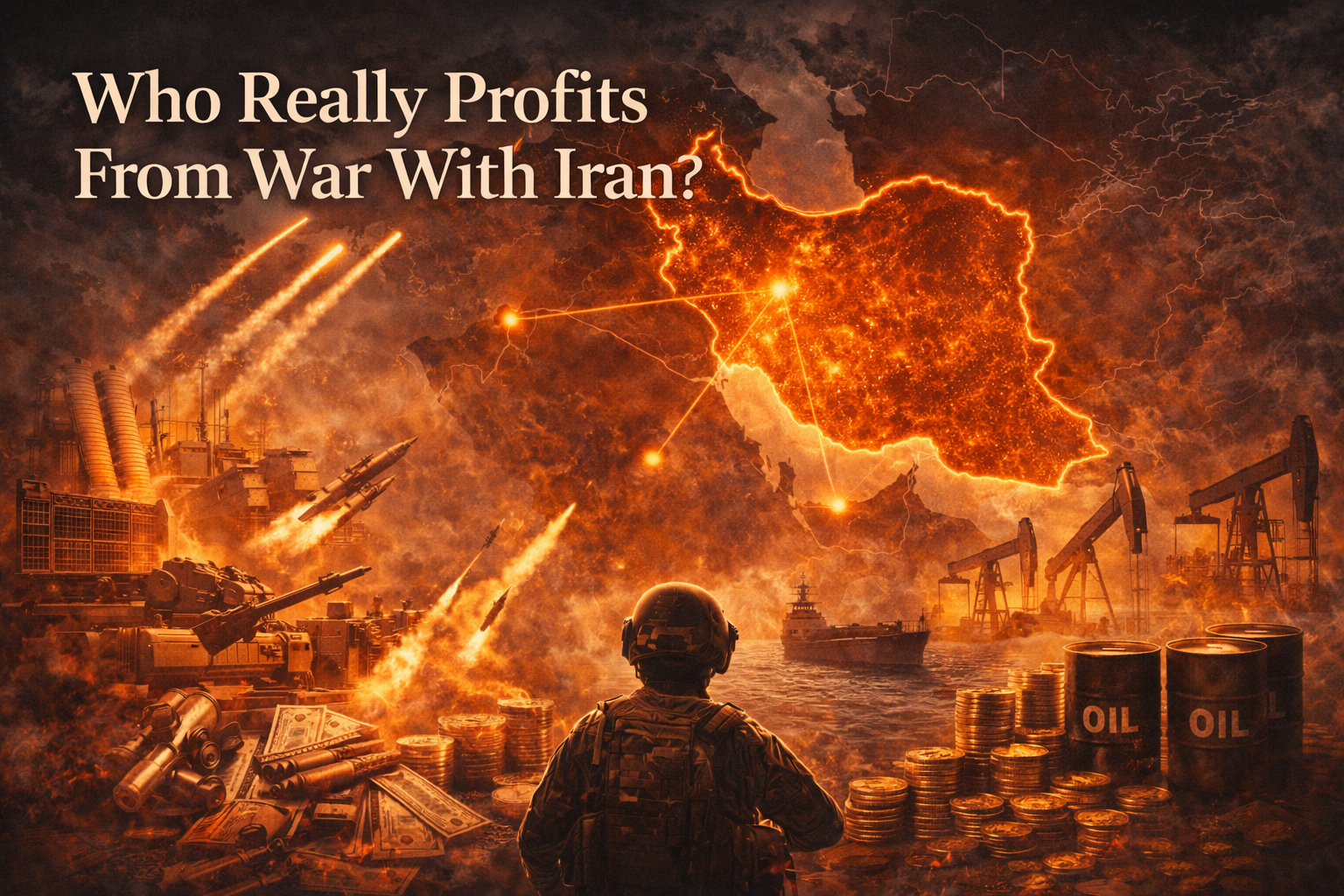
Wars impose enormous human and economic costs but they also create concentrated benefits for specific actors whose interests are rarely acknowledged in public debate
“Wars impose enormous costs on societies — but they also create concentrated benefits for actors whose interests rarely appear in public debate.”
Following the Incentives
The political discourse around military conflict tends to focus on the strategic rationales advanced by governments — the security threats being addressed, the diplomatic failures being responded to, the legal and moral justifications for the use of force. These rationales are real and important; they shape the decisions of leaders who are genuinely concerned about their countries’ security. But any serious analysis of why conflicts start, persist, and resist resolution must also examine the economic and political incentives that sustain them — the actors for whom ongoing conflict produces concentrated benefits, and whose interests therefore do not align with the rapid resolution that most populations would prefer.
This is not a conspiracy theory. It does not require the assumption that wars are orchestrated by shadowy interest groups for profit. It requires only the recognition that in any significant military conflict, some actors benefit materially from the conflict’s continuation, and that those actors’ resources, influence, and political connections give them a structural capacity to affect policy debates in ways that are not always transparent.
The question of who profits from conflict with Iran is worth examining carefully, precisely because the honest answer is more complex and more politically significant than either crude anti-war sloganeering or uncritical acceptance of official strategic rationales would suggest.
Section I: The Defence Industry
The global defence industry’s relationship with military conflict is the most direct form of war profitability. Defence companies produce the weapons systems, the ammunition, the logistics technology, and the military electronics that modern conflicts consume at rates that peacetime procurement cycles never match. When conflicts begin, order books fill, production lines accelerate, and stock prices rise.
The specific defence industry beneficiaries of the current Iran conflict are multiple. Missile defence companies — Raytheon (now RTX), which produces the Patriot air defence system and the Iron Dome interceptors used by Israel; Lockheed Martin, which produces the THAAD advanced air defence system — benefit from the acute demand for air defence solutions created by Iran’s missile campaign and the demonstrated capability of Iranian ballistic missiles. Precision strike munition manufacturers — again led by Raytheon’s AIM-120 AMRAAMs and JDAMs, along with Israeli companies like Elbit Systems and Rafael — benefit from the consumption of precision munitions in the conflict. Electronic warfare companies benefit from the demand for systems that can suppress or deceive Iranian air defence radars.
It is important to note that these companies are not ‘causing’ the conflict. They are responding to demand created by genuine security challenges that exist independently of their commercial interests. But the commercial dimension of their activity creates political economy dynamics worth acknowledging: defence companies employ hundreds of thousands of workers in politically significant congressional districts; they fund think tanks and research institutes that produce analysis supporting robust defence spending; and their lobbying expenditure is among the highest of any industry sector. These activities do not determine policy, but they shape the political environment in which policy is made.
Section II: Energy Market Dynamics
The energy market dimension of the Iran conflict involves a more complex set of interests. The immediate effect of conflict-related disruption to Middle Eastern oil supply is higher oil prices — which benefits oil producers while imposing costs on consumers. The geopolitical economy of this dynamic is significant.
American shale oil producers are among the primary beneficiaries of elevated oil prices caused by Middle Eastern supply disruption. The shale industry’s economics — with higher extraction costs per barrel than conventional Middle Eastern production — require a higher sustained oil price to be profitable. Gulf conflicts that push oil prices above $80-90 per barrel make shale production more economically attractive and accelerate American domestic energy investment. This is not a conspiracy — it is simply the market response to supply disruption — but it does create a constituency within the American energy sector that is not financially harmed by Middle Eastern instability.
Saudi Arabia and the Gulf producers face a more complex calculation. Higher oil prices increase their revenue in the short term, but they are also directly vulnerable to Iranian military action against their infrastructure — the Abqaiq-Khurais precedent — and to the regional instability that conflict creates. The Gulf states’ interest in Iran being militarily weakened and diplomatically isolated does align with their economic interests, but their interest in the conflict remaining contained — rather than expanding into a regional war — is equally strong.
Section III: Political Incentives in Wartime
The political science literature on the relationship between military conflict and domestic politics documents a consistent phenomenon often called the ‘rally round the flag’ effect: in the initial stages of military conflict, publics tend to support their governments, approval ratings rise, and the political space available to opposition and critics narrows. This dynamic creates political incentives for leaders who are domestically embattled or facing elections to initiate or sustain military operations that generate short-term political support.
The relationship between domestic political pressures and military decisions is not simple or deterministic, and it would be reductive to suggest that conflicts are primarily driven by leaders’ electoral calculations. But the political incentive structure is real and worth acknowledging. Governments facing domestic political difficulty — economic dissatisfaction, corruption scandals, opposition pressure — have historically found that external military conflicts provide temporary political relief. The political costs of conflict — casualties, economic disruption, international criticism — tend to accumulate more slowly than the initial political benefits.
This dynamic operates on the Iranian side as well. The Islamic Republic’s history includes multiple episodes in which external threat or conflict — real or constructed — has been instrumentalised to suppress domestic dissent, justify emergency measures, and unite a divided population around the regime. The ‘rally round the flag’ effect works in authoritarian states as well as democracies, and the availability of an external enemy provides political utility to leadership groups whose domestic legitimacy is otherwise challenged.
Section IV: Strategic Advantages for Regional Powers
Several regional powers benefit strategically from a weakened Iran without directly participating in the military conflict — which represents a political economy of indirect profiteering that is worth examining.
Saudi Arabia’s strategic calculus is the most direct. A weakened Iran — with its nuclear programme degraded, its Quds Force leadership eliminated, its proxy network disrupted, and its domestic politics in turmoil — is a less capable adversary for Saudi regional influence. The Saudi-Iranian competition for regional hegemony has defined Middle Eastern geopolitics for decades. Every degradation of Iranian military and political capacity is, from Riyadh’s perspective, a strategic gain that does not require Saudi Arabia to bear the military or political costs of the conflict itself.
Israel’s strategic position in the post-conflict environment depends heavily on how durable the degradation of Iranian capabilities proves to be. A temporarily weakened Iran that uses the conflict period to rebuild its programme under different leadership represents limited long-term strategic gain. A genuinely destabilised Iran — with its nuclear programme set back significantly and its IRGC leadership and coordination capacity disrupted — represents a more substantial strategic achievement. Israel’s willingness to bear the political and economic costs of direct military action reflects its assessment that the strategic stakes justify those costs.
The United States’ strategic position is more ambiguous. The American strategic interest in containing Iranian nuclear ambitions is real and long-standing. But the American interest in Middle Eastern stability — to the extent that that stability supports global oil market function, protects Gulf Arab partners, and prevents the kind of regional conflagration that would require large-scale American military involvement — is simultaneously served and threatened by the current conflict. American policymakers are managing a complex trade-off between the strategic benefit of Iranian nuclear degradation and the risk of the regional instability that further escalation would create.
Section V: The Cost to Civilians
Any analysis of who profits from war must be balanced by an equally explicit examination of who pays. The costs of the current conflict — and of any expansion of it — fall with brutal asymmetry on civilian populations who had no voice in the decisions that produced it.
Iranian civilians are experiencing the economic consequences of the conflict in the most direct terms: the deepening of the economic crisis that sanctions and mismanagement had already produced; the disruption of infrastructure and services; the psychological costs of living under the threat of military action; and the political repression that the regime is likely to intensify as external threat provides justification for internal control.
Israeli civilians in range of Iranian ballistic missiles — particularly in Tel Aviv, Haifa, and the Negev — have experienced the direct consequences of missile attacks and the sustained anxiety of living under the threat of further attacks. The Iron Dome and Arrow air defence systems have intercepted many incoming missiles, but the psychological and economic costs of sustained missile threat are significant even when the physical damage is contained.
Gulf Arab populations — particularly workers in the construction, service, and oil sectors of the Gulf states — are exposed to economic disruption through energy price volatility, reduced regional investment flows, and the generalised uncertainty that conflict creates for commercial activity in the region. The Gulf’s migrant worker population — approximately 25-30 million people across the six GCC states — is particularly vulnerable, having limited political voice and direct economic dependence on the regional stability that conflict threatens.
Conclusion: The Incentive Structures That Sustain Conflict
The question of who profits from the Iran conflict does not have a single answer, and the honest answer is not captured by any single political narrative. Defence companies profit from procurement. Some energy producers benefit from elevated prices. Political leaders on multiple sides derive short-term domestic political benefit. Regional rivals gain from Iranian weakness. All of these benefits are real, and the actors who receive them have various degrees of influence over the political processes that determine whether conflicts continue or end.
None of this means that the stated strategic rationales for the conflict are false or that its participants are acting purely from material self-interest. The Iranian nuclear programme represents a genuine security concern for Israel and its neighbours. The Islamic Republic’s treatment of its own population and its support for armed groups across the region generate legitimate international concern. The conflict is not manufactured for profit.
But understanding the incentive structures that sustain conflicts is essential to understanding why they persist beyond the point at which the stated strategic objectives have been achieved — why wars that were supposed to end quickly continue for years, why peace negotiations stall repeatedly, and why the human cost of conflicts continues to accumulate long after the original rationale has been addressed. The actors who profit from conflict’s continuation are not always the same actors who make the decisions about whether it ends. But they are always worth identifying.
Can Iran Withstand the Air Power of the United States and Israel? A Military Analysis


