


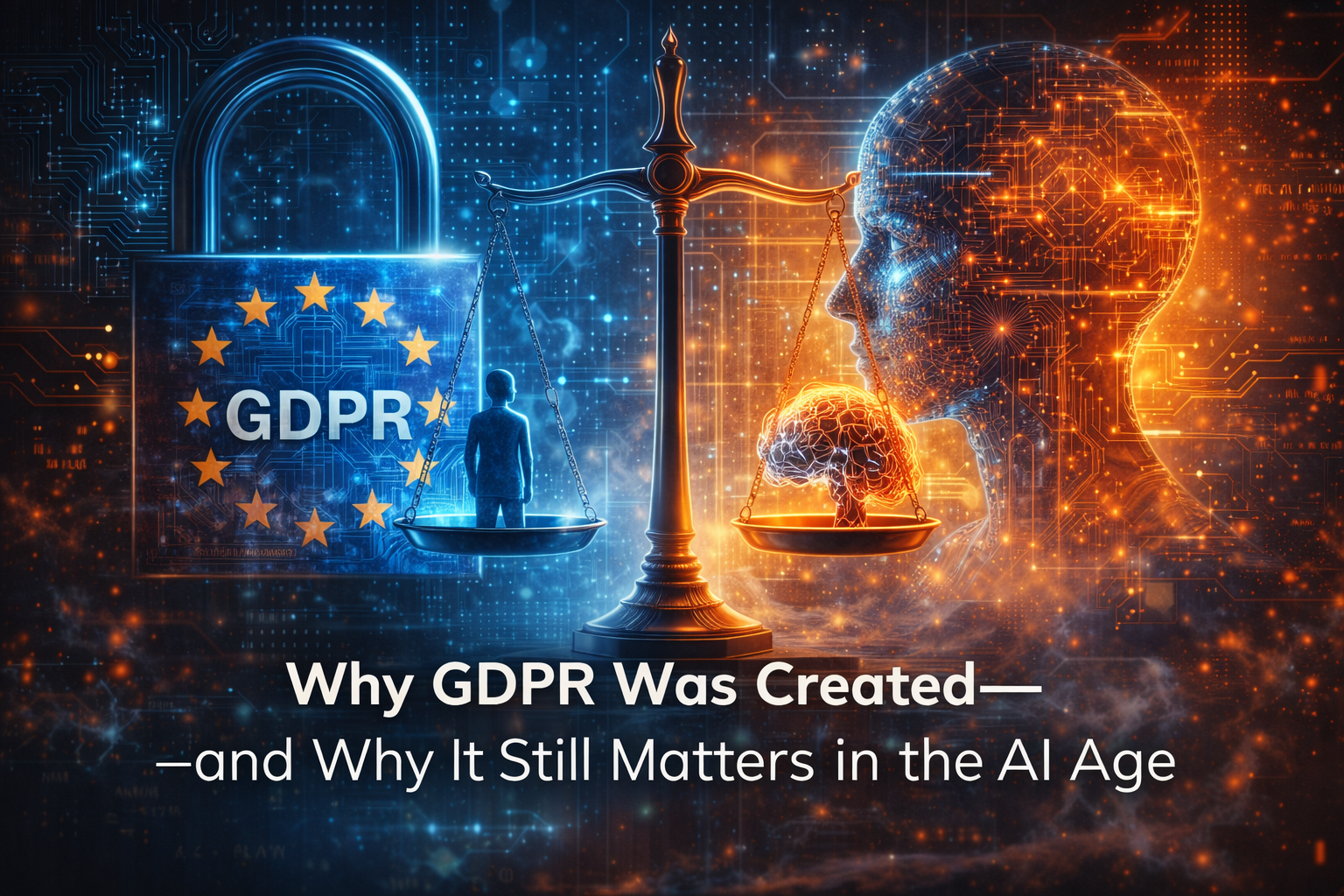
When the General Data Protection Regulation (GDPR) came into force in 2018, it was widely described as the world’s most ambitious privacy law. But GDPR was not created in isolation, nor was it merely a technical regulation. It was a political response to a deeper imbalance of power in the digital age.
Before GDPR, data protection in Europe was governed by fragmented national laws derived from a 1995 directive—written for an era before cloud computing, social media, smartphones, and global data flows. By the early 2010s, these rules had become visibly obsolete.
Several systemic problems had emerged:
- Individuals had little visibility into how their personal data was collected or monetized
- Consent was vague, bundled, or effectively coerced
- Companies accumulated vast amounts of personal information with minimal restraint
- Data breaches were underreported or concealed
- Cross-border enforcement within the EU was weak and inconsistent
At the same time, global digital platforms were building business models centered on surveillance, targeted advertising, and behavioral profiling at unprecedented scale. Personal data had become the fuel of the modern economy—yet individuals had almost no control over it.
GDPR was designed to correct this imbalance.
Its core objectives were clear:
- Restore control of personal data to individuals
- Create a single, uniform rulebook across the EU
- Increase corporate accountability
- Strengthen enforcement and penalties
- Establish privacy as a fundamental digital right
At its core, GDPR sought to make privacy a pillar of modern democracy, not a negotiable commodity.
What GDPR Introduced: A New Regulatory Architecture
GDPR did not merely update existing rules; it fundamentally restructured how data protection works.
1. Expanded Individual Rights
GDPR transformed individuals from passive data subjects into active rights holders. Citizens gained enforceable rights, including:
- The right to access personal data
- The right to rectification
- The right to erasure (“the right to be forgotten”)
- The right to data portability
- The right to object to processing
These rights altered the power dynamic between individuals and corporations, placing legal agency back in the hands of users.
2. Consent and Transparency
Companies were required to:
- Obtain clear, informed, and freely given consent
- Explain data practices in plain language
- Provide easy mechanisms to withdraw consent
This marked the end—at least in principle—of hidden data harvesting through obscure terms and conditions.
3. Corporate Accountability
GDPR shifted compliance from a technical afterthought to a governance obligation by introducing:
- Mandatory Data Protection Officers (DPOs)
- Privacy-by-design and privacy-by-default principles
- Data protection impact assessments
- Mandatory breach reporting within 72 hours
Data protection became a board-level issue, not just an IT concern.
4. Extraterritorial Reach
Any organization processing the data of EU residents—regardless of where it is based—must comply with GDPR.
This extraterritorial scope effectively turned GDPR into a global regulatory benchmark.
5. Meaningful Penalties
With fines of up to 4% of global annual turnover, GDPR ensured that privacy violations carried real financial consequences.
For the first time, ignoring privacy became economically irrational.
What GDPR Has Achieved So Far
1. Global Standard-Setting
GDPR has reshaped data protection far beyond Europe. Its influence can be seen in:
- California’s CCPA
- Brazil’s LGPD
- India’s Digital Personal Data Protection Act
- Japan’s APPI reforms
Privacy regulation has gone global—and GDPR set the template.
2. A Cultural Shift in Business
Privacy is now:
- A boardroom issue
- Part of ESG and risk reporting
- A factor in brand trust
- A competitive differentiator
Large enterprises have built compliance teams, governance frameworks, and internal accountability structures that did not exist a decade ago.
3. Improved Transparency
Users today encounter:
- Clearer privacy notices
- Consent dashboards
- Data access portals
- Mandatory breach notifications
While imperfect, data practices are far more visible than before GDPR.
4. Enforcement and Legal Precedents
European regulators have issued landmark fines against major technology companies, including Meta, Google, Amazon, and Microsoft.
These cases have clarified legal boundaries and signaled that scale does not grant immunity.
5. More Empowered Citizens
Public awareness of digital rights has increased significantly. Individuals are more willing to question data practices, file complaints, and challenge misuse.
Where GDPR Has Fallen Short
Despite its achievements, GDPR is not without weaknesses.
1. Compliance Complexity
GDPR is:
- Legally dense
- Expensive to implement
- Especially burdensome for SMEs
Many smaller firms struggle to meet requirements designed with large multinationals in mind.
2. Uneven Enforcement
Enforcement varies widely across EU member states. Some regulators are proactive and well-funded; others are overstretched.
This inconsistency undermines legal certainty.
3. Consent Fatigue
Endless cookie banners and consent pop-ups have led to:
- User frustration
- Mechanical compliance
- Superficial understanding
Consent often exists in form rather than substance.
4. Friction with Innovation
Critics argue GDPR can slow:
- AI development
- Advanced data analytics
- Medical research
- Cross-border collaboration
Balancing innovation with rights protection remains unresolved.
5. Slow Legal Timelines
Investigations and appeals can take years—far slower than technological change.
How Artificial Intelligence Challenges GDPR
AI systems intensify tensions at the heart of data protection.
1. Data Minimization vs Big Data
GDPR mandates collecting only what is necessary. AI systems thrive on massive datasets.
This is a structural conflict.
2. Explainability and Black-Box Models
GDPR grants individuals the right to meaningful explanations of automated decisions. Yet many deep-learning models remain opaque.
3. Automated Decision-Making
Article 22 limits decisions based solely on automation, yet AI-driven systems increasingly govern:
- Credit scoring
- Hiring
- Insurance pricing
- Surveillance
4. Bias and Discrimination
AI can amplify societal bias embedded in training data. GDPR was not designed to regulate algorithmic fairness directly.
5. Re-Identification Risks
AI has weakened traditional anonymization techniques, making re-identification increasingly feasible.
AI as a Compliance Tool
Ironically, AI is also strengthening GDPR compliance. Companies now deploy AI for:
- Data mapping and classification
- Breach detection
- Risk assessment
- Consent management
- Regulatory reporting
This has given rise to a fast-growing RegTech industry.
What Comes Next: The Future of Data Governance
GDPR is entering a new phase.
1. Integration with New EU Digital Laws
GDPR increasingly operates alongside:
- The AI Act
- The Digital Services Act
- The Digital Markets Act
- The Data Governance Act
Together, they form a de facto European digital constitution.
2. Algorithmic Governance
Future regulation will focus more on:
- Model transparency
- Training data audits
- Risk classification
- Human oversight
Privacy alone is no longer sufficient.
3. Sector-Specific Frameworks
Healthcare, finance, defense, and critical infrastructure will likely see tailored regimes.
4. Global Convergence
International coordination may emerge around:
- Cross-border data transfers
- AI governance
- Cybersecurity standards
Digital sovereignty will shape geopolitical alignments.
5. From Consent to Trust Frameworks
Policymakers are exploring alternatives to checkbox-based consent:
- Data fiduciary duties
- Platform accountability regimes
- Outcome-based regulation
The emphasis may shift from permission to responsibility.
Implications for Business Leaders
For organizations, the message is clear:
- Data strategy is business strategy
- Compliance is a source of resilience
- Ethics underpin market trust
- Governance determines long-term viability
Firms that embed privacy and transparency early will outperform those that treat regulation as a burden.
Conclusion: From Privacy Law to Digital Constitution
GDPR began as a privacy regulation. It has evolved into a cornerstone of digital governance.
It restored individual rights, reshaped corporate behavior, and influenced global regulation. But its greatest test lies ahead: governing intelligent systems that learn, predict, and decide.
In the age of AI, data protection is no longer just about privacy.
It is about power, accountability, and democratic control in a digital world.
Whether GDPR adapts to that challenge will help define the next decade of technological governance.


