


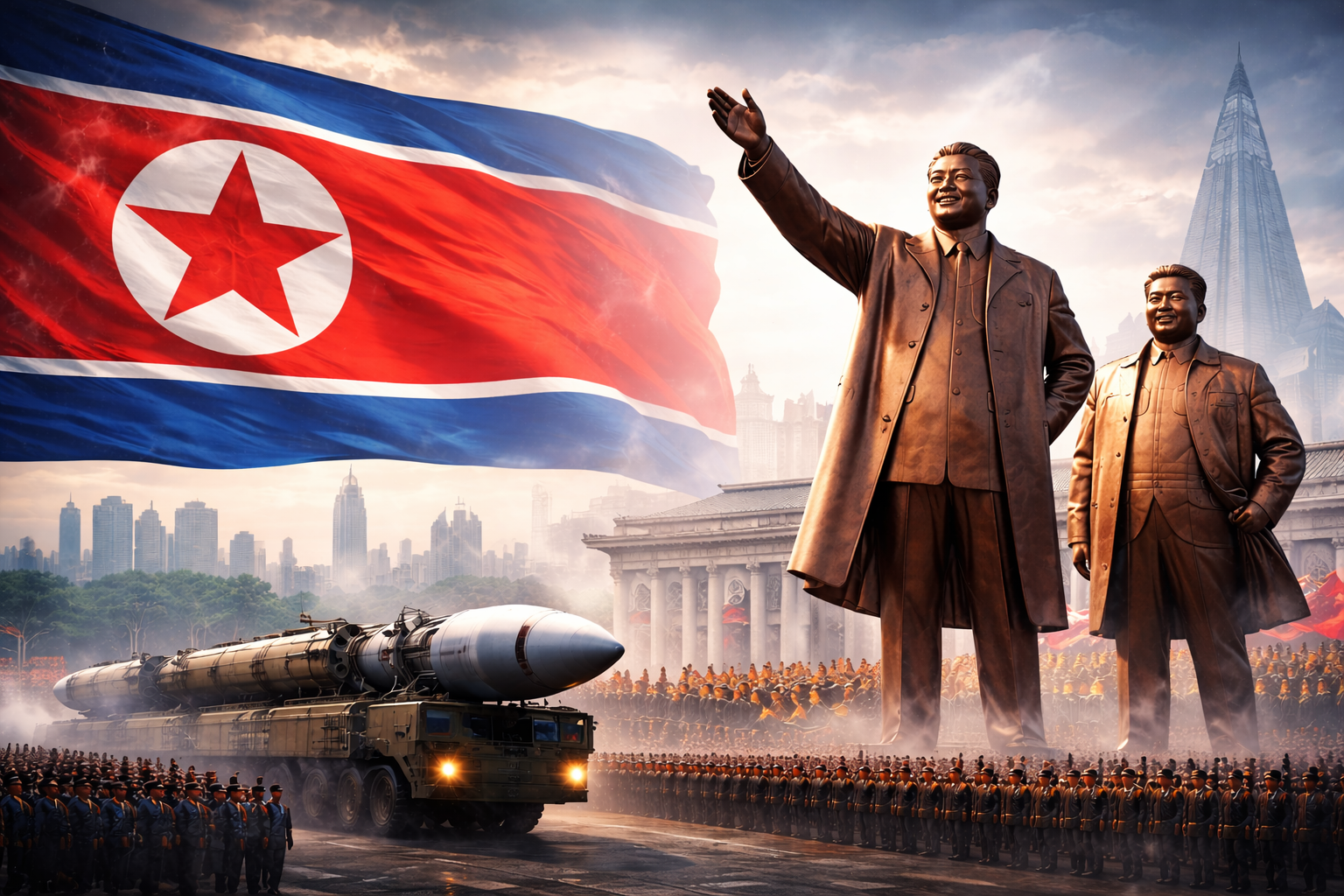
For more than thirty years, economic sanctions have been the international community’s principal response to North Korea. They were designed to coerce, isolate, and ultimately compel Pyongyang to abandon its nuclear ambitions. Instead, North Korea today possesses a growing arsenal of nuclear weapons, an increasingly sophisticated missile programme, and a hardened sense of strategic immunity.
Sanctions did not fail suddenly. They failed gradually, structurally, and predictably.
A country built to absorb pressure
Sanctions are most effective against states integrated into global trade, finance, and investment networks. North Korea is the opposite. Its economy is small, centralised, and deliberately insulated. Chronic scarcity is not a crisis condition but a governing principle.
The ruling elite—party cadres, military leadership, and security services—are shielded from deprivation. Food shortages, energy rationing, and inflation are absorbed by the population, not by decision-makers. Sanctions thus generate suffering without leverage.
Unlike sanction-hit middle-income states, Pyongyang does not face a politically mobilised middle class, organised labour, or electoral consequences. Economic pain does not translate into political pressure.
The enforcement problem
Sanctions regimes are only as strong as their enforcement. In North Korea’s case, enforcement has been inconsistent and increasingly selective.
China and Russia, both permanent members of the UN Security Council, have gradually loosened compliance. For Beijing, the collapse of the North Korean regime would pose greater risks than its survival: refugee flows, regional instability, and the possibility of a unified Korea aligned with Washington. Moscow, particularly after 2022, has viewed Pyongyang as a useful strategic irritant to the United States.
As a result, sanctions leakage has become systemic. Coal exports are disguised, fuel imports under-reported, ships re-flagged, and illicit ship-to-ship transfers conducted at sea. Sanctions have become porous rather than prohibitive.
Illicit adaptation and innovation
Sanctions have not frozen North Korea’s access to resources; they have reshaped it. Pyongyang has developed sophisticated methods to earn foreign currency beyond conventional trade.
Cyber operations—bank thefts, ransomware attacks, and cryptocurrency hacks—have emerged as a critical revenue stream. Arms sales to sanctioned or unstable states, covert labour exports, and counterfeit goods supplement state income.
These activities are difficult to monitor, harder to attribute, and nearly impossible to eliminate without unprecedented international coordination.
Sanctions as strategic reinforcement
Perhaps the most profound failure of sanctions lies not in economics but in psychology. They have reinforced Pyongyang’s core narrative: that nuclear weapons are essential to regime survival in a hostile world.
Each new round of sanctions has been framed domestically as evidence of foreign aggression. Nuclear tests are presented not as provocations but as defensive triumphs. Sanctions, rather than weakening the regime’s legitimacy, have often strengthened it.
By the time diplomacy was attempted seriously, North Korea had already crossed key technological thresholds. The leverage window had closed.
The absence of a political strategy
Sanctions were never embedded in a coherent diplomatic framework. There was no sustained bargain offering security guarantees, economic integration, and political normalisation in exchange for denuclearisation. Pressure was applied without a credible off-ramp.
As a result, sanctions became an end in themselves—a signal of disapproval rather than a tool of persuasion.
Conclusion
Sanctions constrained North Korea’s prosperity, not its power. They slowed economic growth but failed to alter strategic intent. Pyongyang adapted, endured, and ultimately prevailed.
The lesson is not that sanctions never work—but that against isolated, authoritarian states willing to absorb pain, they are blunt instruments. Without diplomacy, they harden defiance. Without unity, they erode credibility.
North Korea is now a nuclear-armed state not because sanctions were insufficiently severe—but because they were insufficiently strategic.
North Korea and the Kim Dynasty: The Dictator’s Paradox Explained
- Iraq After Saddam: Regime Collapse, Occupation and the Long Shadow of State Failure
- The World Is Not Watching a Crisis Unfold — It Is Watching a Redesign
- What If the Biggest Hole in Global Climate Policy Isn’t Coal or Oil — It’s War?
- Diplomacy Is Not About Choosing Sides – It Is About Protecting Interests
- War in the Cloud


