


Israel and US Strike Iran; Retaliatory Attacks Hit Gulf States
The Middle East edged closer to open interstate war on Saturday after Israel and the United States launched coordinated strikes on targets across Iran, prompting swift retaliation from Tehran against Israeli territory and US military assets across the Gulf.
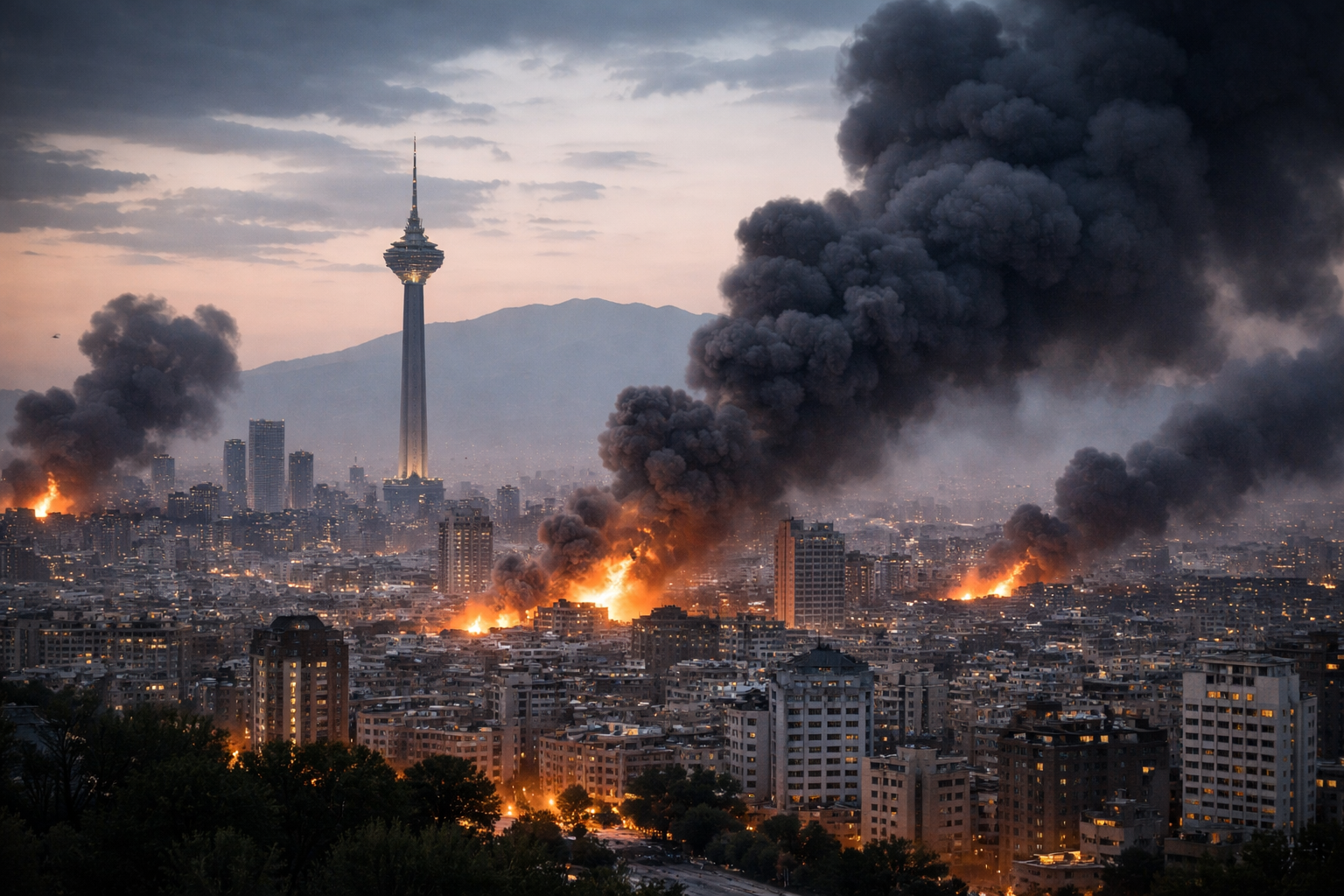
Explosions were reported across Tehran in the early hours of 28 February, with plumes of smoke rising over multiple districts. Israeli officials described the operation—reportedly codenamed Operation Lion’s Roar—as “pre-emptive”, aimed at degrading Iran’s missile capabilities and strategic command infrastructure. Washington confirmed operational coordination, calling the campaign a “limited but decisive action” against what it termed imminent threats.
Iranian authorities denounced the strikes as an act of aggression and vowed retaliation without “leniency”. Within hours, missiles and drones were in the air across several countries, expanding the theatre far beyond a bilateral exchange.
The Opening Salvo
Between 00:40 and 01:30 (Tehran time), multiple explosions were reported across Tehran. Iranian air defences activated. Targets reportedly included military and logistical facilities in Tehran and the Isfahan region.
At 02:00, Israeli Prime Minister Benjamin Netanyahu confirmed authorising a pre-emptive operation. At 03:15, US President Donald Trump acknowledged American operational coordination, describing the strikes as “major combat operations”.
By 05:30, Iran’s Supreme Leader Ali Khamenei condemned the assault and promised retaliation.
Unconfirmed reports suggested that Iran’s Defence Minister and senior IRGC commanders may have been killed. Tehran has not formally acknowledged those claims.
Verified Casualty Figures (As of 20:00 GMT)
Figures remain provisional and subject to revision.
Iran
- At least 48 fatalities reported by Iranian state media, including IRGC personnel and civilians.
- More than 180 injured in Tehran and Isfahan provinces.
- Independent verification remains limited.
Israel
- 7 civilian deaths confirmed following missile impacts in central Israel.
- More than 60 injuries, largely from shrapnel and blast effects.
Gulf States
- United Arab Emirates (Abu Dhabi): 1 confirmed fatality due to falling debris after missile interception.
- No confirmed fatalities reported in Qatar, Bahrain, Kuwait, or Saudi Arabia at time of publication.
United States Forces
- The Pentagon reports no confirmed American fatalities, though minor injuries were sustained at installations in Iraq and Bahrain.
Retaliation Across the Gulf
Between 07:00 and 10:00, Iran launched missile and drone barrages toward Israel and US bases in Qatar, Bahrain, Kuwait and Iraq under what it described as “Operation Truthful Promise 4.”
Air defence systems activated in Abu Dhabi, Doha and Riyadh. In Bahrain, reports indicated that facilities linked to the US Fifth Fleet were targeted. In Jordan and Kuwait, residents reported missile interceptions overhead.
Airspace closures spread rapidly. In Dubai, operations at major airports were temporarily suspended. Global carriers rerouted flights across West Asia.
Map of Impact Zones
Primary Strike Areas
- Tehran metropolitan region
- Isfahan province
- Central Israel
- US military facilities in Qatar, Bahrain, Kuwait and Iraq
- Airspace corridor near the Strait of Hormuz
Palestine: A Potential Second Front
In the territories of Palestine — including the Gaza Strip and the West Bank — security forces were placed on heightened alert.
The group Hamas condemned the Israeli-US strikes but has not declared direct military involvement. The Palestinian Authority urged restraint.
Israeli authorities reinforced checkpoints in the West Bank, concerned that escalation with Iran could trigger unrest or coordinated attacks. Sporadic protests have been reported, but no confirmed large-scale cross-border escalation from Palestinian territories has occurred.
The risk lies in linkage. If Hezbollah in Lebanon becomes directly involved, Israel could face simultaneous northern and southern fronts.
Global and Regional Reactions
Russia condemned the strikes as “unprovoked aggression”.
China urged restraint and diplomatic engagement.
India issued travel advisories and rerouted flights.
Pakistan called for immediate cessation of hostilities.
Saudi Arabia and the UAE condemned attacks on their territory while avoiding direct military alignment statements.
Analysts at Chatham House warned that even calibrated exchanges risk miscalculation if proxy actors in Lebanon or Yemen — including the Houthis — widen the theatre.
Strategic Calculations
For Israel, the strike reflects a deterrence doctrine: neutralise perceived existential threats before capability thresholds are crossed.
For the United States, direct participation signals strategic alignment and willingness to project power in defence of allied security architecture.
For Iran, retaliation serves dual purposes — demonstrating resilience externally and reinforcing regime legitimacy domestically.
For Palestinian actors, restraint limits immediate exposure but preserves strategic ambiguity.
Economic Shockwaves
Oil prices rose sharply amid concerns over disruption through the Strait of Hormuz, a chokepoint for roughly one-fifth of global oil supply. Insurance premiums for Gulf shipping are expected to climb if hostilities persist.
Airspace closures across Iran, Israel, Iraq and Gulf states disrupted international travel and trade corridors.
What Comes Next
Three scenarios now frame the outlook:
Contained Escalation – Limited exchanges followed by diplomatic mediation.
Sustained Campaign – Continued strategic strikes targeting military infrastructure.
Regional War – Wider involvement by Hezbollah, Palestinian armed groups, Gulf states or Yemen-based actors.
The trajectory remains uncertain. The first 24 hours suggest calibrated escalation, yet the density of actors involved increases the probability of miscalculation.
For now, West Asia’s skies carry visible signs of conflict — missile interceptors, air-raid sirens and strategic uncertainty.


